Hello! Welcome to the first lesson of your course.
To achieve your goal of launching a solo-led incubator and accelerator, the first critical step is to understand the landscape of startup support models. Choosing the right model is like selecting the blueprint for your entire business. This lesson will provide that foundational knowledge.
Our focus today is to distinguish between the three primary models: incubators, accelerators, and venture studios. While these terms are sometimes used interchangeably in the industry, they represent distinct philosophies, operational structures, and investment strategies. By the end of this lesson, you will be able to clearly articulate the differences and identify the core value proposition of each. This understanding will be crucial as you begin to design your own firm.
1. The Classic Models: Incubators vs. Accelerators
Let's begin with the two most established models in the startup ecosystem. They both aim to help startups, but they do so at different stages and with different levels of intensity.
To get a clear overview, please watch the following video. It provides a concise comparison of incubators and accelerators.
Startup Accelerators vs Incubators
This video from Greg Raiz offers a great introduction to the core differences between startup accelerators and incubators. Pay close attention to the distinctions made regarding program duration, equity stakes, funding, and the typical stage of the startups they serve.
Watch the video from the beginning until 05:33. Focus on how the speaker contrasts the two models. You can skip the initial 27-second intro if you wish.
As the video explains, the primary distinction lies in their core purpose.
-
Incubators are designed to nurture very early-stage ideas. They are often less structured and provide a supportive environment for founders to explore their concepts.
- Startup Stage: Idea or pre-MVP (Minimum Viable Product). The founder might just have a concept.
- Duration: Flexible and longer-term, often ranging from 6 months to several years.
- Funding & Equity: They rarely provide significant capital and typically take little to no equity. Some may charge a fee for office space and resources.
- Support: Focuses on providing workspace, basic mentorship, and a community. The goal is to help a startup find its footing and validate its initial idea.
-
Accelerators are designed to accelerate the growth of startups that already have a team and some initial traction (like an early product or user base).
- Startup Stage: Early traction (post-MVP). The team is formed and the product is defined.
- Duration: Fixed-term and intense, typically 3-4 months. They operate in cohorts.
- Funding & Equity: They make a seed investment (e.g., $50k - $150k) in exchange for an equity stake (e.g., 5-10%).
- Support: Highly structured program with intensive mentorship, a curriculum focused on growth and fundraising, and culminating in a "Demo Day" where startups pitch to a room of investors.
Test your understanding!
A team of two experienced software engineers has built a functional prototype of a B2B SaaS tool. They have a handful of early, non-paying users and a clear idea of their target customer, but they lack business development expertise and an investor network. They need to prepare for their first major funding round within the next 6 months.
Which model—incubator or accelerator—would be more suitable for them, and why?
Show answer
An accelerator would be the more suitable choice.
Reasoning:
- Stage: The team is beyond the pure idea stage. They have a functional prototype and early users, which fits the "early traction" profile that accelerators look for.
- Needs: Their primary needs are business development, preparation for fundraising, and access to an investor network. These are the core strengths of an accelerator's structured curriculum and demo day format.
- Timeline: Their goal to raise funding within 6 months aligns with the intense, fixed-term nature of an accelerator program, which is designed to produce investor-ready companies quickly.
2. The "Co-Founder" Model: Venture Studios
A third, increasingly popular model is the venture studio, also known as a startup studio or venture builder. This model takes a much more hands-on approach, acting less like a mentor and more like a co-founder.
The following video provides a great deep dive into the philosophy of venture building. It contrasts the model with the traditional path of a startup and explains the fundamental trade-offs involved.
Venture building – A new model for creating winning start-ups
In this talk from London Tech Week, the speaker explains the venture builder (or venture studio) model. He details how it differs from a typical venture-funded startup, focusing on the value it provides and the trade-offs for the founder.
Watch the following segments to understand the venture studio concept: What is a Venture Builder? (01:37 - 04:25): This part defines the model and contrasts it with a traditional startup journey. The Ownership Trade-off (06:27 - 09:12): Focus on the core exchange: founders give up more equity for de-risking, funding, and operational support. Summary (34:40 - 36:01): A concise wrap-up of the value proposition.
The key takeaway is that venture studios don't invest in existing startups; they build startups from scratch.
Here’s how they operate:
- Ideation: Ideas are often generated internally by the studio's team or in partnership with corporations.
- Validation: The studio uses its in-house team of experts (engineers, marketers, strategists) to validate the idea, build the initial product, and find the first customers.
- Founder Recruitment: Once the business concept is de-risked and shows promise, the studio recruits an external founder or CEO to lead and scale the company.
- Funding & Equity: The studio provides the initial capital and comprehensive operational support in exchange for a significant equity stake, often ranging from 15% to as high as 80% in the beginning.
This image from Harvard Business Review illustrates the process well:

In essence, while accelerators and incubators support founders who have ideas, venture studios have ideas and find founders to run them.
3. A Side-by-Side Comparison
Now that we've covered all three models, let's put them together for a direct comparison. The following article provides an excellent data-driven overview and a clear comparative table.
Venture Studios vs. Incubators vs. Accelerators
This article from PanScience, titled 'Venture Studios vs. Incubators vs. Accelerators,' offers a direct, data-driven comparison of the three models. It's a great resource for consolidating your understanding.
Please read the section 'Venture Studios, Incubators, and Accelerators: A Data-Driven Comparison,' focusing on the table. Then, read the section 'Structural and Philosophical Differences.' This should take about 10 minutes.
The table in the article provides a perfect summary. Here are the key axes of differentiation:
| Aspect | Incubator | Accelerator | Venture Studio |
|---|---|---|---|
| Core Function | Nurture Ideas | Accelerate Growth | Build Companies |
| Startup Stage | Idea Stage | Early Traction / MVP | From Scratch |
| Founder Source | External | External | Recruited |
| Equity Stake | 0% - 10% | 5% - 15% | 15% - 80% |
| Funding | Minimal / None | Seed ($50k - $150k) | Pre-seed & Seed ($500k+) |
| Involvement | Hands-off Advisor | Hands-on Mentor | Hands-on Co-Founder |
| Duration | Long-term, Flexible | Short-term, Fixed | Ongoing Partnership |
The article also highlights a key trend you should be aware of: venture studios often boast higher success rates and faster scaling times. This is attributed to their "co-founder" approach, where they provide deep operational support and pre-validated ideas, significantly de-risking the venture from day one.
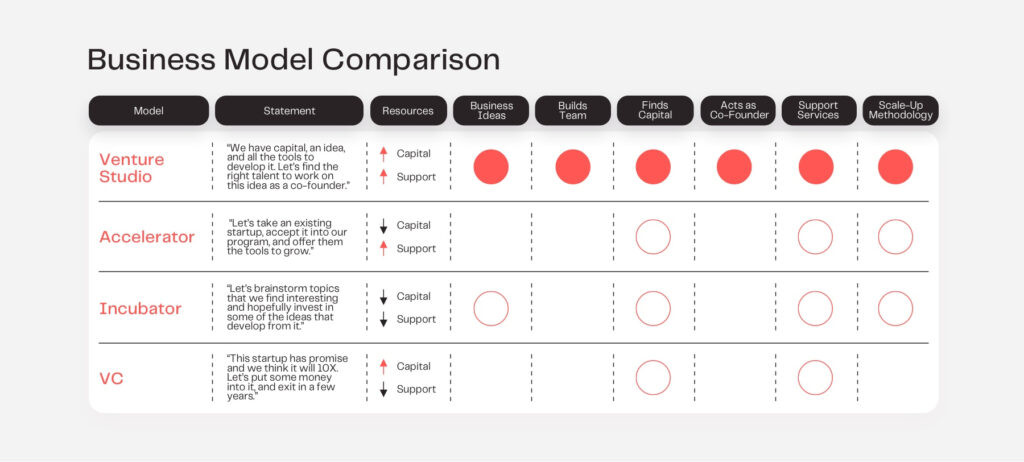
This final image provides another useful visual summary of the different levels of involvement.
Conclusion
You now have a solid framework for understanding the startup support ecosystem. Let's summarize the key takeaways:
- Incubators provide a low-intensity, long-term environment to help founders nurture raw ideas, typically without taking equity.
- Accelerators run high-intensity, short-term programs to accelerate existing startups with early traction, providing seed funding in exchange for equity.
- Venture Studios act as institutional co-founders, building companies from scratch with their own ideas and resources before recruiting a CEO to lead them.
As you move forward with your plan to build your own firm, you'll need to decide where on this spectrum you want to operate. Will you find and support existing teams like an accelerator, or will you build new ventures from the ground up like a studio? Your answer will shape every subsequent decision you make.
Preview of the next lesson:
Now that you understand the fundamental structures, the next logical question is: how do these businesses sustain themselves? In our next lesson, we will identify the revenue streams for accelerators, covering topics like equity, management fees, and corporate sponsorships.