Hello! Welcome to your fourth lesson.
In our last session, we clarified the distinct roles of the General Partner (GP) and the Limited Partner (LP), establishing the foundational structure of a venture capital fund. We learned that as the future founder of your own firm, you will be the GP, actively managing the fund, while LPs are the passive investors who provide the capital.
Today, we'll build on that by mapping out the entire journey of a venture fund over time. This lesson addresses the venture capital fund lifecycle, a critical concept that serves as the operational blueprint for any fund manager. For you, understanding this 10-year cycle is essential for strategic planning, communicating with potential LPs, and setting realistic expectations for your own firm.
Our goal is to describe the three core phases of a VC fund's life: fundraising, deployment, and harvesting.
1. The 10-Year Journey: A Visual Overview
Most venture capital funds are structured as "closed-end" funds with a finite lifespan, typically 10 years. This timeline dictates the fund's strategy and activities, from raising money to returning it to investors.
This lifecycle can be broken down into distinct, sequential phases. The image below provides a clear, high-level map of this journey.
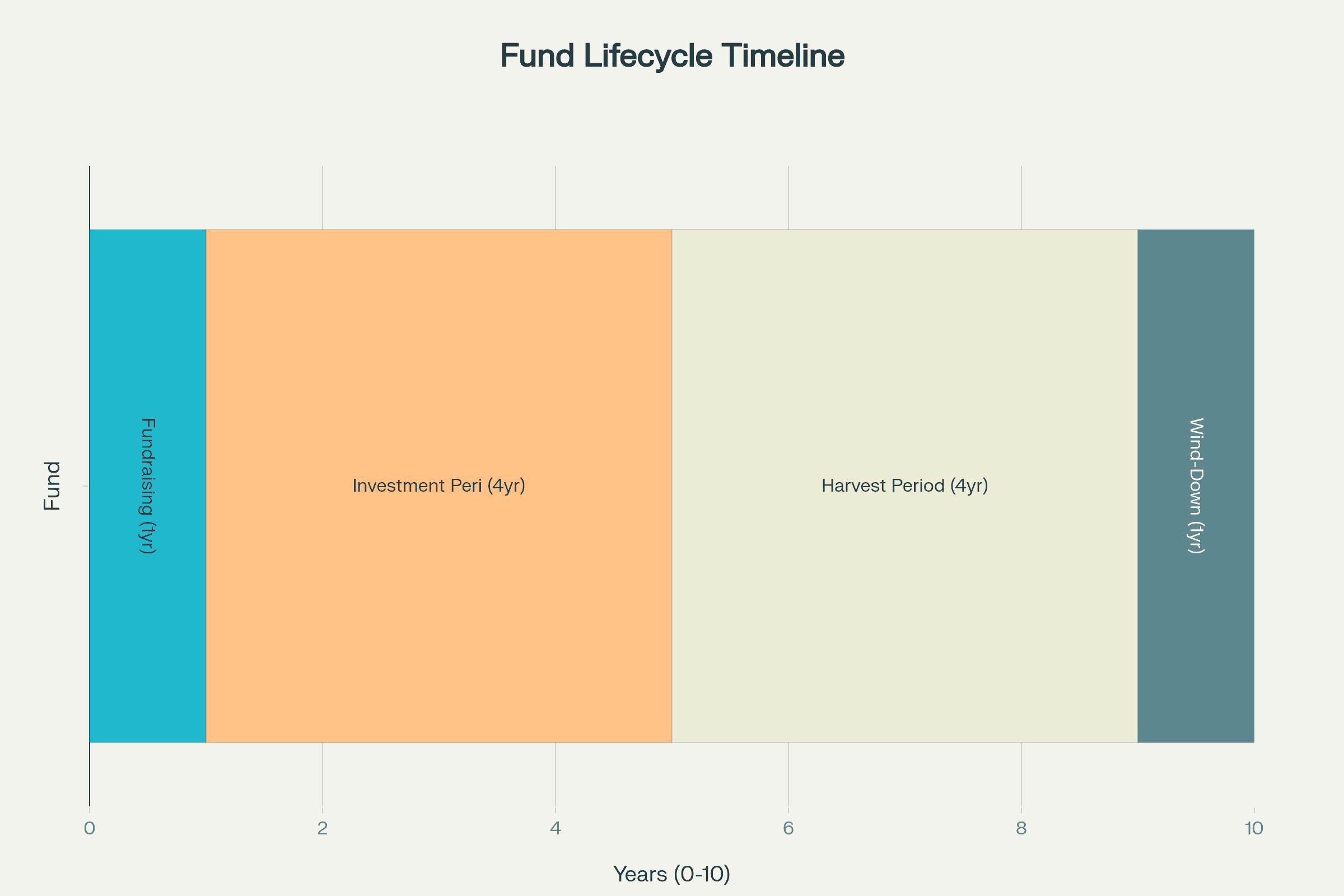
As you can see, the fund's life isn't a single, monolithic activity but a series of focused stages. To get a dynamic walkthrough of this timeline, the following video provides a concise explanation.
How To Start A Venture Capital Fund From Scratch
Fund manager Bridger Pennington gives a practical overview of the standard 10-year fund lifecycle, explaining how fund managers stack funds over time.
Watch the segment from 13:44 to 16:22. Pay close attention to the timing of each phase: raising capital, deploying it, and seeking liquidation events (exits).
Now, let's break down each of these stages in more detail. We'll follow the logical progression from the fund's conception to its conclusion.
2. The Core Phases of the Fund Lifecycle
While the timeline can be divided in several ways, it's best understood through four major operational phases, plus a preliminary step and a final wrap-up.
Pre-Fund Step: Defining the Investment Thesis
Before a single dollar can be raised, a GP must define the fund's investment thesis. This is the fund's strategic compass. Given your goal of launching an AI-focused accelerator, this step is where you would codify that specialization.
The VC Fund Institute provides an excellent summary of what goes into an investment thesis. This is the foundational work you will do before launching your fund.
Read the section '00 Pre Fund Conception: Defining the Fund's Investment Thesis.' Notice how it covers sector (like AI), stage, check size, and geographic focus.
Phase 1: Fundraising (Years 0-1)
With a clear thesis, the GP's first major task is to raise money. This involves identifying and pitching to potential Limited Partners (LPs)—such as family offices, high-net-worth individuals, and institutions—to secure capital commitments.
This is a sales and marketing process where you, the GP, are selling your vision, strategy, and expertise. When an LP commits, they sign the Limited Partnership Agreement (LPA), the legal document we discussed in the last lesson, which locks in the terms of the fund.
The article "1.3 VC Fund Lifecycle" details this process. In section "01 Fund Formation and Fundraising," you can review the key activities, from approaching LPs to finalizing legal structures.
Phase 2: Deployment / Investment Period (Years 1-5)
Once the fund has its initial capital commitments (a "first close"), the clock starts on the investment period. This is when the GP actively sources, evaluates (performs due diligence on), and invests in startups that fit the fund's thesis.
When an investment is made, the GP doesn't use a big pot of cash sitting in a bank account. Instead, they issue a capital call to the LPs, requesting a portion of their committed capital to wire to the startup.
From the startup's perspective, this is when they go through their financing rounds. Your experience with pre-seed startups fits right at the beginning of this journey.
Venture Capital For Beginners (Complete Tutorial) Startup & VC Investing Explained 2023
This video by Nate O'Brien clearly illustrates the startup financing cycle, from the early 'Valley of Death' through the various funding rounds. This is the journey your portfolio companies will be on, funded by your capital deployment.
Watch from 28:07 to 33:02. This will connect the fund's 'deployment' activity to the concrete 'funding rounds' that you're familiar with from your consulting work.
Phase 3: Portfolio Management (Years 2-10)
Investment isn't a "fire and forget" activity. Throughout the fund's life, the GP actively works with the portfolio companies. This is the "value-add" component of your future accelerator. It involves providing strategic guidance, making introductions to customers and future investors, and often taking a board seat.
The goal is to help each company grow and increase its valuation, moving it closer to a successful exit. You can read more about this in the "1.3 VC Fund Lifecycle" article under section "03 Portfolio Management."
Phase 4: Harvesting / Exit Period (Years 4-10)
Harvesting is the process of generating returns by exiting the investments. A fund only makes a profit when its portfolio companies are sold or go public. The GP's job in this phase is to help guide companies toward these liquidity events.
The two most common exit paths are:
- Acquisition: The startup is bought by a larger company (e.g., Google acquires an AI startup). This is the most common exit route.
- Initial Public Offering (IPO): The startup sells its shares to the public on a stock exchange. This is rarer but can lead to massive returns.
Venture Capital For Beginners (Complete Tutorial) Startup & VC Investing Explained 2023
Nate O'Brien provides a straightforward explanation of the most common liquidity events that allow a VC fund to 'harvest' returns.
Watch the segment from 39:21 to 40:49 to understand the primary ways a fund gets its money back—and hopefully, much more.
Once an exit occurs and cash is returned to the fund, the GP distributes the proceeds to the LPs, returning their initial capital first and then sharing the profits according to the LPA (typically an 80/20 split).
The Final Phase: Wind-Down (Year 10+)
At the end of the 10-year term, the fund is formally dissolved. The GP's job is to liquidate any remaining assets, make final distributions to LPs, and complete final reporting. Sometimes, funds may request a 1-2 year extension from their LPs if a promising company needs a little more time to exit.
Test your understanding!
You are the GP of a $20M AI-focused venture fund, currently in its 7th year. You spend your week on the following activities:
- Helping one of your portfolio companies, a 6-year-old AI analytics firm, negotiate its acquisition by a major tech corporation.
- Participating in a board meeting for a 4-year-old portfolio company to advise them on their Series B fundraising strategy.
- Reviewing a pitch from a brand new, pre-revenue AI startup. You politely decline, explaining your fund is no longer making new initial investments.
Which phase of the fund lifecycle best describes your fund's current state and why?
Show answer
The fund is in the Harvesting phase.
Here's why:
- Activity 1 (Negotiating an acquisition) is a core harvesting activity. You are actively working to secure a liquidity event and generate returns for your LPs.
- Activity 2 (Advising on Series B) is a late-stage portfolio management activity, aimed at preparing the company for further growth and an eventual exit. It supports the harvesting goal.
- Activity 3 (Declining a new investment) is the key indicator. At year 7, the fund's investment period is over. The focus has shifted from deploying capital into new companies to managing and exiting existing ones.
Conclusion
You have now seen the complete story of a venture fund, from its strategic inception to its final dissolution. This lifecycle provides the structure within which all of a GP's activities take place.
Key Takeaways:
- A VC fund operates on a finite, typically 10-year timeline, which dictates its strategy.
- The lifecycle begins with Fundraising, where the GP secures capital commitments from LPs based on a defined investment thesis.
- The Deployment (or Investment) period is when the fund actively invests that capital into a portfolio of startups.
- The Harvesting period is focused on achieving exits (acquisitions or IPOs) to generate returns and distribute cash back to the LPs.
- Throughout the process, the GP is actively engaged in Portfolio Management to help their companies succeed.
Preview of the next lesson:
We've now covered the "who" (GPs and LPs) and the "when" (the fund lifecycle). The next step is to focus on the "what" and "why" for your specific fund. In the next lesson, we will begin the practical work of designing an AI-differentiated value proposition for your new incubator/accelerator. We will explore how you can leverage your unique background and the power of AI to create a program that stands out and attracts top-tier AI startups.