
Hello again. In the previous lesson, you separated what a file shows, what someone reports, what you can reasonably infer, and what remains unknown. That discipline now becomes a practical damage-classification skill: deciding whether a condition is supported as related to the claimed loss, appears to pre-date it, or is better treated as unrelated deterioration.
This is not a coverage determination. Your role as an estimator is to document the condition, its evidence, and the limits of its connection to the reported event. A strong preliminary scope does not hide uncertainty behind confident wording; it makes the basis for each proposed repair easy to inspect.
Three classifications, plus one necessary holding category
A visible condition and a claimed event can be related, unrelated, or only partly connected. Treat these as classifications of a specific material condition in a specific location, not as labels for the entire property.
| Classification | Practical meaning | Estimating consequence |
|---|---|---|
| Loss-related damage | Available evidence supports that the claimed event caused or materially worsened the condition. | Scope the supported repair, with evidence references. |
| Pre-existing condition | The condition existed before the reported event. It may or may not have been worsened by the event. | Separate baseline condition from any documented new damage. Do not charge the loss with restoring old damage. |
| Unrelated deterioration | Wear, age, corrosion, poor maintenance, repeated moisture exposure, or another cause has no supported connection to the claimed event. | Do not include it in the loss scope merely because it is visible nearby. Document it when it affects repairability or access. |
| Indeterminate or mixed condition | The available file cannot reliably separate old, new, and unrelated causes, or more than one cause may be involved. | Avoid a final conclusion; request targeted evidence and clearly limit any preliminary scope. |
The categories can overlap in a physical sense. For example, a roof may have pre-existing corrosion, and a later wind event may also damage a small number of panels. The correct estimate is not “all old” or “all storm.” It separates:
- the documented incident-related repair;
- the documented pre-existing condition;
- anything that cannot yet be separated.
This is especially important when reviewing photos remotely. A stain can be old, new, reactivated, or simply photographed after the reported loss. The photo date alone does not establish when the stain formed.
Keep causation, condition, and coverage separate
A common file error sounds like this:
“The storm caused the old roof to leak, so replace the roof.”
That sentence combines several distinct issues:
- Condition: The roof has visible defects.
- Timing: Some defects may have existed before the event.
- Causation: A storm may or may not have created an opening or worsened an existing defect.
- Resulting damage: Water may or may not have entered the building through that area.
- Scope: Repairing one damaged section and replacing an aged system are materially different proposals.
- Coverage: The responsible carrier or adjuster decides what the policy affords.
As an estimator, do not resolve this by writing a stronger sentence. Resolve it by breaking it apart and identifying the evidence needed for each proposition.
A useful rule is:
A condition can be real without being loss-related. A reported event can be real without explaining every damaged material found afterward.
For water losses, the timing and pattern of moisture exposure matter. Read the following short discussion for its distinction between abrupt events and conditions that develop over time. Treat its insurance comments as general context only: actual policy language, jurisdiction, endorsements, and coverage decisions vary by claim.
What Type of Water Damage Is Covered by Homeowners Insurance?
Read this Allied Public Adjusting article for a concise explanation of why investigators distinguish a sudden water event from long-running seepage and deterioration. The estimating value is not its policy conclusion; it is the list of evidence patterns that should prompt you to investigate timing and alternate causes.
In the section “Sudden and Accidental Water Damage Explained,” read from the sudden-loss discussion. Focus on the difference between an asserted abrupt failure and the evidence needed to support resulting material damage. Then, in “Damage Was Determined to Be Gradual Rather Than Sudden,” read the physical indicators. Treat discoloration rings, warping, corrosion, deposits, and prior records as investigation prompts, not as automatic proof that a condition is old.
Build a comparison, not a story
When a claim file is thin, people often tell a single, tidy story: “The leak caused all of this,” or “The building is old, so none of it is related.” Both are shortcuts.
Instead, compare four evidence groups.
1. The claimed event
Identify what is actually documented about the event:
- reported date and time of discovery;
- alleged source or weather event;
- plumber, roofer, mitigation, or inspection findings;
- emergency actions taken;
- photos taken before demolition or drying;
- weather, prior-loss, maintenance, or repair records when supplied.
An insured’s statement that a dishwasher line burst is valuable reported information. A dated plumber report identifying a failed line is stronger support for the source. Photos of water extending from the dishwasher area into adjoining flooring may support the damage pattern. None of these should be silently converted into a universal conclusion that every defect in the kitchen is attributable to that failure.
2. The physical pattern
Ask whether the location and pattern make sense for the claimed mechanism.
For a claimed plumbing release, you would expect the evidence to connect the alleged source, water path, and affected materials. That does not mean every loss has a perfectly visible path; concealed assemblies complicate the picture. It does mean you should look for corroboration:
- affected materials are reasonably located below, beside, or downstream of the reported source;
- moisture documentation identifies the same areas shown in photos and sketch;
- demolition photos reveal conditions consistent with the documented affected area;
- a qualified trade report explains a concealed source or pathway.
A condition far from the reported source is not automatically unrelated. It is a reason to ask how water could have reached it and what evidence supports that path.
3. The pre-loss baseline
You cannot call something pre-existing simply because it looks unattractive, discolored, or heavily damaged. Pre-existing status is best supported by evidence that anchors the condition before the claimed event:
- dated pre-loss photos or listing photographs;
- prior repair estimates, inspection reports, or maintenance records;
- prior claims;
- prior emails or work orders reporting the same leak, stain, roof defect, or flooring issue;
- credible testimony that identifies the condition and date.
A prior photo of a ceiling stain in the same location is meaningful baseline evidence. An undated photo of an unknown room is much weaker.
4. Competing causes and normal deterioration
Consider plausible alternatives without pretending to perform an engineering analysis. In ordinary residential estimating, competing explanations often include:
- an old plumbing seepage versus an abrupt supply-line failure;
- roof or flashing deterioration versus a new wind-created opening;
- condensation versus a plumbing leak;
- settlement cracking versus impact damage;
- normal finish wear versus a recent water, smoke, or moving-related event.
You do not need to decide which explanation wins when the file cannot support a decision. You need to identify why it cannot be decided and what would resolve it.
Visual indicators are clues, not verdicts
Photos are powerful, but they rarely establish age or cause by themselves. Consider the condition, the pattern, and the evidence around the image.
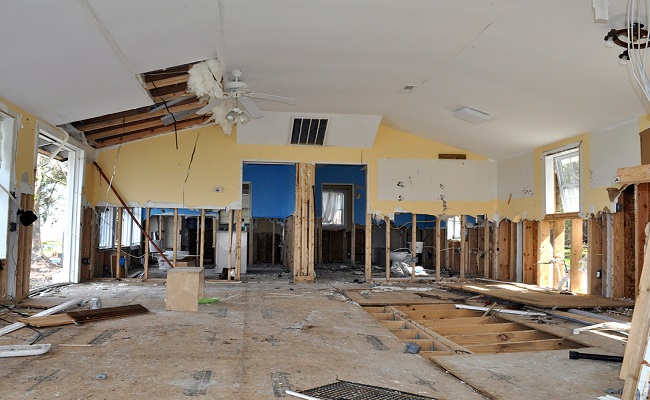
From this image, you can safely observe that lower wall finishes are missing in multiple areas and that framing is exposed. You may also observe ceiling openings and disrupted finishes. What you cannot establish from the image alone includes:
- whether the removed drywall was damaged by the current loss;
- whether removal was performed for water, mold, access, renovation, or another purpose;
- the source and category of any water;
- the affected-material quantities before demolition;
- whether framing, insulation, wiring, or mechanical systems were damaged;
- whether any condition existed before the reported incident.
The image may support a request for pre-demolition photos, mitigation documentation, moisture records, a room sketch, and a demolition rationale. It does not support copying a full-house demolition scope into Xactimate.
Now compare a different kind of visible condition.

A clogged gutter can support this observation:
Photo 8 depicts a gutter containing accumulated leaves and debris.
It can support this limited inference:
The obstruction may reduce normal roof-drainage performance during rainfall; the file does not establish whether overflow occurred or whether it contributed to the reported interior condition.
It does not support this conclusion:
The gutter caused the ceiling leak.
The difference is crucial. A maintenance-related condition may be present at the property while a separate, sudden loss is also validly documented elsewhere. Do not let one visible issue become a shortcut for explaining every condition in the file.
Common indicators and their proper use
The following indicators often deserve attention, but none is conclusive alone.
| What the file may show | What it may suggest | What you still need before a firm classification |
|---|---|---|
| Multiple stain rings, old paint touch-ups, or repeated patching | Possible prior or recurring moisture condition | Dated earlier photos, maintenance records, prior work orders, source investigation |
| Swollen cabinet components, delaminated flooring, softened drywall, or visible microbial-like spotting | Material has experienced moisture exposure; duration may be a concern | Event timing, moisture records, source report, pre-loss condition, concealed-area findings |
| Rust, corrosion, weathering, granule loss, failed sealant, or debris-filled drainage components | Age, maintenance, or long-term environmental exposure may be relevant | Site-wide comparison, inspection findings, maintenance history, event-specific evidence |
| A sharp break, displaced component, fresh opening, or localized impact mark | Possible discrete event damage | Event timing, close and wide photos, comparison with adjoining components, trade or specialist input when needed |
| Water damage below a reported plumbing source | A water path may be consistent with the reported event | Source confirmation, moisture mapping, photos of intervening areas, plumbing documentation |
| Damage in several distant areas | More than one pathway, an extensive event, or unrelated conditions may exist | A room-by-room layout, sequence of discovery, source investigation, pre-loss documentation |
Avoid using visual age adjectives as conclusions. Instead of writing “old damage,” describe the visible fact and the basis for the concern:
- Weak: “Old water damage at ceiling.”
- Better: “Photo 14 depicts multiple overlapping brown stain rings and prior patching at the ceiling. The file contains no dated pre-loss photographs or source report; age and relation to the reported event remain undetermined.”
Similarly:
- Weak: “Roof is deteriorated and not covered.”
- Better: “Photos 31–35 depict corrosion and open panel seams. No documentation currently establishes whether the claimed wind event displaced or damaged panels in this area. Refer cause and coverage determination to the responsible party.”
The second version gives a reviewer something they can verify and avoids deciding issues outside an estimator’s authority.
A public-file example: why records and comparisons matter
The following FEMA appeal concerns public-assistance eligibility, not a private homeowners claim. Its investigation logic is still valuable: a claimed event does not eliminate the need to distinguish incident-caused damage from wear, maintenance issues, and other causes.
Result of Declared Incident | FEMA.gov
Read this FEMA appeal analysis as an example of evidence-led separation of disaster damage from existing roof conditions. Notice that the decision does not rest on one visual cue; it compares photos, fasteners, maintenance documentation, pre-event condition, and the absence of event-specific evidence.
In the “Appeal Analysis” section, begin with the paragraph after the “Background” heading that starts the missing-baseline problem. Focus on why undated photos and generalized maintenance information could not establish a reliable pre-incident comparison. Continue with the eligibility-principles paragraph beginning the distinction framework. Note the evidence categories considered: regular maintenance, pre-disaster condition, incident severity, and reasonable protective action. Finally, read the detailed final analysis beginning the evidence comparison. Pay particular attention to the reasoning: advanced rust and panel gapping were documented, but undamaged fasteners and inadequate maintenance records also mattered. These details are not universal rules for every roof; they are evidence that must be interpreted in the specific file.
The lesson for an estimator is not “rust means deny” or “undamaged fasteners always rule out wind damage.” The lesson is:
Compare the claimed mechanism with the actual condition, and identify what evidence would distinguish event damage from the property’s baseline condition.
A repeatable classification workflow
Use this workflow for each material or assembly you may scope. It is deliberately slower than immediately selecting line items, but it prevents major rework later.
1. Name the condition precisely
Avoid broad labels such as “water damage in kitchen.” State the material and location:
Delamination is visible at the lower toe-kick and side panel of the base cabinet immediately right of the dishwasher.
A precise condition can be compared to a source, a photo, a measurement, and a repair method.
2. Identify the claimed event and its evidence
Record the event without adopting it as fact:
Insured reported dishwasher supply-line failure on June 10. Plumber invoice dated June 10 states supply line was replaced. No cause-of-loss report is present.
This preserves the difference between a report, an invoice, and your own conclusion.
3. Test physical and chronological consistency
Ask:
- Is the material located where the alleged event could reasonably affect it?
- Is its visible condition consistent with the reported water, impact, wind, or fire mechanism?
- Are nearby and intervening materials documented?
- Does the reported discovery timeline fit the photos, mitigation records, and trade documents?
- Is there evidence of a different source or a prior recurring condition?
You are not looking for certainty beyond the file. You are checking whether the proposed scope has a defensible factual pathway.
4. Search for baseline evidence
Look for dated materials from before the event. If none exist, write that limitation plainly rather than guessing.
No pre-loss photos, maintenance records, or prior repair documentation were provided for the north wall and adjacent ceiling.
Absence of baseline evidence does not prove that damage is new. It means the pre-loss condition is unknown.
5. Choose the narrowest defensible classification
Classify the specific condition, not a large assembly merely for convenience.
For example:
- drywall staining at one ceiling area may be indeterminate;
- a clearly documented failed supply line and its direct access opening may be loss-related;
- a prior patched ceiling stain shown in dated photos may be pre-existing;
- gutter debris at an unrelated exterior elevation may be unrelated deterioration, unless additional evidence links it to the claimed interior issue.
6. Decide the scope action
Your classification should lead to one of four practical actions:
| Classification result | Scope action |
|---|---|
| Supported loss-related condition | Include the repair method and evidence-linked quantity. |
| Confirmed pre-existing condition, not worsened by event | Exclude from loss scope; identify it if it affects access or repairability. |
| Unrelated deterioration | Do not include as loss repair; document separately where relevant. |
| Indeterminate or mixed condition | Request evidence, refer as appropriate, and limit the preliminary scope to documented work. |
Write notes that survive review
A reviewer should be able to see your reasoning without being told verbally. Use a note structure that identifies the condition, evidence, classification, limitation, and action.
Supported loss-related condition
Kitchen, east base cabinet: Photos 12–16 depict swelling and delamination at the cabinet end panel adjacent to the dishwasher. Insured reported a dishwasher supply-line release on June 10; plumber invoice dated June 10 documents supply-line replacement. Condition is consistent with the reported release location. Include documented cabinet component repair/replacement pending field measurement.
Pre-existing condition
Hall ceiling, north end: Dated listing photo from March 3 depicts staining in the same ceiling location shown in current Photo 27. Current file does not document a change in the stain after the reported kitchen release. Treat visible staining as pre-existing; do not include ceiling repair in the current preliminary scope without evidence of new or worsened damage.
Unrelated deterioration
Rear elevation gutter: Photo 41 depicts leaves and debris filling the gutter. No exterior opening, overflow evidence, interior damage path, or report links this condition to the claimed plumbing loss. Identify as unrelated maintenance condition; exclude from the loss scope.
Indeterminate or mixed condition
Living-room ceiling near exterior wall: Photos 33–36 depict brown staining and deteriorated drywall texture. The area is not directly below the reported plumbing source, and no pre-loss photographs, moisture readings, roof inspection, or above-ceiling documentation are present. Relation to the reported event cannot be determined. Request source investigation and pre-demolition documentation; do not include full ceiling replacement based on current file.
Notice the difference between saying “exclude because old” and saying “current file cannot establish relation.” The latter is often more accurate and more defensible.
A short desk routine before you scope
Before entering a potentially significant reconstruction item, pause for two minutes and complete this internal check:
-
What exactly is damaged?
Material, location, visible condition. -
What documents the claimed event?
Reported statement, trade report, weather information, mitigation record, or other source. -
What links the event to this material?
Location, pathway, chronology, moisture evidence, inspection result, or direct physical evidence. -
What suggests pre-existing or unrelated conditions?
Prior photos, repair history, recurrent staining, corrosion, maintenance records, or an alternate source. -
What is still missing?
Pre-loss comparison, dimensions, a source report, moisture map, attic/roof photos, plumbing report, or specialist review. -
What is the right estimating action today?
Include, exclude, separate, request, refer, or identify as a limited preliminary assumption.
This is how you preserve a file’s uncertainty without becoming passive. “Unknown” should produce a targeted request or a tightly bounded scope decision.
Key takeaways
Loss-related damage is not simply damage found after a reported event. It is a material condition whose connection to that event is supported by the available evidence.
- Pre-existing means the condition is shown or credibly documented to have existed before the event; it may still need separation from any new damage.
- Unrelated deterioration refers to wear, age, maintenance, or another condition with no supported link to the claimed event.
- Visible clues such as stain rings, corrosion, warped materials, patches, and clogged gutters are investigation prompts, not automatic conclusions.
- When evidence cannot separate old, new, and unrelated conditions, classify the issue as indeterminate or mixed, request what is missing, and avoid an unsupported final scope.
- Your notes should state the condition, evidence reference, limitation, classification, and estimating consequence.
Next, you will turn photographs and known reference measurements into defensible estimated dimensions while recording uncertainty rather than disguising it with false precision.
Can't find a good explanation? Sign up and we'll make it for you
Sign up