
Good to see you again. In the previous lesson, you traced planning data from the operational source through collection and the planning data repository, then into plan results and, where applicable, execution. The next implementation question is more demanding: what must exist, be valid, and be run in the right order before that flow can work?
For a senior functional consultant, the answer is not a flat checklist. It is a prerequisite map: a dependency model connecting enterprise structures, reference and transactional data, planning configuration, and operational run sequence. This lesson builds that map for a connected flow in which a demand forecast informs replenishment decisions and upstream supply planning determines whether those replenishment needs can be met.
Start with one connected business flow
Use this scenario throughout the lesson:
- A manufacturer makes a finished item at Plant A.
- Plant A transfers the item to DC East.
- DC East replenishes several retail stores.
- Demand Management produces an approved forecast using shipment history and, where appropriate, sales orders.
- Replenishment Planning proposes stock replenishment for the stores and DC based on demand, inventory, lead times, and replenishment policy.
- Supply Planning evaluates whether Plant A has the component supply and capacity to meet the proposed upstream requirements.
- Eligible transfer, purchase, or work recommendations are released to execution and then collected back for the next planning cycle.
The planning data repository is the shared planning foundation, but each plan needs a different slice of that foundation and a different set of setup decisions.
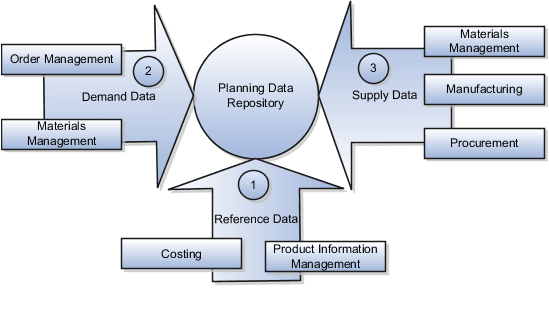
A useful way to frame the map is through five layers:
| Layer | Core question | Example for the scenario |
|---|---|---|
| Enterprise structures | Where does planning occur? | Plant A, DC East, stores, suppliers, customer locations, calendars |
| Master data and relationships | What is being planned, and how can it flow? | Item attributes, BOM, work definition, lead times, sourcing, assignment set |
| Transactional data | What demand, inventory, and open supply exist now? | Shipment history, sales orders, on hand, work orders, purchase orders, transfer orders |
| Planning configuration | How should Oracle interpret the data? | Plan scope, measures, policies, constraints, planning calendars, demand inputs |
| Run sequence and controls | In what order should data and plans be refreshed? | Collection, validation, plan runs, approval, release, feedback collection |
The most important implementation principle is:
A downstream planning result is only as trustworthy as the earliest prerequisite on which it depends.
For example, a replenishment recommendation may look wrong because of a policy parameter. But it might instead originate with a missing item-organization relationship, an outdated lead time, an uncollected on-hand balance, or a sourcing rule that is not assigned to the plan’s assignment set.
Layer 1: Enterprise structures establish the planning context
Enterprise structures determine the organizational and temporal meaning of planning data. An item quantity of 500 is not useful to a plan unless Oracle can identify which organization owns it, when it is available, and, for network planning, where it can move next.
For the connected Plant A, DC East, and store flow, establish and validate the following before treating planning as a forecast or optimization problem:
| Structure | Why it is a prerequisite | Failure symptom if missing or inconsistent |
|---|---|---|
| Source system | Identifies the origin of planning data | Data cannot be collected or is attributed to the wrong source |
| Inventory organizations | Defines nodes where demand, inventory, and supply are planned | Item, on hand, or supply is absent from plan scope |
| Manufacturing organization | Identifies where make supply and resource capacity exist | No feasible planned work order or capacity analysis |
| Customer and customer sites | Provides demand-location context when forecasts or sales orders use customer dimensions | Forecast or demand cannot be analyzed or sourced at the intended level |
| Suppliers and supplier sites | Supports externally purchased supply | Buy recommendations lack a valid supplier context |
| Locations and shipping network | Supports transfer relationships and transit assumptions | Transfer recommendations are missing or have implausible dates |
| Units of measure | Allows consistent planning and conversion | Quantities are missing, distorted, or cannot aggregate correctly |
| Calendars | Defines valid working and planning dates | Orders are proposed on nonworking dates or dates shift unexpectedly |
| Catalogs and categories | Support item segmentation, aggregation, and category-level sourcing | Category assignments or category-level sourcing do not resolve |
The organization code alone is not enough. In an implementation workshop, confirm the role of each organization. DC East may be an inventory organization for planning, but it is also a transfer destination from Plant A and a replenishment source for stores. Those relationships drive different planning behavior.
Layer 2: Master data describes the product and supply network
Master data gives planning its decision logic. Transactions say that demand or supply exists; master data tells the plan whether the item can be made, bought, transferred, substituted, or replenished.
How You Collect Different Data Types for Supply Chain Planning
Read Oracle’s overview of Reference Data, Demand Data, and Supply Data. It is useful because it separates the structural records needed to interpret planning from the operational records that create demand and supply.
In the “Reference Data” and “Demand Data” sections, read the reference and demand overview. Focus on why items, organizations, customers, suppliers, calendars, item structures, work definitions, and units of measure must be available before a demand record can become a usable planning input. Then read the complete “Supply Data” section, especially the supply sources. Relate each source to the Plant A, DC East, and store scenario.
The item-organization record is the planning anchor
At implementation level, avoid speaking only about “the item.” Planning generally depends on the item in a specific organization.
For the finished item in the scenario, validate item-organization planning attributes at every relevant node:
- Plant A: Is the item make-enabled? Does it have a valid work definition, BOM or item structure, lead times, and resource requirements?
- DC East: Is the item transfer-replenished, purchased, or otherwise supplied according to the operating model? Are its lead times and inventory-planning attributes appropriate?
- Stores: Is the item eligible for replenishment, and does it have the policy-related attributes required by the intended replenishment design?
- All locations: Are units of measure, status, lifecycle dates, planning method, and organization assignment valid for the intended plan horizon?
A finished item may be valid at Plant A and absent at DC East. In that case, a Plant A work order can still exist, but DC East cannot be modeled correctly as a destination for its supply.
Product structure and manufacturing prerequisites
Supply Planning cannot produce a credible manufacturing recommendation merely because the item is flagged as “make.”
For a make item, the dependency chain normally includes:
- A valid item at the manufacturing organization.
- A collected item structure or bill of material for component explosion.
- A valid work definition for component and resource requirements.
- Required resources and resource availability for capacity evaluation.
- Lead-time and calendar data to determine when supply can start and finish.
- Component items that are themselves valid and sourced at the required organizations.
If the BOM is missing, Supply Planning cannot translate demand for the finished item into component requirements. If the work definition or resource availability is missing, the plan may not represent manufacturing feasibility as intended.
Network sourcing prerequisites
Sourcing is the bridge between independent demand and an actual supply node. It tells planning whether an item should be made, bought, or transferred and identifies the relevant source.
Assignment Sets, Sourcing Rules, and Bills of Distribution
Read Oracle’s description of the three configuration components that turn a set of organizations into a usable planning network: sourcing rules, bills of distribution, and assignment sets.
In “Sourcing Rules,” “Bills of Distribution,” and “Assignment Sets,” read the core sourcing model. Pay particular attention to the distinction among Transfer From, Make At, and Buy From. Then read “Sourcing Assignment Hierarchy,” beginning with the hierarchy explanation. Note that a more specific item-organization assignment overrides a broader rule; this is a common reason actual plan behavior differs from an assumed global sourcing design.
For the example network, the intended sourcing model might be:
| Destination and item | Expected source | Required relationship |
|---|---|---|
| Finished item at Plant A | Make at Plant A | Make sourcing plus valid manufacturing master data |
| Finished item at DC East | Transfer from Plant A | Transfer sourcing rule or bill of distribution |
| Finished item at a store | Transfer from DC East | Transfer sourcing rule or bill of distribution |
| Purchased component at Plant A | Buy from approved supplier site | Buy sourcing plus supplier and supplier-site data |
The assignment set is crucial. Creating a sourcing rule does not automatically make it effective for every item and plan. The assignment set associates sourcing rules or bills of distribution with the intended items, categories, and organizations. The plan must use the intended assignment set.
Two constraints matter particularly for interview answers involving Replenishment Planning:
- Replenishment Planning does not support Make At sourcing rules.
- Replenishment Planning considers rank-one sources and does not support sourcing splits.
Therefore, do not model a store replenishment policy as directly “making” a product. Model the upstream manufacturing decision in Supply Planning, then provide the replenishment network with a valid transfer or buy source.
Layer 3: Transactional data supplies the current planning picture
Once the structural model is usable, transactions establish the time-phased planning position: what customers need, what inventory exists, and what supply is already expected.
A connected flow generally needs the following transaction families.
| Transaction family | Typical records | Planning purpose |
|---|---|---|
| Historical demand | Shipment history, bookings history | Statistical forecast generation and forecast diagnostics |
| Current demand | Sales orders, transfer demand, forecasts | Requirement signal for supply or replenishment |
| Inventory position | On hand, reservations, receipts, in-transit supply | Determines net available inventory |
| Existing supply | Purchase requisitions, purchase orders, work orders, transfer orders | Prevents duplicate recommendations and establishes expected supply dates |
| Capacity-related transactions | Resource availability and manufacturing status | Determines whether proposed make supply is feasible |
A good prerequisite map distinguishes history from current demand. Shipment history might provide the basis for a demand forecast, but it does not replace an open sales order that must be fulfilled. Similarly, an approved forecast becomes a planning input only when it is available at the appropriate item, organization, customer, and time level for the consuming plan.
The relationship test: can Oracle connect the records?
In practice, data can be technically collected yet functionally unusable. Before blaming plan logic, verify these relationships:
| Relationship to validate | Example evidence |
|---|---|
| Item to organization | Finished item exists at Plant A, DC East, and relevant stores |
| Item to source system | Collected record shows the expected source system |
| Demand to item and location | Sales order or forecast references a valid item and demand organization |
| Supply to item and location | Purchase order, work order, or transfer order references a valid item and supply organization |
| Customer to demand | Customer or customer site is valid where demand-level forecasting or sourcing uses it |
| Supplier to buy source | Supplier site used in sourcing is valid and collected |
| Source to destination | Transfer relationship resolves through the plan’s assignment set |
| Make item to components and resources | BOM, work definition, resources, and availability are valid in the manufacturing organization |
| Date to calendar | Demand, supply, transit, and work dates fall within valid calendar and plan horizon context |
This is the difference between a data inventory and a dependency map. An item, customer, supplier, order, and sourcing rule can all exist independently. Planning works only when the applicable links resolve for the item, organization, date, and assignment set used by the plan.
Layer 4: Configuration tells each plan how to interpret shared data
The planning data repository contains available inputs. Configuration determines which inputs a plan uses and what decision it makes from them.
For the connected scenario, separate shared configuration from plan-specific configuration.
Shared and cross-plan configuration
These decisions affect more than one planning process:
- Planning source system and collection setup
- Organization, item, customer, supplier, and catalog scope
- Calendars, units of measure, and time zone consistency
- Sourcing rules, bills of distribution, and assignment sets
- Data access and planner responsibilities
- Forecast publication or approval process
- Collection templates, filters, and cadence
Demand Management configuration
Demand Management needs, at minimum:
- Plan scope and forecast horizon
- Time levels and output granularity
- Historical demand measure and its data source
- Forecast method and relevant forecasting parameters
- Product, customer, and geography hierarchies where used
- A defined forecast measure that can later be approved or consumed downstream
The practical handoff is not simply “run the demand plan.” It is: produce an approved forecast at a level that the downstream plan can consume without unintended aggregation, disaggregation, or duplication.
Replenishment Planning configuration
Replenishment Planning needs:
- Replenishment plan scope and relevant item-location combinations
- Planning horizon and time buckets
- Inventory, demand, and supply inputs
- Replenishment policies and policy parameters
- A valid rank-one replenishment source
- Lead times, calendars, sourcing, and order constraints
- Where used, a connected supply input that reflects upstream availability or constraints
Supply Planning configuration
Supply Planning needs:
- Plan scope across manufacturing, distribution, and supplier organizations
- Demand sources, including sales orders, forecasts, and connected-plan demand
- Planning horizon and calendar
- Planning mode and applicable constraint settings
- Assignment set for network sourcing
- BOMs, work definitions, resources, capacities, lead times, and order modifiers
- Existing supply and inventory netting behavior
A senior consultant calls out a critical distinction:
Master data describes what is possible; plan configuration determines what the current plan is allowed to consider.
For example, a transfer sourcing rule may be correct, but DC East still will not receive transfer recommendations if the source organization is excluded from the plan scope, if the plan uses a different assignment set, or if the related item is excluded.
A consolidated prerequisite map
The following map can be used in a design workshop, configuration workbook, test script, or interview explanation.
| Dependency level | Required prerequisites | Validation gate before proceeding |
|---|---|---|
| 1. Enterprise foundation | Source system, organizations, locations, calendars, units of measure, catalogs, customers, suppliers | Relevant organizations and parties are collected and visible in planning |
| 2. Product foundation | Item master, item-organization attributes, categories, lifecycle and planning status | Each planned item exists and is usable at every required node |
| 3. Supply-network model | Sourcing rules or bills of distribution, assignment set, shipping and transit assumptions | View sourcing resolves the intended active source for item, organization, and date |
| 4. Manufacturing model, where applicable | Item structures, work definitions, components, resources, capacity, lead times | Finished-item demand can explode to valid components and resource requirements |
| 5. Transactional position | Demand history, forecasts, sales orders, on hand, reservations, work orders, purchase orders, transfer orders | Plan Inputs show the expected record, quantity, date, and organization |
| 6. Plan definitions | Plan scope, horizon, calendars, measures, demand sources, policies, planning mode, assignment set | Plan includes the intended records and is configured for the intended decision |
| 7. Plan execution and handoffs | Collection schedule, demand-plan approval, connected-plan schedule, review and release controls | Each plan runs after its required inputs are refreshed and approved |
| 8. Execution feedback | Release process, execution acceptance, subsequent collection | Released documents return as existing supply or demand in the next cycle |
This map is intentionally ordered from the least volatile prerequisites to the most volatile. Enterprise structures and network relationships usually change less often than sales orders or inventory balances, but a change in a foundational layer has much broader impact.
Run sequence: establish once, operate repeatedly
A prerequisite map needs two sequences:
- an initial implementation sequence, when the planning foundation is built; and
- a recurring operating sequence, when the plans are run in business-as-usual cycles.
Initial implementation sequence
For a selective or phased implementation, use this order:
-
Define the planning design and scope.
Identify source systems, organizations, items, customers, suppliers, plan types, decision ownership, time horizons, and the required connected-plan handoffs. -
Establish enterprise structures and source-system ownership.
Confirm that organizations, locations, calendars, units of measure, customers, suppliers, catalogs, and source-system relationships are valid. -
Create and validate master-data relationships.
Complete item-organization setup, product structures, work definitions, resources, lead times, sourcing rules or bills of distribution, and assignment sets. -
Configure plan definitions and operational policies.
Define Demand Management measures and scope, Replenishment Planning policies and scope, and Supply Planning demand inputs, constraints, and assignment set. -
Run an initial targeted collection of reference data.
Validate organizations, items, customers, suppliers, calendars, product structures, work definitions, and sourcing-related inputs in the planning repository. -
Run a targeted collection of required history, demand, supply, inventory, and capacity data.
Include enough valid history for forecasting and enough open transactions to represent the current position. -
Validate collected records before running plans.
Confirm the critical item-organization combinations, demand records, on-hand balances, open supply, resources, and source-destination relationships in Plan Inputs and the supply network model. -
Run plans in their configured dependency order.
Generate and approve the demand forecast first. Run downstream replenishment and supply processes according to the connected design. -
Validate outputs and handoffs.
Reconcile forecast, demand, inventory, supply, exceptions, and pegging. Verify that connected-plan schedules are current and at the expected grain. -
Release only approved eligible recommendations.
Confirm that the resulting execution transaction is created successfully. -
Collect execution feedback and rerun as required.
The released work order, purchase order, or transfer order must return as existing supply in the next cycle.
Recurring connected planning cycle
For the example scenario, a practical cycle is:
- Refresh changes to reference data when required, and collect current transactional demand, inventory, supply, and capacity.
- Validate high-impact exceptions in the collected inputs, particularly missing items, invalid sourcing, late supplies, and unexplained inventory changes.
- Run Demand Management and review the resulting forecast.
- Approve or publish the forecast measure intended for downstream consumption.
- Run the downstream operational plan or plans according to the connected design.
- Where Supply Planning is intended to constrain replenishment availability, run the plans in the configured sequence so the replenishment result reflects the latest upstream supply position.
- Review projected inventory, shortages, capacity issues, exceptions, and pegging.
- Release approved eligible recommendations.
- Run a follow-up collection when released execution documents must be recognized as existing supply.
Do not present the sequence as immutable. A consultant should say: “The exact run order follows the approved connected-plan design, but every schedule must respect the dependency of the consuming plan on refreshed and approved upstream input.”
That distinction is important. If a Replenishment Plan consumes an upstream constrained supply schedule, running replenishment before that schedule is refreshed may yield a technically successful but operationally stale result.
Diagnose failures by locating the broken prerequisite
When a planning result is implausible, classify the issue before changing setup.
| Symptom | Most likely layer to inspect first | Example |
|---|---|---|
| Item is missing from the plan | Collection, scope, or item-organization master data | Item exists in Product Management but was not collected for DC East |
| Transfer is proposed from the wrong DC | Sourcing or assignment-set configuration | A global sourcing rule is active instead of the item-organization rule |
| Supply Plan does not create component demand | BOM, work definition, component setup, or plan options | Finished item is make-enabled, but the item structure was not collected |
| Replenishment quantity ignores recent inventory change | Transactional collection timing or inventory input selection | On-hand was changed after the last successful collection |
| Forecast does not influence Supply Planning | Approved forecast handoff, demand source, measure, or aggregation | Demand Plan produced a forecast, but the consuming plan references another measure |
| Same supply is repeatedly proposed | Existing supply transaction, release feedback, or netting issue | Released purchase order has not yet been collected back into planning |
| Recommendation date is unrealistic | Lead time, calendar, transit, order modifier, or capacity data | Transfer lead time is missing or source organization calendar is incorrect |
Use the lifecycle timestamps from the previous lesson with this prerequisite map:
- When did the source record or setup change?
- Was the applicable entity collected successfully?
- Is the dependency visible and valid in the planning repository?
- Did the plan run after that collection?
- Did the correct plan, assignment set, scope, and configuration interpret it?
- If released, did the execution record come back through collection?
This prevents a common implementation mistake: altering plan parameters to compensate for missing or stale data.
Practice in your environment: create a one-page prerequisite map
Use one item that exists in your practice environment at two or more organizations. If possible, choose a make item supplied from a plant to a distribution organization.
Create a short worksheet with these five sections:
-
Network and scope
Record source system, Plant A equivalent, DC equivalent, item, suppliers if applicable, customers or stores if applicable, and planning calendars. -
Master-data relationships
Record the item-organization status at each node, make or buy behavior, lead times, sourcing rule or bill of distribution, assignment set, and manufacturing structure where applicable. -
Transactional inputs
Record at least one demand input, on-hand balance, and existing supply record. Note their quantity, date, organization, and collection status. -
Plan configuration
Record the Demand Plan forecast measure, the Replenishment Plan policy or policy assignment, and the Supply Plan assignment set and demand input. Do not attempt to configure every parameter yet; establish the dependency and ownership of each setting. -
Run sequence and evidence
Write the intended collection and plan-run order, then capture the latest collection timestamp, latest plan-run timestamp, and one output record that demonstrates the item is flowing through the model.
For validation, use the planning work area’s seeded tables and supply network model to inspect the collected item, organizations, suppliers, and relationships. For sourcing, use the assignment set’s View Sourcing capability with the specific assignment set, organization, item, and effective date. This is more reliable than assuming the rule you created is the rule Oracle is currently applying.
Key takeaways
A connected Oracle Cloud SCM Planning flow depends on five linked layers: enterprise structures, master-data relationships, transactional inputs, planning configuration, and a controlled run sequence.
- Enterprise structures establish where and when planning occurs.
- Item-organization attributes, manufacturing data, and sourcing relationships determine what supply paths are possible.
- Transactions establish the current demand, inventory, supply, and capacity position.
- Plan definitions determine how each planning module interprets those shared inputs.
- Collection, validation, plan execution, approval, release, and feedback collection must occur in a dependency-aware sequence.
For an interview, avoid reciting a generic list of data objects. Explain the relationships: an item must exist at the relevant organization; its sourcing must resolve through the active assignment set; its demand and supply must be collected; and the plan that consumes them must run after its upstream inputs are available.
Next, you will configure a planning source system and run targeted data collections in the practice environment, turning this prerequisite map into a working implementation baseline.
Can't find a good explanation? Sign up and we'll make it for you
Sign up