
Welcome to the first lesson of HSK 1 Chinese Basics. Because your aim is to speak comfortably with Chinese friends, we will begin with the system that lets you read, look up, and eventually type Mandarin pronunciation: pinyin.
This first module builds a practical sound map. Today is not about mastering every sound or producing tones perfectly yet. Instead, you will learn to inspect any written pinyin syllable and separate it into its three meaningful parts: initial, final, and tone. In the following lessons, you will learn how each part is pronounced.
By the end, you should be able to look at a syllable such as nǐ and identify:
- initial: n
- final: i
- tone: third tone, shown by ˇ
Pinyin is a pronunciation system, not an English spelling system
Mandarin is normally written with Chinese characters, such as 你 (“you”). Pinyin uses the Roman alphabet plus tone marks to represent the Mandarin pronunciation of a character or syllable: nǐ.
This is useful from the beginning:
- Dictionaries commonly give pinyin alongside characters.
- Language-learning materials use pinyin to introduce spoken words.
- Chinese phone keyboards accept pinyin as input.
- When a friend writes a word you do not recognize, pinyin helps you connect its character, sound, and meaning.
A critical caution: pinyin letters do not always represent the sounds you expect from English. For now, treat them as a dedicated notation system. We are learning how to parse the notation before learning the exact pronunciation of its pieces.
Introduction to Pinyin: All about Chinese Pinyin | Chinese Pinyin Lesson 1
Watch “Introduction to Pinyin: All about Chinese Pinyin” from Everyday Chinese. It introduces the three-part structure using a simple example.
At around 1:20, watch the syllable breakdown. Focus on the distinction between the first consonant part, the vowel-based part, and the mark above the vowel. Do not worry yet about reproducing the sound accurately.
The three parts of a pinyin syllable
A typical pinyin syllable has this structure:
| Part | What it is | In nǐ |
|---|---|---|
| Initial | The consonant at the beginning, if there is one | n |
| Final | Everything after the initial; it is vowel-based | i |
| Tone | The pitch category, marked over a vowel or left unmarked for neutral tone | ˇ, third tone |
The initial comes first in writing, the final follows it, and the tone mark sits on a vowel inside the final. The mark is not an extra letter, but it is still an essential part of the syllable.
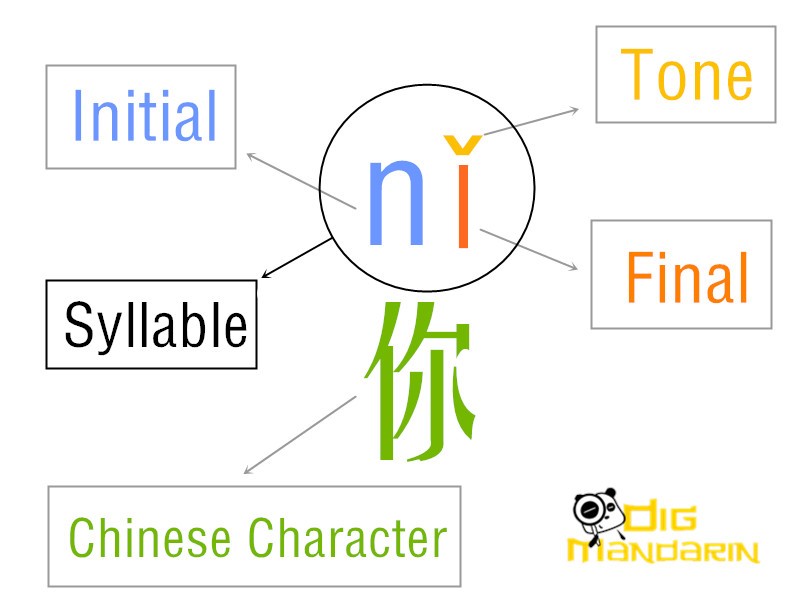
Notice that the Chinese character is not made out of the letters n and i. The character 你 is the usual written form; nǐ tells you how its syllable is pronounced.
A word may contain more than one syllable. For example, Shànghǎi has two syllables:
| Syllable | Initial | Final | Tone |
|---|---|---|---|
| Shàng | sh | ang | fourth |
| hǎi | h | ai | third |
So you parse each syllable separately, even when pinyin is written as one word.
Initials: the syllable’s possible opening consonant
An initial is the consonant sound at the beginning of a syllable. Standard Mandarin has 21 conventional initials:
| Group | Initials |
|---|---|
| Lip sounds | b, p, m, f |
| Tongue-tip sounds | d, t, n, l |
| Back-of-mouth sounds | g, k, h |
| Front-palatal sounds | j, q, x |
| Hissing sounds | z, c, s |
| Retroflex sounds | zh, ch, sh, r |
You do not need to memorize this list today, nor do you yet need to pronounce each one. But you should immediately notice one important writing pattern:
zh, ch, and sh are each a single initial, even though each uses two letters.
For example:
| Written syllable | Correct separation | Common incorrect split |
|---|---|---|
| zhè | initial zh; final e; fourth tone | z + he |
| chī | initial ch; final i; first tone | c + hi |
| shàng | initial sh; final ang; fourth tone | s + hang |
When identifying an initial, check for zh, ch, or sh before treating the first letter as a one-letter initial.
Some syllables have no initial at all. For example:
| Written syllable | Initial | Final | Tone |
|---|---|---|---|
| ài | none | ai | fourth |
| è | none | e | fourth |
A syllable without an initial is sometimes called a zero-initial syllable. It is still a complete syllable: it has a final and a tone.
Finals: everything after the initial
The final is the rest of the syllable after the initial. It always contains the vowel core of the syllable and may include more than one vowel or end in n or ng.
At this stage, think of a final as one chunk. Do not try to break it into English-style letter sounds.
Examples:
| Syllable | Initial | Final |
|---|---|---|
| mā | m | a |
| nǐ | n | i |
| hǎo | h | ao |
| shàng | sh | ang |
| wǒ | spelling convention to be covered later | o in its underlying sound pattern |
The final may be short, such as a or i, or longer, such as ai, ao, and ang. The coming lessons will teach you the individual vowel finals, compound finals, nasal finals, and the special spelling conventions involving y and w. For today, the main skill is simply to identify where the initial stops and the final begins.
Basic Chinese 1 - Syllables, initals, finals and tones
This concise overview reinforces the basic structure of Mandarin syllables and introduces how tone marks appear in pinyin.
In the “Syllables, initals, finals and tones — Introduction” section, read the central definition. Then scroll to the “Tones” section and read the tone notation explanation. Focus on the fact that the initial is optional, while every complete spoken syllable has a tone category.
Tone: the mark that changes the syllable
Mandarin uses pitch patterns called tones. In ordinary pinyin, the four main tones are shown by a mark above a vowel:
| Tone category | Written example | Mark |
|---|---|---|
| First tone | mā | ¯ |
| Second tone | má | ´ |
| Third tone | mǎ | ˇ |
| Fourth tone | mà | ` |
| Neutral tone | ma | no mark |
For this lesson, you only need to identify the category from its written mark. Detailed pitch contours and tone production are the focus of Module 2.
The key principle is this:
The letters and the tone together identify a Mandarin syllable. Changing the tone changes the syllable’s pronunciation and can change its meaning.
For example, all of these have the same initial and final:
| Syllable | Initial | Final | Tone |
|---|---|---|---|
| mā | m | a | first |
| má | m | a | second |
| mǎ | m | a | third |
| mà | m | a | fourth |
| ma | m | a | neutral |
In carefully marked learning materials, no tone mark usually signals a neutral tone. In casual online writing, however, people often omit all tone marks for convenience. If someone types ni, you cannot reliably identify its tone from the spelling alone; you need context, a dictionary entry, or a properly marked version such as nǐ.
A reliable parsing routine
Use this routine whenever you encounter a new, tone-marked pinyin syllable.
- Find the tone mark above a vowel, or notice that there is no mark.
- Identify the initial, if there is one. Check first for the two-letter initials zh, ch, and sh.
- Treat the remaining letters as the final.
- Name the tone from its mark: first, second, third, fourth, or neutral.
Here are several fully worked examples:
| Syllable | Initial | Final | Tone |
|---|---|---|---|
| nǐ | n | i | third |
| hǎo | h | ao | third |
| xiè | x | ie | fourth |
| zhōng | zh | ong | first |
| mā | m | a | first |
| ài | none | ai | fourth |
| ma | m | a | neutral |
The most common early errors are predictable:
- treating sh as two separate parts rather than one initial;
- treating the tone mark as decorative rather than meaningful;
- assuming every syllable must begin with a consonant;
- trying to pronounce pinyin as though it were English before learning the Mandarin sound values.
Avoiding those errors now will make the next pronunciation lessons much more efficient.
Key takeaways
A written Mandarin pinyin syllable is usually composed of:
- an optional initial consonant;
- a vowel-based final;
- a tone shown by a mark over a vowel, or by no mark for the neutral tone.
In nǐ, the separation is n + i + third tone. In shàng, it is sh + ang + fourth tone. In ài, there is no initial: the syllable is ai + fourth tone.
Next, you will begin turning this written map into sound by learning to pronounce the six simple finals: a, o, e, i, u, and ü.
Can't find a good explanation? Sign up and we'll make it for you
Sign up