
Hello. In the previous lesson, you learned to split a pinyin syllable into an optional initial, a final, and a tone. Today we make the final physically real: you will learn the six simple finals—a, o, e, i, u, ü—as mouth and tongue positions.
For now, keep your pitch steady and comfortable. Tones matter, but producing their contours comes in Module 2. The goal today is a clean vowel sound that you can later combine with initials such as m, n, or b.
Simple finals: six new sound targets
A simple final is a one-vowel final. The letters look familiar, but they are not English vowel letters. Treat each as a new sound-and-mouth-shape pairing.
The two controls that matter most are:
- Tongue position: low or high; toward the front or back of the mouth.
- Lip shape: relaxed, spread, or rounded.
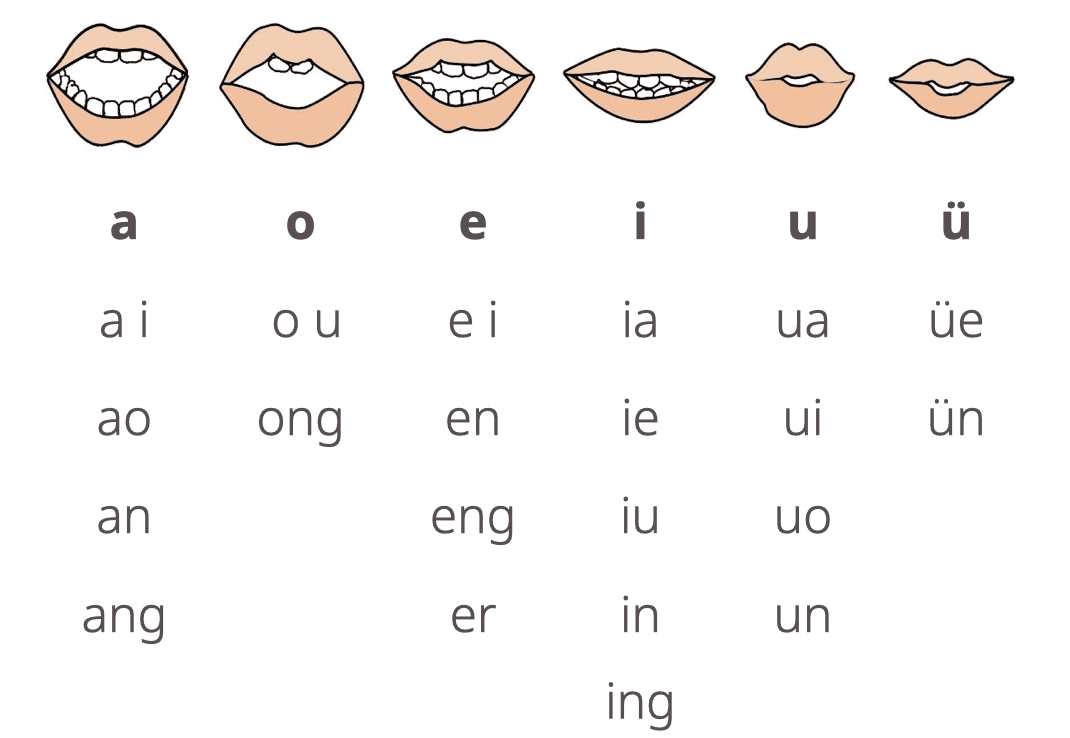
Use the image as a mirror guide, but do not try to make a perfectly identical face. What matters is the sound: open versus narrow, rounded versus unrounded, and front versus back tongue position.
| Final | Core mouth position | Useful English bridge—not an exact match |
|---|---|---|
| a | Jaw open wide; tongue low and flat; lips unrounded | a in father |
| o | Lips rounded; tongue raised and pulled back | aw in law, held without a glide |
| e | Lips relaxed or lightly spread; tongue toward the back and moderately high | a sustained “uh,” but with the tongue farther back |
| i | Lips spread in a slight smile; tongue high and forward | ee in see |
| u | Lips tightly rounded with a small opening; tongue high and back | oo in food |
| ü | Tongue high and forward as for i; lips rounded as for u | French tu or German ü, if familiar |
The most important habit is to make each sound steady. English speakers often let vowels slide at the end, especially sounds resembling English “o.” In Mandarin practice, hold the target position for the entire sound, then stop cleanly.
Build the six sounds deliberately
Start with the two easiest physical extremes: a, the most open vowel, and u, one of the narrowest.
a: open and low
Say a as though a doctor has asked you to say “ah.”
- Drop and relax the jaw.
- Keep the lips neutral rather than rounded.
- Let the tongue lie low and broad in the mouth.
Do not turn it into the short vowel of English cat. Mandarin a is open and sustained:
A useful physical check: among these six finals, a should feel like your jaw is lowest.
o: rounded lips, back tongue
For o, draw your lips into a clear round shape. Your tongue moves back and rises somewhat compared with a.
Say a sustained o. Avoid ending with the English glide in go. You want one stable vowel quality, not a sound that changes shape as it ends.
Contrast the mouth positions slowly:
- a: wide opening, unrounded lips
- o: smaller opening, rounded lips
e: the unfamiliar back vowel
Mandarin e is often the least familiar of the six. It is not the English letter-name “e,” and it is not the vowel in bed.
Begin from the tongue position of o: the tongue is back and moderately raised. Then relax the lip rounding and let the lips become neutral or slightly spread. The result is e.
A rough first bridge is the hesitation sound “uh,” but do not let it become lazy or central. Keep the tongue pulled back. It may feel unusual initially; that is normal.
The key contrast is:
| Final | Tongue | Lips |
|---|---|---|
| o | Back, moderately raised | Rounded |
| e | Back, moderately raised | Unrounded or lightly spread |
This pair is a good reminder that lip shape can change the vowel even when the tongue stays in a similar general area.
Learn Standard Chinese Pronunciation - Pinyin Lesson 1: a o e i u ü (Simple Finals)
Watch “Learn Standard Chinese Pronunciation – Pinyin Lesson 1: a o e i u ü (Simple Finals)” from Everyday Chinese for clear visual demonstrations of the first three finals. Keep a mirror nearby and copy the mouth position, not merely the sound.
Watch final a, focusing on the wide jaw drop and low tongue. Then watch final o, noting the rounded lips, followed by final e. For e, observe the instructor’s transition from rounded o lips to a wider, unrounded mouth while retaining the tongue position.
Front vowels and the critical contrast: i, u, ü
The remaining three finals are high vowels: the tongue is raised. Their differences are especially useful because they can be built from one another.
i: high, front, unrounded
For i, slightly spread the lips as if making a restrained smile. Raise the body of the tongue toward the front of the mouth. The tongue tip rests near the lower front teeth.
It is close to the long ee in English see. Keep it pure and steady:
The mouth should look relatively wide from side to side, not rounded.
u: high, back, rounded
For u, purse your lips firmly, leaving only a small opening. The tongue is high and toward the back of the mouth; it should not press against the teeth.
It resembles English oo in food, but use a more deliberate, consistently rounded lip shape. Do not let the lips relax before the sound ends.
Compare i and u:
| Final | Tongue location | Lips |
|---|---|---|
| i | High and front | Spread, unrounded |
| u | High and back | Tightly rounded |
ü: high, front, rounded
ü has no ordinary English equivalent, but it becomes manageable when you separate tongue position from lip position.
Use this construction:
- Hold a long i. Keep its high, front tongue position.
- Do not move your tongue backward.
- Round your lips as though you were going to whistle.
- Sustain the resulting sound: ü.
In other words, ü uses the tongue of i and the lips of u.
The two contrasts worth practising most carefully are:
| Pair | What must change? | Diagnostic |
|---|---|---|
| i / ü | Lips: spread versus rounded | If your ü sounds like u, your tongue probably moved backward. |
| u / ü | Tongue: back versus front | Keep the same rounded lips; shift only the tongue forward for ü. |
| o / e | Lips: rounded versus unrounded | Keep the tongue generally back while changing the lips. |
You may see ü in pinyin words such as nǚ (“woman”), although this word also contains an initial and a tone. At this stage, isolate the final: hear and feel the ü at the end. The special spelling rules that sometimes hide the dots above ü will be covered later.
Learn Standard Chinese Pronunciation - Pinyin Lesson 1: a o e i u ü (Simple Finals)
Continue with Everyday Chinese’s demonstrations of i, u, and ü, then use its review and listening drills to compare what you hear with what you produce.
Watch final i and adopt the “fake smile” lip shape. Watch final u, concentrating on the narrow, fully rounded lips. Then study final ü; use the instructor’s method of holding i while rounding the lips. Finish with the review drills, pausing after each model sound to repeat it aloud before hearing the next one.
A short, effective pronunciation routine
Rather than rushing through all six sounds repeatedly, practise contrasts. Contrast practice teaches your mouth—and your ear—what changes actually matter.
Round 1: mouth opening and rounding
Stand in front of a mirror and produce each sound three times, holding it for about one second:
- a: jaw low, lips neutral
- o: lips round
- e: lips relax and spread slightly
Keep the tongue position for o and e generally toward the back. Your visible cue is the lips: round for o, unrounded for e.
Round 2: front versus back
Say i and u alternately, slowly. Do not aim for speed.
- For i, show a slight smile and keep the tongue forward.
- For u, purse the lips and retract the tongue.
Then alternate u and ü. Keep your lips rounded for both. The difference should come from the tongue: back for u, forward for ü.
Round 3: attach a familiar pinyin frame
You do not yet need perfect initials or tones. Use the examples simply to feel how a final follows an opening consonant:
| Pinyin syllable | Final to isolate |
|---|---|
| mā | a |
| bō | o |
| è | e |
| nǐ | i |
| mù | u |
| nǚ | ü |
Say each once on a comfortable, level pitch. Then say it again while paying attention only to the final. For example, in nǚ, make sure the vowel does not drift toward u.
If possible, make a short recording of one round. Listen back for two concrete things: whether o, u, and ü stay rounded all the way through, and whether ü has a noticeably more forward tongue quality than u. This type of self-listening is more useful than trying to judge your pronunciation while speaking.
Key takeaways
The six simple Mandarin finals are vowel targets defined by tongue and lip position:
- a is open, low, and unrounded.
- o is back and rounded.
- e is back and unrounded.
- i is high, front, and unrounded.
- u is high, back, and rounded.
- ü is high, front, and rounded.
The most valuable contrasts to retain are o/e, i/u, i/ü, and u/ü. In particular, build ü by keeping the tongue position of i while rounding the lips.
Next, you will add the first group of initials—b, p, m, f, d, t, n, and l—and learn how aspiration changes sounds such as b and p.
Can't find a good explanation? Sign up and we'll make it for you
Sign up