
Hello! Welcome to our next lesson in the "Structural Design Patterns" module.
In the previous lesson, we dove into the Decorator pattern, seeing how it allows us to add new behaviors to objects dynamically by "wrapping" them. This is great for adding functionality.
Today, we shift our focus from adding functionality to simplifying it. Your learning outcome for this lesson is to apply the Facade pattern to provide a simplified interface to a complex subsystem.
While the Decorator pattern adds responsibilities to an individual object, the Facade pattern provides a clean, simple entry point to a whole collection of objects and their intricate interactions. In system design, especially in complex backends like those you build with Spring Boot, you often need to hide complexity from clients, and the Facade pattern is a primary tool for achieving this.
The Problem: The Tangle of a Complex Subsystem
Imagine you're integrating a powerful but complex third-party library or interacting with a set of microservices to perform a single business operation. The client code would need to:
- Know about many different classes or services.
- Understand the correct order to call their methods.
- Handle the data transformation required between each step.
This creates tight coupling between the client and the subsystem. If any part of the subsystem changes, all the clients that use it directly might need to be updated. This is a maintenance nightmare.
Let's watch a short video that illustrates this exact problem using a cryptocurrency trading application that needs to interact with a complex library.
The Facade Pattern Explained and Implemented in Java | Structural Design Patterns | Geekific
This video from Geekific clearly demonstrates the issues of tight coupling and code duplication that arise when a client directly interacts with a complex subsystem.
Please watch from the beginning until 01:52. Pay attention to the challenges mentioned, such as what happens when requirements change or when the same complex logic needs to be used in multiple places.
The Solution: A Simple "Front" for the System
The Facade pattern solves this by introducing a single class that acts as a simplified, unified interface to the complex subsystem. The client interacts only with this facade, which then takes care of orchestrating the calls to the various components within the subsystem.
A great real-world analogy is a food delivery app like Zomato or DoorDash. As a user, you interact with a simple interface to order food. Behind the scenes, the app (the facade) handles a complex process:
- It communicates with the restaurant to place your order.
- It processes your payment.
- It finds and assigns a delivery partner.
- It tracks the delivery status.
You, the client, don't need to know about or interact with the restaurant's internal system, the payment gateway, or the delivery logistics system. The app provides a facade that hides all that complexity.
To explore this analogy further, watch this brief explanation.
Facade Design Pattern in detail | Interview Question
This clip from Daily Code Buffer uses the Zomato food delivery app as an intuitive example of a facade, making the concept very easy to grasp.
Watch from 02:16 to 03:18. This will help solidify your intuitive understanding of what a facade does before we look at the technical structure.
The Structure of the Facade Pattern
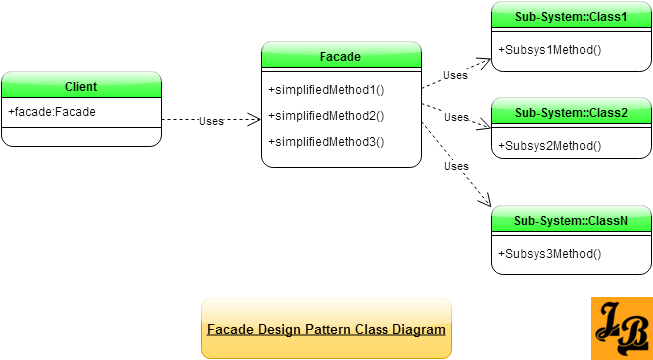
The pattern is structurally simple and consists of three main parts:
- Facade: The class that provides the simplified interface. It knows which subsystem classes are responsible for a request and delegates the work to them.
- Subsystem Classes: The collection of classes that implement the complex functionality. They do the real work but have no knowledge of the facade.
- Client: The object that uses the facade to interact with the subsystem, avoiding direct dependencies on its complex inner workings.
Here is a standard UML diagram illustrating these relationships.
The Geekific video we watched earlier also provides a great walkthrough of this structure, connecting it back to their cryptocurrency example.
The Facade Pattern Explained and Implemented in Java | Structural Design Patterns | Geekific
Let's revisit the Geekific video for a clear breakdown of the pattern's structure and the roles of each component.
Watch from 01:52 to 05:13. This segment defines the facade, shows how it's implemented in the crypto example, and explains the class diagram in detail. Note the important point about creating additional facades to prevent a single facade from becoming a 'god object'.
A Practical Example in Spring Boot
Given your experience with Java Spring Boot, the most valuable way to see this pattern is in a context you're familiar with. A common use case for a facade in a Spring application is to orchestrate calls to multiple services from a controller.
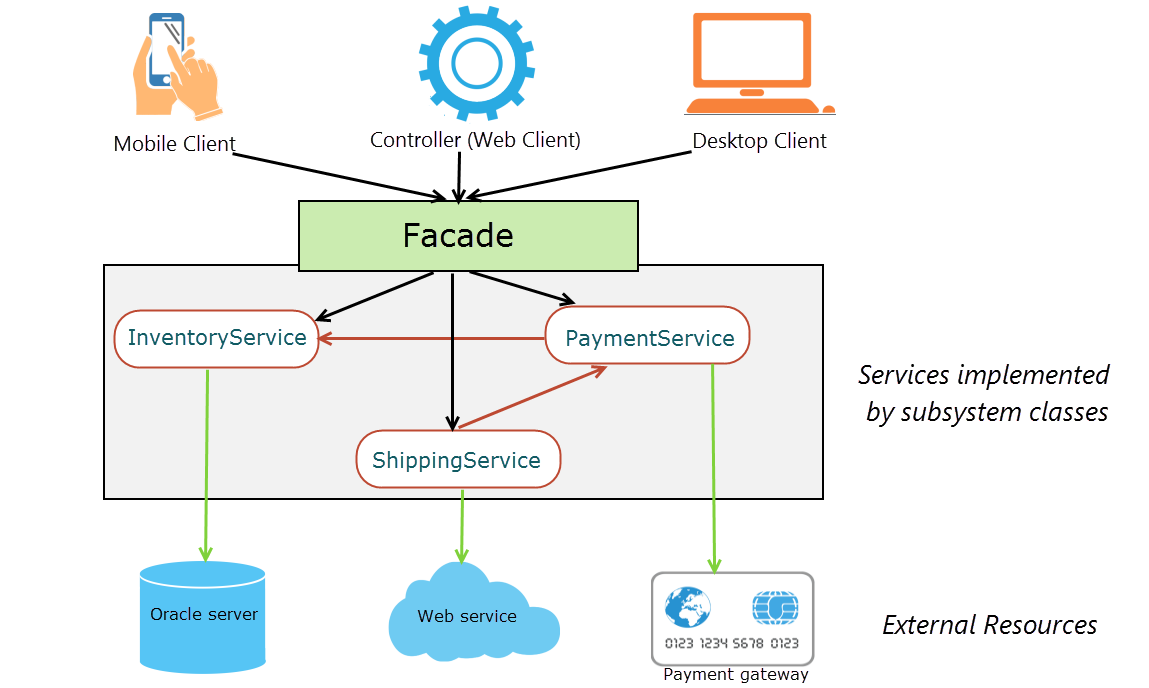
Consider an e-commerce application. When a user places an order, the system needs to perform several actions: validate the order, check inventory, process payment, save the order to the database, and send a confirmation email. Instead of having the OrderController inject and call five different services, we can introduce an OrderFacade.
The following article provides a perfect, step-by-step implementation of this exact scenario in a Spring Boot project.
Facade Pattern in a Spring Boot Project
This article from javaguides.net walks through a complete, real-world example of an e-commerce checkout process. It directly relates to the kind of work you do and is an ideal demonstration of the Facade pattern in a modern Java backend.
Please read through the following sections to see how the pattern is built: Start with 'Real-World Example: E-Commerce Order Checkout' to understand the problem. Skim 'Step 1: Create Individual Services' to see the different components of the subsystem. These are standard Spring @Service classes. Carefully study 'Step 3: Build the Facade Class'. This is the core of the pattern. Notice how it uses constructor injection to get references to all the subsystem services and how the placeOrder method orchestrates them. Finally, look at 'Step 4: Create a Controller to Trigger the Flow' to see how clean the client code becomes. The controller only needs to know about the single OrderFacade.
The architecture described in the article is visualized perfectly by this diagram:
Test your understanding!
Imagine you are designing a "User Registration" feature for an application. The process involves several steps:
- A
ValidationServiceto check if the user's input (email, password strength) is valid. - A
UserServiceto check if an account with that email already exists in the database. - The same
UserServiceto save the new user to the database. - An
EmailServiceto send a welcome email.
How would you design a RegistrationFacade to simplify this process for the client (e.g., a UserController)? Describe the facade's key method and its interactions.
Show answer
You would create a RegistrationFacade class, likely annotated as a Spring @Component or @Service.
-
Dependencies: The
RegistrationFacadewould use constructor injection to get instances ofValidationService,UserService, andEmailService.private final ValidationService validationService; private final UserService userService; private final EmailService emailService; public RegistrationFacade(ValidationService validationService, UserService userService, EmailService emailService) { this.validationService = validationService; this.userService = userService; this.emailService = emailService; } -
Facade Method: It would expose a single, high-level method like
registerUser(RegistrationRequest request). -
Orchestration: Inside this method, it would call the subsystem services in the correct order:
public void registerUser(RegistrationRequest request) {
    // 1. Validate input
    validationService.validate(request);

    // 2. Check for existing user
    if (userService.userExists(request.getEmail())) {
        throw new UserAlreadyExistsException("Email is already taken.");
    }

    // 3. Create user
    User newUser = userService.createUser(request);

    // 4. Send welcome email
    emailService.sendWelcomeEmail(newUser.getEmail());
}
The UserController would then only need to inject and call registrationFacade.registerUser(request), keeping the controller lean and decoupled from the details of the registration process.
When to Use the Facade Pattern
This pattern is incredibly useful, but it's not a one-size-fits-all solution. Knowing when to apply it is key.
Facade Pattern in a Spring Boot Project
Let's conclude by reviewing the primary benefits and the best practices for using the Facade pattern. The same javaguides.net article has excellent, concise summaries for this.
Please read the sections 'Why Use Facade Pattern in Spring Boot?', 'Best Practices', and 'When NOT to Use the Facade Pattern'. Understanding the trade-offs is crucial for interview discussions.
Finally, it's good to know that the Facade pattern appears in the core Java libraries themselves. The article "Facade in Java" by Refactoring Guru points out that classes like javax.faces.context.FacesContext act as facades for more complex underlying APIs, proving this is a time-tested and widely-used pattern.
Conclusion
Today we've learned how the Facade pattern helps manage complexity in large systems. It promotes loose coupling and adheres to the Single Responsibility Principle by creating a dedicated class to orchestrate a complex workflow.
Key Takeaways:
- Purpose: To provide a simple, unified interface to a complex subsystem.
- Mechanism: A single
Facadeclass encapsulates the knowledge of how to interact with multipleSubsystemcomponents, delegating calls to them. - Benefit: It decouples clients from the complex internal logic of a system, making the client code simpler and the subsystem easier to maintain and refactor.
- Relevance: In Spring Boot applications, facades are commonly used to orchestrate business logic across multiple services, keeping controllers clean and focused.
In our next lesson, we will explore the Proxy pattern. While both Facade and Proxy act as intermediaries, they serve different purposes. A Facade provides a different, simpler interface to a system, while a Proxy provides the same interface but adds a layer of control over access to the object it represents.