Welcome to the third lesson in the "Legal and Regulatory Framework" module.
In our last lesson, we created a high-level map of the key US federal regulations that apply to a venture fund. You learned that the core strategy isn't to register with the SEC in the same way a public mutual fund would, but to operate under specific, well-defined exemptions. We identified the three key areas: the fundraising process (Regulation D), you as the manager (Exempt Reporting Adviser), and the fund itself (Investment Company Act exemptions).
Today, we will zoom in on that third area. This lesson is dedicated to achieving the learning outcome: to describe common legal exemptions (e.g., 3(c)(1), 3(c)(7)) that early-stage funds use to operate. We will move beyond simply naming these exemptions to understanding their specific rules and, most importantly, the strategic implications of choosing one over the other. This decision directly dictates who you can raise capital from, making it one of the first and most critical choices you'll make with your legal counsel.
1. The Starting Point: The Investment Company Act of 1940
As a quick refresher, the Investment Company Act of 1940 was designed to regulate pooled investment vehicles. Because your accelerator's fund will pool capital from multiple investors (your Limited Partners or LPs) to invest in startups, it falls under the Act's definition of an "investment company."
Without an exemption, you would be subject to extensive and costly SEC registration and reporting requirements that are unworkable for a private fund. Therefore, every venture capital fund must be structured to qualify for an exemption. The two you will encounter most are Section 3(c)(1) and Section 3(c)(7).
To understand these, let's start with a foundational reading.
Venture Capital Funds: 3(c)(1) Funds vs. 3(c)(7) Funds
This article from DLA Piper, a law firm with deep venture expertise, provides a clear breakdown of the 3(c)(1) and 3(c)(7) exemptions. It's an essential read for any aspiring fund manager.
Please read the introduction of the article, which begins right under the title and ends just before the 'Non-Public Offering' heading. This will set the stage by re-confirming why these exemptions are so critical.
2. The Universal Requirement: A Private Offering
Before a fund can even consider using the 3(c)(1) or 3(c)(7) exemption, it must satisfy a fundamental condition: it cannot make a public offering of its securities (i.e., the interests in your fund).
This is where the exemptions connect. To ensure a non-public offering, funds typically rely on Rule 506(b) of Regulation D, which we briefly touched on in the last lesson. This rule allows you to raise unlimited capital from accredited investors, but it strictly prohibits "general solicitation" or advertising. This is why you can't tweet that your fund is open for investment or post about it on LinkedIn.
Let's continue with the DLA Piper article to solidify this concept.
Venture Capital Funds: 3(c)(1) Funds vs. 3(c)(7) Funds
The next section of the article explains this non-public offering requirement and its connection to Regulation D.
Please read the section titled 'Non-Public Offering.' Pay special attention to why most VCs avoid taking non-accredited investors, even though Rule 506(b) technically allows for up to 35.
The key takeaway is that your fundraising must be private and targeted. You'll work through your existing network and seek warm introductions, not broadcast your fund to the public. With this foundation, you can now choose your primary exemption.
3. The 3(c)(1) Exemption: The Standard for Emerging Managers
The Section 3(c)(1) exemption is the most common path for new and emerging fund managers. Its rules are primarily based on the number of investors in your fund.
To get a clear definition, we'll turn to a resource from Carta, which provides a very accessible summary.
Sections 3(c)(1) and 3(c)(7) of the Investment Company Act
This article from Carta clearly outlines the rules for both 3(c)(1) and 3(c)(7) funds. We'll start with the 3(c)(1) section.
Please read the sections titled 'Sections 3(c)(1) and 3(c)(7)' and 'Section 3(c)(1) funds.' Focus on the two different investor limits mentioned: the standard 100-owner limit and the expanded 250-owner limit for 'qualifying venture capital funds.'
As you just read, the rules for a 3(c)(1) fund are:
- Standard Limit: You must have fewer than 100 beneficial owners.
- Qualifying VC Fund Limit: This limit can be raised to 250 beneficial owners if your fund has $12 million or less in assets and adheres to a specific venture capital strategy. For your first fund, this is a very relevant provision.
A crucial point to discuss with your lawyer is the concept of "beneficial owners." The counting is not always straightforward due to "look-through rules," which prevent investors from creating a single entity to circumvent the 100-owner limit. For example, if an investment club specifically formed to invest in your fund has 10 members, your lawyer might advise you to count them as 10 beneficial owners, not 1. This is a key area where professional legal advice is non-negotiable.
4. The 3(c)(7) Exemption: For Larger, More Established Funds
The Section 3(c)(7) exemption operates on a different principle. Instead of limiting the number of investors, it restricts the type of investor.
Let's look at the DLA Piper and Carta articles for the specifics.
Venture Capital Funds: 3(c)(1) Funds vs. 3(c)(7) Funds
Now let's examine the requirements for a 3(c)(7) fund.
First, read the '3(c)(7) Funds' section in the DLA Piper article. Note the financial thresholds for an individual to be considered a 'qualified purchaser.'
Sections 3(c)(1) and 3(c)(7) of the Investment Company Act
The Carta article also provides a concise definition and maximum investor count.
Now, read the short 'Section 3(c)(7) funds' section in the Carta article to see the upper limit on beneficial owners.
The rules for a 3(c)(7) fund are:
- Investor Type: All of your investors must be "Qualified Purchasers" (QPs).
- Investor Limit: You can have up to 2,000 beneficial owners.
A Qualified Purchaser is a significantly higher tier of financial sophistication than an "Accredited Investor." For an individual, this generally means owning at least $5 million in investments.
This brings us to the core strategic decision.
5. The Strategic Choice: 3(c)(1) vs. 3(c)(7)
The choice between these two exemptions boils down to a simple trade-off:
- 3(c)(1): A broader pool of potential investors, but a cap on the total number of investors.
- 3(c)(7): A much higher cap on the number of investors, but a much smaller, wealthier pool of eligible individuals.
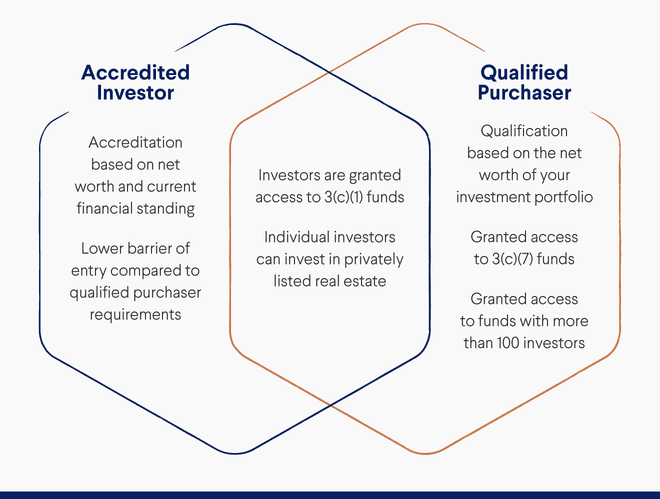
For context:
- An Accredited Investor (for 3(c)(1) funds) is generally an individual with a net worth over $1 million (excluding primary residence) or an annual income over $200k ($300k with a spouse).
- A Qualified Purchaser (for 3(c)(7) funds) is an individual with over $5 million in investments.
Because the pool of accredited investors is vastly larger than the pool of qualified purchasers, nearly all first-time fund managers choose the 3(c)(1) exemption. The 100-investor limit (or 250 for a qualifying VC fund) is more than sufficient for a new manager raising their first fund.
The following table from the Carta article provides a perfect summary.
Sections 3(c)(1) and 3(c)(7) of the Investment Company Act
Finally, let's review the summary table in the Carta resource for a side-by-side comparison.
Review the table in the section 'Section 3(c)(1) vs. Section 3(c)(7).' It clearly lays out the differences in beneficial owner limits, investor types, and fund size limits.
Test your understanding!
You are building a target list of potential LPs for your new $10 million fund. Your friend offers to introduce you to two of their contacts:
- Investor A: A successful surgeon who earns $600,000 per year and has a net worth of $2 million.
- Investor B: A retired tech executive who owns a $15 million investment portfolio.
Assuming you structure your fund under the standard 3(c)(1) exemption, who can you accept as an investor? What if you chose to structure it as a 3(c)(7) fund instead?
Show answer
-
Under a 3(c)(1) exemption: You could accept both Investor A and Investor B. Investor A qualifies as an Accredited Investor based on income, and Investor B qualifies based on net worth (and is also a Qualified Purchaser, which automatically makes them an Accredited Investor).
-
Under a 3(c)(7) exemption: You could only accept Investor B. Investor A, despite being an Accredited Investor, does not meet the $5 million investment portfolio requirement to be a Qualified Purchaser. This highlights the restrictive nature of the 3(c)(7) exemption and why 3(c)(1) is the standard for emerging managers who need access to the broader pool of accredited investors.
Conclusion
You have now dissected the two most important legal exemptions for a venture capital fund. You understand the rules, the terminology, and the strategic trade-offs involved in choosing between them. This knowledge is not meant to replace legal counsel, but to empower you to have a productive, strategy-focused conversation with the lawyers who will execute the setup of your fund.
Key Takeaways:
- All VC funds must be exempt from the Investment Company Act of 1940.
- The 3(c)(1) exemption is the standard for new funds. It limits the fund to fewer than 100 beneficial owners (or 250 for a qualifying VC fund under $12M AUM), who must be Accredited Investors.
- The 3(c)(7) exemption is for larger funds. It allows up to 2,000 investors, but they must all be Qualified Purchasers—a much higher wealth threshold ($5M+ in investments).
- The strategic choice is clear: for a new accelerator fund, the 3(c)(1) structure provides the necessary flexibility to fundraise from a wider pool of investors.
Preview of the next lesson:
Now that you've established the legal structure of your fund and chosen the exemption it will operate under, what do you actually have to do to stay compliant? In our next lesson, we will outline the core compliance responsibilities of a fund manager, covering essential topics like Form ADV filings and fiduciary duties.