Hello! Welcome to the first lesson of Module 2: Legal and Regulatory Framework.
In the last module, we established the strategic and financial foundations for your accelerator. You designed a value proposition, chose an admission model, and, most recently, outlined the unit economics that will determine your firm's sustainability. We ended by noting that a great business model needs a solid legal structure to support it.
Today, we build that structure. The learning outcome is to select appropriate legal entity structures for the operating company and investment fund. This is the first, and arguably most critical, legal step in launching your firm. Your background in startup consulting has given you exposure to companies as legal entities, but today we'll focus on the specific multi-entity structure unique to the world of venture capital. This lesson will empower you to have a productive, strategic conversation with your legal counsel, ensuring you set up a framework that provides liability protection and aligns with your long-term goals.
1. The Core Principle: Separation of Concerns
The most common mistake first-time fund managers make is thinking of their "firm" as a single company. In reality, a standard venture capital or accelerator operation is built on at least two distinct legal entities, each with a specific purpose:
- The Management Company (OpCo): This is your business. It runs the accelerator program, employs you, pays for software and rent, owns the brand and intellectual property (e.g., your curriculum), and collects management fees.
- The Investment Fund (Fund): This is the investment vehicle. It is a separate legal entity that pools capital from your investors (Limited Partners) and uses it to invest in portfolio companies.
This separation is not just a formality; it is essential for liability protection, regulatory compliance, and financial clarity. It ensures that the operational risks of the Management Company are firewalled from the investment capital in the Fund, and vice versa.
This diagram provides a great visual overview of how these pieces fit together.
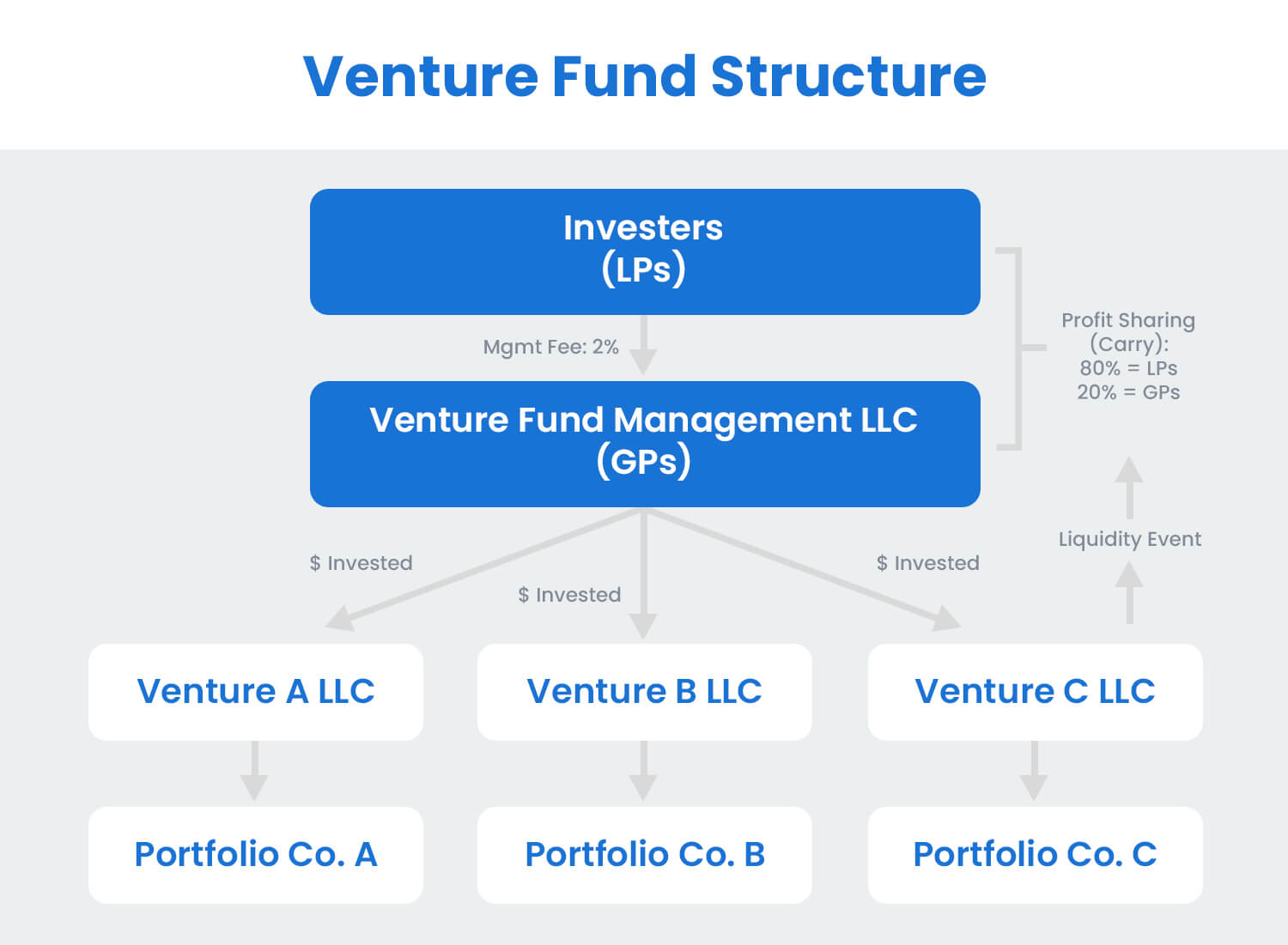
2. Deconstructing the Standard VC Structure
To understand how to build this for your firm, let's break down the roles of each component in more detail. The structure can seem complex, but it's logical once you understand the function of each part.
Let's start with a video that walks through this standard model.
How VC works | Limited partnerships & management companies | VC 101
This video from Carta provides a concise overview of the key entities in a venture fund structure and how they relate to one another.
First, watch the overview from the beginning to 0:53. Then, jump to the section on the Management Company from 2:02 to 3:08. Pay attention to how the Management Company, GP, and Fund are distinct entities with different roles.
As the video explains, there are three primary components:
- The Fund: The pool of money.
- The General Partner (GP): The entity with legal authority to manage the fund.
- The Management Company: The operating business that provides services to the fund.
Now let's dive into the specific legal structures for each.
3. Structuring the Investment Fund: The Limited Partnership
The vast majority of venture funds are structured as Limited Partnerships (LPs). This structure is ideal for investment vehicles because it cleanly defines two different types of partners:
- Limited Partners (LPs): Your investors (e.g., family offices, high-net-worth individuals). Their role is purely financial; they provide capital but do not participate in management. Crucially, their liability is limited to the amount of money they invested in the fund.
- General Partner (GP): This is the entity that manages the fund, makes investment decisions, and calls capital. By law, the GP has unlimited liability for the fund's debts and obligations.
That "unlimited liability" for the GP should raise a major red flag. You would never want to be a GP in your individual capacity, as it would put all of your personal assets at risk.
This is why a critical protection layer is added: the GP is itself a legal entity, almost always a Limited Liability Company (LLC). This shields you, the human manager, from the GP's unlimited liability.
This next video explains this vital concept very clearly.
How VC works | How VC funds are structured | VC 101
So, how do you handle the GP's 'unlimited liability'? This video explains the most important structural decision you'll make to protect yourself as a fund manager.
Please watch from 1:33 to 4:45. This segment explains the different liability levels and demonstrates exactly why the GP is structured as an LLC to insulate the individual managers.
To summarize the Fund structure:
- You will form an investment fund, likely a Delaware Limited Partnership (e.g., "AI Accelerator Fund I, LP").
- You will also form a Delaware LLC to act as the General Partner of that fund (e.g., "AI Accelerator GP I, LLC"). You will be the owner/member of this GP LLC.
This structure achieves the best of both worlds: it gives your LPs the limited liability they require, and it gives you the control you need to manage the fund while shielding your personal assets.
4. Structuring Your Operations: The Management Company
Now, let's turn to your actual business—the entity that will run the accelerator. This is the Management Company.
The Management Company is your firm's operational hub. It will:
- Receive management fees from the fund to pay for expenses.
- Employ you (and any future staff).
- Own the brand, website, and other intellectual property.
- Sign contracts for office space, software, etc.
Since you are the sole founder, the key decision is how to structure this entity. The overwhelming choice for this purpose is an LLC. The following reading is extremely practical for your situation, as it comes from a platform dedicated to helping emerging managers.
The Basics of Venture Capital Management Companies
This article from AngelList provides a practical guide to Management Companies, focusing on the decisions an emerging manager like you needs to make.
Please read the sections titled 'What is a Management Company?', 'How is a Management Company Structured?', and 'How to Pick a Management Company Structure'. Focus on the comparison between a single-member and multi-member LLC, as this is directly applicable to your solo-led firm.
As the article highlights, you have a straightforward choice:
- Single-Member LLC: This is the simplest, most flexible, and most cost-effective option for a solo founder. It establishes the legal entity you need for operations without the complexity of a partnership agreement. You can easily convert it to a multi-member LLC later if you decide to bring on partners. For your goal of launching a solo-led incubator, this is the most logical starting point.
- Multi-Member LLC: This is for firms with two or more founding partners from day one. It requires a detailed operating agreement that specifies ownership, compensation, decision-making, and what happens if a partner leaves.
Your likely structure: You will form a Single-Member LLC to serve as your Management Company (e.g., "AI Accelerator Management, LLC"). This entity will be owned 100% by you.
Test your understanding!
You're meeting with your lawyer to officially begin setting up your solo-led accelerator and its first fund. She asks you what legal entities you believe you need to create.
Based on this lesson, what two primary entities would you describe? For each, state its purpose and its likely legal structure.
Show answer
-
Entity 1: The Management Company
- Purpose: To serve as the operating company for the accelerator. It will run the program, employ me, receive management fees, and own the firm's brand and IP.
- Legal Structure: A Single-Member LLC (e.g., "My Accelerator Management, LLC").
-
Entity 2: The Investment Fund
- Purpose: To be the investment vehicle that pools capital from my investors (LPs) and makes investments into the portfolio companies.
- Legal Structure: A Limited Partnership (e.g., "My Accelerator Fund I, LP"). Its General Partner will be a separate LLC that I control, to shield me from personal liability.
Conclusion
You now have a clear blueprint for the legal architecture of your accelerator and fund. Understanding this structure is not about replacing your lawyer, but about being an informed client who can make sound strategic decisions.
Key Takeaways:
- A venture firm is not one company, but a system of at least two entities: a Management Company (LLC) for operations and an Investment Fund (Limited Partnership) for investing.
- The Fund is managed by a General Partner (GP), which is itself an LLC to protect the individual managers from the GP's unlimited liability.
- For a solo founder, the Management Company is best structured as a Single-Member LLC for simplicity and flexibility.
- These entities are typically formed in Delaware due to its well-established and favorable corporate law.
Preview of the next lesson:
Now that we have designed the "what"—the legal entities themselves—we must understand the "how." How are these entities regulated? In our next lesson, we will identify key US federal regulations governing venture capital funds and discuss the common legal exemptions, such as Section 3(c)(1) of the Investment Company Act, that are critical for making your fund viable to operate as an emerging manager.