
Hello! Welcome to the next lesson in your journey to becoming a professional penetration tester.
In our last session, we established the cardinal rule of web security: never trust the client. We saw how applications that delegate security decisions to the browser can be exploited by manipulating client-side code, parameters, and responses. Today, we pivot to the server-side to explore a direct and powerful consequence of this principle: Insecure Direct Object References (IDOR). This is one of the most common and impactful authorization vulnerabilities you will encounter in the wild.
This lesson directly addresses the learning outcome: Identify and exploit Insecure Direct Object References (IDOR) to access unauthorized data and functionality. We will cover:
- The fundamental concept of an IDOR vulnerability.
- A systematic, manual methodology for discovering potential IDORs.
- Advanced techniques to bypass common protections.
- Tools and strategies to automate and scale your testing efforts.
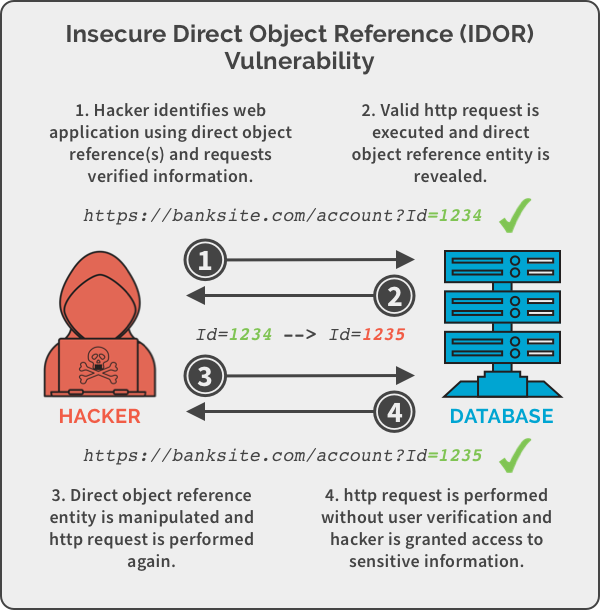
Let's begin by visualizing the attack.
1. What is an Insecure Direct Object Reference?
At its heart, an IDOR is a type of access control failure. It happens when an application uses an identifier provided by the user to access an object (like a user profile, a file, or a database record) without first verifying if that user has the permission to access that specific object.
Insecure Direct Object Reference (IDOR) Attack Guide
For a concise definition, let's start with the "Insecure Direct Object Reference (IDOR)" article from Hackviser.
Read the first two sections, 'Insecure Direct Object Reference (IDOR)' and 'How It Works'. This will give you a clear, formal definition and a simple example.
As the article explains, if an application lets you view your own data at .../account?id=123, the first thing a tester should do is try accessing .../account?id=124. If that shows you another user's account, you've found an IDOR.
While this example uses a simple, predictable integer, the "object reference" can be anything: a database ID, a filename, a UUID, or even a hashed value. The "insecure" part comes from the missing server-side authorization check.
2. A Methodology for Finding IDORs
Finding IDORs consistently requires a methodical approach, not just random guessing. It's about understanding how the application works and where to look for these user-controllable references.
The following video from bug bounty hunter NahamSec provides an excellent, practical walkthrough of a solid IDOR hunting methodology.
Insecure Direct Object Reference / IDOR Explained // How to Bug Bounty
Watch these segments from 'Insecure Direct Object Reference / IDOR Explained' by NahamSec to learn a professional's workflow for identifying these bugs.
As you watch, pay close attention to the systematic process: Always Be Watching (01:50 - 03:22): Note the habit of keeping the browser's Network tab or Burp Suite's history open to observe every API call the application makes. This is how you map the attack surface. Find the Other IDs (04:32 - 06:51): This is a crucial step. When IDs aren't sequential (e.g., they are UUIDs), how do you get a valid ID for another user? See how he finds another user's ID by observing public activity on the site (reviews). Dig Deeper (07:35 - 09:22): An important concept: even if the main user profile endpoint is secure, IDORs often hide in deeper functionalities like managing addresses, viewing orders, or exporting data. Always test every feature. Test All Verbs (09:22 - 12:22): Just because you can't GET another user's data doesn't mean you can't POST (update), PUT (replace), or DELETE it. An endpoint might have different access controls for different HTTP methods.
Systematizing the Hunt
Let's combine NahamSec's workflow with a structured checklist. A successful IDOR hunt generally follows these steps:
- Map the Application: With Burp Suite running, browse the entire application. Log in, edit your profile, create a post, send a message, view an order—perform every action a user can. This populates your proxy history with all the requests the application uses.
- Identify Direct Object References: Now, review those requests and look for any parameter that seems to reference a specific object.
Insecure Direct Object Reference (IDOR) Attack Guide
The Hackviser article provides a fantastic checklist of where to look for these references.
Read the 'Manual Testing' section, which covers finding references in URL parameters, POST bodies, HTTP headers, cookies, file paths, and API endpoints. This is your hunting ground.
- Obtain a Second ID: To test for an IDOR, you need at least two accounts. Let's call them Attacker and Victim. You'll log in as the Attacker and try to access objects belonging to the Victim.
- If IDs are numeric (e.g.,
id=101,id=102), this is easy. - If IDs are unpredictable (e.g., UUIDs), you need to find a way to get the Victim's ID. As shown in the video and the Intigriti article "A complete guide to exploiting advanced IDOR vulnerabilities", these can often be found in public profiles, shared links, password reset URLs, or even by just creating a second account yourself.
- If IDs are numeric (e.g.,
- Test and Analyze: For every endpoint you identified in Step 2, replace your own object ID with the Victim's ID and send the request. Analyze the response. Do you see the Victim's data? Does the server return a
200 OKbut with different content? Or do you get an error like403 Forbidden? Any response other than a clear authorization error deserves closer inspection.
Test your understanding!
You are testing a web application. When you request to download an invoice you own, you see the following request:
GET /invoices/download?file_id=8a7b1c9f-3d4e-4f5a-8b6c-2d1e9f0a8b7c
You have also created a second account and found that one of its invoice IDs is 9b6d0e8a-1f2c-3d4e-5a6b-7c8d9e0f1a2b.
Simply trying to access this second ID gives you a 403 Forbidden error. Following the methodology above, what are at least two other things you should try before giving up on this endpoint?
Show answer
Based on the methodology, you should:
- Test other HTTP methods. Even if a
GETrequest is forbidden, the developer may have forgotten to implement the same authorization check on other methods. You should try sending the request with a different method, such asPOST,PUT, orDELETE, to see if you can modify or delete the other user's invoice. - Look for parameter pollution. Try sending the request with both IDs, like
?file_id=8a7b...&file_id=9b6d.... Depending on how the server parses parameters, it might process the second one while only validating the first, granting you access.
3. Advanced IDOR Techniques
Simple IDORs are often caught by automated scanners or junior testers. To find high-impact bugs, you need to know how to bypass common, but incomplete, defenses. Your CS background will be useful here, as many of these techniques involve understanding how different data formats and protocols are processed.
Here are some advanced variations to add to your arsenal:
- Hashed/Encoded IDs: If an ID looks like a hash (e.g., MD5) or is Base64 encoded, the application might still be vulnerable. If you can guess the input (e.g., it's just hashing the sequential integer ID), you can generate your own IDs for other users and test them.
echo -n "1235" | md5sum - JSON Body Manipulation: If a request uses a JSON body, try manipulating the structure. For example, if
{"id": 1234}is blocked, try{"id": [1234, 1235]}(array wrapping) or{"id": 1235, "id": 1234}(parameter pollution). The backend parsing library might handle these unexpected inputs in a way that bypasses security checks. - API Versioning: Always check for older API versions. A vulnerability might be patched in
/api/v2/user, but the/api/v1/userendpoint might still be live and vulnerable. - Blind IDOR: This is an IDOR where you don't get the other user's data back in the response, but the action is still performed. For example, submitting a
POSTrequest to.../delete-accountwith another user's ID. You might get a generic "OK" message, but you can confirm success if the other user's account is actually deleted. - Static Keywords: Some APIs use keywords like
/api/users/meto refer to the current user. Always check if the application also accepts your actual user ID, e.g.,/api/users/5678. If it does, you can then try to substitute other user IDs.
For a deeper dive into these techniques, the "A complete guide to exploiting advanced IDOR vulnerabilities" article from Intigriti is an excellent resource. It covers exploiting IDORs via parameter pollution, JSON globbing, and method-based attacks in more detail.
4. Automating IDOR Discovery
Manually testing every parameter in a large application is tedious. As a professional, you'll want to automate parts of this process. Since you're comfortable with Python, scripting is a great option.
Insecure Direct Object Reference (IDOR) Attack Guide
The Hackviser article shows examples of how to automate IDOR discovery using common tools, including a simple Python script that connects perfectly with your skills.
Review the 'Automated Discovery' section. Focus on the examples for Burp Suite Intruder (for simple numeric fuzzing), ffuf (a command-line fuzzer), and especially the Python script example. Think about how you could adapt that script for different scenarios.
For more integrated testing within Burp Suite, several extensions are invaluable.
Burp Suite tutorial: IDOR vulnerability automation using Autorize and AutoRepeater (bug bounty)
The video 'Burp Suite tutorial: IDOR vulnerability automation' by STÖK provides a great overview of two must-have Burp extensions: Autorize and AutoRepeater.
You don't need to watch the whole video in detail right now, but understand the purpose of these tools: Autorize (00:31 - 02:04): You browse an application with a high-privileged user (e.g., admin). Autorize automatically re-sends every request using the session cookies of a low-privileged user. It then flags any request that succeeded, instantly showing you where a low-privilege user can access high-privilege functionality. AutoRepeater (05:48 - 08:12): This tool is more flexible. You can define specific replacement rules. For example, 'Whenever you see my user UUID in a request, replace it with this other user's UUID and send a second request'. This is perfect for testing IDORs with non-sequential IDs.
These tools don't replace manual testing, but they dramatically improve efficiency by handling the repetitive task of swapping IDs and cookies, allowing you to focus on analyzing the results.
Conclusion
IDOR vulnerabilities are a direct result of broken access control and are a staple of bug bounty hunting and penetration testing. Their impact can range from leaking user data to full account takeover, making them critical findings.
Key Takeaways:
- Core Flaw: IDOR is a server-side failure to verify that a user is authorized for the specific data object they are requesting via a direct reference.
- Methodology is King: A systematic process of mapping the application, identifying all object references, obtaining valid IDs for other users, and testing every endpoint with different HTTP verbs is crucial for success.
- Go Beyond Integers: Look for IDORs in endpoints that use UUIDs, hashes, or encoded strings. The vulnerability is in the missing check, not the format of the ID.
- Automate for Efficiency: Use tools like Burp Intruder,
ffuf,Autorize, and custom scripts to handle the repetitive parts of testing, especially on large applications.
Next Lesson Preview:
In this lesson, we focused on manipulating parameters that act as direct identifiers for objects. In our next lesson, "Manipulate request parameters to bypass authorization checks and impersonate other users," we will broaden our focus. We'll explore how to tamper with other types of parameters—those that might not be object IDs but still control application logic, user roles, or access rights—to achieve similar goals of authorization bypass and impersonation.