
Hello again. In the previous lesson, you established why Australia entered the war in 1914: its place in the British Empire, strong cultural and economic ties to Britain, and security concerns in the Pacific. Australia then had to raise an army for overseas service. This lesson explains an important qualification: although the Australian Imperial Force was made up of volunteers, volunteering did not mean that every Australian who wanted to serve was allowed to do so.
By the end, you should be able to explain how the voluntary recruitment system shaped the AIF by selecting for willingness and by imposing legal, physical, racial, and gender-based limits on eligibility.
A voluntary force for overseas service
In 1914, Australian military law drew a distinction between defending Australia and fighting overseas. Under the Defence Act 1903, men already serving in Australia’s military forces, including reserves, could not simply be sent overseas. They first had to volunteer for a separate force created specifically for the war: the Australian Imperial Force (AIF).
This means the AIF was not an army of men automatically called up from the population. It depended on people deciding to enlist. Recruiting offices opened rapidly after war began, and thousands of men came forward. However, volunteering was only the first step. A volunteer still had to satisfy the AIF’s rules.
Enlisting in the Australian forces during World War I
Read the opening of this Anzac Portal overview to establish why Australia needed a new, voluntary overseas force rather than simply sending its existing military forces abroad.
In the section “Preparation for war,” begin with the statement that explains the legal requirement. Focus on the difference between Australia’s pre-war forces and the newly formed AIF.
A concise way to express this in an exam is:
Australia’s overseas army was voluntary because Australian law did not allow existing military forces to be sent abroad without men first volunteering for a special force, the AIF.
Be precise with the word voluntary. It describes how men entered the AIF: they chose to put their names forward. It does not mean the AIF accepted every person who volunteered.
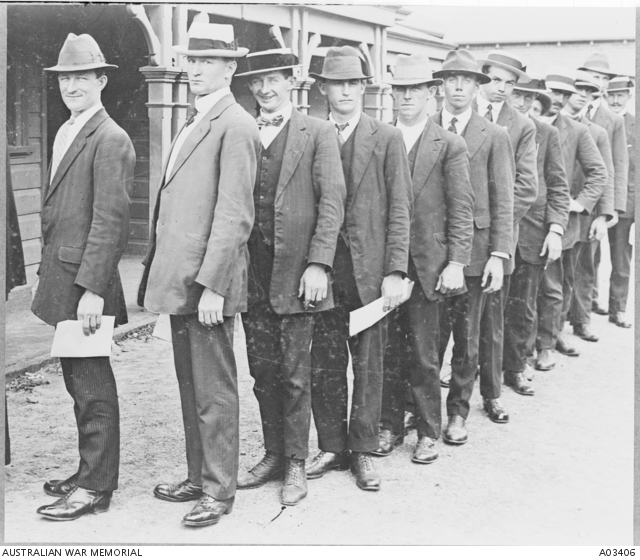
When using this photograph as evidence, observe what it can and cannot show. It is valuable evidence that substantial numbers of men presented themselves to enlist. It cannot tell us whether these particular volunteers were accepted, why each joined, or whether the queue represented all Australians.
Selection: willingness was not enough
At a recruiting depot, volunteers underwent a medical examination. In the early months of the war, the AIF wanted men who could quickly endure military training and active service. Its requirements were therefore strict, especially for age, height, chest measurement, weight, general health, and dental condition.
The early AIF was consequently not a random cross-section of Australian men. It was weighted toward men judged physically fit enough for service. In the first year of the war, almost one-third of volunteers were rejected. A man could want to fight, yet be refused because of poor teeth or another medical issue.
The changing rules show how military need shaped eligibility:
| Minimum requirement | August 1914 | June 1915 | April 1917 |
|---|---|---|---|
| Age | 19 to 38 | 18 to 45 | 18 to 45 |
| Height | 168 cm | 157 cm | 152 cm |
| Chest measurement | 86 cm | 84 cm | 84 cm |
As casualties mounted and the AIF expanded, it needed reinforcements. The authorities relaxed standards: younger and older men became eligible, and minimum height and chest requirements fell. Thus, the pool of people who could enlist became broader as the war continued.
Enlisting in the Australian forces during World War I
Continue with the Anzac Portal overview for the recruitment process, the changing physical standards, and the discriminatory rules concerning ancestry.
In “Selecting volunteers,” read from the sentence on medical selection and changing standards. Then study the table headed “Enlistment standards for the Australian Imperial Force over the course of World War I” and note the three changes between August 1914 and April 1917. Next, under “Rejections on grounds of origin or descent,” read the discussion of racial exclusion and the 1917 change. Focus on why the policy remained unequal even after it was relaxed.
Do not interpret the relaxation of standards as evidence that the original rules were unimportant. It demonstrates the opposite: eligibility rules were actively controlling who entered the AIF, and the Army changed them because it required more personnel.
A strong causal explanation is:
Because the AIF relied on volunteers, it could only recruit from people willing to serve; medical standards narrowed that group further. As casualties increased, the AIF relaxed age and physical requirements to enlarge the number of eligible volunteers.
Race and ancestry: a voluntary system built on exclusion
The AIF’s selection system was also shaped by the racist policies of the period. Initially, the AIF accepted only volunteers considered to be of European descent. Medical officers could classify a volunteer as “not substantially of European origin or descent,” making ancestry an official barrier to enlistment.
This particularly affected Aboriginal and Torres Strait Islander men. Many wanted to serve but were rejected either at recruitment centres, after arriving at camp, or even after a period of training. Enforcement was inconsistent and subjective: in some First Nations families, one brother was accepted while another was refused.
In May 1917, the government relaxed this restriction. Some men of mixed heritage could be accepted if officials believed that one parent was of European origin. This was not equal access to enlistment. The final decision still rested with military authorities, and the policy continued to rely on discriminatory judgments about ancestry.
The key point is that “voluntary” does not mean “open to all.” A First Nations man could be willing, physically fit, and able to serve, yet be rejected because of the AIF’s racial rules. Hundreds of Aboriginal and Torres Strait Islander people nevertheless served in the AIF, often despite these barriers.
Use careful language in an exam:
- Accurate: “The AIF initially restricted enlistment to men of European descent, excluding many First Nations volunteers.”
- More complete: “Restrictions were relaxed in 1917, but decisions remained discriminatory and discretionary.”
- Avoid: “First Nations people did not serve in the AIF.” This is incorrect.
Gender and the restricted roles available to women
Gender also strongly shaped who could enlist and what work they could perform. Women were not eligible to enlist as ordinary AIF soldiers or combat troops. During the First World War, women could enlist in the AIF as nurses. Other women served as Voluntary Aid Detachments (VADs), supporting medical work through tasks such as assisting in Red Cross homes, canteens, and troop trains.
Enlistment: In Their Own Words
Read this short Anzac Portal section to identify the narrow opportunities open to women who wanted to contribute through military or medical service in the First World War.
Under “Enlistment for women,” read the First World War discussion. Concentrate on the distinction between nurses who could enlist and VADs who performed voluntary support work.
Therefore, the voluntary system produced a force that was overwhelmingly male, while women’s formal participation was largely confined to nursing and medical-support roles. This was not because women necessarily lacked willingness to contribute; it reflected the gender expectations and military rules of Australian society in 1914.
Building an exam explanation
For this learning outcome, organise your answer around the principle that volunteering was necessary but not sufficient. A person had to be willing to serve and also meet the AIF’s legal and official criteria.
A useful structure is:
- Define the system: The AIF was a new voluntary force for overseas service because existing Australian forces could not be sent abroad under the Defence Act.
- Explain selection: Medical and physical standards meant only those judged fit were accepted; almost one-third were rejected in the first year.
- Show change over time: Standards were relaxed as the need for reinforcements grew.
- Explain exclusion: Racial restrictions excluded many First Nations men, while women could enlist only as nurses.
Here is a model paragraph:
Australia’s voluntary recruitment system meant that men had to choose to enlist in the Australian Imperial Force rather than being automatically sent overseas. However, the AIF did not accept every volunteer. Early recruits had to meet strict age, height, chest, health, and dental standards, and almost one-third of volunteers were rejected in the first year of the war. As casualties increased, the Army lowered physical requirements and widened the age range to increase the pool of eligible men. The system also excluded many people through racial and gender rules: First Nations volunteers were often rejected because the AIF initially required European descent, while women could only enlist as nurses. Therefore, the AIF was voluntary but selective and unequal.
Key takeaways
Australia needed a separate voluntary AIF because the Defence Act prevented existing military forces from being sent overseas without men volunteering first.
Remember:
- The AIF relied on people choosing to enlist, but volunteering did not guarantee acceptance.
- Strict medical and physical standards initially selected the “biggest and fittest” men; almost one-third of volunteers were rejected in the first year.
- Standards were relaxed during the war because the AIF needed more reinforcements.
- Racial rules excluded many First Nations volunteers, although some served after restrictions were partly relaxed in 1917.
- Women’s formal enlistment was restricted to nursing; many others contributed through voluntary medical-support work.
Next, you will move from who was eligible to enlist to why men chose to enlist: personal, economic, social, and patriotic motives.
Can't find a good explanation? Sign up and we'll make it for you
Sign up