
Hello! Welcome back to our course on building a modern JavaScript framework.
In the previous modules, you've built a robust foundation for our observable library, including the core classes, creation functions like of and interval, and essential transformation operators like map and filter.
Today, we move into Module 5: Pipeable Operators: Combination & Timing. We'll start by implementing our first combination operator, which, as the name suggests, combines multiple source observables into a single output stream.
Our goal for this lesson is to implement and test a static merge operator that combines multiple observables, inferring the output type as a union of the input observable types. This operator is fundamental for handling concurrent events from different sources, like user inputs from multiple buttons or data from parallel API calls.
1. Understanding the merge Operator
Before we write any code, let's get a clear conceptual understanding of what merge does. It takes multiple input observables and creates a single output observable that emits all the values from all the inputs, in the order they arrive.
To get a good overview, please read the introduction and first example from the RxJS documentation on merge.
This resource from learnrxjs.io provides a clear explanation of the merge operator, including a helpful analogy and a marble diagram.
Read the introductory section 'Why use merge?' and review 'Example 1: merging multiple observables, static method'. Focus on the core idea: merge subscribes to all source observables and passes their emissions through as they happen, without waiting.
As you saw, merge acts like a funnel. It doesn't care which observable a value comes from; it just pushes it into the output stream as soon as it's emitted. The resulting stream completes only when all of the source observables have completed. If any source stream errors, the merged stream will immediately error as well.
2. The Type-Safe Signature: Inferring Union Types
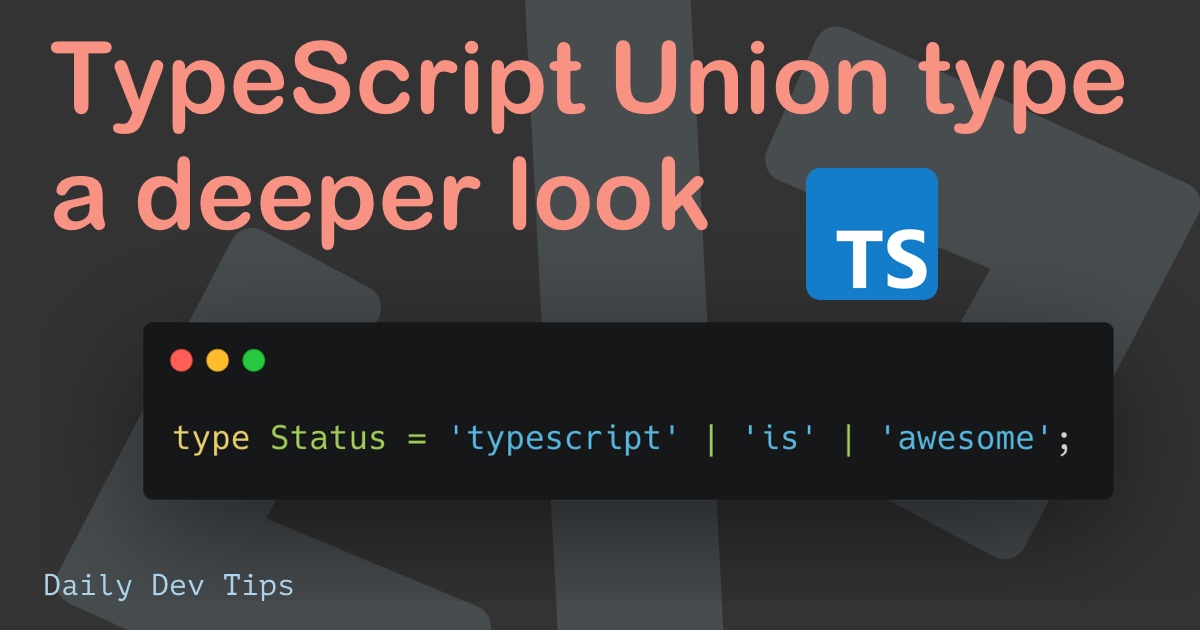
A key requirement of our implementation is type safety. If we merge an Observable<string> and an Observable<number>, the resulting observable should be correctly typed as Observable<string | number>. This is achieved using TypeScript's union types.
To achieve this, we'll define a static merge function that uses generics and rest parameters. The function signature is a bit advanced, but it's a powerful pattern in TypeScript.
// src/operators/merge.ts

import { Observable } from '../observable';
import { Subscription } from '../subscription';
import { Observer } from '../observer';

// This is the type we want to achieve. Let's break it down.
type ObservableValue<T> = T extends Observable<infer U> ? U : never;

export function merge<T extends Observable<any>[]>(
  ...observables: T
): Observable<ObservableValue<T[number]>> {
  // Implementation will go here
}
Let's dissect that return type: Observable<ObservableValue<T[number]>>.
T extends Observable<any>[]:Tis a tuple type representing the array of observables passed to the function (e.g.,[Observable<string>, Observable<number>]).T[number]: This is an indexed access type. It gets the types of the elements in the arrayT, resulting in a union. For our example, this would beObservable<string> | Observable<number>.ObservableValue<...>: This is a conditional type we defined. It takes an observable type and "extracts" its inner value type.- When TypeScript applies this to the union
Observable<string> | Observable<number>, it distributes the conditional type over the union. - It evaluates
ObservableValue<Observable<string>>which results instring. - It evaluates
ObservableValue<Observable<number>>which results innumber. - The final result is the union of these types:
string | number.
- When TypeScript applies this to the union
This elegant piece of type-level programming ensures our merge function is perfectly type-safe.
3. Implementation Strategy
Now for the runtime logic. Our merge function must return a new Observable. The core logic resides within the producer function passed to the Observable constructor.
Here's the plan:
- Initialization: Inside the producer, we need a counter to track how many of the input observables are still active (i.e., have not completed). Initialize it to the total number of input observables.
- Subscription Management: We'll need an array to hold the
Subscriptionobjects for each input observable. This is crucial for cleanup. - Subscribe to All Sources: Iterate over the input
observables. For each one, subscribe to it. - Forward Emissions:
next: When any input observable emits a value, pass it directly to theobserverof our merged stream.error: If any input observable errors, immediately callerroron the merged stream'sobserver. This will terminate the whole process.complete: When an input observable completes, decrement the active observables counter. If the counter reaches zero, it means all sources are done, so we can callcompleteon the merged stream'sobserver.
- Teardown Logic: The producer function must return a
Subscriptionwhoseunsubscribemethod will clean up everything. This method should iterate through the array of inner subscriptions and unsubscribe from all of them. This prevents memory leaks if a consumer unsubscribes before the merged stream completes naturally.
4. Your Task: Implement merge
It's time to put this all together. Create a new file src/operators/merge.ts and implement the merge function.
Here is a skeleton to get you started.
// src/operators/merge.ts

import { Observable } from '../observable';
import { Subscription } from '../subscription';
import { Observer } from '../observer';

type ObservableValue<T> = T extends Observable<infer U> ? U : never;

export function merge<T extends Observable<any>[]>(
  ...observables: T
): Observable<ObservableValue<T[number]>> {
  return new Observable(observer => {
    let activeSubscriptions = observables.length;
    const subscriptions = new Subscription();

    if (activeSubscriptions === 0) {
      observer.complete();
      return subscriptions;
    }

    const sources = observables.map(source$ => {
      const innerSub = source$.subscribe({
        next: value => {
          observer.next(value);
        },
        error: err => {
          observer.error(err);
        },
        complete: () => {
          activeSubscriptions--;
          if (activeSubscriptions === 0) {
            observer.complete();
          }
        },
      });
      return innerSub;
    });

    sources.forEach(sub => subscriptions.add(sub));

    return subscriptions;
  });
}
A quick note on the skeleton:
I've used the Subscription class's add method, which you implemented in Module 2. It allows grouping multiple subscriptions together so they can all be unsubscribed with a single call. This is a common and clean pattern for operators that manage multiple inner subscriptions.
5. Testing Your Implementation
With your merge function implemented, the next step is to verify its behavior with unit tests. Create a new test file src/operators/merge.test.ts.
The article on testing RxJS provides excellent patterns for testing complex observable chains, even though it uses a slightly different operator (mergeWith). The key takeaway is using Subjects or simple of/interval observables to control the sources and assert the output.
Unit Testing RxJS Observables - A Practical Guide
This article from WeAreAdaptive demonstrates practical strategies for testing observables that combine multiple sources. Pay attention to how they mock the source streams and test the resulting emissions.
Skim through the article, focusing on the test setup in state.test.ts. Notice how Subject is used to create mock source observables (mockPricesDto$, mockResetPrices$) and how .next() is called on them to trigger emissions and test the behavior of the combined prices$ observable. You can adapt this approach for your tests.
Here are the test cases you should cover:
-
Merging Different Types:
- Create
of('a', 'b')andof(1, 2). - Merge them and collect the results into an array.
- Assert that the final array contains
['a', 'b', 1, 2](or a similar interleaved order, sinceofis synchronous). - The TypeScript compiler should correctly infer the output type as
Observable<string | number>.
- Create
-
Asynchronous Merging:
- Use
vitest.useFakeTimers(). - Create two
intervalobservables with different periods (e.g., 100ms and 150ms). You can usepipewithmapto give their outputs distinct values. - Merge them and advance the timers.
- Assert that the values are emitted in the correct interleaved time order.
- Use
-
Completion Logic:
- Merge two finite observables (e.g., created with
ofor atakeoperator on aninterval). - Assert that the
completecallback is only called after both source observables have completed.
- Merge two finite observables (e.g., created with
-
Error Handling:
- Create one observable that emits values and another that immediately errors (e.g.,
new Observable(obs => obs.error('test error'))). - Merge them.
- Assert that the
errorcallback of the merged subscription is called and that no values from the other observable are emitted.
- Create one observable that emits values and another that immediately errors (e.g.,
-
Unsubscription:
- Create two
intervalobservables. - Merge them and subscribe.
- Immediately (or after a short delay) call
unsubscribe()on the merged subscription. - Assert that no values are received. This implicitly tests that the inner subscriptions were torn down.
- Create two
Conclusion
In this lesson, you've implemented merge, your first combination operator. This is a significant step, moving from single-stream transformations to orchestrating multiple streams concurrently.
Key Takeaways:
mergecombines multiple observables into one, emitting values as they arrive from any source.- The merged stream completes only when all sources complete, and errors if any source errors.
- A robust implementation requires careful management of inner subscriptions to prevent memory leaks.
- Advanced TypeScript generics (like conditional and indexed access types) are essential for creating truly type-safe operators that correctly infer complex output types like unions.
In our next lesson, we will implement another powerful combination operator: combineLatest. We'll explore how it differs from merge by combining the latest values from each stream into a single emission, and how its typing requirements introduce new challenges.
Can't find a good explanation? Sign up and we'll make it for you
Sign up