
Hello. This module turns from Daoist stories about everyday responsiveness to the practices through which Daoists have cultivated stillness, vitality, and relationship with the larger order of life. The point is not to turn Daoism into an ancient wellness app—although it has plenty to say about breathing, movement, and reducing needless strain. It is to see why meditation, bodily cultivation, temple ritual, and longevity practices belong to one broad, historically evolving tradition.
By the end of this lesson, you should be able to place four practice families on a map of Daoism and make a careful distinction: what practitioners traditionally sought is not automatically the same as what a secular practitioner today may reasonably seek or claim.
One tradition, many ways of cultivation
It is tempting to divide Daoism into “philosophy”—the Daodejing, Zhuangzi, wu wei—and “religion”—temples, robes, rituals, gods, and alchemy. That division can be useful as a rough orientation, but it becomes misleading when treated as a wall.
Daoist traditions have long treated a person as embodied, situated, and relational. Alignment with the Dao might involve quieting the mind, regulating breath, moving the body, performing rites for a community, caring for ancestors, studying scriptures, or pursuing longevity. These practices did not all arise at the same moment or mean the same thing to every lineage. But they are connected by a family resemblance: cultivating a more harmonious relation among person, society, cosmos, and Dao.
The short introduction in Introduction to Daoism makes an important historical point: contemplative cultivation is not a late religious add-on to an earlier “pure philosophy.” The early Neiye (“Inner Training,” around the fourth century BCE) already links breath, concentration, and alignment with the Dao.
Read the opening discussion of the Neiye. It gives a compact historical reason not to separate Daoist ideas from embodied practices too sharply.
In the subsection “Inner Training,” read the full passage. Focus on the three terms jing, qi, and shen, and on the claim that cultivation involved practices as well as reflection from very early on.
The traditional “Three Treasures” are:
- Jing: essence—often understood as foundational bodily vitality or generative potency.
- Qi: vital breath or energy. It belongs to a classical Chinese cosmology and medical vocabulary; it should not be casually equated with a measurable physical energy in the modern scientific sense.
- Shen: spirit, awareness, or spiritual luminosity.
Different Daoist systems describe their relationships differently. Later internal alchemy, for example, speaks of refining these treasures in stages. For now, the key idea is simpler: mind, breath, body, and spiritual orientation were not cleanly separable domains.
A practical map: four overlapping families
The following map is not a list of mutually exclusive boxes. A single practitioner or temple may combine several of them; a meditation can involve breath, an alchemical discipline can include ritual, and a health practice can have religious meaning.
| Practice family | Representative examples | Traditional Daoist orientation | Possible modern secular use |
|---|---|---|---|
| Meditation | Zuowang (“sitting in forgetting”), quiet sitting, concentration, visualization | Stillness, clarity, loosening attachment to the ordinary ego, realization or alignment with Dao | Attention training, observing thoughts, a quiet daily pause |
| Breath cultivation and movement | Tuna (breath regulation), daoyin stretching and guiding, later qigong-style practices | Regulating and harmonizing qi; supporting cultivation, health, and sometimes transformation | Gentle movement, body awareness, coordination of breath and motion |
| Ritual and liturgy | Offerings, chanting, zhai rites of merit, jiao offerings, community ceremonies | Relation with deities, ancestors, local community, cosmic order; merit and salvation | Cultural participation, communal meaning, remembrance, structured reflection |
| Nourishing life and longevity | Yangsheng, diet, sleep, massage, exercise, meditation, alchemy | Preserving life, preventing illness, extending longevity; in some lineages, becoming a xian or transcendent | Health-supporting routines, moderate exercise, rest, practical self-care—without claims of immortality |
A good rule is to ask two questions whenever you encounter a Daoist practice:
- What did this practice mean inside its original worldview?
- What, if anything, is being retained when it is adapted today?
That prevents two opposite errors. One is dismissing a traditional practice because it does not fit modern biomedical language. The other is borrowing its exotic vocabulary while quietly making unsupported medical claims.
Meditation: stillness is not merely stress management
Daoist meditation is a broad category. At its simplest, it can involve attending to one thing: breathing, a sound, a phrase, an image, or a deity. At more elaborate levels, it may involve visualization of inner bodily landscapes, divine presences, or journeys through celestial realms.
One influential mode is zuowang, usually translated “sitting in forgetting.” The phrase appears in the Zhuangzi. “Forgetting” does not mean becoming dull, erasing your memory, or dissociating from reality. It means loosening the habitual grip of self-concern, fixed labels, and compulsive commentary—making room for a less cramped, more responsive awareness.
The tradition did not necessarily describe this in the modern language of “relaxation.” Its aims could include clarity, spiritual transformation, returning toward primordial simplicity, or realizing one’s place within the Dao. A modern person may sit quietly and notice breath in order to pause before reacting to a difficult Slack message. That can be a worthwhile adaptation, but it is a narrower aim than the full traditional horizon.
Sitting in Forgetting: introducing the Daoist meditation style mentioned in Zhuangzi
Watch “Sitting in Forgetting” from Qigong Project for an accessible introduction to zuowang and to one modern breath-observation adaptation. Treat its more expansive descriptions of inner experience as one practitioner-oriented interpretation, rather than as laboratory claims.
Begin with the Zhuangzi story, which introduces self-forgetting as heightened openness rather than blankness. Then watch the modern adaptation. Focus on the contrast between traditional contemplative aims and the later secular method of sitting comfortably and observing unforced breathing.
A modest contemporary adaptation retains the method’s central gesture: do less to the mind rather than trying to dominate it. It need not retain every metaphysical commitment. Next lesson, you will try a short version framed very conservatively: observe directly what happens, rather than assuming that calmness, qi circulation, or health benefits must occur.
Breath and movement: cultivation, not a special effect
Breath cultivation appears early in Chinese traditions and later became deeply interwoven with Daoism. Terms such as tuna (“exhaling and inhaling”), daoyin (“guiding and pulling”), and later qigong-related practices cover a spectrum from gentle stretches and coordinated breathing to demanding esoteric regimens.
Within traditional frameworks, breathing was not only about getting more oxygen. It was a way of regulating qi, maintaining balance, and supporting the whole process of self-cultivation. Some systems linked it to longevity; others treated breath as a support for meditation or internal alchemy.
The historical record is also less tidy than a lineage chart might imply. The Zhuangzi mentions animal-like stretches, while other passages caution against mistaking physical techniques for the whole path. Later Daoist communities absorbed, reshaped, debated, and transmitted methods that also circulated through medical, martial, and popular traditions. “Daoist breathwork” is therefore not one standardized protocol handed down unchanged for 2,000 years.
For an overview of how contemporary presentations group these practices, watch this brief segment.
ReligionForBreakfast’s “What is Daoism?” provides a concise overview of meditation, alchemy, and yangsheng as overlapping forms of Daoist self-cultivation.
Watch self-cultivation overview. Notice the three categories the video uses—meditation, alchemy, and nourishing life—and the way qigong combines movement, breathing, and attention.
A careful modern translation
A secular practitioner can reasonably use slow breathing or gentle coordinated movement to explore:
- posture and muscular tension;
- whether breath becomes strained when attention tries to control it;
- the felt difference between rushed and unhurried movement;
- a pause before acting.
But avoid turning traditional words into scientific conclusions. Feeling warmth, tingling, heaviness, calm, or restlessness is an observation. Calling that sensation “qi,” a nervous-system change, or a medical effect is an interpretation requiring a different kind of evidence. Both traditional and modern vocabularies can be meaningful, but they answer different questions.
Also, do not experiment with forceful breath retention, extreme fasting, or any practice advertised as a substitute for medical care. In Daoist terms, forcing is already suspicious; in practical terms, it is unnecessary for this course.
Ritual: the Dao is not only private
Meditation is often the most exportable Daoist practice because it can be done alone in a quiet room. Ritual points to another dimension: Daoism has also been a communal and liturgical tradition.
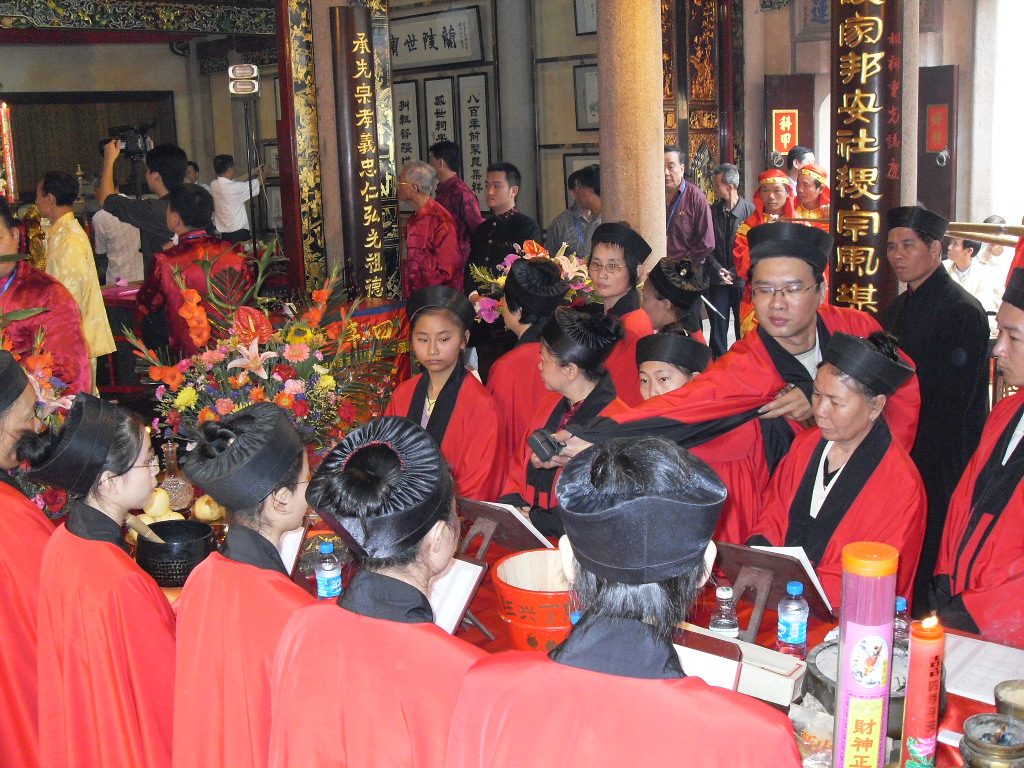
Rituals vary widely by region, period, and lineage. They may include incense, offerings, recitation, sacred registers, petitions, music, processions, fasting disciplines, and invocations. A major traditional purpose is to establish right relation: between a community and its deities, living people and ancestors, the human world and the wider cosmos.
The Lingbao tradition, for example, developed communal rites such as zhai (often translated rites of merit or fasting rites) and jiao (offering rites). These could be directed not merely toward an individual’s private spiritual achievement, but toward the welfare and liberation of a wider network of beings.
Read this short account of Shangqing visualization and Lingbao communal ritual. It shows two very different Daoist modes: interior contemplation and public liturgy.
In “The Visions of Yang Xi,” read the discussion of visualization. Then, in “The Lingbao Synthesis,” read the passage on communal rites. Track the change in scale: personal transformation in one case, collective salvation and merit in the other.
A secular visitor may participate in or observe a ritual for cultural learning, aesthetic attention, commemoration, belonging, or respectful curiosity. That does not make the rite “just theatre,” nor does it require the visitor to affirm every religious proposition behind it. The respectful position is more precise: this practice has meanings for its practitioners that exceed my personal use of it.
Nourishing life: health, longevity, and the risky edge of transcendence
Yangsheng literally means “nourishing life.” It is the broadest and most everyday-looking category on our map: diet, sleep, seasonal routines, movement, massage, moderate conduct, breathing, and meditation can all appear within it.
Its traditional aims range across a spectrum:
- keeping the body and mind in balance;
- preventing illness and preserving vitality;
- extending life;
- in some traditions, pursuing transcendence or “immortality” as a xian.
This is where contemporary wellness language can be both useful and dangerous. The practical, moderate strand—rest, movement, diet, avoiding excess—can look familiar. Yet yangsheng also historically included practices such as grain avoidance and external alchemy (waidan), involving mineral elixirs. Some such elixirs contained toxic substances, including mercury and arsenic, and caused poisoning and death. These are historical facts, not “secret techniques” awaiting rediscovery.
Yangsheng (Daoism) - Wikipedia
Use this overview to distinguish ordinary life-nourishing practices from the more ambitious—and sometimes hazardous—pursuit of transcendence.
Read the opening definition, the list of yangsheng practices. Continue through the distinction between health practices and hazardous immortality methods. Focus on the range hidden within the single term yangsheng.
Later Daoists increasingly developed internal alchemy (neidan), which shifted the language of alchemy inward. Instead of treating a laboratory elixir as the central means of transformation, neidan texts describe the body and its vital capacities using alchemical metaphors: furnace, cauldron, refinement, essence, qi, and spirit. This did not make all Daoist practice suddenly safe or secular; it did, however, mark a major move away from swallowing potentially lethal substances.
For a learner today, the sensible boundary is clear:
Take nourishment-of-life as an invitation to notice rhythms, moderation, and unnecessary strain—not as a promise of supernatural longevity or a substitute for medical judgment.
That boundary is not hostile to Daoism. It echoes a deeply Daoist suspicion of excess, compulsion, and the fantasy that one dramatic technique can solve the whole problem of living.
Traditional purpose versus secular adaptation
Here is the distinction to retain.
| If a practice is approached traditionally | If a practice is adapted secularly |
|---|---|
| It may be situated within a cosmology of Dao, qi, deities, spirits, karma, transcendence, or ritual efficacy. | It may be framed as attention, movement, rest, culture, personal reflection, or community. |
| Its goal may be transformation of one’s whole mode of being, long life, merit, harmony with cosmic processes, or salvation of others. | Its goal is usually more limited: a calmer pause, awareness of tension, a sustainable habit, or cultural understanding. |
| Instruction may depend on lineage, texts, ritual authority, or long-term apprenticeship. | Practice can be deliberately simple and low-risk, while acknowledging what has been left out. |
| “Qi” and related terms are meaningful within a traditional framework. | Bodily sensations can be described directly without pretending they prove a specific metaphysical or physiological theory. |
| Results may be interpreted religiously. | Claims of clinical benefit should be proportionate to reliable evidence, not inferred from tradition alone. |
The modern version does not have to be fake. It simply needs to be honest about its scope. You can borrow the practical attitude of non-forcing without claiming to be performing medieval internal alchemy. You can attend to breath without assuming it will cure illness. You can be moved by a ritual without treating someone else’s religious world as an aesthetic accessory.
Key takeaways
Daoist practice is best understood as a connected field of cultivation, not as an awkward pile of unrelated “philosophy,” fitness, superstition, and wellness techniques.
- Meditation includes stillness, concentration, and visualization; zuowang aims at loosening habitual self-grasping and opening awareness.
- Breath and movement practices cultivate body and breath within traditional ideas of qi and harmony; contemporary adaptations can focus on direct, modest observation.
- Ritual is a communal and cosmic practice of relation, merit, remembrance, and order—not merely private spirituality with more incense.
- Yangsheng includes ordinary life-nourishing habits but also, historically, ambitious longevity and immortality pursuits. Some historical methods were dangerous and should not be imitated.
- The most respectful modern approach is neither credulous nor dismissive: preserve what you are actually doing, name what you are not claiming, and let the traditions remain richer than their wellness-market versions.
Next, you will try a brief, secular adaptation of sitting in forgetting: relaxed posture, natural breathing, and a factual record of what you notice—no mystical performance review required.
Can't find a good explanation? Sign up and we'll make it for you
Sign up