
Welcome to the final lesson. You have moved from the turbulent world in which early Daoist texts arose to several practical images: Cook Ding’s unforced mastery, the uncarved block’s simplicity, the lost horse’s refusal of premature verdicts, the butterfly’s shifting standpoint, and water’s flexible strength. Most recently, you practiced sitting without trying to manufacture a special state, then slow walking while testing whether particular tensions were actually needed.
This week turns those ideas into a small field experiment. It is not a seven-day attempt to become a serene river-shaped productivity system. It is a way to test, in ordinary life, whether you can notice needless forcing, remove one layer of friction, loosen a hasty interpretation, and return briefly to direct experience.
By the end, you will have a realistic plan of roughly 10–15 minutes a day, with a deliberately modest record of what happened.
Why a Daoist week should be small, specific, and unfinished
A plan can easily contradict its own purpose. If it demands perfection, detailed tracking, heroic discipline, and harsh catch-up rules, it has already become another object of striving.
The Dao De Jing repeatedly presents a different logic: handle what is difficult through what is simple; begin large matters from their small, available parts. Read these passages before designing the week.
Tao Te Ching, English by Derek Lin, Terebess Asia Online (TAO)
Read Derek Lin’s translation and commentary on Chapters 63 and 64. These passages give the design principle for the week: do not tackle “becoming more Daoist” as a large project; make a small intervention where you already stand.
In Chapter 63, read the compact passage and then the commentary beginning “The sages break tasks down to their constituent parts.” Focus on the distinction between beginning with the smallest workable component and making overconfident promises. Continue to Chapter 64. From its opening line, read the opening of Chapter 64. Notice that the image is not primarily about heroic willpower: even the longest journey has to begin with the ground presently beneath your feet.
For this course, treat a Daoist-inspired practice as an experiment, not a commandment. It has four features:
- A concrete setting. “Before my first meeting,” “when I make tea,” or “during the walk home” is better than “when I have time.”
- One small intervention. Soften the jaw, remove two unnecessary steps from a routine, delay a judgment, or write a clearer boundary.
- A short duration. Ten minutes is enough. A plan that you can actually begin while tired is stronger than an ideal plan for an imaginary, well-rested version of you.
- An observable record. Record what you did and what changed, if anything. Do not demand calm, wisdom, or a medical benefit.
The success condition is therefore not “I felt enlightened.” It is simpler:
I ran the experiment, or I noticed honestly why I did not.
A missed day is data, not a debt. Do not double tomorrow’s practice to compensate. Resume with the next day’s small action.
Four lenses for the week
The daily experiments below use four connected Daoist lenses.
| Lens | Practical question | What it is not |
|---|---|---|
| Non-forcing (wu wei) | “What extra effort am I adding that this task does not require?” | Avoiding responsibility, skipping care, or doing nothing |
| Simplicity | “What can I remove while preserving the actual purpose?” | Minimalism as a competitive sport |
| Perspective | “What else might this event mean, from another standpoint or over time?” | Pretending harm is good or that facts do not matter |
| Contemplative attention | “What can I notice directly for a few minutes?” | Forcing a blank mind or claiming a health outcome |
The first two lenses concern how you act; the third concerns how quickly you judge; the fourth gives you a place to pause before habit takes over.
Two short passages provide useful images for perspective and flexibility.
Tao Te Ching, English by Derek Lin, Terebess Asia Online (TAO)
Read two short chapters from Derek Lin’s translation: Chapter 2 on paired distinctions and Chapter 8 on water. They support the perspective and non-contention days in your plan.
In Chapter 2, read the Chapter 2 verse. Read it as an invitation to notice that labels such as easy and difficult, success and failure, or good and bad depend partly on comparison and position. It does not require abandoning moral judgment. Then find Chapter 8 and read the Chapter 8 verse. Focus especially on water’s capacity to benefit, adapt, and avoid petty contention. In the plan, this will mean changing your method when possible while retaining a necessary boundary.
Before Day 1: make the plan fit your actual week
Take five minutes now and put the following seven practices on real days in the coming week. Attach each one to a reliable cue: after coffee, before opening Slack, after lunch, after the last meeting, or before bed.
Keep the whole practice under 15 minutes unless you genuinely want more. The aim is continuity without coercion.
Use this tiny record after each day:
Setting:
What I tried:
What I directly noticed:
What I will leave alone or adjust tomorrow:
For example:
Setting: After my final meeting, at my desk.
What I tried: Spent ten minutes simplifying the start of my daily status update.
What I directly noticed: The update took less switching between tabs; I still wanted to over-explain one detail.
What I will leave alone or adjust tomorrow: Keep the shorter template; do not remove the technical check that prevents mistakes.
That is enough. A notebook, notes app, or a plain text file is perfectly adequate. This is not a dashboard.
Your seven-day Daoist-inspired experiment
Day 1 — Sit without improving anything
Time: 8 minutes
Cue: Before beginning work, or before bed
Sit comfortably. Let the breath remain ordinary. For the first few minutes, feel the body being supported by the chair or floor. When thoughts arise, identify them only as thinking, planning, remembering, rehearsing, or worrying; then return to a bodily sensation or to the next natural breath.
Do not try to relax every muscle or empty the mind. Your sole task is to notice the difference between direct sensation and the stream of commentary about it.
In the record, use concrete language:
- “My shoulders were raised for most of the sitting.”
- “I repeatedly planned tomorrow’s work.”
- “The room sounds became more noticeable after several minutes.”
Avoid turning one sitting into evidence that meditation has solved or failed to solve anything.
Day 2 — Find one place where you are forcing a routine
Time: 10–12 minutes
Cue: At the start of a recurring, low-stakes task
Choose one task that repeats often: drafting a status message, preparing a meeting note, triaging an inbox, beginning a code review, planning lunch, or getting ready to leave home.
First, state the real purpose in one sentence. For example:
“The purpose is to identify the next useful action, not to produce a perfect plan.”
Then identify one piece of surplus effort. Common candidates include:
- opening far more tabs or documents than the task needs;
- polishing a first draft before its basic structure exists;
- repeatedly checking messages while trying to think;
- adding elaborate formatting where plain wording would do;
- trying to predict every downstream consequence before making a reversible first move.
Remove only one source of friction and run the task for ten minutes. Preserve safeguards that genuinely matter: tests, review, security checks, factual verification, and respectful communication are not “unnecessary effort” simply because they take time.
This is wu wei as a practical diagnostic: not “do less no matter what,” but “do not add effort that obstructs the work.”
Day 3 — Make one thing plainer
Time: 12 minutes
Cue: After work, or before you close your computer
The uncarved block is not an order to own fewer objects or become aesthetically austere. Here it means reducing needless complication while keeping the function alive.
Choose one small zone:
- one desktop folder;
- one browser window;
- one workbench, shelf, or kitchen surface;
- one recurring digital template;
- one communication channel that has become unnecessarily noisy.
Ask:
What must remain for this thing to serve its purpose well?
Then remove, archive, mute, combine, or simplify only what interferes with that purpose. Stop at twelve minutes, even if the area remains imperfect. Leaving some disorder behind is useful training against the urge to finish and control everything.
A good outcome might be as modest as: “I reduced five browser tabs to the two documents required for tomorrow’s task.” The Daoist point is not visual cleanliness. It is less interference between you and what needs doing.
Day 4 — Give one event more than one meaning
Time: 10 minutes
Cue: After a mildly disappointing, irritating, or unexpectedly favorable event
Choose an event with low emotional stakes: a delayed reply, an interrupted plan, a critical comment on a draft, a meeting cancellation, or an unexpectedly free hour. Do not use serious harm, mistreatment, or danger as material for an attitude exercise. Perspective does not erase the need for protection, accountability, or action.
Write three brief accounts:
- My first interpretation: “This is bad because…”
- A credible alternative perspective: “From another person’s position, or with different information, it might look like…”
- What remains unknown: “The outcome I cannot yet assess is…”
This is the lost-horse lesson in miniature. You are not required to proclaim that every setback is secretly good. You are practicing a pause between event and verdict.
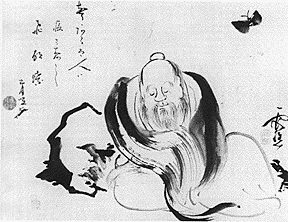
The butterfly image adds a second twist. Sometimes the question is not whether your first judgment is positive or negative, but whether the categories you are using are too narrow. An event can be inconvenient and useful; a disagreement can be both frustrating and informative.
Day 5 — Practice water, while keeping a boundary
Time: 10–15 minutes
Cue: Before a low-stakes conversation, message, or response
Pick a minor point of friction: scheduling, unclear responsibilities, a request you cannot fully meet, or a disagreement about how to proceed.
Separate two things:
- The boundary: what you cannot agree to, cannot do, or believe needs to be said clearly.
- The method: the timing, wording, format, or partial accommodation that can remain flexible.
Prepare one concise response. For example:
“I cannot complete that by today without dropping the review step. I can send a first version tomorrow morning, or we can reduce the scope today.”
This is water-like only in the relevant sense: you adapt the route rather than smash into the obstacle, while still continuing in a direction you judge necessary. Non-contention is not resignation, conflict avoidance, or saying yes when the honest answer is no.
Afterward, note whether changing the method made the boundary easier or harder to communicate.
Day 6 — Walk and subtract five percent
Time: 12 minutes
Cue: During a safe, level walk
Repeat the slow-walking practice from the previous lesson. For the first few minutes, attend to the basic events of stepping: lifting, moving, placing, and receiving weight.
Then scan for one place of extra effort: toes gripping, hands clenching, shoulders lifting, the jaw pressing, or the belly bracing. Ask whether that area can do five percent less while you remain stable and attentive.
Finish with two minutes of ordinary walking. Do not chase a special feeling. The contrast is the experiment: how does deliberate tension compare with a small release of unnecessary effort?
If you are tired, dizzy, in pain, carrying something, navigating uneven ground, or need to monitor traffic, skip the slow version. Ordinary safe walking is the wiser practice.
Day 7 — Review without grading yourself
Time: 15 minutes
Cue: At the end of the week
Read your six brief records. Do not score the week or search for a grand transformation. Look instead for patterns in four areas:
| Lens | Look for |
|---|---|
| Non-forcing | Where did added control, haste, or perfectionism make a task worse? |
| Simplicity | What did you remove that did not need to return? |
| Perspective | Which judgment became less certain or more nuanced? |
| Contemplation | What sensations, habits, or tensions became easier to notice? |
Then choose one practice to retain for the next week, at a frequency that is almost embarrassingly realistic. Examples:
- sit for eight minutes twice a week;
- use the “real purpose” sentence before one recurring work task;
- take one slow, attentive walk on weekends;
- pause before sending one difficult message and separate boundary from method;
- simplify one small area every Friday.
The other practices do not need to become permanent. In Daoist terms, keeping everything would be another form of grasping. Let the useful element remain; let the rest go.
When the plan goes wrong
A Daoist-inspired plan has to make room for conditions. A demanding week, illness, travel, conflict, or simple fatigue can change what is appropriate.
Use these adjustments rather than abandoning the week entirely:
- No time: do the two-minute version: three natural breaths, one unclenched jaw, one sentence noting a first judgment.
- Too much mental strain: choose walking or a simple physical task rather than sitting and analyzing.
- A task is high stakes: preserve necessary diligence. Wu wei does not authorize carelessness.
- A conflict is serious: choose safety, support, and clear boundaries over “flowing with it.”
- You miss a day: continue with the next day. No catch-up marathon.
The plan is serving you only when it remains responsive to actual conditions. That responsiveness is closer to Daoist practice than rigid compliance would be.
Key takeaways
A useful seven-day Daoist experiment is deliberately small and grounded in ordinary life. It gives each day one focus:
- Day 1: sit and notice without manufacturing a state;
- Day 2: remove one surplus effort from a recurring task;
- Day 3: simplify one small system while preserving its purpose;
- Day 4: suspend a premature judgment by writing credible alternatives;
- Day 5: adapt your method while retaining a necessary boundary;
- Day 6: use slow walking to test whether tension is needed;
- Day 7: review the evidence gently and keep only one realistic practice.
Across the course, Daoism has not offered a universal instruction manual. It has offered images and questions: the cook who stops hacking, the block before it is overworked, the horse whose fortune cannot be settled too soon, the butterfly who unsettles a fixed standpoint, and water that yields without simply giving up. A small experiment is a fitting way to end: not by mastering those images, but by seeing where one of them becomes quietly useful in your own week.
Can't find a good explanation? Sign up and we'll make it for you
Sign up