
Welcome back. In the previous lesson, you chose BFS or DFS by identifying what a graph traversal must guarantee: shortest distance by layers, or exhaustive branch exploration. Dynamic programming has a similar discipline: rather than beginning with loops, begin by specifying what one subproblem means and how smaller subproblems determine it.
This lesson focuses on the core interview skill behind sequence DP: formulating a precise state, recurrence, and base cases. We will use longest increasing subsequence to establish the pattern, then derive and implement longest common subsequence in Java. Study time: about 40 minutes.
1. Dynamic programming is a system for reusing subproblem answers
A brute-force recursive solution often branches through many possible decisions. Dynamic programming is appropriate when different decision paths repeatedly ask for the same smaller answer.
For example, in a sequence problem, many candidate solutions may eventually need the answer to:
- “What is the best result using the first items?”
- “What is the best result that ends at index ?”
- “What is the best result for the first characters of one string and the first characters of another?”
Instead of recomputing that answer, DP stores it once.
The phrase state does not mean “any variable in the code.” A DP state is the minimal information that uniquely identifies a subproblem. A good state must preserve every constraint that matters for the remaining decision.
For most interview problems, derive the solution in this order:
-
Define the state in one complete sentence.
State exactly whatdp[...]represents. -
Identify the final answer.
It may be one particular cell, such asdp[n], or the maximum across several states. -
Find the final decision or structural case.
Ask: “What must be true immediately before this subproblem is solved?” -
Write the recurrence.
Express the current answer through smaller states. -
State base cases.
These are the smallest valid subproblems, not arbitrary initial values. -
Choose an evaluation order.
Every state referenced on the right-hand side must already be available when computing the left-hand side.
A concise formulation is more valuable in an interview than immediately producing a memorized loop:
“Let
dp[i]mean ___. For state , the valid preceding states are ___. Therefore the recurrence is ___. The base cases are ___. The final answer is ___.”
This short video illustrates the crucial middle of that process: choosing a sequence subproblem and generalizing its relationship to earlier subproblems.
5 Simple Steps for Solving Dynamic Programming Problems
Watch “5 Simple Steps for Solving Dynamic Programming Problems” from Reducible. It develops the longest increasing subsequence by defining a state that ends at a fixed index, rather than treating the whole array as one undifferentiated problem.
Watch state to implementation. Focus on why “the best subsequence ending at index k” is a more useful state than simply “the best subsequence so far,” and on why earlier indices must be computed first.
The dependency rule determines loop order
A bottom-up DP table is not merely an array filled with nested loops. It represents a dependency structure.
If dp[i] depends only on states with smaller indices, compute left to right. If dp[i][j] depends on the row above, the cell to the left, and the diagonal, fill from the top-left toward the bottom-right. This is analogous to processing a directed acyclic graph in an order where prerequisites are already known.
2. One sequence: formulate an increasing-subsequence state
Consider the classic problem:
Given an integer array, find the length of its longest strictly increasing subsequence.
A subsequence preserves relative order but does not need to use adjacent elements. For example, in:
[3, 1, 5, 2, 6, 4]
[1, 2, 6] is a subsequence. So is [3, 5, 6].
A tempting but incomplete state is:
dp[i]is the best increasing subsequence in the first elements.
That state can work in some formulations, but it hides an important constraint: if you want to append nums[i], you need to know the value of the sequence’s previous final element. A more useful state makes the endpoint explicit:
State: is the length of the longest strictly increasing subsequence that ends at index .
Now derive the recurrence from the final element. Any increasing subsequence ending at i either:
- consists only of
nums[i], with length ; or - extends a valid subsequence ending at some earlier index , where and
nums[j] < nums[i].
Therefore:
The base case is built into the state definition:
initially, because every one-element subsequence is increasing.
The answer is not necessarily dp[n - 1]. The best subsequence may end anywhere, so the final answer is:
This distinction is an interview-critical habit:
| State meaning | Where is the answer? |
|---|---|
| Best result using a prefix | Often the last state |
| Best result ending at a particular index | Usually the maximum across states |
| Best result for two complete prefixes | Usually the bottom-right table cell |
3. Two sequences: longest common subsequence
Now consider a two-sequence problem:
Given strings
aandb, find the length of their longest common subsequence.
A subsequence preserves character order but can skip characters. For example:
a = "ACADB"
b = "CBDA"
"CD" is a common subsequence of length . "CA" is also one. A substring would require contiguity; LCS does not.
With two sequences, one index is not enough. We need to know how much of each string is available.
State: is the length of the longest common subsequence between the first characters of
aand the first characters ofb.
This definition deliberately uses prefix lengths, not direct character indices. Thus:
dp[0][j]compares an empty prefix ofawith a prefix ofb;dp[i][0]compares a prefix ofawith an empty prefix ofb;dp[i][j]comparesa.charAt(i - 1)withb.charAt(j - 1).
The extra row and column make the boundary conditions natural.
1143. Longest Common Subsequence
Read AlgoMonster’s explanation of longest common subsequence before looking closely at the Java implementation. It emphasizes the two possible structural cases: a character match extends a smaller answer, while a mismatch requires retaining the better of two ways to skip a character.
In the “Intuition” section, begin at the decision logic. Follow both cases through the explanation: a match uses the diagonal subproblem, while a mismatch compares the subproblem above with the one to the left.
Base cases: an empty string has no nonempty common subsequence
If either prefix is empty, the LCS has length :
for every valid and .
These are meaningful claims about the problem. They also prevent invalid accesses such as dp[-1][j].
Recurrence: match or mismatch
At state , compare the final characters of the two active prefixes.
Case 1: the characters match
If:
then that common character can extend the LCS of the two shorter prefixes:
The diagonal state represents both prefixes with their final character removed.
Case 2: the characters do not match
If:
then a common subsequence cannot use both current final characters. At least one must be excluded:
- Exclude the last character of
a, giving . - Exclude the last character of
b, giving .
Keep the longer result:
Combining the cases:
The answer for the full strings is:
where and are the string lengths.
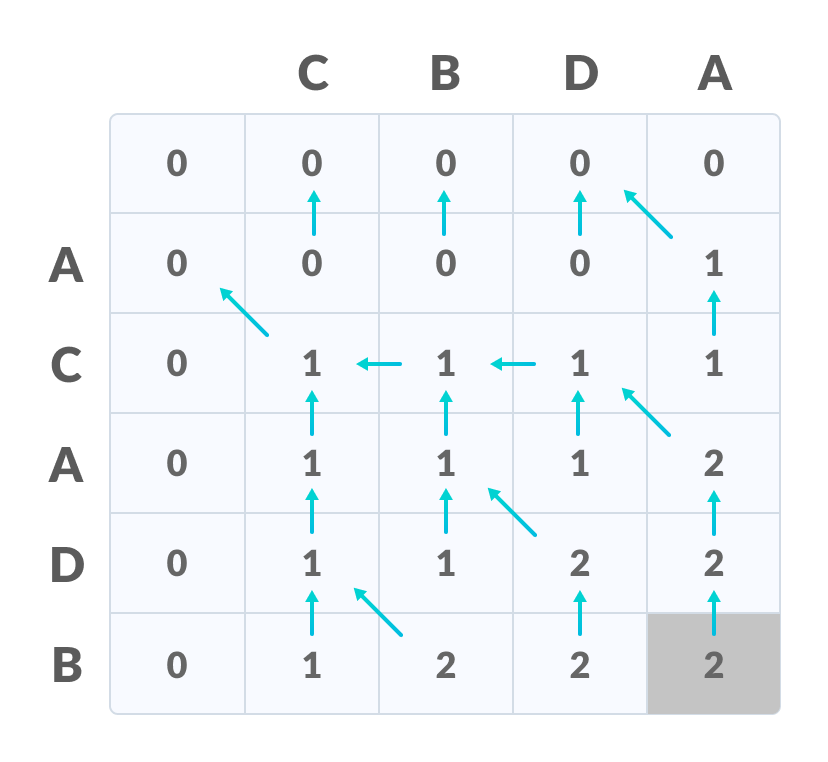
Read the table as a grid of progressively larger prefix comparisons. Moving right includes one more character from the horizontal string; moving down includes one more character from the vertical string. A diagonal contribution occurs when the active characters match. Otherwise, the value is carried from the better prefix above or to the left.
4. Convert the formulation directly into Java
Once the state and recurrence are correct, the implementation is almost mechanical.
public static int longestCommonSubsequence(String a, String b) {
    int m = a.length();
    int n = b.length();

    int[][] dp = new int[m + 1][n + 1];

    for (int i = 1; i <= m; i++) {
        for (int j = 1; j <= n; j++) {
            if (a.charAt(i - 1) == b.charAt(j - 1)) {
                dp[i][j] = dp[i - 1][j - 1] + 1;
            } else {
                dp[i][j] = Math.max(dp[i - 1][j], dp[i][j - 1]);
            }
        }
    }

    return dp[m][n];
}
The array’s default zero initialization correctly establishes all base cases:
dp[0][j] = 0
dp[i][0] = 0
The loops begin at 1 because states on row 0 or column 0 are already known. At each inner-loop iteration, all dependencies are available:
| Current state | Required earlier states | Why they are available |
|---|---|---|
dp[i][j] on a match | dp[i - 1][j - 1] | It is in a completed earlier row |
dp[i][j] on a mismatch | dp[i - 1][j] | It is in a completed earlier row |
dp[i][j] on a mismatch | dp[i][j - 1] | It was computed earlier in the current row |
Why the recurrence is correct
A brief correctness explanation is useful in an interview.
Match case. If the last characters of the active prefixes are equal, one optimal common subsequence can include that shared character. Everything before it must be a common subsequence of the two shorter prefixes. Thus the best length is the diagonal answer plus one.
Mismatch case. If the active final characters differ, no common subsequence can include both of them at its end. Any valid common subsequence must omit the final character from at least one string, so it is represented by either the prefix above or the prefix to the left. Taking the maximum preserves the best option.
Complexity
For strings of lengths and :
There are non-base cells, and each takes constant time to compute.
The full table is useful while learning, debugging, and later reconstructing an actual subsequence rather than just its length.
Three frequent implementation mistakes
-
Confusing DP indices with string indices
dp[i][j]represents prefixes of length and , but Java strings are zero-indexed:a.charAt(i - 1) b.charAt(j - 1) -
Allocating
mbyninstead of(m + 1)by(n + 1)The extra row and column encode empty-prefix base cases cleanly.
-
Returning a maximum over the table
For this state definition, the complete problem is exactly
dp[m][n]. The maximum-over-all-cells pattern belongs to states such as “best subsequence ending at index ,” not prefix-pair states.
5. A practical formulation checklist
When you encounter a new sequence DP question, resist the urge to immediately draw a table. First write these four lines on paper or in comments:
State:
dp[...] means ...

Choices or cases:
The final decision is ...

Recurrence:
dp[...] = ...

Base cases and answer:
...
For LCS, that becomes:
State:
dp[i][j] = LCS length of the first i characters of a
           and the first j characters of b.

Cases:
The final characters match, or they do not.

Recurrence:
Match:    dp[i][j] = dp[i - 1][j - 1] + 1
Mismatch: dp[i][j] = max(dp[i - 1][j], dp[i][j - 1])

Base cases and answer:
dp[0][j] = dp[i][0] = 0
Answer = dp[m][n]
Notice how the wording of the state determines every later design decision:
- It tells you the table dimensions.
- It tells you what each index means.
- It tells you which result to return.
- It exposes valid predecessor states.
- It prevents accidental use of an invalid recurrence.
Key takeaways
Dynamic programming starts with a precise subproblem definition, not with code.
- A state uniquely identifies a smaller version of the problem.
- A recurrence explains how a state is built from strictly smaller states.
- Base cases define the smallest valid subproblems and anchor the recurrence.
- The DP fill order must ensure every dependency has already been computed.
- For one sequence, “best result ending at index ” is often a powerful state.
- For two sequences, prefix-pair states such as naturally lead to a two-dimensional table.
- In LCS, matching final characters use the diagonal plus one; mismatches take the maximum of excluding one final character from either sequence.
Next, you will shift from algorithmic interview patterns to Java concurrency, beginning with how Java’s happens-before rules and synchronization expose race conditions in an execution trace.
Can't find a good explanation? Sign up and we'll make it for you
Sign up