
Welcome back. In the previous lesson, you mapped the institutions behind an Indian stock transaction: SEBI regulates, brokers connect you to exchanges, NSE and BSE match orders, clearing corporations manage settlement obligations, and NSDL/CDSL hold securities electronically.
Now we turn to the numbers that dominate market headlines: market capitalization, free float, NIFTY, and Sensex. By the end of this lesson, you should be able to read “a company’s market cap is Rs. X crore” as a meaningful market valuation, explain why an index gives some companies more influence than others, and use an appropriate index as a market reference rather than as a list of automatic buy recommendations.
This is a foundational lesson for both long-term investing and short-term cash-equity decisions. We will stay with stocks, mutual funds, and indices—not derivatives.
Market capitalization: the market’s valuation of the equity
A company divides its ownership into shares. Market capitalization, commonly called market cap, estimates what the equity market is currently valuing all of those shares at.
Suppose Company A has 100 crore shares outstanding and its share price is Rs. 250.
If its share price rises to Rs. 300, while the share count stays the same:
The company has become Rs. 5,000 crore larger in market valuation. That does not mean Rs. 5,000 crore of cash entered the company that day. It means buyers and sellers are now agreeing, at the latest traded price, on a higher value for its equity.
Market cap changes when either of two things changes:
- Share price changes, as investors revise their expectations about profits, growth, risks, interest rates, or the broader market.
- Number of shares changes, for example through a fresh share issue, buyback, conversion, bonus issue, or other corporate action.
What market cap does—and does not—tell you
Market cap is useful because it gives a common scale for companies with very different share prices. A Rs. 5,000 share is not necessarily “bigger” than a Rs. 100 share; the number of shares outstanding matters equally.
However, market cap is not:
- the company’s annual revenue or profit;
- the cash held by the company;
- the price someone paid to acquire every share;
- a measure of intrinsic value;
- proof that a company is safe, high-quality, or a good purchase.
A company can have a large market cap because investors expect strong future cash flows. Those expectations can later prove too optimistic. Conversely, a smaller company may be undervalued or may be risky and poorly governed. Market cap tells you the market’s current valuation scale, not whether that valuation is justified. You will learn to assess the justification through financial statements, business quality, and valuation later in the course.
What is Market Cap? Small-cap, Mid-cap, Large-cap explained
Watch Zerodha’s “What is Market Cap? Small-cap, Mid-cap, Large-cap explained” for a compact visual explanation of market cap and India’s market-cap categories.
Watch market cap basics to see why both share price and shares outstanding matter. Then watch Indian categories for the distinction between large-, mid-, and small-cap classifications. Focus on the central caution: these are size labels, not guarantees of returns or safety.
Large cap, mid cap, and small cap: relative size labels
In India, these labels are especially important when reading mutual-fund mandates. The AMFI market-cap list ranks listed companies by market capitalization and is updated periodically. Under the standardized mutual-fund framework:
| Category | Rank by market capitalization |
|---|---|
| Large cap | 1 to 100 |
| Mid cap | 101 to 250 |
| Small cap | 251 onward |
These are relative ranks, not permanent categories based on a fixed rupee amount. A company can move from mid cap to large cap if its market value rises relative to others; it can also move in the other direction.
In broad terms, larger companies often have more active trading, broader institutional ownership, and greater analyst coverage. Smaller companies often have lower trading liquidity and can react more sharply to news or buying and selling pressure. But these are tendencies, not rules:
- A large-cap company can fall sharply.
- A small-cap company is not automatically a high-growth opportunity.
- A higher share price does not make a stock large cap.
- A low market cap does not by itself make a stock “cheap.”
For now, treat market-cap labels as a way to understand the size and typical trading environment of a company or fund portfolio. They are not a substitute for analysis.
Why an index exists
India has thousands of listed securities. Checking every share to answer “How is the market today?” would be impractical. A stock-market index solves that problem by tracking a selected basket of securities under published rules.
An index is therefore a calculated measure, not a company and not a fund. Its value moves as the prices of its constituents move.
Stock market index explained: Sensex, Nifty & how they work – Varsity by Zerodha
Read Zerodha Varsity’s introduction to indices for the practical reason indices exist: they summarize a broad market segment and provide a comparison yardstick.
In Section 7.1, “Overview,” read the index intuition. Then, in Section 7.2, “The Index,” read the explanation of NIFTY, Sensex, and Bank Nifty. In Section 7.3, “Practical uses of the Index,” read the information use, followed by the benchmarking use. Stop before the subsection labelled “Trading”; this course is focusing on cash equity and mutual funds rather than derivatives.
An index has several useful purposes.
1. A market barometer
If the NIFTY 50 is up for the day, it suggests that the weighted basket of its 50 constituent companies has risen overall. It does not mean every Indian company, every sector, or every stock in your portfolio is up.
For example, banking stocks may be weak while IT stocks are strong. A broad index could be nearly unchanged even though the two sectors moved sharply in opposite directions.
So replace this oversimplification:
“NIFTY is up, so the whole market is strong.”
with this more precise reading:
“The free-float-weighted NIFTY 50 basket is up; I should check its leading constituents and relevant sectors before drawing conclusions about my own holdings.”
2. A benchmark for performance
A return is meaningful only relative to a suitable alternative.
If your diversified Indian equity portfolio gained 12% in a year while its appropriate broad-market benchmark gained 18%, your absolute return was positive but you lagged that benchmark. Conversely, if the benchmark fell 10% and you fell 4%, the loss still matters, but your relative performance was better.
The comparison must be fair:
| What you hold | More relevant reference |
|---|---|
| A broad large-company equity portfolio | NIFTY 50 or Sensex-type broad large-company benchmark |
| A portfolio mainly beyond the largest companies | A broader or mid-cap-oriented benchmark |
| A banking-sector fund or stock basket | NIFTY Bank or another banking-sector index |
| An IT-sector fund or stock basket | NIFTY IT or another IT-sector index |
A sector index is not a fair benchmark for a diversified portfolio. Nor is the NIFTY 50 automatically the right benchmark for every mutual fund simply because it is the best-known index.
For long-term comparisons, you will often encounter two return versions:
- Price Return Index (PRI): reflects index-price movement.
- Total Return Index (TRI): assumes constituent dividends are reinvested.
Because dividends are part of an investor’s return, TRI is generally the more meaningful long-term benchmark for an equity mutual fund or a portfolio where dividends are included in return calculations.
3. A transparent basis for passive investing
Index funds and exchange-traded funds aim to track a stated index, rather than have a manager choose a concentrated set of stocks. The index gives the fund a clear mandate: hold the securities in approximately the index proportions, subject to costs, cash holdings, and practical trading constraints.
Later, when comparing passive funds, you will examine whether a fund actually tracks its benchmark closely and at a reasonable cost. For now, remember the chain:
- An index publishes rules and constituents.
- A passive fund seeks to replicate that index.
- Your return will be close to, but usually somewhat below, the index return because of costs and tracking differences.
Major Indian indices: what each one is designed to represent
The two headline indices you will see most often are:
- S&P BSE Sensex: BSE’s flagship index of 30 large, established companies.
- NIFTY 50: NSE’s flagship index of 50 large, liquid companies.
They are broad large-company benchmarks, but they are not identical portfolios. Their constituent lists, eligibility rules, and weights differ. Their daily direction is often similar because major Indian companies and common macroeconomic forces affect both, but differences can still matter.
Other useful families of indices include:
| Index type | Examples | What it helps you observe |
|---|---|---|
| Broad-market | NIFTY 50, Sensex, NIFTY 500 | Performance of a defined broad basket of Indian listed equities |
| Next-largest-company | NIFTY Next 50 | Companies outside the NIFTY 50 that form the next large-company segment |
| Mid-cap and small-cap | NIFTY Midcap 150, NIFTY Smallcap 250 | Performance of segments below the largest companies |
| Sectoral | NIFTY Bank, NIFTY IT | Performance of a specific industry rather than the whole market |
| Thematic | Indices focused on a theme such as consumption, infrastructure, or healthcare | A narrower economic theme; useful but inherently less diversified |
The lesson is not to memorize index names. It is to ask, “What exact basket is this index measuring?”
A NIFTY Bank rally means bank shares in that index have performed well. It does not establish that non-bank financial companies, insurance businesses, IT companies, or the entire Indian equity market have done equally well.
Similarly, a NIFTY Smallcap index surge can coexist with weak large caps. Different company sizes, liquidity conditions, valuations, and investor flows can produce very different outcomes.
Free float: why full market cap is not the whole story for an index
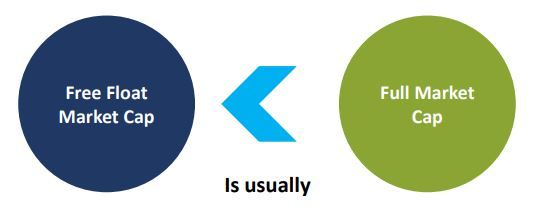
Full market cap counts all outstanding shares. But not every share is realistically available for ordinary public trading.
A large portion may be held by promoters, founders, governments, controlling shareholders, or other strategic owners who are unlikely to trade those shares frequently. An index intended to be investable should not give a company its full theoretical influence if only a smaller part of its equity is actually available in the market.
That is the purpose of free-float market capitalization.
The Investible Weight Factor, or IWF, is a factor that reflects the proportion of a company’s shares treated as available for public trading under the index methodology. In simple terms:
- A company with a higher public float receives a higher IWF.
- A company with more strategic or promoter holding has a lower IWF.
- Lower IWF means lower free-float market cap, all else equal.
- Lower free-float market cap generally means a lower index weight.
Read NSE Indices’ explanation of Investible Weight Factors. This is the key official source for understanding why major indices use free-float market capitalization rather than full market capitalization alone.
Read the free-float rationale in the opening section. Then read the IWF explanation. Focus on two ideas: IWF reflects investible public float, and it is determined using quarterly public shareholding disclosures.
A simplified example
Consider two companies in a fictional two-stock index.
| Company | Full market cap | IWF | Free-float market cap |
|---|---|---|---|
| A | Rs. 10,000 crore | 0.40 | Rs. 4,000 crore |
| B | Rs. 8,000 crore | 1.00 | Rs. 8,000 crore |
Under full-market-cap weighting, Company A would appear larger. Under free-float weighting, Company B gets more index influence because more of its shares are counted as investible.
The total free-float market cap of this small index is:
So the approximate weights are:
If Company A rises 10%, its isolated contribution to this simplified index is roughly 3.33 percentage points. If Company B rises 10%, its isolated contribution is roughly 6.67 percentage points.
This is why a headline such as “one heavyweight stock lifted the NIFTY” has real meaning. A relatively small number of high-weight constituents can materially affect a market-cap-weighted index.
In practice, index providers use detailed rules, periodic reviews, and adjustments for corporate actions. You do not need to calculate NIFTY or Sensex by hand. You do need to understand that their movements are weighted, not a simple count of how many stocks rose or fell.
How to read index news without being misled
When you see a market headline, use this compact checklist:
-
Which index?
NIFTY 50, Sensex, NIFTY Bank, NIFTY Midcap 150, and NIFTY IT answer different questions. -
What period?
A one-day move is not evidence of a long-term trend. A one-year return says little about tomorrow’s movement. -
What drove it?
Check whether a few high-weight constituents caused most of the movement, or whether gains were broad-based. -
Is it price return or total return?
For longer-term comparisons, dividend treatment matters. -
Does it match your holdings and goal?
A NIFTY 50 headline may be useful context even if you own a small-cap fund, but it is not a direct report card for that fund. -
Is someone using index strength as a stock tip?
“The market is bullish, so buy this stock” skips the essential analysis of business quality, valuation, risk, and entry discipline.
An index is a map of a defined segment of the market. It is valuable precisely because it is systematic. But a map is not the territory: it cannot tell you whether a particular company deserves a place in your portfolio.
Key takeaways
- Market cap is share price multiplied by total shares outstanding. It measures the market value of a company’s equity, not its intrinsic value or business quality.
- Indian large-, mid-, and small-cap labels are relative market-cap ranks used prominently in mutual-fund classification; they are not risk ratings.
- A stock-market index tracks a defined basket of shares and is useful as a market barometer, a performance benchmark, and the basis for passive funds.
- NIFTY 50 and Sensex are flagship large-company Indian indices. Sectoral and size-based indices answer narrower questions.
- Major Indian equity indices generally use free-float market capitalization, so a company’s index influence depends on its investible public float as well as its full market value.
- A rising index does not mean every constituent is rising, and index membership does not make a stock automatically suitable to buy.
Next, you will trace a cash-equity purchase or sale in operational detail: from placing an order in your trading account through settlement and the credit or debit in your demat account.
Can't find a good explanation? Sign up and we'll make it for you
Sign up