
Good to see you again. In the previous lesson, you used the CIA triad to ask what must remain confidential, accurate, and available in a backend service. CIA tells us what we are trying to protect. This lesson gives you the vocabulary to describe what could go wrong, why it could happen, and what reduces the chance or consequence.
By the end, you should be able to distinguish an asset, threat, vulnerability, exploit, risk, and control in a realistic backend scenario. These are terms used constantly in security reviews, vulnerability reports, incident discussions, and Security+ questions.
A security problem is a chain, not a single label
Consider ParcelTrack, the shipment-tracking service from the previous lesson. Suppose an API endpoint accepts a shipment identifier and returns the associated delivery record. A merchant discovers that changing the identifier in their request returns another merchant’s shipment data.
It would be imprecise to call every part of this situation “a vulnerability.” Each term plays a different role:
- The customer addresses and shipment records are valuable things: assets.
- A malicious merchant, an external attacker, or even an accidental software failure can cause harm: threats.
- The endpoint’s failure to verify ownership is the weakness: a vulnerability.
- Manipulating the identifier to obtain another merchant’s record is the technique that takes advantage of that weakness: an exploit.
- The possibility that unauthorized parties expose customer address data, with a particular probability and business consequence, is the risk.
- A server-side ownership check is a control that reduces that risk.
A useful mental model is:
This diagram is deliberately simplified. A control may reduce the chance that an exploit succeeds, limit the damage after it succeeds, detect it quickly, or enable recovery. The critical idea is that risk is the overall potential for harm, rather than merely another name for a bug or attacker.
The six terms: identify each one by its role
The most reliable way to classify a statement is to ask: What role does this thing play in the scenario?
| Term | Core question | Definition in practical terms | ParcelTrack example |
|---|---|---|---|
| Asset | What is valuable? | Anything worth protecting: data, systems, money, services, people, reputation, or capability. | Customer addresses, API keys, shipment database, production service, source repository |
| Threat | What could cause harm? | A potential cause of harm, including people, malicious activity, mistakes, system failure, or environmental events. | Credential theft, a malicious insider, ransomware, DDoS traffic, a database outage |
| Vulnerability | What weakness makes harm easier? | A flaw in design, implementation, configuration, process, or operation that could be exploited. | No tenant ownership check; exposed database port; unpatched library; overly broad IAM permission |
| Exploit | How is the weakness used? | Code, a technique, or an action that leverages a vulnerability to achieve an unauthorized result. | Modifying a request identifier to retrieve another tenant’s data |
| Risk | What bad outcome might occur, and how serious or likely is it? | The potential for harm when a threat could exploit a vulnerability and cause consequences. | Unauthorized data disclosure causing privacy harm, contractual penalties, and loss of customer trust |
| Control | What reduces likelihood or impact? | A safeguard, policy, process, or mechanism used to manage risk. | Server-side authorization, MFA, backups, monitoring, security training, firewall rules |
Two distinctions matter especially:
-
A threat is not necessarily a person.
A hostile actor is a threat actor, but threats can also be accidental deletion, a power outage, an unplanned dependency failure, or a fire. The common feature is potential harm to an asset. -
A vulnerability is not an exploit.
The vulnerability is the unlocked door; the exploit is the method of walking through it. A weakness may exist for years without anyone using it. Conversely, one vulnerability may be usable by several different exploit techniques.
Threats Vulnerabilities and Exploits
Watch “Threats Vulnerabilities and Exploits” from IBM Technology for a compact explanation of the relationship among threats, vulnerabilities, exploits, risk, and controls. Its physical-security comparison is useful, but keep translating each example back to software and backend-service decisions.
Watch threats and identify the difference between a harmful activity and the person behind it. Continue with vulnerabilities, then exploits, focusing on the distinction between the weakness and its use. Finish with risk and controls; note that risk concerns probability and consequence, while controls are countermeasures. You do not need to memorize control categories yet; that is the focus of the next lesson.
Read a scenario from left to right
Security discussions often become confusing because people jump straight to a solution: “We need a firewall,” “Patch it,” or “Add MFA.” Start instead by describing the causal chain.
1. Identify the asset
An asset is not limited to a physical server. In modern backend systems, some of the most important assets are intangible:
- Data: personal data, payment records, authentication tokens, encryption keys, backups, logs
- Systems: API servers, databases, CI/CD runners, identity providers, cloud accounts
- Capabilities: the ability to create shipment labels, authenticate users, deploy software, restore service
- Business value: revenue, customer trust, contractual commitments, reputation
Whether something is an asset depends on its value to the organization. A debug log may be an asset because it supports incident investigation, but it may also contain sensitive data that needs protection.
2. Name the threat and, when useful, the threat actor
A threat is the potential cause of harm. It might be broad—“credential theft”—or concrete—“a disgruntled administrator abuses access.”
Be precise about the distinction:
- Threat: phishing campaign targeting engineering staff
- Threat actor: criminal group sending the campaign
- Threat: cloud-region outage
- Threat actor: none; this is an environmental or operational threat
Do not assume that only malicious threats matter. A backend engineer may face an availability risk because of a traffic flood, but also because an unbounded query exhausts database connections during ordinary usage.
3. Locate the vulnerability
A vulnerability is a weakness that makes an asset susceptible to a threat. It may be:
- a coding flaw, such as constructing a database query from untrusted input;
- a design flaw, such as assuming a client will honestly provide its own tenant identifier;
- a configuration flaw, such as a storage bucket accessible to the public;
- an operational weakness, such as no tested restore procedure;
- a human or process weakness, such as approving production access without review.
A missing or ineffective safeguard often creates a vulnerability. For example:
- “No rate limit on the password-reset endpoint” is a vulnerability.
- “Rate limiting requests to the password-reset endpoint” is a control.
This is why statements about absence matter. “The server has no firewall rule restricting database access” describes a vulnerability; “the firewall rule allowing only the API subnet” describes a control.
4.0 Introduction and Objectives - WSTG - Latest | OWASP Foundation
Read the opening definitions in the OWASP Foundation’s Web Security Testing Guide. It anchors the terminology in a testing workflow: identify weaknesses, assess their impact, and propose mitigation.
In the section “What is Web Application Security Testing?”, read the testing context. Then read the full “What is a Vulnerability?” subsection immediately below it, paying attention to its inclusion of design, implementation, operation, and management weaknesses. In the next section, “What is a Threat?”, read the threat and asset definition. Relate “resources of value” to the data and operational capabilities of a backend service, not just its infrastructure.
Exploit, attack, event, and incident: related but not identical
These terms overlap in ordinary conversation, so focus on whether you are describing a means, an attempt, or an outcome.
An exploit is the method or technique used to take advantage of a vulnerability. It can be a piece of code, a crafted input, a sequence of actions, or a known method. An attacker might exploit missing authorization by changing an object ID in an HTTP request. The exploit is not the missing authorization check; it relies on it.
An attack is an attempt to compromise a security objective. It often uses an exploit, but the terms are not perfectly interchangeable:
- Vulnerability: the API does not check whether the authenticated user owns the requested record.
- Exploit technique: alter the record identifier in the request.
- Attack: use the altered request against the production API to access another tenant’s record.
- Incident: the unauthorized data access actually occurs and requires response.
This distinction prevents a common reporting mistake: a scanner may find a vulnerability, but that does not prove it was exploited or that an incident occurred. Similarly, seeing a suspicious request may indicate an attempted attack, not necessarily a successful compromise.
The “SQL injection” naming trap
The phrase SQL injection can describe different things depending on context:
- “The application has an SQL injection vulnerability” means unsafe query construction exists.
- “An attacker launched an SQL injection attack” means someone attempted to exploit that weakness.
- “The payload used to alter the query was an exploit” describes the method.
- “Customer data was extracted” describes the adverse event or impact.
When a term is ambiguous, add the noun that clarifies its role: vulnerability, attack, payload, incident, or risk.
Risk is a statement about possible harm
A risk is not simply “there is an attacker” or “the application has a bug.” It connects a realistic threat, a weakness, an asset, and a consequence.
A practical risk statement has this form:
Because [vulnerability], a [threat or threat actor] could [exploit or harmful action] against [asset], causing [CIA-related impact].
For ParcelTrack:
Because the export endpoint trusts a client-provided tenant identifier, an authenticated merchant could modify that identifier to access another merchant’s address export, causing a confidentiality breach and potential contractual and privacy harm.
Here is the classification:
| Part of the statement | Classification |
|---|---|
| Address export and shipment data | Asset |
| Authenticated merchant misusing access | Threat / threat actor |
| Trusting the client-provided tenant identifier | Vulnerability |
| Modifying the identifier to retrieve another export | Exploit technique |
| Possible cross-tenant disclosure and resulting harm | Risk |
| Server-side authorization based on authenticated identity | Control |
Risk includes two dimensions that you will assess formally in a later lesson:
- Likelihood: How plausible is it that the threat will exploit the vulnerability?
- Impact: If it happens, how much harm follows?
A useful shorthand is:
This is a conceptual relationship, not a universal calculation rule. Organizations may use qualitative labels such as low, medium, and high; numerical scores; or more detailed models. The important point is that a critical asset does not automatically make every related risk critical. A serious impact combined with very low likelihood may be treated differently from moderate impact with constant, easy exploitation.
Interpreting a simple risk table
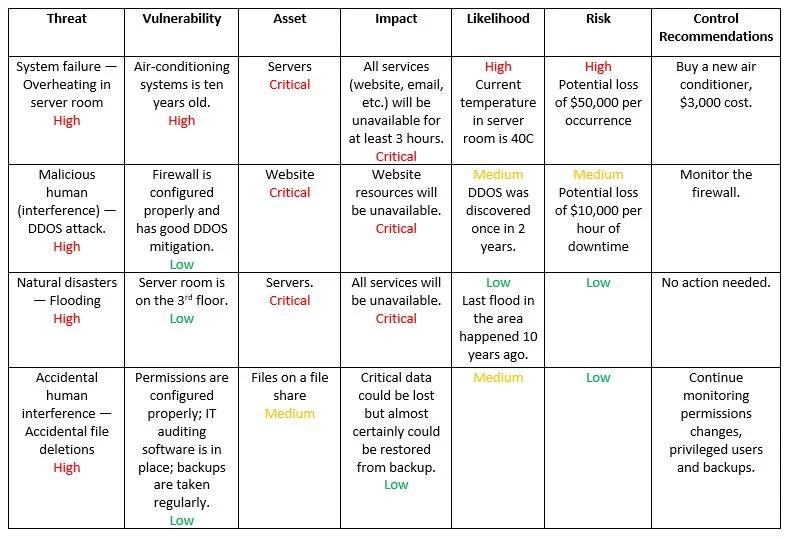
The table illustrates why it helps to keep the terms separate. Take the DDoS row:
- Asset: the website and its ability to serve users
- Threat: a DDoS attack, which can impair availability
- Vulnerability or exposure: the degree to which current DDoS protections are inadequate
- Impact: website resources become unavailable
- Likelihood: an estimate based on evidence and context
- Risk: the combined prioritization result
- Control recommendation: monitor and maintain the firewall or DDoS protections
Notice that “DDoS” may appear in an organization’s documents as a threat, an attack type, or an incident category. The surrounding wording tells you which role is intended. If the question asks “What could harm availability?” classify it as a threat. If it asks “What did the attacker do?” it may be describing an attack.
Also notice the flood row. A flood is not a software exploit, but it can still be a threat to the server-room asset. Locating the server room on a higher floor lowers the vulnerability to flooding. Cybersecurity risk includes physical, environmental, operational, and human sources of harm—not only code defects.
The color labels in such a table are judgments based on stated criteria, not facts inherent in the words “flood” or “DDoS.” You will define and apply rating criteria in the upcoming risk-rating lesson.
Controls change the chain, not the past
A security control is anything deliberately put in place to reduce risk. It might prevent an event, reveal it, limit the damage, or make recovery possible. At this stage, classify something as a control if its purpose is to protect an asset or manage a risk.
For the cross-tenant export example, a defense-in-depth set of controls might include:
- deriving tenant identity from the authenticated session rather than trusting a request parameter;
- checking ownership on every object-level request;
- automated authorization tests in CI;
- audit logs for export creation and download;
- alerts on unusually large or frequent exports;
- minimum-necessary access for support accounts.
These controls are not interchangeable. Authorization checks address the underlying vulnerability directly. Logging may not stop the disclosure, but it can detect or investigate it. Rate limiting can make bulk extraction harder but should not be mistaken for authorization. This is why security recommendations should state which part of the chain they address.
One control can support multiple CIA objectives. Backups are usually associated with availability and recovery, but immutable backups can also help restore integrity after destructive changes. Audit logging supports integrity by making unauthorized modification more detectable, although logs themselves must be protected from alteration and excessive disclosure.
In the next lesson, you will classify controls more rigorously by what they do and how they are implemented. For now, do not overcomplicate the terminology: the key recognition rule is that a control is a safeguard, not an asset, threat, weakness, exploit, or risk.
A fast classification method
When you encounter a security scenario in a ticket, architecture review, or exam question, do this in order:
- Separate the statements. A single sentence can contain several categories.
- Circle the valuable thing or capability. That is usually the asset.
- Find the potential source of harm. That is the threat.
- Find the condition that should not exist. That is the vulnerability.
- Find the action or technique that uses the weakness. That is the exploit.
- Express the possible consequence with likelihood and impact in mind. That is the risk.
- Find the deliberate safeguard. That is the control.
A short example:
A public object-storage bucket contains database backups. An attacker discovers its URL and downloads the backups. The organization enables private access, least-privilege permissions, and access logging.
- Assets: database backups and their contents
- Threat: unauthorized external access
- Vulnerability: public bucket configuration
- Exploit: discovering and using the public URL to download files
- Risk: confidential customer or business data may be exposed
- Controls: private access configuration, least privilege, access logging
A final habit worth developing: classify the specific phrase, not the whole scenario. “Database backups” and “public access” appear in the same sentence but belong to entirely different categories.
Key takeaways
- An asset is something valuable to the organization: data, systems, services, capabilities, or reputation.
- A threat is a potential source or cause of harm; it can be malicious, accidental, environmental, or operational.
- A vulnerability is the weakness that makes a threat more able to cause harm.
- An exploit is the technique or action that takes advantage of the vulnerability.
- Risk describes the potential adverse outcome, considering likelihood and impact—not just the existence of a bug or attacker.
- A control is a deliberate safeguard that reduces likelihood, impact, or both.
- Use a full risk statement to connect the terms clearly: vulnerability, threat, asset, possible exploit, and CIA impact.
Next, you will go deeper on controls: distinguishing their functions—such as preventive, detective, and corrective—from their implementation types, such as technical, operational, managerial, and physical.
Can't find a good explanation? Sign up and we'll make it for you
Sign up