
In our last lesson, we explored the annual lifecycle of a honey bee colony, observing how its focus shifts with the seasons. We saw that summer is the peak production phase, where the colony works relentlessly to create and store honey. Today, we'll zoom in on that remarkable activity. The goal of this lesson is to explain the fascinating process of how bees transform simple flower nectar into the stable, energy-rich honey they need to survive the winter.
Understanding this natural manufacturing process—a blend of chemistry and collaborative engineering—is not just a point of curiosity; it's fundamental to appreciating the substance you'll eventually harvest as a beekeeper.
From Flower to Honey: A Natural Production Line
The journey from a flower's nectar to a sealed cell of honey is a multi-stage process, much like a well-optimized production pipeline. It involves collection, transportation, chemical processing, and long-term storage.
This infographic from Purdue University provides a clear, high-level overview of the entire sequence. We will use it as our roadmap for this lesson.
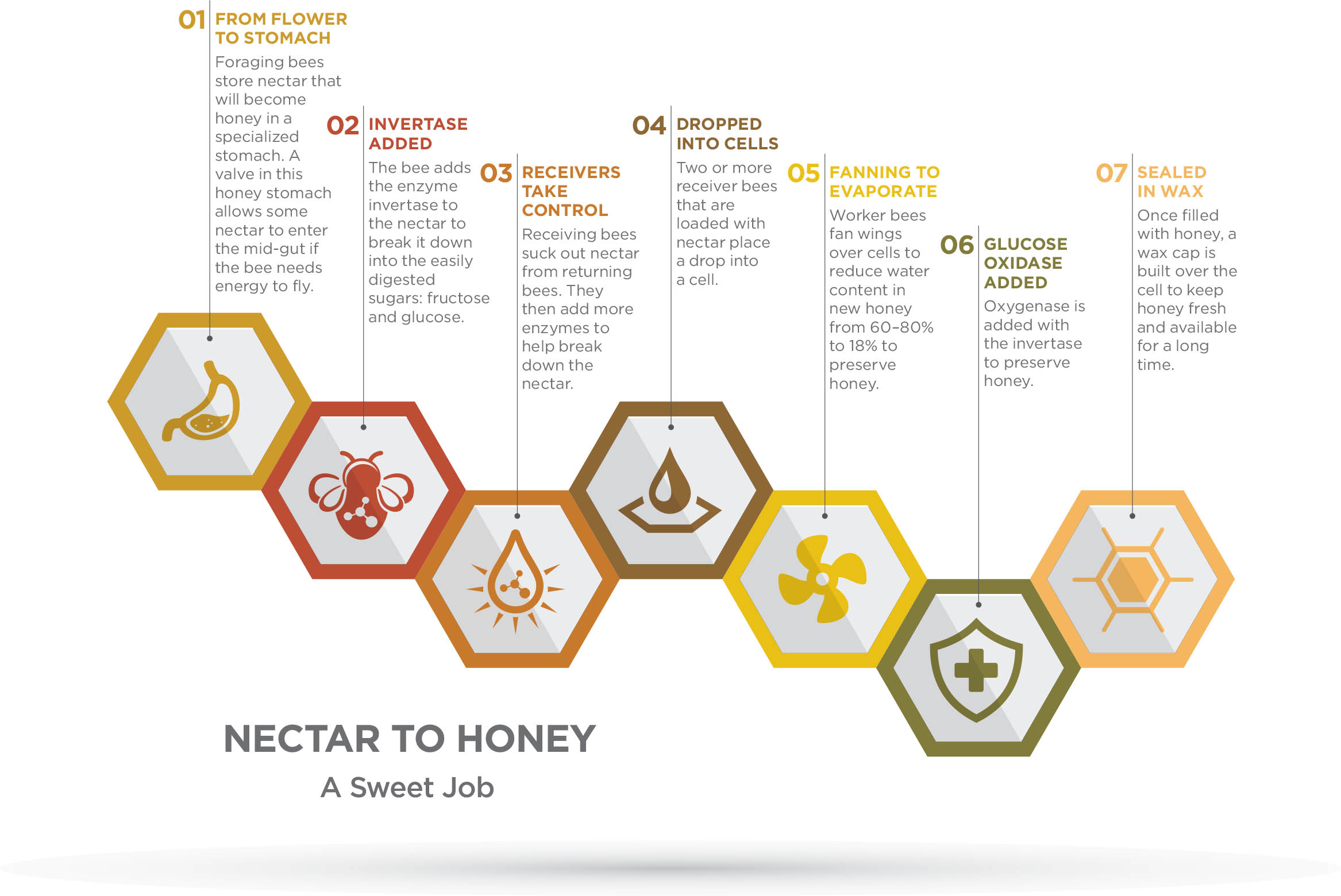
Now, let's watch a short, engaging video from the "Be Smart" YouTube channel that brings this process to life. It provides a dynamic overview of the steps we'll be breaking down in more detail. Pay attention to the concepts of the "honey stomach" and the "regurgitation telephone."
This video, "How Do Bees Make Honey?", provides a quick and visually rich summary of the entire process.
Watch from the beginning until the end of the main explanation. The video covers nectar collection, the enzyme-driven process of passing nectar between bees, and the final evaporation and capping stages.
The Key Stages of Honey Production
As you saw in the video and the infographic, making honey is a team effort involving two main groups of worker bees: older forager bees that collect the raw material, and younger house bees (or processor bees) that manage the in-hive production. Let's break down the key transformations.
1. Collection and Chemical Breakdown
The process begins when a forager bee visits a flower. Using its long tongue, or proboscis, it sips nectar and stores it in a special organ called the crop, or honey stomach. This is purely a transport vessel; the nectar is not digested for the bee's own immediate energy unless a special valve is opened.
On the flight back to the hive, the process has already begun. The bee's body introduces the first crucial enzyme, invertase, into the nectar. This enzyme starts breaking down the complex sugar in nectar (sucrose) into two simpler sugars: glucose and fructose. This is a chemical process called inversion.
Upon returning to the hive, the forager bee regurgitates the nectar and passes it to a house bee. This mouth-to-mouth transfer may happen several times, forming a chain. With each pass, more invertase is added, further breaking down the sugars.
2. Dehydration and Storage
The partially converted nectar is still very watery, typically 60-80% water. To become honey, which has a water content below 18.6%, it must be dehydrated. The house bees deposit the nectar into the hexagonal wax cells of the honeycomb.
Then, the bees begin one of their most critical tasks: evaporation. They vigorously fan their wings over the cells, creating a steady airflow throughout the hive that works like a dehumidifier, drawing moisture out of the nectar. The warm, regulated temperature of the hive (around 32-35°C or 90-95°F) also aids in this evaporation process.
3. Preservation and Capping
As the water content drops, the bees add a second important enzyme: glucose oxidase. This enzyme has a dual purpose. When the honey is eventually diluted with a little water (for example, when it's fed to larvae), glucose oxidase produces hydrogen peroxide, which has an antimicrobial effect that protects the honey and bee larvae from pathogens.
Once the nectar has "ripened" into honey—meaning its water content is sufficiently low—the bees seal the cell with a fresh cap of beeswax. This airtight seal is vital. It prevents the finished honey, which is hygroscopic (meaning it readily absorbs moisture from the air), from reabsorbing water and fermenting.
To solidify your understanding of these chemical and physical changes, let's read a concise explanation from North Carolina State University.
How Do Bees Make Honey? (It’s Not Just Bee Barf) | NC State News
This article clearly separates the collection and transfer process from the "ripening" process, providing a great textual reinforcement of what we've just discussed.
First, read the initial paragraphs describing the roles of forager and processor bees, from the beginning of the process. Next, focus on the section that details the two key transformations: the enzymatic breakdown of sugar and the evaporation of water. Read from this point until the end of that paragraph.
The result of this meticulous process is a supersaturated sugar solution that is also acidic and contains natural preservatives. These properties are why honey is so resistant to spoilage and can last for an incredibly long time if sealed properly.
Conclusion
Today we've uncovered the remarkable biological and chemical process that turns floral nectar into honey. It's a system refined over millions of years to create a perfect, stable food source.
Let's review the key takeaways:
- Collection: Forager bees collect nectar in a special honey stomach.
- Enzymatic Conversion: Bees add enzymes like invertase to break down complex sucrose into simpler glucose and fructose. This happens during transport and transfer between bees.
- Dehydration: Bees deposit the nectar in honeycomb cells and fan their wings to evaporate water, reducing the content from ~70% down to below 18.6%.
- Preservation and Capping: Bees add glucose oxidase for its antimicrobial properties and then seal the finished honey in a wax-capped cell for long-term storage.
You now understand not just what honey is, but the incredible collaborative effort that goes into making it. This provides context for why beekeepers wait for frames to be "capped" before harvesting.
In our next lesson, we will transition from the biology of the bees to the practical tools of the beekeeper. We'll begin Module 2 by identifying the components of a modern Langstroth hive and understanding the function of each part.
Can't find a good explanation? Sign up and we'll make it for you
Sign up