Hello! Welcome back.
In our last lesson, we explored Cassandra's eventual consistency model, defining the relationship between the Replication Factor (N), Write Consistency (W), and Read Consistency (R). We established the crucial formula, R + W > N, for achieving strong consistency.
Today, we transition from the "what" to the "how" and "why." This lesson focuses on the practical application of these concepts, directly addressing the learning outcome: Configure various consistency levels for read and write operations in Cassandra and analyze the resulting trade-offs in availability and consistency.
We will cover:
- The mechanisms for setting consistency levels in your application.
- A detailed analysis of each major consistency level, from the most stringent (
ALL) to the most lenient (ANY). - The strategic trade-offs between consistency, availability, and latency for each level.
- Practical scenarios to guide the selection of an appropriate consistency level for different workloads.
Your experience in designing high-load financial systems has undoubtedly involved making critical decisions about data consistency. This lesson will provide a structured framework for making those same decisions within the Cassandra ecosystem, mapping technical configurations to business requirements.
1. How to Configure Consistency Levels
Before analyzing the levels themselves, let's clarify how you apply them. Consistency is not a static, cluster-wide setting. It's a dynamic parameter you control at runtime.
How is the consistency level configured?
The DataStax documentation provides a concise explanation of how to set consistency levels. This will give us the foundational syntax and methods.
Please read the introductory paragraphs and the final section, "Configuring client consistency levels." Focus on the two primary methods: setting it for an entire session and setting it for an individual operation.
As the documentation highlights, you have two main approaches:
-
Session-Level Configuration: Using
cqlsh, you can set a default consistency for your entire interactive session with theCONSISTENCYcommand (e.g.,CONSISTENCY QUORUM;). This is useful for administrative tasks or debugging but is not the standard for applications. -
Per-Operation Configuration: This is the standard and most powerful method. When building an application, your Cassandra driver (e.g., the Java, Python, or Go driver) allows you to specify the consistency level for each individual read or write query.
This per-operation granularity is a cornerstone of Cassandra's flexibility. It allows a single application to use LOCAL_QUORUM for writing a critical financial transaction but switch to ONE for logging a non-essential user event, all within the same service.
2. A Deep Dive into the Consistency Spectrum
Cassandra's consistency levels exist on a spectrum, forcing a trade-off between consistency, availability, and latency. Let's analyze the most important levels, moving from strongest to weakest.
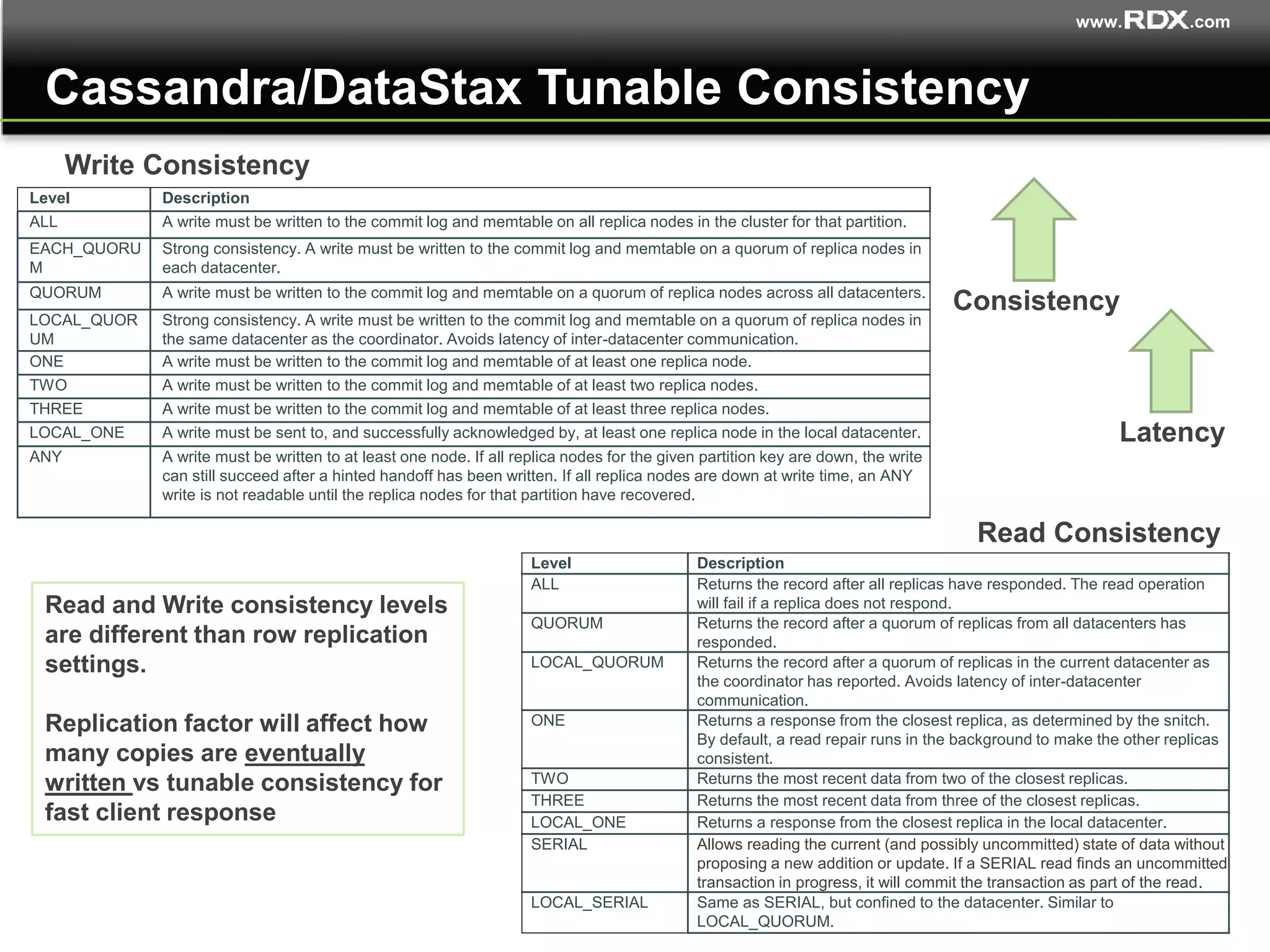
2.1. The Strongest Guarantees (CP Systems)
These levels prioritize consistency above all else, sometimes at a significant cost to availability and latency.
Cassandra Consistency Level Guide
The Pythian blog post, "Cassandra Consistency Level Guide," offers a clear, narrative explanation of the different levels and their implications. We'll start with the strongest levels.
Please read the sections on "CL = ALL" and "CL = EACH_QUORUM." Pay attention to the analysis of why these levels sacrifice availability.
-
ALL:- Requirement: The coordinator must receive an acknowledgment from all
Nreplicas for the operation to succeed. - Trade-off: Provides the absolute strongest consistency. If a write with
CL=ALLsucceeds, you are guaranteed that any subsequent read (even withCL=ONE) will see that write. However, it has the lowest availability. If just one of theNreplicas is down or slow, the entire operation fails. This makes it unsuitable for systems that require high uptime, especially across multiple datacenters where network issues are more probable.
- Requirement: The coordinator must receive an acknowledgment from all
-
EACH_QUORUM(Writes only):- Requirement: The coordinator must receive an acknowledgment from a quorum of replicas in every datacenter.
- Trade-off: This is the go-to level for applications that need to guarantee a write has been durably persisted in multiple geographic locations. For example, a global user authentication system might use this to ensure a password change is reflected in both the US and EU datacenters before confirming success. The cost is high latency (it's gated by the slowest DC) and reduced availability (an outage in one DC's ability to form a quorum will fail the write globally).
2.2. The Balanced Approach: Quorum Levels
This is where most production applications live. Quorum-based consistency provides strong guarantees while tolerating node failures.
First, let's formalize how a quorum is calculated.
How is the consistency level configured?
The DataStax documentation clearly defines the formula for calculating a quorum.
Please read the section "How QUORUM is calculated." Note the formulas for a simple quorum, a local quorum, and EACH_QUORUM.
The key formula is quorum = floor(replication_factor / 2) + 1.
- For a local RF of 3, a
LOCAL_QUORUMis 2. The DC can tolerate 1 node failure. - For a local RF of 5, a
LOCAL_QUORUMis 3. The DC can tolerate 2 node failures.
Now let's look at the quorum levels themselves.
Cassandra Consistency Level Guide
Let's return to the Pythian blog to understand the practical differences between QUORUM and LOCAL_QUORUM.
Please read the sections on "CL = QUORUM" and "CL = LOCAL_QUORUM." Focus on the distinction regarding cross-datacenter communication.
-
QUORUM:- Requirement: A quorum of replicas across all datacenters must respond. If you have
RF=3in DC1 andRF=3in DC2, the totalNis 6, and a global quorum isfloor(6/2) + 1 = 4. - Trade-off: This provides strong consistency (
R=QUORUM,W=QUORUMsatisfiesR+W > N). It is more available thanEACH_QUORUMbecause it can tolerate an entire DC being down, as long as a total of 4 replicas are available across the cluster. However, it frequently requires cross-DC communication, introducing latency.
- Requirement: A quorum of replicas across all datacenters must respond. If you have
-
LOCAL_QUORUM:- Requirement: A quorum of replicas in the local datacenter (the one the coordinator belongs to) must respond.
- Trade-off: This is often the recommended best practice for most applications. It provides strong consistency within a single datacenter without incurring cross-DC latency for acknowledgments. Writes are replicated to other datacenters asynchronously. This gives you low-latency operations, strong local durability, and high availability. If you use
W=LOCAL_QUORUMandR=LOCAL_QUORUM, your application is guaranteed to read its own writes within that datacenter.
2.3. The High Availability Approach
These levels prioritize speed and availability over immediate consistency.
Cassandra Consistency Level Guide
Finally, let's examine the weaker consistency levels, which are essential for certain use cases.
Please read the sections on "CL = numeric value" (which covers ONE/TWO/THREE), "CL = LOCAL_ONE," and "CL = ANY."
-
ONE/LOCAL_ONE:- Requirement: Only one replica (
ONE) or one replica in the local DC (LOCAL_ONE) needs to respond. - Trade-off: This offers the highest availability and lowest latency. The operation succeeds as long as at least one replica is up. The significant downside is the risk of stale reads. A read with
CL=ONEimmediately following a write withCL=ONEis not guaranteed to see that write, as the read could be served by a different replica that hasn't yet received the data. This is suitable for non-critical data like analytics, activity feeds, or view counters, where eventual accuracy is acceptable.
- Requirement: Only one replica (
-
ANY(Writes only):- Requirement: The write succeeds as long as any node accepts it, even if it's just a hinted handoff on the coordinator because all replicas are down. The coordinator can acknowledge the write before it has even been written to a single replica node.
- Trade-off: This provides the absolute highest write availability. A write will virtually never fail. However, it offers the weakest durability guarantee. If the coordinator node crashes before it can deliver the stored hint to the replica, the write is lost forever. This level is rarely advisable for any data you cannot afford to lose.
2.4. Special Case: SERIAL and LOCAL_SERIAL
You will see SERIAL and LOCAL_SERIAL in the list of read consistency levels. These are not for general-purpose reads. They are used exclusively with Lightweight Transactions (LWTs), which provide a compare-and-set (CAS) mechanism in Cassandra. LWTs are used to achieve linearizable consistency for single-key operations, but they come with a significant performance penalty. We will not delve deeper into LWTs in this lesson, but it is important to know that these consistency levels are tied to that specific feature.
3. Scenario Analysis: Choosing Your Consistency Level
Let's apply this knowledge. The choice of CL is an architectural decision that balances business needs with technical realities. Consider these scenarios from your domain:
-
Scenario 1: Processing a Payment
- Write Operation: A user's payment must be recorded durably. Data loss is unacceptable. The user is waiting for a confirmation.
- Recommended CL:
LOCAL_QUORUM. This ensures the transaction is durably stored on multiple nodes within the local datacenter before you confirm to the user, providing a great balance of safety and low latency. UsingQUORUMmight be too slow if it has to cross to another continent.EACH_QUORUMmight be used if regulatory requirements demand immediate persistence in multiple jurisdictions, but this would come at a high latency cost.
-
Scenario 2: Reading a User's Balance for a UI Display
- Read Operation: The application needs to display the user's current account balance. The value must be accurate.
- Recommended CL:
LOCAL_QUORUM. To prevent showing a stale balance (e.g., before a recent payment is reflected), you need strong consistency. UsingLOCAL_QUORUMfor both the payment write and this balance read ensures thatR+W > N(locally), guaranteeing the read will see the latest write.
-
Scenario 3: Recording a "Like" on a Product Review
- Write Operation: A user clicks "like." The operation should be fast, and the system should remain available even if some nodes are down. Losing a single "like" during a transient failure is not a critical business problem.
- Recommended CL:
ONEorLOCAL_ONE. This provides the fastest possible response to the user and maximizes availability. The data will eventually propagate to all replicas via Cassandra's background repair mechanisms.
Conclusion
You now have a detailed map of Cassandra's consistency levels and a strategic guide for navigating the trade-offs. This is not just a technical knob to turn; it is a primary tool for aligning your system's behavior with business requirements for durability, availability, and performance.
Key Takeaways:
- Consistency is configured per-operation in the client driver, allowing for fine-grained control.
LOCAL_QUORUMis the workhorse for most applications, offering strong consistency within a datacenter with low latency and high availability.- The combination of
W=LOCAL_QUORUMandR=LOCAL_QUORUMis a common pattern to guarantee read-your-writes consistency within a local DC. ONEandLOCAL_ONEare ideal for high-volume, latency-sensitive workloads where eventual consistency is acceptable.- Extreme levels like
ALLandANYhave niche uses but are generally avoided for mainstream application logic due to their significant impact on availability and durability, respectively.
Preview of the Next Lesson:
We have now examined how Cassandra distributes data (partitioning), ensures redundancy (replication), and manages consistency (consistency levels). The final piece of the core architectural puzzle is understanding what happens inside a single node. How does Cassandra achieve its famously high write throughput?
In the next lesson, we will explore Cassandra's storage architecture, diving into the Log-Structured Merge-Tree (LSM-Tree), Memtables, and SSTables. This will illuminate the mechanics that make Cassandra's write performance possible.