
Welcome back. In the previous lesson, you learned to make pronouns agree with clear antecedents and to avoid shifts in point of view such as moving from a student to you. This lesson applies the same reader-centered principle to verbs: your reader should always be able to tell when an action happens.
You will learn to establish a paragraph’s main time frame, identify accidental tense shifts, and make purposeful shifts when the paragraph genuinely moves to an earlier, current, or future moment. This will help in narratives, literary analysis, and academic writing—three places where tense control strongly affects clarity.
Tense consistency is really timeline consistency
A verb’s tense locates an action or state in time:
- Present: The student revises the paragraph.
- Past: The student revised the paragraph.
- Future: The student will revise the paragraph.
Verb tense consistency means that verbs in a sentence or paragraph follow a logical timeline. It does not mean every verb must have the identical form. A well-written paragraph may use past, present, and future tense—but every change must tell the reader that the time frame has changed.
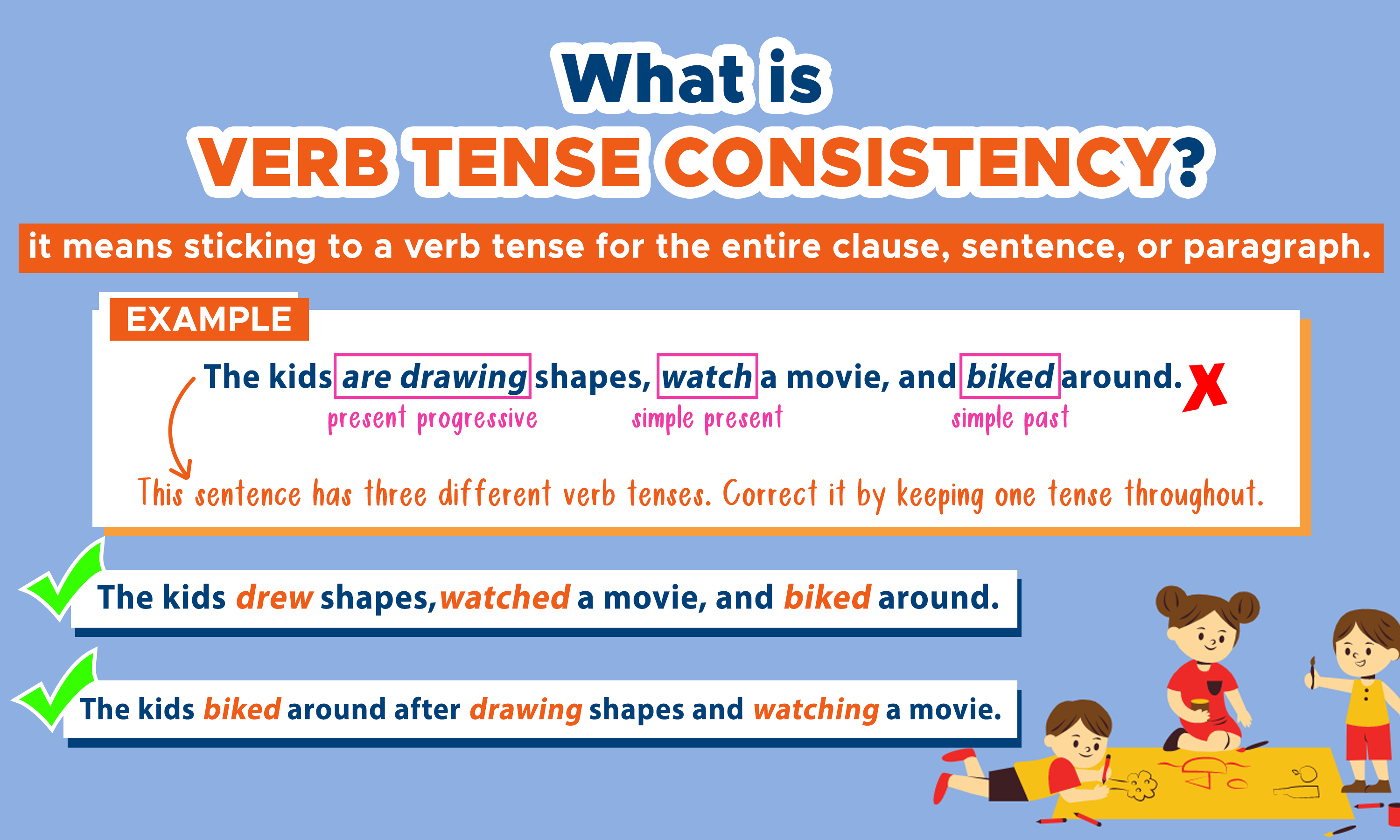
Consider this sentence:
Inconsistent: Yesterday, I finish my homework and watched a movie.
The word yesterday establishes the past. Watched correctly stays in that past time frame, but finish shifts without reason.
Correct: Yesterday, I finished my homework and watched a movie.
Now compare a sentence with different verb forms but a logical relationship:
I was finishing my homework when my friend called.
Both actions occurred in the past. The past progressive verb, was finishing, shows an activity already in progress; the simple past verb, called, marks the shorter event that occurred during it. Different forms, one coherent time frame.
The key editing question is therefore not “Are all my verbs the same?” Instead, ask:
Does each verb accurately match the time at which its action occurs?
First, choose the paragraph’s primary tense
Most paragraphs have a primary tense: the main time frame in which the paragraph operates. Choose it based on the job of the paragraph, not on which tense feels easiest.
Verb Tense Consistency - Purdue OWL
Read Purdue OWL’s “Verb Tense Consistency” to see the central rule in action: establish a main tense, then shift only when the timeline truly changes.
In the section “Controlling shifts in verb tense,” begin with the opening explanation, which shows why even non-narrative writing has an implied time frame. Then read the guideline and examples beginning “Generally, writers maintain one tense” through the no unnecessary shift rule. Next, in “Controlling shifts in a paragraph or essay,” read the three “Hints” for common academic uses of past and present tense. Finish with “Sample paragraphs,” comparing the corrected past-tense bus narrative with the dragonfly paragraph, where past and future shifts are justified by the dragonfly’s life cycle.
Past tense: completed events
Use past tense when narrating events that happened and ended at a particular time.
Last Friday, our class visited the library. We met with the research specialist, and she showed us the database.
A personal narrative usually stays mainly in past tense because the writer is recounting a completed experience.
Inconsistent narrative: I walked into the auditorium and see my name on the program.
Consistent narrative: I walked into the auditorium and saw my name on the program.
Writers sometimes slip into present tense because they can vividly imagine the moment again. That feeling is understandable, but unless you deliberately choose present-tense narration from the beginning, it creates an unintended disruption.
Present tense: current facts, habits, and analysis
Use present tense for facts, routines, general claims, and ideas that the reader can consider now.
Strong topic sentences give paragraphs focus.
A revision process often includes planning, drafting, and editing.
The school newspaper publishes new articles each month.
Present tense is also the standard convention for discussing literature, films, and other works of art:
In Romeo and Juliet, Shakespeare shows how impulsive decisions intensify the conflict.
The narrator recognizes the problem but refuses to act.
Even though Shakespeare wrote the play centuries ago, the events and choices exist in the text whenever a reader opens it. For literary analysis, write the narrator reveals rather than the narrator revealed.
Future tense: planned or expected actions
Use future tense for events expected to happen later.
Next week, the class will begin its research project.
The team will present its findings on Friday.
You may also see present progressive used for a scheduled future event:
The team is presenting its findings on Friday.
The important point is not the label of the tense. The wording must make the intended timeline clear.
When a tense shift is necessary
The rule is not “never shift tense.” A logical shift is often the most accurate choice. It tells the reader that the paragraph is looking backward, forward, or at an ongoing action.
Looking back from a present situation
A paragraph may describe something that is true now while briefly explaining its earlier cause.
The debate team is more confident this year because its members practiced regularly over the summer.
The team’s confidence is current; the practice happened earlier. The shift is necessary.
Explaining an earlier event within a past narrative
Sometimes a past-tense narrative needs to mention an event that happened before the main past event. Use the past perfect, usually formed with had plus a past participle.
By the time I arrived at rehearsal, the director had chosen the cast.
The main past moment is arrived. The casting decision came before that moment, so had chosen accurately places it further back in time.
A useful rule:
| Main time frame | Earlier action |
|---|---|
| present | present perfect: has revised |
| past | past perfect: had revised |
| future | future perfect: will have revised |
For example:
The writer explains the issue after she has introduced the evidence.
The writer explained the issue after she had introduced the evidence.
Do not use had automatically for every past action. In a straightforward sequence, simple past is usually clearer:
I opened the document, read the comments, and revised the introduction.
All three events belong to the main story line, so simple past works well.
Combining an ongoing and a completed past action
Use a progressive form for an action in progress at a particular time.
While I was revising my conclusion, my laptop shut down.
The audience was waiting when the speaker arrived.
These sentences are consistent because both verbs refer to past time. The forms simply show different roles: an ongoing background action and a shorter completed event.
Moving between literary analysis and history
Academic writing often needs a controlled shift between the work itself and the historical world around it.
In the speech, King argues that justice cannot wait. He delivered the speech during the March on Washington in 1963.
The first sentence analyzes ideas in a text, so it uses present tense. The second provides a completed historical fact, so it uses past tense. This is logical and common in literary and rhetorical analysis.
A useful distinction:
- The author wrote the novel in 1952. Historical action, so past tense.
- The novel explores isolation. Discussion of the work, so present tense.
- The author argues that isolation damages relationships. Discussion of an argument available in the work, so present tense.
Diagnose tense problems across a whole paragraph
Tense errors are harder to notice in paragraphs than in isolated sentences because each sentence can sound acceptable by itself. Read for the paragraph’s timeline before correcting individual verbs.
Here is a draft:
Last month, our class began a service project at the community garden. We meet every Saturday morning and cleared weeds from several garden beds. At first, the work seems slow, but the group soon noticed visible progress. By the end of the project, we will create a space that local families can use.
The topic begins with Last month, and most verbs describe a completed project. The primary tense should be past. Several verbs shift accidentally.
Revised: Last month, our class began a service project at the community garden. We met every Saturday morning and cleared weeds from several garden beds. At first, the work seemed slow, but the group soon noticed visible progress. By the end of the project, we had created a space that local families could use.
Notice the final revision. Had created makes sense if the sentence looks backward from the end of the project: by that point, the space was already complete. In a shorter, more direct version, simple past also works:
We created a space that local families could use.
Choose the form that expresses the relationship you actually mean; do not make the sentence more complicated than its meaning requires.
A reliable editing pass
When editing your own paragraph, work in this order:
- Circle time signals. Look for words such as yesterday, now, usually, in 2020, before, currently, later, and next year.
- Name the primary time frame. In the margin, write past narrative, present analysis, present habit, or future plan.
- Underline finite verbs. These are verbs that carry tense, such as argues, explained, was studying, and will apply.
- Check each shift. For every verb that differs from the main tense, identify its reason: an earlier action, an ongoing action, a current fact, or a future result.
- Revise unsupported shifts. If you cannot state a time-based reason for the change, bring the verb back to the primary tense.
- Read aloud once. Changes in tense often become obvious when you hear the timeline rather than merely scan the words.
This process gives you a way to edit deliberately rather than changing verbs because one version “sounds better.”
Watch an editor reason through a paragraph
The next resource models the process of identifying a paragraph’s main tense first, then correcting only the verbs that do not fit its timeline.
Verb Tense Consistency in English with Examples (A COMMON Writing Error)
Watch “Verb Tense Consistency in English with Examples (A COMMON Writing Error)” from Sparkle English for a quick explanation of justified shifts followed by a worked paragraph revision.
Watch logical shifts to reinforce the principle that different time frames, not different verb forms alone, justify a tense change. Then watch the paragraph edit. Before the correction begins, pause briefly and identify the routine, the event that happened “yesterday,” and the later past events; then compare your timeline with the presenter’s revisions.
One practical caution: a paragraph may change from a general present-tense statement to a specific past example. Signal the transition clearly.
Clear: Revising often requires patience. Last night, I spent thirty minutes reorganizing one body paragraph.
The first sentence offers a general truth; the second introduces one completed example. The phrase Last night makes the shift easy to follow.
Without a signal, the same shift can seem careless:
Unclear: Revising often requires patience. I spent thirty minutes reorganizing one body paragraph.
The second sentence could be a deliberate example, but it needs a time marker or transition to make that relationship obvious.
Tense control in the writing you will do next
As you move into paragraph and essay writing, choose tense based on the task:
| Writing situation | Usual primary tense | Example |
|---|---|---|
| Personal narrative | Past | I entered the room and opened the letter. |
| Analysis of a story, poem, or film | Present | The speaker questions the promise of success. |
| Research-based general claim | Present | Sleep improves memory and concentration. |
| Historical explanation | Past | The movement gained support during the 1960s. |
| Professional update or plan | Present or future | The team is reviewing the proposal and will respond Friday. |
A strong paragraph does not avoid all shifts. It uses them with intention. Think of tense as a timeline you are building for the reader: establish where the paragraph stands, then mark every move to another point in time clearly.
The essential habits from this lesson are:
- Establish a primary tense based on the paragraph’s purpose.
- Keep verbs in that tense when actions occur in the same time frame.
- Shift tense only to show a real change in time: earlier background, ongoing action, current fact, or future event.
- Use past tense for completed narration, present tense for general claims and literary analysis, and future tense for expected actions.
- During revision, check the paragraph’s timeline before changing individual verbs.
Next, you will build on this sentence-level control by punctuating compound and complex sentences with commas and semicolons.
Can't find a good explanation? Sign up and we'll make it for you
Sign up