
Hello again. In the previous lesson, you learned to distinguish an independent clause, which can stand alone, from a dependent clause, which needs another clause to complete its meaning. That distinction is now the tool you will use to fix one of the most common errors in school and professional writing: the sentence fragment.
A fragment can make writing feel abrupt or unfinished—not because it is short, but because something essential is missing. Today, you will diagnose fragments systematically and repair them by adding a missing subject, a complete verb, or an independent clause. The goal is not simply to “make it grammatical”; it is to make the intended meaning clear.
What makes a fragment?
A sentence fragment is a group of words incorrectly punctuated as though it were a complete sentence. A standard complete sentence needs:
- a subject;
- a complete verb; and
- an independent clause that expresses a complete thought.
A fragment may be missing one of those parts, or it may contain a dependent clause that has not been connected to a main clause.
For instance:
Studied the chapter carefully before the quiz.
This has an action, studied, but it does not identify who studied. The reader has to supply information that the sentence should state.
The students studied the chapter carefully before the quiz.
Now the sentence has a subject (The students), a verb (studied), and a complete idea.
A useful editing principle is this:
Do not fix a fragment by adding random words. Fix it by identifying what the reader still needs to know.
A three-part diagnostic
When you proofread a sentence that feels incomplete, work through these questions in order.
| Question | If the answer is no | Likely repair |
|---|---|---|
| Is there a subject? | Who or what performs the action is unclear. | Add a subject. |
| Is there a complete verb? | The subject has no action or state of being. | Add or complete the verb. |
| Can it stand alone as a complete thought? | It may be a dependent clause or phrase. | Attach it to an independent clause. |
This diagnostic keeps you from relying only on intuition. It is especially useful when revising a longer draft, where an incomplete sentence can look convincing because it resembles the sentence before it.
Sentence Fragments & How to Fix Them | How to Write Complete Sentences | English Writing Essentials
Watch “Sentence Fragments & How to Fix Them” from Sparkle English for a quick visual walkthrough of the three main fragment types: missing subject, missing verb, and dependent-clause fragments.
Watch the definition for the central test of sentence completeness. Then watch missing subjects, missing verbs, and dependent clauses. Pause briefly after each category and notice that the repair is based on what is missing, not on sentence length.
Type 1: The subject is missing
The subject tells the reader who or what performs the action or exists in the state described by the verb.
Fragment: Revised the conclusion after reading the teacher’s comments.
The verb is revised, but who revised the conclusion? A reader cannot know for certain. Add a subject that fits the context:
Revision: I revised the conclusion after reading the teacher’s comments.
Or, in a different context:
Revision: Maya revised the conclusion after reading the teacher’s comments.
Why this error happens
Missing-subject fragments often appear when a writer breaks one intended sentence into two:
The group met after school to plan the presentation.
Decided to divide the research tasks.
The writer knows that the group decided, but the new sentence cannot borrow its subject automatically from the previous one. Two good repairs are possible:
The group met after school to plan the presentation. They decided to divide the research tasks.
Or:
The group met after school to plan the presentation and decided to divide the research tasks.
Choose between these versions based on emphasis. The two-sentence version gives the decision more weight; the combined version presents the meeting and decision as closely connected actions.
A necessary exception: commands
Not every sentence without a written subject is a fragment. In an imperative sentence, the subject you is understood.
Read the prompt carefully.
Save your work before closing the document.
Please email the final draft by Friday.
Each sentence is a command directed at you, so it is complete. In formal writing, however, do not mistakenly treat ordinary statements as commands just to avoid adding a subject.
Type 2: The verb is missing or incomplete
A sentence can name a person, place, thing, or idea but still fail to say anything about it.
Fragment: The most useful source in my research folder.
This group has a possible subject, The most useful source, but no verb. The sentence leaves the reader waiting: What about the source?
Revision: The most useful source in my research folder explains the issue clearly.
Sometimes the missing verb is a form of be:
Fragment: The main reason for the policy change unclear.
Revision: The main reason for the policy change is unclear.
Watch for verbs ending in -ing
Words ending in -ing can be part of a complete verb, but they often need a helping verb such as is, are, was, or were.
Fragment: The students preparing for the debate.
The word preparing suggests an action, but it does not complete the verb phrase by itself in this sentence.
Revision: The students are preparing for the debate.
Compare that with a complete sentence:
The students prepared for the debate.
Both are preparing and prepared are complete verbs; preparing by itself is not complete in the fragment above.
Do not confuse a long noun phrase with a sentence
Longer groups of words can disguise the absence of a verb:
Fragment: Several detailed notes about unreliable evidence in the article.
The central noun is notes, but the sentence still lacks a verb.
Revision: Several detailed notes about unreliable evidence in the article appear in my reading journal.
When editing, locate the core noun first, then ask: What is this noun doing or being?
Proofreading for Errors - Purdue OWL
Read the “Sentence Fragments” portion of Purdue OWL’s “Proofreading for Errors.” It gives a compact model for finding the exact element a fragment lacks and demonstrates each repair.
In the “Sentence Fragments” section, begin with the subject example. Continue through the example in which “trying” needs “were,” then read the dependent-clause repair. Focus on the author’s sequence: check for a subject, check for a complete verb, then check for an independent clause.
Type 3: A dependent clause is standing alone
This kind of fragment is especially important because it often contains both a subject and a verb. It can look like a sentence at first glance.
Fragment: Because the evidence came from an unreliable website.
- Subject: the evidence
- Verb: came
- Dependence signal: Because
The word because creates an unfinished relationship. It makes the reader ask: What happened because the evidence came from an unreliable website?
To repair it, attach an independent clause:
The writer removed the source because the evidence came from an unreliable website.
You can also place the dependent clause first:
Because the evidence came from an unreliable website, the writer removed the source.
In both revisions, the central claim is now complete:
The writer removed the source.
The dependent clause supplies the reason.
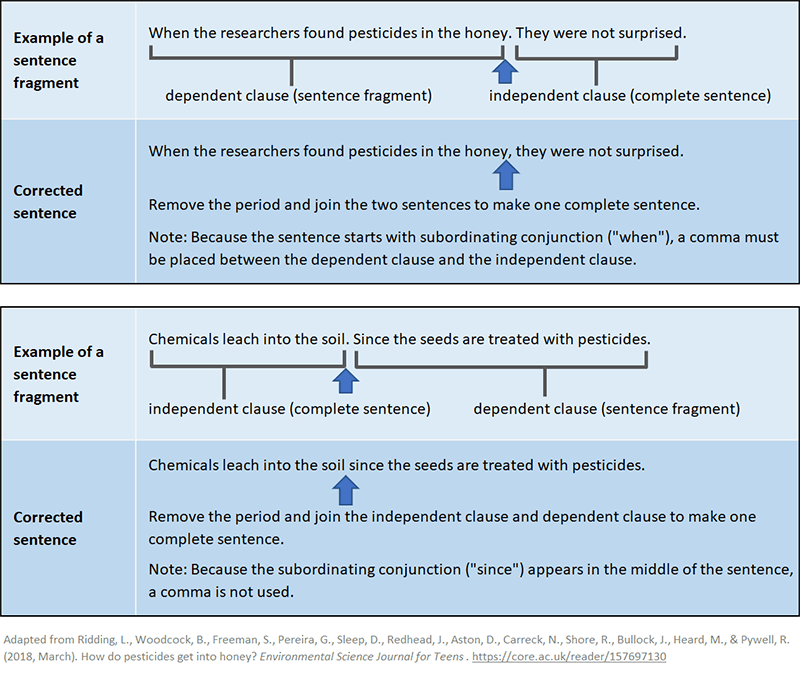
Two dependable sentence patterns
When a dependent clause begins with a word such as because, although, when, while, if, since, or after, use one of these patterns:
| Pattern | Example | Main point |
|---|---|---|
| Dependent clause, independent clause | Although the topic was difficult, the class discussion was productive. | the class discussion was productive |
| Independent clause dependent clause | The class discussion was productive although the topic was difficult. | The class discussion was productive |
For now, remember the basic comma distinction:
-
Put a comma after an introductory dependent clause.
When the bell rang, students packed their bags.
-
Usually do not put a comma before a dependent clause that follows the independent clause.
Students packed their bags when the bell rang.
A later lesson will examine comma and semicolon rules in greater depth. Today, your priority is ensuring that the dependent clause is connected to a complete independent clause.
Relative-clause fragments
Some fragments begin with words such as which, that, who, or whose. These words often introduce clauses that describe a noun and cannot stand alone.
Fragment: Which made the argument more convincing.
The reader asks: Which thing made the argument more convincing?
A possible repair is:
The writer included a statistic, which made the argument more convincing.
Or, if the meaning is essential to identifying a noun:
The statistic that supported the writer’s claim came from a government report.
The correct repair depends on your intended meaning. That is why editing fragments is also an act of thinking: you must decide what relationship you mean to express.
Repairing fragments without creating a new error
When you find a fragment, there is often more than one grammatical repair. Choose the one that communicates your intended idea most precisely.
Consider:
Fragment: After reading the article twice.
You could add a subject and verb:
After reading the article twice, I understood the author’s position.
You could combine it with a neighboring independent clause:
I understood the author’s position after reading the article twice.
Or you could revise it into a different complete statement:
Reading the article twice helped me understand the author’s position.
All three are correct, but they emphasize slightly different things. The first foregrounds the time sequence; the second foregrounds the conclusion; the third makes the rereading itself the subject.
Avoid a careless repair such as this:
Fragment: After reading the article twice.
Weak repair: After reading the article twice, and I understood the author’s position.
The word and does not belong there. The introductory dependent clause already connects to the independent clause with a comma:
After reading the article twice, I understood the author’s position.
A clear repair should do two things:
- make the grammar complete;
- preserve the logical relationship the writer intended.
A proofreading routine for your own writing
Fragments tend to appear during drafting, especially when you are moving quickly from one idea to another. That is normal. The important skill is learning to find and revise them during editing.
Use this short sentence-boundary pass after you finish a paragraph:
- Read only the first few words after every period. Be alert for openings such as because, although, when, which, and such as.
- Underline the subject and complete verb in each sentence. If you cannot find both, investigate.
- Ask the stand-alone question: Can this group of words make sense as a complete statement without leaning on the previous sentence?
- Choose the most logical repair: add a subject, complete a verb, or attach the fragment to an independent clause.
- Read the repaired sentence aloud. Listening helps you notice whether you accidentally created an awkward or overly long sentence.
For a brief, low-pressure editing habit, take one paragraph from a current class assignment and mark each sentence with:
- S for subject,
- V for complete verb,
- IC for independent clause.
You do not need to change every short sentence or combine every idea. You are checking that each period marks a genuinely complete sentence.
The key distinction: fragment or deliberate stylistic choice?
In creative writing, writers sometimes use fragments deliberately:
No answer.
Not yet.
Those fragments can create tension or imitate a character’s thought process. But this is an advanced stylistic choice, not a substitute for sentence control. In academic writing, applications, professional emails, and most school assignments, default to complete sentences unless you have a clear rhetorical reason to do otherwise.
For the moment, treat fragments as errors during formal proofreading. Once complete sentences become automatic, you will be able to vary them intentionally rather than accidentally.
A sentence fragment is not one single mistake. It usually signals one of three specific problems: the subject is missing, the verb is missing or incomplete, or a dependent clause has been left without an independent clause.
Your editing questions are therefore simple and powerful:
- Who or what is this sentence about?
- What complete action or state does it express?
- Can it stand alone, or does it need a main clause?
In the next lesson, you will work with the opposite problem: sentences that contain too much independent material without correct punctuation or connection. You will learn to repair run-on sentences and comma splices while keeping your ideas clear and controlled.
Can't find a good explanation? Sign up and we'll make it for you
Sign up