Hello! Welcome to the final lesson in our module on Investment Due Diligence.
Over the past few lessons, we have systematically built a framework for evaluating a startup, covering the core pillars of Team, Market, Product, and finally, the key Legal and IP Risks. You've learned what questions to ask and what red flags to look for. Now, it's time to bring it all together.
This lesson addresses the learning outcome: Synthesize due diligence findings into a concise investment memo to support a decision.
The investment memo is arguably the most critical deliverable of the entire diligence process. For you as a future solo GP, it is more than just a document; it is the ultimate tool for disciplined thinking. It forces you to move beyond gut feelings, structure your analysis, articulate a clear investment thesis, and make a final, evidence-based decision. Mastering this skill is fundamental to building a successful investment track record.
1. The Role and Purpose of an Investment Memo
First, let's clarify what an investment memo is and, just as importantly, what it isn't. A founder's pitch deck is a marketing document designed to generate excitement and tell a compelling story. An investment memo, by contrast, is a private, analytical document created by the investor, for the investor. Its purpose is to dispassionately weigh the evidence gathered during diligence and form a logical argument for or against an investment.
The article "VC Investment Memos" provides a great overview of their strategic importance.
VC Investment Memos: How Investors Document Decisions
To understand the strategic role of an investment memo, please read the following sections from this article by Qubit Capital. It explains why memos are the 'backbone of decision-making' in the VC world.
Read the sections 'What VC Investment Memos Are and Why They Matter,' 'Who Reads Your Investment Memo and Common Questions Answered,' and 'How Pitch Decks Compare to VC Investment Memos.' Focus on the memo's role in fostering alignment, building confidence, and supporting analytical decision-making.
As the article highlights, a well-crafted memo serves several critical functions, even for a solo investor:
- Enforces Intellectual Honesty: It forces you to write down your assumptions, acknowledge risks, and justify your conclusions with data, not just enthusiasm.
- Creates an Archived Thesis: It captures your thinking at a specific point in time. Years later, you can review your memos from both successful and failed investments to understand why you made certain decisions, which of your assumptions were correct, and where your analysis was flawed. This is an invaluable tool for learning and improving as an investor.
- Builds a Foundation for Co-investment: If you decide to bring in other investors on a deal, a strong memo is the most effective way to present the opportunity and your rationale, demonstrating your thoroughness and conviction.
2. The Anatomy of an Investment Memo
While every VC firm has its own template, most investment memos follow a standard structure that maps directly to the diligence areas we've already covered. The goal is to create a logical flow from the high-level opportunity down to the granular details and a final recommendation.
The following image shows a high-level example of what the first page of a memo might look like.
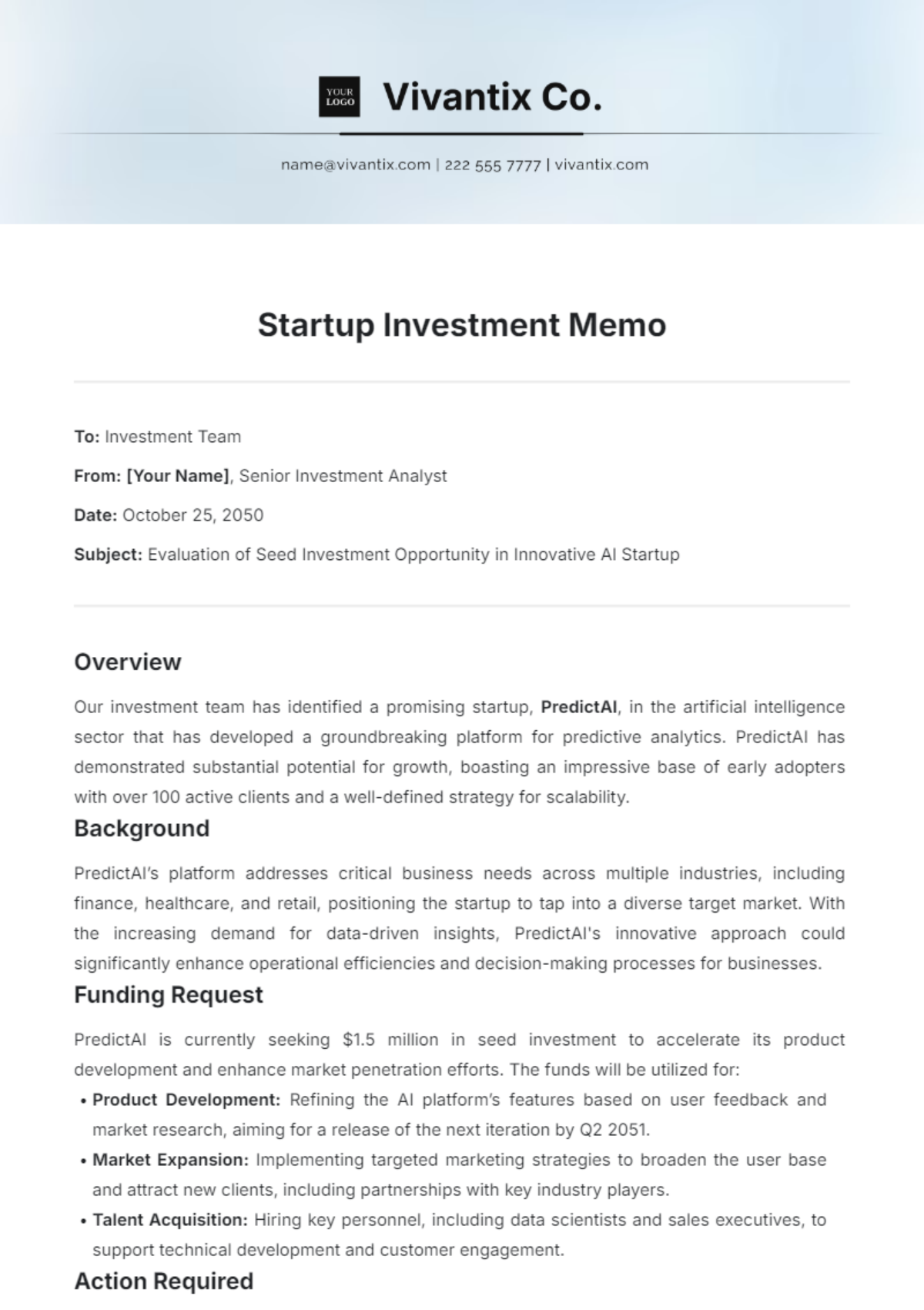
A comprehensive memo goes much deeper. The template provided in the next resource is an excellent, detailed guide that we will use as our framework.
A Template for Startup Executive Summary or Investment ...
This article from Ali Tamaseb, a partner at DCVC, offers one of the most comprehensive and practical investment memo templates available. It breaks down each section into the specific questions you need to answer.
First, carefully read the initial 'Overview' section. This is your one-page summary. Then, scan through the detailed breakdowns for 'Team', 'Product', 'Market', and 'Business'. Notice how these sections directly correspond to the diligence topics we've covered in previous lessons.
Let's walk through the key sections of this template, connecting them back to your diligence work:
-
Overview/Executive Summary: This is the most important part of the memo. It's a one-page distillation of the entire opportunity, covering the vision, problem, product, team, market, traction, deal terms, and your final recommendation. It should be concise enough that someone can grasp the entire investment case in under three minutes.
-
Team: Here, you synthesize your findings on the founders.
- History/Motivation: Why are they uniquely suited to solve this problem?
- Composition & Gaps: Do their skills complement each other? What key roles are missing (e.g., sales, marketing)? This is where you'd note if a technical team lacks commercial experience.
-
Product & Technology:
- Problem & Solution: A detailed explanation of the customer pain point and how the product alleviates it.
- Core Tech/IP: What is the "secret sauce"? You must summarize your findings from IP diligence here, noting any patents, proprietary data, or significant dependencies on open-source technology.
-
Market:
- Market Size (TAM/SAM/SOM): Your analysis of the market's scale.
- Market Drivers & Challenges: What tailwinds support this market? What headwinds or disruptive threats exist?
- Competition: Who are the direct and indirect competitors? What are the startup's moats or defensible advantages?
-
Business & Traction:
- Business Model: How will the company make money? (e.g., SaaS, usage-based, marketplace take-rate).
- Metrics: Synthesize the key performance indicators: revenue, growth rate, burn rate, runway, unit economics (CAC/LTV), etc.
- Sales Strategy: How will they acquire customers?
-
Due Diligence Checks & Risks: This section is crucial. It is not about re-stating all your diligence work, but about summarizing the most critical findings and outstanding risks.
- Legal/Corporate: "Corporate records are clean. All IP assignment agreements are signed by founders and employees." OR "Red Flag: Co-founder's 83(b) election was not filed; this creates a significant personal tax liability and needs to be addressed with counsel before closing."
- Reference Checks: "Spoke with two pilot customers who were highly positive, validating the core value proposition. Spoke with a former manager of the CEO who praised her technical skills but noted a need for mentorship on team management."
- Key Risks: List the top 3-5 risks to the investment (e.g., team risk, market adoption risk, technical risk, competitive risk).
-
Deal & Recommendation:
- Deal Terms: Round size, instrument (e.g., SAFE, priced round), valuation/cap.
- Investment Thesis: This is the culmination of your analysis. In 1-2 paragraphs, you state why this is a compelling investment despite the risks. A good thesis might sound like: "While the team is still unproven in sales, we believe their deep technical expertise in [X] gives them a temporary monopoly on a novel solution for the growing [Y] market. If they can achieve product-market fit before larger competitors pivot, the potential return is commensurate with the early-stage risk."
- Verdict: A clear INVEST or PASS.
To see how these principles apply in the real world, it's insightful to look at the memos written for companies that went on to be massive successes.
VC Investment Memos: How Investors Document Decisions
The article from Qubit Capital also includes case studies of the actual early-stage investment memos for Shopify and Twilio from Bessemer Venture Partners. These are fantastic examples of how to articulate a strong thesis.
Read the section 'Learn from Case Studies and Examples of Investment Memos'. Pay attention to what the investors focused on (e.g., founder-market fit, developer-first approach, early adoption metrics) when revenue was still minimal or non-existent.
Test your understanding!
Imagine you've completed diligence on an AI startup. Your findings are below:
- Team: Two PhDs in computer vision from a top university. Brilliant technical talent but first-time founders with no commercial experience.
- Product: A proprietary algorithm that significantly reduces error rates in manufacturing quality control.
- Market: The global quality control market is large ($12B TAM), but dominated by a few legacy hardware players.
- Traction: Three successful unpaid pilots. No paying customers yet.
- Legal Diligence: The core algorithm was developed using a dataset licensed from the founders' university. The license is non-exclusive and contains ambiguous language about commercial use.
- Deal: Seeking $750k SAFE at a $8M post-money cap.
Based on these findings, write a 1-2 paragraph "Risks" section and a 1-paragraph "Investment Thesis & Recommendation" for your memo. There is no single correct answer; the goal is to practice synthesizing facts into a reasoned judgment.
Show answer
Example Answer:
Key Risks:
The primary risks for this investment are threefold. First is the Team Risk: the founders are exceptionally strong technically but lack any sales or go-to-market experience, which is a critical gap for penetrating an entrenched industrial market. Second, there is significant Market Adoption Risk: despite the technology's superiority, the sales cycle for manufacturing hardware is notoriously long and risk-averse, and displacing incumbent relationships will be a major challenge.
Most critically, there is a significant Intellectual Property Risk. The ambiguity in the university data license is a potential time bomb. If the university challenges the company's right to commercialize its model, or if a competitor secures an exclusive license, it could fundamentally undermine the company's core asset. This risk must be clarified by legal counsel before any investment can be considered.
Investment Thesis & Recommendation:
The company presents a classic high-risk, high-reward scenario. The technical talent and the performance of the core algorithm are top-decile. However, the combination of a first-time commercial team, a challenging go-to-market, and a critical unresolved IP risk makes this too speculative at the current valuation. Our thesis would depend on getting clear title to the IP and seeing evidence that the team can recruit a seasoned commercial leader.
Verdict: PASS at this time. We should recommend the founders engage legal counsel to clarify the university license. We would be open to re-evaluating if they can resolve the IP issue and demonstrate early commercial traction or bring on an experienced business co-founder.
Conclusion
You have now completed the full diligence and decision-making arc, from initial screening to a final investment memo. The memo is the ultimate expression of your work as an investor. It transforms a mountain of research into a clear, defensible decision. For a solo GP, the discipline of writing a memo for every potential deal—even the quick passes—is what separates a professional investor from a hobbyist.
Key Takeaways:
- Memo as a Thinking Tool: The primary purpose of an investment memo is to structure your thoughts, challenge your own biases, and create an honest record of your investment thesis.
- Synthesis over Summary: A good memo doesn't just list facts; it synthesizes them into a coherent narrative, explaining how the pieces fit together to form the overall opportunity.
- Identify and Underwrite Risks: Your job is not to find risk-free investments, but to identify the key risks and make a conscious decision that the potential reward justifies them. The memo is where you articulate this trade-off.
- The Verdict is a Call to Action: Every memo must end with a clear, unambiguous recommendation: Invest or Pass.
Preview of the Next Lesson
You now have a robust, general-purpose framework for conducting due diligence and documenting your decisions. In the next module, we will sharpen this framework for your specific area of interest: AI startups. Our first lesson, "Assess the technical feasibility and defensibility of AI-native business models," will dive deep into the unique technical diligence required to separate genuine AI innovation from superficial "AI-washing."