
Welcome. This first module builds the operating view needed to manage Order-to-Cash (O2C) as one connected system rather than a set of separate Billing, AR, and Accounting tasks.
In this lesson, you will construct a practical B2B SaaS O2C process map. The emphasis is on the handoffs, records, and financial milestones that connect customer setup, orders, subscription billing, receivables, collections, cash application, revenue recognition, and month-end close. Later lessons will assign formal accountability and controls to these steps; for now, the goal is to see the complete operating chain.
O2C is several connected streams, not one straight line
At its simplest, O2C begins when a business accepts a customer order and ends when it has collected and recorded payment. In a SaaS company, however, “ending” is not quite the right mental model. The service continues through the contract term, invoices may recur, revenue is recognized as service is delivered, and the same customer may renew, upgrade, dispute, or cancel.
A useful manager-level view separates four streams that must stay aligned:
- Commercial stream: customer agreement, order, pricing, contract dates, amendments.
- Billing and receivables stream: invoices, credit memos, due dates, open AR.
- Cash stream: payments received, remittance data, matching, bank and ERP posting.
- Revenue and close stream: deferred revenue, revenue schedules, reconciliations, and financial reporting.
The key distinction is between three terms that are often mixed up:
| Term | What it represents | Typical SaaS example |
|---|---|---|
| Bookings | Commercial value committed in a signed agreement | A customer signs a 12-month contract worth |
| Billings | Amount invoiced to the customer in a period | An annual invoice for is issued on the service start date |
| Cash collection | Money received from the customer | The customer pays the invoice 20 days later |
| Revenue | Amount earned as the SaaS service is delivered | is recognized each month over 12 months |
A booking is a commercial commitment, not automatically an accounting entry. The invoice, receipt, and delivery of service are the events that generally drive accounting records.
SaaS Accounting (Revised): Bookings, Billings, Revenue, Deferred Revenue, and More
Watch SaaS Accounting (Revised): Bookings, Billings, Revenue, Deferred Revenue, and More from Mergers & Inquisitions / Breaking Into Wall Street. It gives a concise visual explanation of why contract value, invoicing, cash, AR, and revenue move on different dates.
Watch the distinctions to separate bookings, billings, and revenue. Then watch AR and deferred revenue to see how invoicing can create both an AR balance and a deferred-revenue balance before cash is received or revenue is earned.
For a manager, this separation is diagnostic. A business can have strong bookings but weak billings because orders are incomplete. It can have high billings but weak cash because customers are paying late. It can collect cash before recognizing revenue because annual subscriptions are billed in advance. Each pattern points to a different part of the O2C process.
The end-to-end B2B SaaS O2C process map
Use the following map as a reusable template. Each stage has a trigger, operating activity, key record, and handoff. The process is presented in sequence for clarity, but revenue recognition runs throughout the service period, while collections and cash application occur whenever invoices become due and payments arrive.
| Stage | Primary operating activity | Key records and data | Exit or handoff |
|---|---|---|---|
| 1. Customer setup | Create or validate the customer in CRM, billing, and ERP systems | Legal entity, bill-to and sold-to customer, billing contacts, tax details, currency, payment terms, credit profile | A usable customer master record |
| 2. Contract and order setup | Convert the signed commercial agreement into an executable order | Contract term, products, quantities, prices, discounts, start and end dates, PO number, billing frequency, renewal terms | Approved order and billing schedule |
| 3. Credit and release checks | Confirm that credit, approvals, and required order data are complete before billing | Credit limit, payment terms, exception approvals, tax validation, pricing approval | Order released for activation and billing |
| 4. Service activation and delivery | Provision access or activate the subscription; establish when the customer receives service | Provisioning date, entitlement, service commencement date, usage data where relevant | Evidence that service can begin or has begun |
| 5. Billing and invoicing | Generate, validate, approve where required, and send invoices | Invoice, tax calculation, invoice date, due date, billing period, payment instructions | Invoice posted to AR and delivered to customer |
| 6. AR management and collections | Monitor open receivables, aging, disputes, promises to pay, and overdue accounts | AR subledger, aging report, collection notes, dispute cases, credit memos | Payment received, dispute resolved, or escalation completed |
| 7. Cash application | Identify receipts, match them to invoices or customer accounts, and post the application | Bank statement, lockbox file, remittance advice, payment reference, customer payment record | Receipt applied, placed on account, or held as unapplied/unidentified cash |
| 8. Revenue recognition | Recognize revenue as subscription and service obligations are satisfied | Revenue schedule, performance-obligation data, deferred revenue balance, contract changes | Period revenue entries and updated contract balances |
| 9. Month-end close | Reconcile operational subledgers and schedules to the general ledger; investigate exceptions | Billing-to-AR reconciliation, AR-to-GL reconciliation, bank reconciliation, revenue schedule, close checklist | Supported balances and completed reporting period |
1. Customer setup: establish a reliable financial identity
The O2C lifecycle should not begin with an invoice. It begins with reliable customer data.
A B2B SaaS customer may have several relevant identities:
- The sold-to customer, which signs for the service.
- The bill-to customer, which receives invoices.
- The payer, which remits funds.
- The service user, which receives access to the platform.
These may be the same entity, but in enterprise SaaS they often are not. A parent company may sign the contract, a subsidiary may use the product, and a shared-services center may pay the invoice. If these relationships are unclear, invoices can be sent to the wrong contact, payments can be difficult to match, and collections staff can chase the wrong entity.
The customer master should therefore contain more than a name and address. It needs payment terms, currency, tax treatment, invoice delivery method, billing contacts, legal entity, and credit information. This is foundational master data, not administrative detail.
2. Contract and order setup: turn an agreement into executable data
A signed contract is usually the commercial source document. The sales order, subscription record, or billing schedule is the operational translation of that contract.
For SaaS, an executable order must answer questions such as:
- What products or service tiers did the customer purchase?
- When does each service start and end?
- Is billing monthly, quarterly, annually, or based on usage?
- Is the invoice issued in advance or in arrears?
- What discount, tax, and currency rules apply?
- Is a customer purchase order required on the invoice?
- Are implementation services separate from the subscription?
- Is renewal automatic, optional, or subject to a new order?
A good order setup creates one source of truth that Billing, AR, Revenue Accounting, Customer Success, and Finance can use. If Sales communicates a discount in an email but it is missing from the order record, the problem will eventually appear as an invoice dispute, credit memo, delayed cash, or revenue correction.
3. Release and service activation: ensure the order is actually billable
Before an order reaches Billing, the business normally performs release checks. These may include credit approval, pricing approval, tax validation, contract approval, and confirmation that required customer data is complete.
Once released, the service must be activated or made available. In a physical-goods company, the operational milestone might be shipment. In SaaS, it is commonly provisioning, customer access, subscription commencement, or completion of an implementation milestone.
This stage matters because billing dates and revenue recognition depend on reliable service dates. If a customer’s subscription begins on April 15 but the billing system records April 1, the business can invoice incorrectly and potentially recognize revenue for service not yet available.
What is order to cash (O2C)? Here's how it works - Stripe
Read Stripe’s overview to place the SaaS lifecycle within the broader O2C model. Focus on the distinction between order management, credit management, invoicing, AR, and collections, then notice how recurring subscriptions add ongoing onboarding, billing, service delivery, and renewal activity.
In the section “How does the order-to-cash process work?”, read the full sequence from Order management through Data management. Use the operating stages as an anchor, but begin at the Order management subsection so you retain the full context. Then, in “How order to cash works in subscription businesses,” read from the introductory paragraph through Analytics and reporting; use the subscription flow to locate the passage. As you read, identify which activities are continuous rather than one-time events.
Billing, AR, collections, and cash application: related, but distinct
Once an order becomes billable, Billing creates the invoice based on the approved contract data and billing schedule. A well-formed invoice identifies the customer, charges, billing period, tax, payment terms, due date, and payment instructions.
In an annual SaaS contract billed in advance, issuing an invoice commonly has this simplified financial effect:
The debit reflects the customer’s obligation to pay. The credit reflects the company’s obligation to provide future service. Exact accounting can vary with contract facts, taxes, and accounting policy, but this is the core advance-billed subscription pattern.
Accounts Receivable is the record of amounts customers owe. AR owns the integrity and visibility of open invoices, credits, adjustments, and customer balances. AR should be able to answer: What is outstanding? Is it due? Is it disputed? Has a credit been issued? Has payment been received but not applied?
Collections uses AR information to pursue overdue amounts. Collection activity might include reminders, calls, escalation to an account manager, credit hold, or service suspension under an approved policy. Collections does not simply “collect cash”; it manages customer communication, payment risk, and escalation on the open receivables portfolio.
Cash application begins when cash arrives through a bank transfer, card processor, lockbox, payment portal, or other channel. The Cash Application team or automated process must identify:
- Who sent the payment.
- Which invoice or invoices the payment settles.
- Whether the amount agrees with the remittance advice and open AR.
- How to treat any difference, such as a short payment, overpayment, deduction, or foreign-exchange difference.
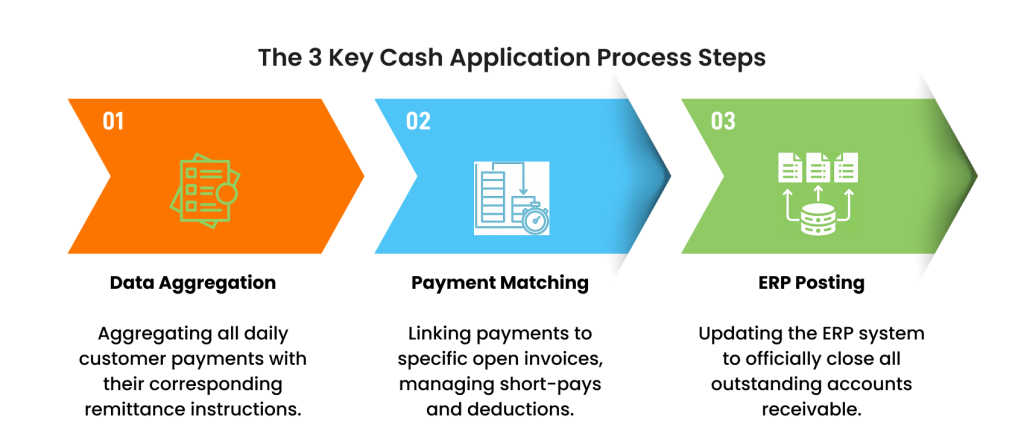
When the customer pays an identified invoice in full, the simplified accounting effect is:
The final matching action is often called clearing. It means the payment and invoice are linked so the invoice is no longer open.
A critical mapping insight: cash application is not merely the last step after collections. A customer may pay before any collection outreach. Cash application is triggered by a receipt, while collections is triggered by payment risk or overdue AR. Both interact with the AR ledger, but their triggers differ.
Essential feedback loops
An end-to-end map should make exceptions visible, because exceptions create most operational workload.
| Exception | Likely route back through the process |
|---|---|
| Invoice has the wrong price | Billing investigates against the approved order; a credit memo or corrected invoice may be required |
| Customer disputes services not activated | Billing, Customer Success, and Order Management validate the service start date and contract terms |
| Customer pays less than invoiced | Cash Application posts the undisputed amount where allowed; AR and Collections investigate the deduction |
| Payment arrives with no remittance | Cash Application identifies the payer, requests remittance, or posts controlled unapplied/on-account cash |
| Contract changes mid-term | Order Management updates the contract and billing schedule; Billing and Revenue Accounting assess downstream effects |
| Customer does not pay by due date | AR provides aging; Collections begins the approved dunning and escalation process |
This is why an O2C map should never imply that each team can optimize independently. For example, a Billing team can make its “invoice volume” metric look strong by sending invoices quickly, but inaccurate invoices will later worsen disputes, collections productivity, unapplied cash, and close effort.
Revenue recognition and close: the financial completion of the process
For SaaS, the invoice date and revenue-recognition date are frequently different.
Revenue accounting applies the revenue model to determine what was promised, the transaction price, and when the promised service is delivered. In a straightforward subscription arrangement, revenue is often recognized evenly over the period that the customer receives access to the service.
For a 12-month subscription billed in advance, a simplified pattern looks like this:
| Event | AR | Cash | Deferred revenue | Recognized revenue |
|---|---|---|---|---|
| Invoice issued for | ||||
| One month of service delivered | ||||
| Customer pays invoice | ||||
| Remaining months of service | decreases monthly | increases monthly |
The monthly revenue entry in this simple example is:
Revenue recognition depends on satisfaction of the performance obligation, not on when cash is received. That is the central reason an O2C manager must understand both operational data and accounting consequences.
At month-end, the close process gathers evidence from each stream:
- Billing confirms invoices and credits are complete and recorded in the right period.
- AR reconciles the invoice and credit population to the AR subledger.
- Cash Application reconciles posted receipts to bank activity and investigates unapplied cash.
- Revenue Accounting validates revenue schedules, deferred revenue, and contract changes.
- Accounting reconciles subledgers and revenue schedules to general-ledger balances, reviews unusual items, and completes period-close controls.
Think of close as a test of whether the records across the map tell one coherent story. The signed contract, order, invoice, open AR, cash receipt, deferred revenue balance, recognized revenue, and general ledger should agree with one another after allowing for valid timing differences.
A compact manager-level map narrative
A concise way to explain the full O2C lifecycle is:
O2C begins with a validated customer and a complete contract or order record. The order is checked for required approvals, credit terms, pricing, tax, service dates, and billing schedule before it is released. Once the subscription is activated or reaches a billable milestone, Billing issues invoices and posts receivables. AR monitors open balances and disputes, while Collections works overdue and risk-based accounts. When payments arrive, Cash Application uses remittance and invoice references to match, clear, and post receipts, or records controlled exceptions. In parallel, Revenue Accounting recognizes SaaS revenue over the service period rather than simply when invoiced or paid. At month-end, Billing, AR, Cash Application, Revenue Accounting, and the general ledger are reconciled so the company can close with complete and supported balances.
Use this as the first draft of your own process map. To make it usable in a real role, add four annotations to every stage:
- Input: What record or event starts the work?
- Processing rule: What validation, approval, or decision is required?
- Output: What document, system record, or accounting result is produced?
- Exception route: What happens when the data does not agree?
That level of detail distinguishes a decorative flowchart from an operating map that can expose bottlenecks, control gaps, and unclear handoffs.
Key takeaways
- B2B SaaS O2C connects commercial agreements, customer and order data, recurring billing, AR, collections, cash, revenue accounting, and close.
- Bookings, billings, cash, and revenue measure different milestones and often occur on different dates.
- SaaS service delivery and revenue recognition continue throughout the contract period; O2C is therefore a recurring lifecycle.
- AR tracks what customers owe, Collections pursues overdue risk, and Cash Application matches actual receipts to customer balances.
- Month-end close validates that the operational records and accounting balances across the entire lifecycle reconcile.
Next, you will add structure to this map by assigning who is Responsible, Accountable, Consulted, and Informed at each cross-functional O2C stage.
Can't find a good explanation? Sign up and we'll make it for you
Sign up