
Hello. In the last lesson, you practiced checking whether evidence truly supports an author’s claim. Now we shift to the GED editing questions, where you must notice when ideas are not separated or completed correctly.
This is a high-value, practical skill: GED questions often ask which revision makes a sentence clear and correct. Today’s focus is on three common sentence-boundary errors: fragments, run-ons, and comma splices. Keep the goal simple: identify whether each part is a complete sentence, then use punctuation or a connector that matches the meaning.
Start with one key idea: the independent clause
An independent clause can stand alone as a complete sentence. It needs:
- A subject: who or what the sentence is about
- A complete verb: what the subject does or is
- A complete thought
The volunteers cleaned the park.
This is complete. Volunteers is the subject, cleaned is the verb, and the thought is finished.
Some word starters make a clause dependent, meaning it cannot stand alone:
- because
- although
- when
- if
- while
- since
Because the weather improved
This has a subject and verb, but it makes the reader wait: What happened because the weather improved? It needs a complete clause attached to it.
Because the weather improved, the volunteers cleaned the park.
A short sentence is not automatically wrong. For example, “She laughed.” is a complete sentence. The issue is completeness, not length.
The three errors you need to spot
| Error | What it is | Example | Fast repair |
|---|---|---|---|
| Fragment | An incomplete sentence | “When the bus arrived.” | Attach it to a complete thought. |
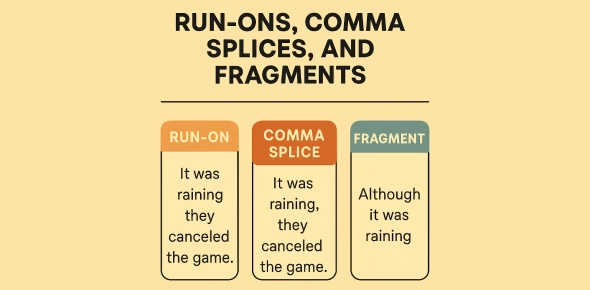
| Run-on | Two complete sentences with no correct separation | “The bus arrived everyone got on.” | Use a period, semicolon, or comma plus a connector. |
| Comma splice | Two complete sentences joined by only a comma | “The bus arrived, everyone got on.” | Use a period, semicolon, or comma plus a connector. |
The two questions to ask are:
- Can each side stand alone as a sentence?
- If both sides can, is the punctuation strong enough?
Fixing fragments
A fragment often happens in one of three ways.
1. It is missing a subject
Worked late at the grocery store.
Who worked late? Add a subject:
Maya worked late at the grocery store.
2. It is missing a complete verb
The students in the computer lab.
The sentence tells where the students are but not what they are doing. Add a verb:
The students are working in the computer lab.
3. It begins with a dependent word
Although the store was closing soon.
This is not a full thought. Connect it to the idea it belongs with:
Although the store was closing soon, Marcus finished his shopping.
You can also remove the dependent starter when that creates the intended meaning:
The store was closing soon.
Watch this short section from Sentence Fragments & How to Fix Them by Sparkle English. It focuses on the fragment type that appears often in GED editing: a dependent clause incorrectly left on its own.
Sentence Fragments & How to Fix Them | How to Write Complete Sentences | English Writing Essentials
Watch “Sentence Fragments & How to Fix Them” from Sparkle English for a clear explanation of why clauses beginning with words such as “because,” “when,” and “if” usually need another clause.
Watch dependent fragments. Focus on the question, “Does this thought leave the reader waiting for more?” Notice how each correction attaches the incomplete idea to a complete sentence.
Fixing run-ons and comma splices
A run-on joins two independent clauses with nothing between them:
The library closed early we returned the books the next day.
A comma splice joins two independent clauses with only a comma:
The library closed early, we returned the books the next day.
Both sentences contain two complete thoughts:
- The library closed early.
- We returned the books the next day.
A comma by itself cannot safely join those two complete thoughts. On the GED, use one of these reliable repairs.
Repair 1: Make two sentences
This is often the fastest and safest choice.
The library closed early. We returned the books the next day.
Remember to capitalize the first word of the new sentence.
Repair 2: Use a comma plus a coordinating conjunction
The coordinating conjunctions are often remembered as FANBOYS:
- for
- and
- nor
- but
- or
- yet
- so
The library closed early, so we returned the books the next day.
Choose a conjunction that fits the relationship between the ideas:
| Meaning | Useful connector |
|---|---|
| Add information | and |
| Contrast | but, yet |
| Cause or result | so |
| Choice | or |
Do not add and automatically. The connector should make sense. For instance, if the second idea is a result, so may be better than and.
Repair 3: Use a semicolon
A semicolon can join two closely related complete sentences:
The library closed early; we returned the books the next day.
For test purposes, remember this rule: a semicolon needs a complete sentence on both sides.
Incorrect: “Because the library closed early; we returned the books.”
The first part is dependent, so it cannot sit before a semicolon.
A quick GED decision routine
When an editing question highlights a sentence, slow down for a few seconds and use this routine:
-
Find the verbs.
This helps you locate possible clauses. -
Check each clause.
Can it stand alone as a complete sentence? -
Name the problem.
- No complete thought: fragment
- Two complete thoughts with nothing: run-on
- Two complete thoughts with only a comma: comma splice
-
Choose the cleanest repair.
Usually, a period is the safest choice. A comma plus and, but, or so is correct only when the connector fits. A semicolon works only between closely related complete thoughts.
You do not need to pick the fanciest sentence. You need the choice that is complete, correctly punctuated, and clear.
For a quick review of run-ons and comma splices before the practice questions, use this portion of What to Know about Run-On Sentences and Comma Splices to Pass GED RLA by Test Prep Champions.
What to know about Run-On Sentences and Comma Splices to pass GED RLA
Watch this Test Prep Champions video for GED-focused examples of separating complete thoughts with periods, commas plus coordinating conjunctions, and semicolons.
Watch run on fixes first. Then watch comma splices. As you watch, identify the two complete thoughts before looking at the correction. The key distinction is simple: a run-on has no proper separator; a comma splice has only a comma.
Keep these test-day rules
- A fragment lacks a complete independent clause.
- A run-on has two complete sentences pushed together without correct punctuation.
- A comma splice has two complete sentences joined by a comma alone.
- A period is always a strong, simple repair when two complete thoughts can stand separately.
- A comma needs help when joining two complete thoughts: add a fitting coordinating conjunction, such as and, but, or so.
- Do not be distracted by sentence length. A long sentence may be correct, and a three-word sentence may be complete.
Next, you will practice another frequent GED editing target: making subjects, verbs, pronouns, and their antecedents agree correctly.
Can't find a good explanation? Sign up and we'll make it for you
Sign up