
Hello! Welcome back.
In our last lesson, we analyzed Masato Nakamura's compositional approach to Sonic the Hedgehog, focusing on his use of pop song structures, unique harmonic progressions, and memorable melodic hooks. We explored the "what" of his music—the notes and chords on the page.
Today, we shift our focus to the "how"—the sound design. This lesson directly addresses the learning outcome: Deconstruct 2-3 of Nakamura's signature patch designs to identify the techniques used to achieve bright, melodic timbres. We will delve into the fundamentals of the YM2612's FM synthesis engine and then reverse-engineer some of the iconic sounds that brought Nakamura's melodies to life.
1. The Building Blocks of Genesis Sound: FM Synthesis
Before we can deconstruct Nakamura's patches, we need a solid understanding of how the YM2612 chip creates sound. Your background in physics and signal processing will be advantageous here, as the principles are grounded in wave modulation.
At its core, the YM2612 uses Frequency Modulation (FM) synthesis. This involves using one oscillator, called a modulator, to alter the frequency of another oscillator, called a carrier. The carrier is the part of the signal we ultimately hear.
- An Operator is the YM2612's term for a sine wave oscillator with its own set of parameters.
- Each of the 6 FM channels on the Genesis has 4 operators.
- An Algorithm is a pre-defined configuration that determines which operators are carriers (outputting sound) and which are modulators (modifying other operators).
The interaction between modulators and carriers creates additional frequency components called sidebands. In audio terms, these sidebands are new harmonics that enrich the simple sine wave of the carrier, creating complex timbres.
To get a practical feel for these concepts, we'll watch a tutorial that uses DefleMask, a popular tool for creating Genesis music.
DefleMask Instrument Tutorial - Sega Genesis / Megadrive FM Sound (part 1 of 3)
This video, 'DefleMask Instrument Tutorial' from the channel debuglive, provides an excellent visual introduction to the core concepts of FM synthesis on the Genesis.
Please watch two segments: 03:35 - 05:30: This part introduces operators, algorithms, and the 'Total Level' (volume) parameter. 14:50 - 18:00: This is a crucial section explaining basic 2-operator FM synthesis. Focus on how changing the modulator's level affects the brightness and harmonic content of the carrier.
2. Key Parameters for Timbre Design
As the video demonstrates, the timbre of an FM patch is defined by a handful of critical parameters for each operator. Let's formalize them, using the technical manual for the FMDRIVE VST (a modern YM2612 emulator) as a reference.
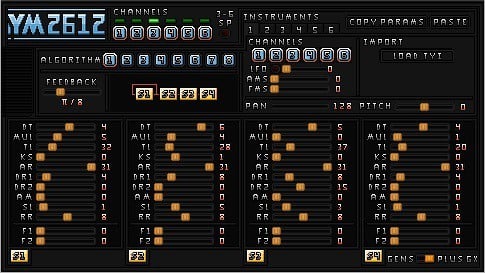
Here are the most important parameters for shaping a sound:
-
Total Level (TL): An attenuation value from 0 (max volume) to 127 (silence).
- For a carrier, TL controls its volume.
- For a modulator, TL controls the modulation index—how intensely it affects the carrier's frequency. A higher TL (lower value) on a modulator results in more sidebands and a brighter, more complex sound.
-
Multiplier (MULT): Sets the operator's frequency as a multiple of the base note's frequency.
- Integer
MULTvalues (1, 2, 3, 4...) create harmonic relationships, resulting in pitched, musical sounds. A higherMULTon a modulator adds higher-frequency harmonics. - Non-integer or fractional
MULTvalues create inharmonic sidebands, leading to metallic, bell-like, or percussive sounds.
- Integer
-
Envelope (ADSR): The Attack-Decay-Sustain-Release envelope controls how an operator's TL changes over time.
- The envelope on a carrier shapes the sound's volume.
- The envelope on a modulator shapes the sound's timbre over time. A fast attack and decay on a modulator can create a sharp, bright transient at the start of a note.
-
Feedback (FB): A special parameter for Operator 1, allowing it to modulate itself. This can transform its sine wave output into something closer to a sawtooth wave, which is inherently richer in harmonics.
To solidify your understanding of these parameters, please review the following technical documentation.
The 'SEGA FM DRIVE TECH MANUAL' provides precise definitions for the YM2612's parameters. Reading these sections will clarify the function of each control.
Please read the following two sections: OPERATOR CORE: Find this section on page 4. Read the descriptions for TL, KS, MUL, and DT1. ALGORITHMS and Feedback: Find this section on page 7. Review the algorithm diagram and read the description of the Feedback (FB) mechanism.
3. Deconstructing Nakamura's Patches
With this foundation, we can now analyze how these parameters were likely combined to create some of Sonic's signature sounds.
Patch 1: The Green Hill Zone Lead
This is arguably the most iconic sound in the game—a bright, punchy lead that carries the main melody.
- Sonic Goal: A clear, bright, and melodic tone that cuts through the mix.
- Likely Technique: A simple 2-operator stack.
- Algorithm: A simple modulator-carrier structure like that found in Algorithm 4 or 5. Let's assume Operator 1 (modulator) feeds into Operator 2 (carrier).
- Brightness (
MULT&TL): The brightness comes from the modulator (OP1). AMULTvalue of 2, 3, or 4 on OP1 would add pleasant upper harmonics to the fundamental frequency of the carrier (OP2, likely withMULT=1). TheTLof OP1 would be set high enough to create a bright timbre, but not so high that it dissolves into noise. - Punchiness (
Envelope): The key to its punchy character is the modulator's envelope. OP1 would have a very fast attack and a quick decay to a lower sustain level. This creates a bright "chiff" at the very beginning of the note, which then softens slightly for the sustained part. The carrier's envelope would have a more standard shape, perhaps with a quick decay and full sustain, to hold the note's volume.
This is the classic technique for creating bright lead and bass sounds in FM synthesis: use the modulator's MULT to set the harmonic character and its Envelope to shape the timbre's evolution.
Patch 2: The Spring Yard Zone "Clavinet"
This sound is funkier and more metallic, fitting the New Jack Swing influence we discussed previously.
- Sonic Goal: A percussive, metallic, and harmonically rich sound reminiscent of a Hohner Clavinet.
- Likely Technique: A more complex operator stack, possibly involving feedback.
- Algorithm: An algorithm that allows for a deeper stack, like Algorithm 0 or 1, would be suitable. In Algorithm 0, three modulators (OP1, OP2, OP3) are stacked in series before hitting the carrier (OP4).
- Metallic Timbre (
MULTRatios): The metallic quality is achieved by setting specificMULTratios between the operators in the stack. For instance, a ratio of 1:3:5 in the modulator stack can create complex, slightly inharmonic sidebands. Thedebuglivevideo touches on this when discussing how higher multipliers sound more "metallic." - Feedback (
FB): To add even more grit and harmonic richness, a moderate amount ofFeedbackon OP1 would be used. This would turn OP1's output from a pure sine wave into a more complex sawtooth-like wave before it even begins modulating the next operator, adding an aggressive edge. - Percussive Envelope: As with the Green Hill lead, the envelopes are critical. All modulating operators would have very fast attacks and decays with zero sustain. This ensures their contribution is almost entirely in the initial transient, creating the percussive "hit" of the note. The carrier's envelope would then provide the decay of the note itself.
Patch 3: The Star Light Zone Pad/Lead
This sound is much smoother and more atmospheric, fitting the track's relaxed, nocturnal feel.
- Sonic Goal: A soft, evolving sound with expressive vibrato.
- Likely Technique: Simple modulation with LFO.
- Algorithm: A simple 2-operator stack (like Algorithm 4 or 5) would suffice.
- Softness (
TL&MULT): The key here is subtlety. The modulator'sTLwould be set to a lower level (a higher numerical value) for a gentler modulation, producing fewer, less prominent harmonics. TheMULTwould likely be a simple integer like 2, adding just a bit of body without harshness. The carrier's envelope would have a slightly slower attack to create a gentle "swell" at the start of each note. - Vibrato (LFO): The signature wavering pitch is achieved using the YM2612's global Low-Frequency Oscillator (LFO). By enabling Pitch Modulation Sensitivity (
PMS), the LFO's sine wave output modulates the pitch of the entire channel, creating a smooth and consistent vibrato. This adds the expressive, "singing" quality that defines the melody.
Conclusion
As we've seen, creating Nakamura's bright and melodic timbres was a deliberate process of manipulating a few key FM synthesis parameters. It wasn't just about the notes he wrote, but how he programmed the very physics of the sound waves to give those notes their distinct character.
Key Takeaways:
- Brightness is controlled by Modulators: The
Total LevelandMultiplierof modulating operators are the primary tools for adding harmonics and making a sound brighter. - Timbre Evolves with Envelopes: Applying an envelope to a modulator allows the timbre to change over time, creating percussive attacks or swelling sounds.
- Metallic Tones come from Ratios and Feedback: Using more complex
MULTratios and self-modulating feedback on Operator 1 are techniques for creating harmonically rich, metallic, or aggressive sounds. - Expressiveness is added with the LFO: Smooth vibrato, a key feature of many melodic leads, is achieved by applying the LFO to modulate the channel's pitch.
Next Lesson Preview:
Now that we understand both Nakamura's compositional style and his sound design techniques, we can explore how these two elements were integrated. In our next lesson, we will examine how he structured his memorable melodies and counter-melodies to work effectively within the Genesis's strict polyphony limitations (only 6 FM channels), a challenge that required clever arrangement and voice allocation.
Can't find a good explanation? Sign up and we'll make it for you
Sign up