
Hello! Welcome back to our final lesson on Marketing Mix Modeling.
In our last session, we focused on the critical first step of commissioning an MMM project by crafting a comprehensive brief. You learned that a successful MMM is built on clear business questions and provides not just data, but a strategic decision-making tool.
However, as we hinted, even the best MMM is not a silver bullet. It's a powerful instrument, but it plays in an orchestra of other measurement tools. Today, we address the learning outcome: to synthesize MMM findings with other measurement methods (e.g., incrementality) to create a holistic view.
Your experience with platform-specific analytics (like in Meta and Google Ads) has given you a ground-level view of performance. This lesson will elevate that perspective, showing you how a marketing leader combines the satellite view (MMM), the scientific experiment (incrementality), and the microscope view (attribution) into a single, coherent strategy.
1. The Challenge of Conflicting Signals
As a marketing leader, one of the most common challenges you'll face is that your measurement tools will disagree. Your Meta Ads manager might report a 5x ROAS, while your MMM attributes a much lower return to Paid Social. Who do you believe?
This isn't a sign that one tool is "broken." It's an expected outcome because they measure different things in different ways.
- Platform Attribution (Last-click, MTA): Tends to be bottom-up, user-level, and often over-credits channels that are the final touchpoint before conversion (like branded search or retargeting).
- Marketing Mix Modeling (MMM): Is top-down, aggregated, and better at capturing the influence of upper-funnel, brand-building channels and external factors over time.
Look at this common example:
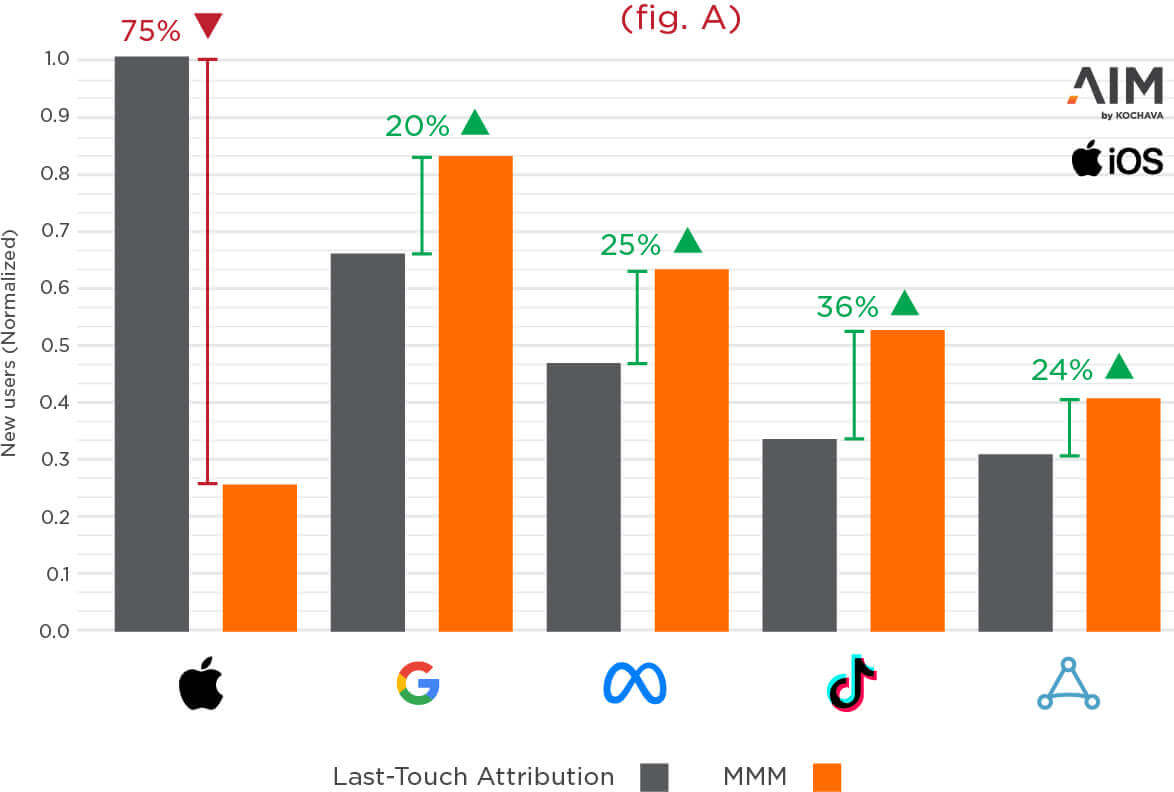
Your task as a leader isn't to pick a "winner" but to understand why they differ and use that discrepancy to uncover deeper insights. These contradictions are opportunities.
2. The Three Pillars of Modern Measurement
To build a holistic view, you need to orchestrate three distinct types of measurement, each with its own role. Think of them as providing different levels of magnification on your marketing performance.
| Methodology | Analogy | Key Question | Strengths | Weaknesses |
|---|---|---|---|---|
| Marketing Mix Modeling (MMM) | Satellite View | How should I set my total budget and allocate it across major channels? | Strategic, top-down, includes online/offline & external factors (e.g., economy). | Lacks granularity, slow to update (historically), correlational. |
| Incrementality Testing | Scientific Experiment | Is this channel truly causing more sales? | Causal "ground truth," validates other models, highly credible. | Limited scope (one channel/campaign at a time), can be complex/costly. |
| Multi-Touch Attribution (MTA) | Microscope View | Within a channel, which campaign, ad, or keyword is performing best? | Granular, real-time, user-level, great for tactical optimization. | Prone to bias (e.g., cookie issues, privacy changes), struggles with offline or cross-device journeys. |
Multi-touch attribution (MTA) vs marketing mix modeling (MMM)
To solidify the distinction between the 'satellite' and 'microscope' views, let's watch a short segment from Supermetrics that contrasts MMM and MTA. Pay close attention to the analogy of MMM as a 'GPS' for your marketing.
Please watch from 16:37 to 20:13. The speaker explains the fundamental shift from backward-looking measurement (MTA as a 'map') to forward-looking, dynamic analytics (automated MMM as a 'GPS'). This framing is perfect for a strategic leader.
The video's "map vs. GPS" analogy is powerful. MTA gives you a static map of past journeys, while a modern MMM acts like a GPS, providing forward-looking predictions and the ability to dynamically re-route your strategy based on changing conditions. Incrementality testing then acts as your occasional reality check, ensuring your GPS is calibrated to the real world.
3. Building a Unified Framework: The Power of Triangulation
So, how do you make these three pillars work together? The answer is a concept called measurement triangulation. Instead of relying on a single source of truth, you use the strengths of each methodology to cover the weaknesses of the others.
Bridging Contradictions in Measurement Data: MTA vs. MMM vs. Incrementality Testing
The article 'Bridging Contradictions in Measurement Data' from Rockerbox explains this concept well. It argues that contradictions are not setbacks but pivotal moments for marketers.
Please read the sections 'Why Contradictions Arise' and 'Navigating the Discrepancies'. Focus on the definition of triangulation and how it creates a more reliable, blended perspective.
As the article states, triangulation allows you to "use the strengths of one approach to compensate for the weaknesses of another." This creates a decision-making framework that is far more robust.
Here is a visual representation of how these systems fit together:

Let's make this even more concrete with an analogy.
How the triangulation tango reignites marketing measurement
Funnel.io's article on triangulation uses a great 'paint-by-numbers' analogy to illustrate how these methods combine to create a full picture.
Please read the section 'How measurement triangulation works — with examples'. It clearly demonstrates how MMM provides the overview, MTA fills in the details, and incrementality validates the actual impact.
4. An Actionable Workflow for Marketing Leaders
Knowing the theory is one thing; applying it is another. Here is a practical workflow you can use to synthesize these inputs and make strategic decisions.
Step 1: Set Strategy with MMM (The Satellite View)
- Use your MMM outputs (response curves, channel contributions) to answer big-picture questions and set your quarterly or annual budgets.
- Decision: "Based on our MMM, the optimal allocation for Q3 is 40% to Google Ads, 30% to Meta, 20% to TV, and 10% to partnerships. We will allocate budgets to channel teams accordingly."
Step 2: Validate and Calibrate with Incrementality (The Scientific Experiment)
- Identify the biggest areas of uncertainty or disagreement. For example, your MMM shows a low ROI for Meta, but your social team's platform attribution shows a high ROI. This is a clear signal to test.
- Action: Commission a conversion lift study on Meta to measure its true incremental impact.
- Decision:
- If the test confirms a low incremental lift, you can confidently stand by the MMM's recommendation to reduce or reallocate the Meta budget.
- If the test shows a high incremental lift, it suggests the MMM might be mis-specified. You would work with your analytics team to see why (e.g., missing variables, incorrect adstock assumptions) and calibrate the model with the test results.
Step 3: Optimize Tactics with Attribution (The Microscope View)
- Within the budget allocated in Step 1, your channel managers use platform attribution data for day-to-day optimization.
- Action: The social media team, working with their $3M quarterly budget, uses Meta's attribution to test different ad creatives, optimize audience targeting, and shift spend between campaigns (e.g., from a low-performing awareness campaign to a high-performing prospecting campaign).
- Decision: They are not deciding if Meta should get a budget, but how to best spend the budget they've been given.
This tiered approach ensures that strategic decisions are guided by a top-down view (MMM) validated by causal data (Incrementality), while still empowering teams to optimize tactically using real-time data (Attribution).
How the triangulation tango reignites marketing measurement
To see the business impact of this synthesized approach, let's look at two case studies from the Funnel.io article.
Please read the final section, '2 measurement triangulation success stories'. Note how Deuba used a holistic approach to discover that their social media ads were 80% under-attributed by their previous last-click model, leading to smarter budget decisions.
Test your understanding!
You are the Head of Performance Marketing. Your MMM results suggest that TikTok has a very low marginal ROI and its budget should be cut by 50%. Your social media team presents platform-reported data from TikTok showing strong engagement and a high number of attributed conversions.
As a leader applying the triangulation framework, what is your immediate next step, and what are the possible outcomes?
Show answer
The immediate next step is to treat the contradiction as a signal to launch an incrementality test. You would work with your team and TikTok to design a geo-lift or brand lift study to measure the true causal impact of your TikTok spend on sales or key brand metrics.
The possible outcomes are:
- The test confirms low incrementality: This validates the MMM's finding. You now have causal evidence to support the decision to reduce the TikTok budget and can confidently explain the rationale to your team and stakeholders.
- The test shows high incrementality: This suggests the MMM may be underestimating TikTok's impact. Perhaps its influence is longer-term or it impacts other channels in a way the model isn't capturing. You would then use this causal data to "calibrate" your MMM and re-evaluate the budget decision.
In either case, you have moved from a debate based on conflicting correlational models to a decision based on causal evidence.
Conclusion
You've now reached the end of the Marketing Mix Modeling module. You have not only learned how to interpret and commission an MMM but also how to place it within a sophisticated, modern measurement ecosystem.
Key Takeaways:
- No single measurement methodology is a silver bullet. Relying on one will lead to blind spots.
- Contradictions between models (e.g., MMM vs. platform attribution) are not problems to be solved, but opportunities to dig deeper and test assumptions.
- Triangulation is the strategic framework for synthesizing insights:
- Use MMM for top-down strategic budget allocation.
- Use Incrementality Tests to validate models and establish causality.
- Use Attribution (MTA) for real-time, in-channel tactical optimization.
- Your role as a leader is to orchestrate this system, using each tool for its intended purpose to build a holistic and defensible view of marketing performance.
Preview of the Next Lesson:
This lesson concludes our deep dive into MMM. We will now move to the next module, Multi-Touch Attribution and Customer Journey Intelligence. In the first lesson, we will take a closer look at the "microscope view" by comparing the strategic implications of different attribution models (e.g., last-click, linear, data-driven). This will build directly on the framework we established today, giving you the knowledge to guide your teams in their tactical optimization efforts.