Introduction
Welcome to the final lesson in our module on Institutional Pluralism. In our previous lesson, we explored polycentric governance, a model of horizontal, networked order where multiple, overlapping authorities create adaptive solutions from the ground up. You saw how this system, championed by Elinor Ostrom, challenges the simple state-versus-market dichotomy by demonstrating the power of self-organization.
Today, we will broaden our lens to the macro-level societal architecture that is a central interest for you. We will analyze the dynamic balance between three fundamental spheres of social organization: the State, the Market, and Civil Society. Our goal is to apply the framework of institutional pluralism to understand how the interplay between these domains affects individual liberty.
This lesson synthesizes the concepts we've been building, from Montesquieu's intermediate bodies to Ostrom's polycentric networks. We will move beyond simply identifying different institutions to analyzing the functional roles they play in relation to one another—sometimes competing, sometimes integrating, and, crucially for liberty, sometimes opposing one another.
1. The Three Spheres of a Modern Society
To analyze a society's architecture, we first need to identify its main components. A common and powerful model divides society into three distinct, yet interacting, spheres.
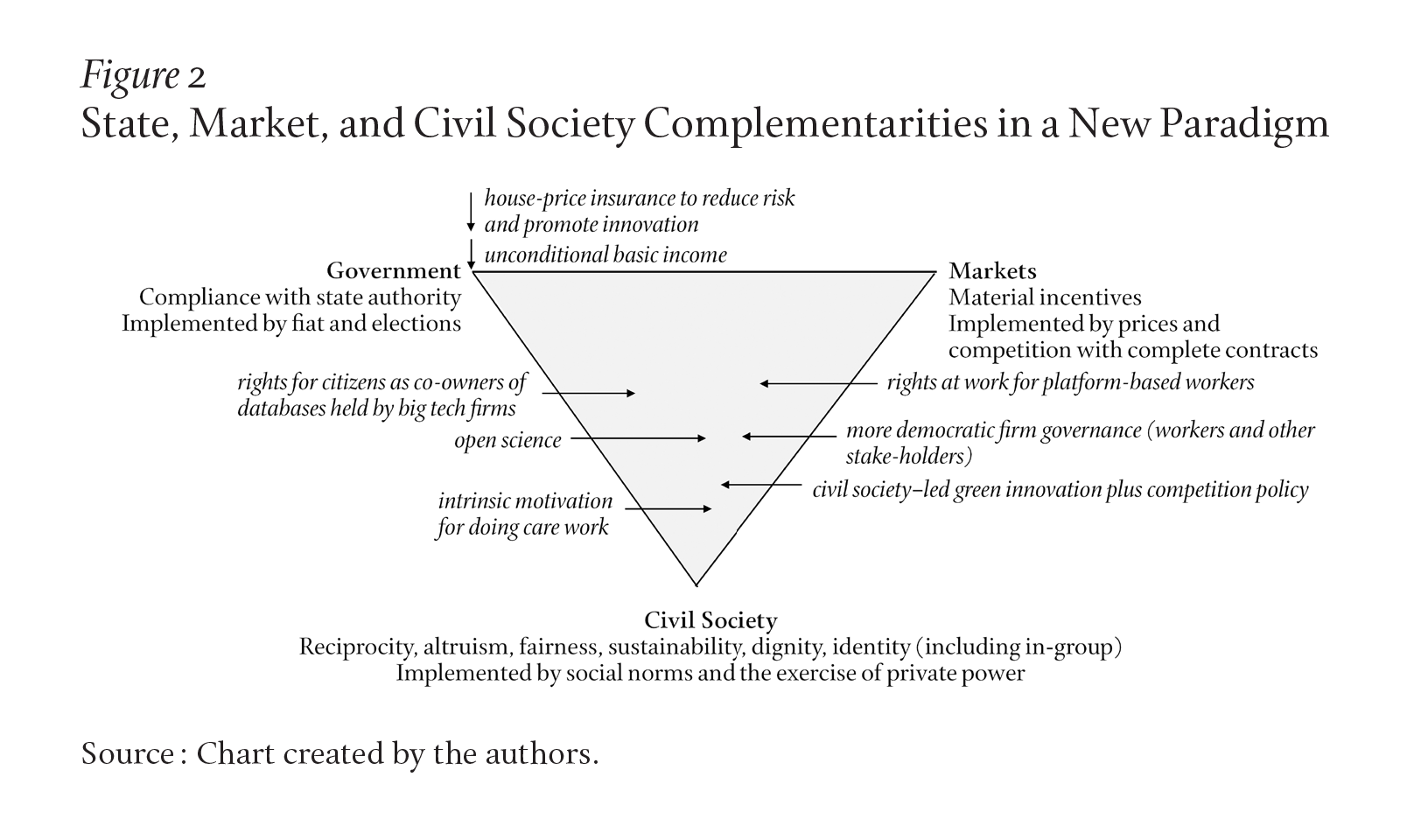
As the diagram shows, these spheres are:
- The State (Government): The set of institutions holding the monopoly on the legitimate use of force within a territory. It operates through hierarchical authority, law, and administration. Its primary logic is governance, regulation, and the provision of public goods.
- The Market: The sphere of production, distribution, and consumption organized through voluntary exchange. It operates through competition, contracts, and price signals. Its primary logic is efficiency and the satisfaction of individual preferences.
- Civil Society: This is the vast "third sector" that is neither state nor market. It consists of the web of voluntary associations and non-governmental institutions that bind people together, such as families, religious organizations, charities, community groups, unions, professional associations, and advocacy movements. It operates through trust, cooperation, and shared norms.
Most classical economic and political theories, as you'll know from your background, tend to focus on the State-Market axis. The civil society perspective insists that this third sphere is not just a residual category but a crucial source of social order and individual identity.
PART ONE: The Idea of Civil Society
To formalize this distinction, let's read a brief text that contrasts the civil society perspective with theories that reduce social order to either state power or market forces.
Please read the section titled 'Civil Society Versus Realists and Rationalists.' This section starts on page 19. It distinguishes the civil society approach from 'Realist' (state-centric) and 'Rationalist' (market-centric) perspectives, which should be familiar frameworks from political science and economics.
As the reading highlights, viewing society through this three-part lens prevents us from reducing all social problems to questions of either state coercion or market incentives. Civil society has its own logic, grounded in normative and consensual relationships, which is essential for a functioning free society.
2. The Functions of Pluralism: Three Analytical Models
Recognizing that society has multiple institutions is just the first step. To analyze their effect on liberty, we need to understand the roles these institutions play relative to each other and to the central state. A powerful framework for this comes from the political theorist Jacob T. Levy. He proposes three distinct models for how intermediate groups function within a pluralist order.
1 Pluralism Without Privilege? Corps Intermédiaires, Civil ...
We will now turn to Jacob T. Levy's paper, 'Pluralism Without Privilege?'. It provides a sophisticated historical and analytical framework for understanding institutional pluralism.
Please read the introductory section that lays out three models of group life. It begins, 'I begin with three simplified ways of thinking...' and ends just before the paragraph starting 'With these three models in mind...'. Focus on understanding the distinct logic of the competitive, integrative, and oppositional models.
Let's break down these three crucial models:
-
Competitive Pluralism: This model sees groups in a state of horizontal rivalry. Municipalities compete for residents (the Tiebout model), political parties compete for votes, and universities compete for students. This model aligns well with the economic logic of competition and the polycentric systems we studied last lesson. The key dynamic is choice and exit.
-
Integrative Pluralism: This model focuses on vertical, harmonious nesting. It's about how smaller groups connect their members to a larger whole. A local parish integrates a believer into the wider Church; a professional guild integrates a craftsman into the state's economic order. The doctrine of subsidiarity we discussed previously is a classic example of this integrative logic. The key dynamic is belonging and participation.
-
Oppositional Pluralism: This model emphasizes vertical rivalry or resistance. Here, intermediate groups act as a check on the central power of the state. They provide their members with the resources, norms, and organization to dissent, to say "no" to the state. The key dynamic is counterbalance and resistance.
For our analysis of liberty, this third model—oppositional pluralism—is of paramount importance. A society's freedom often depends on the existence of institutions with the power and motivation to stand against the state's centralizing tendencies.
3. Civil Society as an Oppositional Force
The idea that liberty is protected by powerful, independent groups that can defy the sovereign is a cornerstone of the institutional pluralist tradition. We'll now see how this "oppositional" logic was central to the thought of Montesquieu and Tocqueville.
Montesquieu and Pluralism with Privilege
As you know from our syllabus design, Montesquieu is a key figure. His defense of liberty was not based on individual rights alone, but on the constitutional role of powerful intermediate bodies, the corps intermédiaires.
1 Pluralism Without Privilege? Corps Intermédiaires, Civil ...
Let's return to the Levy paper to see how he analyzes Montesquieu's argument.
Please read Section II, which focuses on Montesquieu's theory of 'corps intermédiaires'. Pay attention to how the privileges and honor of the nobility, clergy, and towns gave them both the power and the motivation to check the monarch and prevent a slide into despotism.
Montesquieu’s insight is that liberty requires more than just good intentions from a ruler; it requires a structural balance of power. The nobility, clergy, and guilds, precisely because of their entrenched privileges and independent social standing, could act as a bulwark against the king’s ambition. Their sense of "honor" was an extra-political motivation that compelled them to defend their standing, and in doing so, they defended the constitutional limits on power. This is a classic case of oppositional pluralism with privilege.
Tocqueville and Pluralism without Privilege
Over a century later, Alexis de Tocqueville visited an America that had explicitly rejected the hereditary aristocracy and privileged orders of Europe. He sought to understand how liberty could survive in a democratic age of equality. His answer lay in the Americans' "art of associating"—the vibrant civil society that had emerged to fill the space left by the old corps intermédiaires.
1 Pluralism Without Privilege? Corps Intermédiaires, Civil ...
Now, let's examine Tocqueville's analysis of this new form of pluralism.
Please read Section V on Tocqueville. Focus on how he saw American voluntary associations and, especially, local self-government (townships) as the democratic equivalent of the old intermediate bodies. Note his concern that these new, fluid associations might be too weak to resist the 'soft despotism' of a centralized, bureaucratic state.
Tocqueville saw that in an egalitarian society, the isolated individual is powerless against the state or the "tyranny of the majority." American liberty was preserved because individuals constantly formed associations—political, commercial, religious, and civic. These groups, along with strong local governments, served as a buffer, mediating between the individual and the central state. They were the engine of oppositional pluralism without privilege.
Yet, as Levy points out, Tocqueville (and his predecessors like Adam Smith and Benjamin Constant) remained concerned. Could these voluntary, fluid associations, populated by what the sociologist Ernest Gellner would later call "modular man," truly generate the same oppositional energy as the old, privileged orders whose members' very identity and honor were tied to their institutional role? This question remains at the heart of debates about civil society today.
4. Finding the Right Balance: A Normative Debate
So, what is the ideal relationship between the state, the market, and civil society for preserving liberty? This is not merely a descriptive question; it's a deeply normative one. Different political philosophies propose different arrangements, prioritizing different values.
The balance is delicate:
- An overly powerful State can crush both the market and civil society, leading to totalitarianism.
- An unfettered Market can commodify all aspects of life, eroding the norms of trust and solidarity that underpin civil society (a critique you'll find in both conservative and leftist thought).
- A dominant Civil Society with strong, non-overlapping group identities can lead to a fragmented, tribalistic, or "segmented" social order, undermining the universal rule of law necessary for both a national market and a liberal state.
To understand these trade-offs, we can look at several competing visions for how the three spheres should relate.
PART ONE: The Idea of Civil Society
The paper 'The Idea of Civil Society' outlines four distinct conceptions of how civil society should interact with the state and market. This framework will help us map the landscape of the debate.
Please read the section titled 'Four Contending Proposals,' which describes the Communitarian, Social Conservative, Left-Progressive, and Liberal conceptions. Focus on how each view envisions the proper role of civil society in relation to state power and market logic.
As the reading shows, the "right" balance is contested:
- Liberal View (e.g., Michael Walzer): Values civil society for fostering tolerance and individual choice. The state should remain neutral between different ways of life, protecting the autonomy of individuals and groups. Liberty is maximized when civil society is a space of free entry and exit.
- Communitarian View (e.g., Charles Taylor): Values civil society for building solidarity and shared moral understandings ("horizons of significance"). A strong civil society is necessary for meaningful individual autonomy. The state can and should partner with civil society to foster a sense of common purpose.
- Left-Progressive View (e.g., Cohen & Arato): Sees civil society as the crucial "public sphere" where social movements arise to challenge the oppressive logic of both state power and market profit. It is the engine of emancipation and the expansion of rights (e.g., for environmental, feminist, or anti-racist causes).
- Social Conservative View (e.g., drawing on MacIntyre): Values civil society for upholding traditional moral virtues and institutions (family, church). They are often willing to use state power to defend these traditions against what they see as the corrosive effects of both market-driven individualism and liberal progressivism.
Each of these visions implies a different architecture for society and a different understanding of how liberty is best secured. The enduring tension, particularly within modern liberalism, is between the Liberal emphasis on individual autonomy and choice and the Communitarian emphasis on the solidarity and shared norms necessary to sustain a free society.
Test your understanding!
Consider the ongoing debate about the power of large technology platforms (e.g., Google, Meta, Amazon). Analyze this issue using the frameworks from this lesson.
- How do the State, Market, and Civil Society interact in this domain?
- What kinds of oppositional forces exist or have been proposed to check the power of these platforms?
- Briefly map one or two proposed solutions to the four normative conceptions (Liberal, Communitarian, etc.). For example, which conception would most favor strong antitrust action? Which might favor data ownership rights for users?
Show answer
-
Three Spheres Interaction:
- Market: The platforms operate as massive market actors, competing for users, advertisers, and data.
- State: Governments attempt to regulate them through antitrust laws (e.g., lawsuits against Google), privacy legislation (e.g., GDPR), and content moderation rules.
- Civil Society: Advocacy groups (like the Electronic Frontier Foundation), journalists, academics, and user-led movements scrutinize the platforms' actions, campaign for new regulations, and create alternative, open-source technologies.
-
Oppositional Forces:
- State vs. Market: The most direct oppositional force is the state's use of antitrust and regulatory power to break up or constrain the companies.
- Civil Society vs. Market: Advocacy groups act as an oppositional force by organizing boycotts, exposing harmful practices, and building public pressure for change.
- Civil Society vs. State: Civil society groups also act oppositionally toward the state when they lobby against surveillance laws or censorship that the state might want to impose via the platforms.
-
Mapping Solutions to Normative Conceptions:
- Left-Progressive: This view would strongly support robust state intervention. Solutions like aggressive antitrust action to break up monopolies, strict regulation to combat misinformation, and empowering platform workers align with the goal of using state and civil society power to challenge concentrated corporate power.
- Liberal: This view might be more divided. It would support solutions that enhance user choice and autonomy, such as laws guaranteeing data portability (making it easy to leave a platform) or user ownership of data. It might be warier of heavy-handed state content regulation that could infringe on free speech.
- Communitarian: This view might focus on the platforms' impact on social cohesion. It could support measures designed to foster healthier online communities, reduce polarization, and require platforms to invest in the "social health" of their ecosystems, perhaps through a state-civil society partnership.
Conclusion
In this lesson, we have moved from specific institutional models to a broad analysis of societal architecture. We have seen that a free society depends on a complex and dynamic balance between the state, the market, and a vibrant civil society.
Key Takeaways:
- Modern societies can be understood as an interplay of three spheres: State, Market, and Civil Society.
- Institutional pluralism can serve competitive, integrative, or oppositional functions. For preserving liberty, the oppositional role of intermediate institutions is critical.
- Thinkers like Montesquieu and Tocqueville show that powerful, independent groups—whether privileged corps or voluntary associations—are essential for checking the centralizing tendencies of the state.
- The "ideal" balance between the three spheres is a subject of intense normative debate, with different political philosophies (Liberal, Communitarian, etc.) offering competing visions.
Preview of the Next Lesson:
We have focused on how external institutional arrangements—a balance of power between different societal groups—can protect liberty. In our next module, we will turn to a different, though related, question. We will explore the republican tradition, which argues that freedom is not merely about being left alone (non-interference), but about not being subject to the arbitrary power of a master. This concept, known as non-domination, shifts the focus from external checks to the internal design of the law and the state itself. This will provide another orthogonal perspective on justice and liberty.