
Hello. In the previous lesson, we traced the rise of Muslim political authority from Sindh to the Mughal imperial system and ended with a crucial paradox: by Aurangzeb’s death in 1707, the Mughal Empire covered more territory than ever, yet its institutions were already under acute strain.
This lesson explains how that strain became political fragmentation, why regional powers did not simply replace the Mughals with a new all-India empire, and how the English East India Company converted commercial privileges into territorial sovereignty. The central CSS/PMS argument is that Mughal decline created opportunities, but British ascendancy required its own military-fiscal, diplomatic, and administrative capacities. Neither development was inevitable.
1. The right way to frame 1707–1857
It is misleading to write that “the Mughal Empire ended in 1707.” Aurangzeb’s death marked the end of an era of effective imperial dominance, not the immediate disappearance of the dynasty. Mughal emperors remained on the throne in Delhi until 1857, but increasingly possessed ceremonial legitimacy rather than independent military or fiscal power.
A more accurate periodization is:
| Period | Main development | Historical significance |
|---|---|---|
| 1707–1739 | Succession struggles, factional court politics, provincial autonomy | Imperial authority weakens from within |
| 1739–1765 | Foreign invasions and rise of regional powers; Company gains Bengal | The Mughal centre loses prestige; Company acquires a fiscal base |
| 1765–1818 | Company expands from Bengal; Mysore and Maratha power defeated | A trading corporation becomes the strongest Indian military-fiscal power |
| 1818–1857 | Paramountcy, annexations, Sindh and Punjab conquest, Awadh annexed | Company establishes subcontinental supremacy, provoking widespread resentment |
| 1857–1858 | Revolt and its suppression | Mughal sovereignty ends; Crown replaces Company rule |
The process was therefore not a simple transfer of power from “Muslims” to “the British.” Between them stood powerful and diverse regional states: Bengal, Awadh, Hyderabad, Mysore, the Maratha confederacy, the Sikh kingdom of Punjab, and numerous smaller principalities. Some emerged from Mughal institutions; others challenged them. The Company succeeded partly by exploiting their rivalries and partly by developing resources no Indian polity could easily match.
A strong examination thesis is:
Mughal decline after 1707 resulted from the interaction of imperial overextension, a crisis in the revenue and jagir system, succession conflict, weakening military organization, regional resistance, and external invasions. British ascendancy was not the automatic consequence of this decline: the East India Company built supremacy through naval-commercial power, disciplined sepoy armies, Bengal’s revenue, alliances, indirect control over princely states, and carefully timed conquest.
2. Why the Mughal system weakened after Aurangzeb
Political causes: succession, factions, and provincial autonomy
The Mughal dynasty had no binding principle of primogeniture, under which the eldest son automatically succeeds. Each imperial death could produce a contest among princes. Such contests had occurred before 1707, including Aurangzeb’s own struggle for the throne, but they became more destructive once the empire faced simultaneous fiscal, military, and regional pressures.
After Aurangzeb, Bahadur Shah I ruled from 1707 to 1712 but could not restore durable central authority. Later rulers, including Jahandar Shah, Farrukhsiyar, Muhammad Shah, and Shah Alam II, relied heavily on powerful nobles. The Sayyid brothers became famous as “kingmakers” because they helped place Farrukhsiyar on the throne in 1713 and later removed him. This illustrates the change in the balance of power: nobles no longer simply served the emperor; they competed to control him.
Court factionalism was not merely a story of personal intrigue. It affected appointments, military command, access to revenue assignments, and provincial authority. Rival Iranian, Turani, Afghan, Hindustani, Rajput, and Deccani interests competed within the nobility. When imperial authority weakened, provincial governors and large revenue intermediaries had stronger incentives to secure their own territories and income.
Several provinces became effectively autonomous while retaining nominal Mughal loyalty:
- Bengal under Murshid Quli Khan and his successors;
- Awadh under Saadat Khan and later Shuja-ud-Daulah;
- Hyderabad under Nizam-ul-Mulk Asaf Jah from 1724.
These were not necessarily immediate “rebellions.” Their rulers often continued to use Mughal titles, institutions, and symbols of legitimacy. But revenue, troops, and local patronage became increasingly controlled at the provincial level rather than from Delhi.
Imperial overextension and the Deccan burden
Aurangzeb’s long Deccan campaigns were a major structural burden. His annexation of Bijapur in 1686 and Golconda in 1687 enlarged the empire, but also brought it into prolonged conflict with mobile Maratha forces. The emperor spent much of his later life in the Deccan, far from the northern political centre.
The consequences were cumulative:
- Large armies had to be maintained over great distances.
- Supply lines, horses, weapons, and officials consumed enormous resources.
- The empire expanded faster than its administrative capacity.
- Provincial governors gained room to act independently while the emperor was preoccupied in the south.
- Maratha warfare demonstrated the difficulty of controlling extensive territory by conventional imperial campaigns alone.
Aurangzeb’s religious policies also mattered, especially the reimposition of jizya in 1679 and conflicts with Rajput houses, Sikhs, Jats, and others. Yet it is analytically weak to explain the decline solely through “religious intolerance.” Hindu officials continued to serve in the Mughal administration, and regional resistance had political, fiscal, and local causes as well as religious dimensions. The more convincing argument is that policies which alienated important allies became especially costly when the state was already overstretched.
3. The fiscal core: the jagirdari and agrarian crises
The Mughal Empire was fundamentally a military-fiscal state. It depended on land revenue to pay officials, sustain cavalry, finance war, and maintain the imperial court.
Recall the previous lesson’s distinction:
- A mansab was a rank in the imperial service.
- A jagir was usually a transferable assignment of revenue from a territory, used to pay a mansabdar.
- A zamindar was a local intermediary with varying hereditary claims, social influence, and revenue rights.
The system functioned when the emperor could allocate productive jagirs, discipline mansabdars, and ensure that revenue reached the state. By the late Aurangzeb period, this balance deteriorated.
The jagirdari crisis
There were more nobles seeking revenue assignments than there were sufficiently productive jagirs available. The expansion into the Deccan required the incorporation of new commanders and elites, increasing the number of mansabdars. At the same time, many desirable assignments were scarce or yielded less actual income than their assessed revenue suggested.
The key distinction is between:
- Jama: assessed or expected revenue;
- Hasil: revenue actually collected.
When actual revenue fell below expected revenue, jagirdars attempted to extract more from local society during their often short tenure. That created conflict with zamindars, village headmen, peasants, and rival officials. Rather than binding the nobility to the centre, the jagir system increasingly encouraged competition, factionalism, and local power-building.
Agrarian pressure and social resistance
Land revenue was the principal source of state wealth, but heavy assessment could weaken the very agricultural base on which the empire depended. In some regions, peasants fled, resisted demands, or aligned with local chiefs. Zamindars and rural groups also resisted when imperial officials threatened their established rights.
This does not mean every rural disturbance was a modern nationalist revolt or a unified religious movement. The Jats around Mathura and Agra, the Sikhs in Punjab, the Marathas in the Deccan, and various Rajput groups had distinct political histories and interests. Yet their success revealed a common structural fact: the weakened imperial centre could no longer maintain the negotiated balance among revenue collectors, military elites, local magnates, and cultivators.
The following reading gives you a useful historiographical vocabulary. Do not memorize scholars as isolated names; use them to show that the decline had several interacting dimensions.
[PDF] Decline of the Mughal Empire
Read the section “Major Theories on Decline of Mughal Empire” in Dr. Anjali Yadav’s overview. It introduces the leading explanations associated with Satish Chandra, M. Athar Ali, Irfan Habib, J. F. Richards, Muzaffar Alam, and Jadunath Sarkar.
Begin with Satish Chandra’s account of the jagirdari crisis. Read his core argument, focusing on the shortage of productive revenue assignments and the growth in mansabdars. Then read the discussion of Irfan Habib’s “Agrarian Crisis,” especially the pressure created by assessment, jagir rotation, and rural discontent. Finally, in the subsection on “Muzaffar Alam, Region-centric approach,” read the regional interpretation. Its key corrective is that decline did not take the same form in every province: Awadh developed relatively stable dynastic rule, whereas Punjab experienced much deeper disruption.
A scholarly judgement
For a high-level CSS answer, avoid endorsing one theory as a complete explanation:
- Satish Chandra emphasizes the jagirdari crisis and noble competition.
- M. Athar Ali links the influx of Deccani and Maratha nobles to the increasing shortage of viable jagirs.
- Irfan Habib focuses on agrarian exploitation and tensions between the ruling class, zamindars, and peasants.
- Muzaffar Alam cautions that provincial political transformations differed substantially by region.
- Jadunath Sarkar gives greater weight to Aurangzeb’s policies and the deterioration of leadership.
The best synthesis is that fiscal stress damaged the relationship between emperor and nobility; this weakened military discipline and provincial control; regional social forces then gained space to challenge the centre.
4. Military decline, invasions, and the new regional order
Weaknesses in the Mughal military system
The Mughal army was formidable under Akbar, Jahangir, Shah Jahan, and much of Aurangzeb’s reign. But it was not a modern standing national army. Many troops were raised, maintained, and paid through nobles. Their primary loyalty could be to their commander rather than directly to the emperor.
As political authority weakened:
- nobles withheld troops or bargained over military service;
- commanders competed for prestige and revenue;
- discipline and coordination deteriorated;
- artillery and infantry reform lagged behind changing military methods;
- prolonged campaigns depleted manpower and resources.
The problem was not that Mughal soldiers suddenly became incapable. Rather, the state increasingly lacked the administrative cohesion and predictable finances needed to mobilize them effectively.
Nadir Shah and Ahmad Shah Abdali
External invasions dramatically exposed Mughal weakness.
In 1739, Nadir Shah of Iran invaded North India, defeated the Mughal army at Karnal, entered Delhi, and carried away immense wealth, including the Peacock Throne and the Koh-i-Noor diamond. The invasion had a psychological effect as great as its financial one: it showed that the emperor could no longer defend the imperial capital.
Thereafter, Ahmad Shah Abdali, also known as Ahmad Shah Durrani, invaded repeatedly from Afghanistan. His campaigns intensified instability in Punjab and North India. The Third Battle of Panipat in 1761, where Abdali defeated the Marathas, prevented immediate Maratha supremacy in North India but did not restore Mughal power. Instead, it deepened the political fragmentation from which the Company would benefit.
Punjab and the successor states
For the history of areas now within Pakistan, the weakening of Mughal authority was especially consequential. Punjab became a zone of contest among Mughal officials, Afghan invaders, Sikh misls, local chiefs, and eventually the Sikh kingdom of Maharaja Ranjit Singh.
Ranjit Singh unified much of Punjab after 1799 and created a powerful state centred on Lahore. His empire extended into Multan, Kashmir, and Peshawar. It was not a remnant of Mughal rule; it was a new regional power that adopted and adapted elements of Mughal administration while building disciplined infantry and artillery with European assistance. British annexation of Punjab in 1849 therefore came only after the decline of this strong successor state following Ranjit Singh’s death in 1839.
5. From merchant company to territorial power
The English East India Company was chartered in 1600 and initially sought profits through Asian trade. It established settlements at Surat, Madras, Bombay, and Calcutta. The Company’s rise cannot be understood simply as a British military invasion from outside. It operated within Indian commercial and political networks, negotiated privileges from Indian rulers, recruited Indian soldiers, used Indian bankers, and gradually intervened in local succession disputes.
Its decisive advantage was its ability to combine commerce, diplomacy, armed force, and revenue extraction in a single corporate structure.
Bengal: Plassey and Buxar
The first major political breakthrough came in Bengal, one of the richest regions in the subcontinent.
At the Battle of Plassey in 1757, Company forces under Robert Clive defeated Nawab Siraj-ud-Daulah. The victory was not primarily a triumph of British numbers. It depended heavily on conspiracy and the defection of important Bengali elites, notably Mir Jafar, who expected to become nawab under Company patronage.
Plassey made the Company politically influential. But Buxar in 1764 was more decisive constitutionally and fiscally. The Company defeated a coalition of:
- Mir Qasim, the former Nawab of Bengal;
- Shuja-ud-Daulah, Nawab of Awadh;
- Shah Alam II, the Mughal emperor.
In 1765, Shah Alam II granted the Company the Diwani of Bengal, Bihar, and Orissa: the right to collect land revenue. This was the turning point because Bengal’s revenues could now finance Company armies, administration, trade, and further conquest.
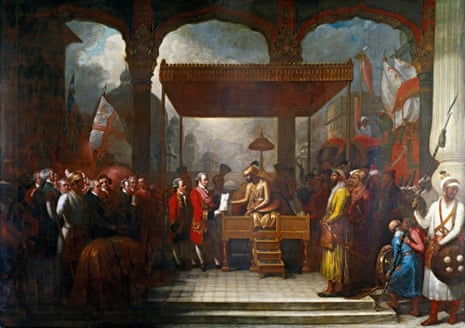
The Diwani created an extraordinary contradiction. The Mughal emperor still appeared to grant legitimacy, but the Company was acquiring the material basis of sovereignty: control over revenue. Bengal was no longer merely a market from which the Company bought goods; it became a financial base for empire.
British military and geopolitical advantages
The Company did not conquer India with European troops alone. Its armies consisted largely of Indian sepoys, commanded within a more standardized structure and backed by British naval strength, commercial capital, and a global imperial network.
Its advantages included:
| Company advantage | Why it mattered |
|---|---|
| Bengal revenue after 1765 | Funded armies and reduced dependence on money sent from Britain |
| Naval power | Protected sea routes and enabled movement of troops and supplies |
| Sepoy armies | Provided a large, locally recruited military force under Company command |
| European rivalry | British victory over France removed its principal European competitor |
| Diplomacy and alliances | Enabled the Company to isolate Mysore, the Marathas, and the Sikh state |
| Administrative record-keeping | Helped turn conquest into sustained territorial control |
| Political flexibility | Combined direct annexation with indirect rule through princely states |
The Company’s ability to use local alliances is vital. For example, in the struggle against Tipu Sultan of Mysore, it benefited from cooperation with the Nizam of Hyderabad and Maratha interests. British supremacy was built as much through divided opponents and unequal treaties as through battlefield victory.
6. The conquest of the subcontinent, 1765–1856
After securing Bengal, the Company removed or subordinated each major power in stages.
Mysore
Hyder Ali and then Tipu Sultan challenged Company expansion in southern India. Four Anglo-Mysore Wars took place between 1767 and 1799. Tipu’s diplomatic ties with France made him especially threatening in British eyes, since Britain and France were global imperial rivals.
Tipu Sultan was killed during the Fourth Anglo-Mysore War in 1799. Mysore was reduced and placed under a restored Wodeyar dynasty, but under Company influence. This was a model of indirect control: retain a local ruler while stripping away meaningful strategic independence.
The Maratha confederacy
The Marathas were the Company’s strongest Indian competitors after Panipat. Their confederacy contained powerful houses, including the Scindias, Holkars, Bhonsles, Gaekwads, and the Peshwa at Pune. Their decentralization gave them reach, but it also made coordinated resistance difficult.
The Company fought three Anglo-Maratha Wars:
- 1775–1782;
- 1803–1805;
- 1817–1818.
The final war destroyed the Peshwa’s position and ended Maratha paramountcy. By 1818, the Company had become the predominant power across most of India.
Subsidiary alliances, paramountcy, and annexation
The Company did not always annex territory immediately. Lord Wellesley’s Subsidiary Alliance system required Indian rulers to accept Company troops, pay for their maintenance, avoid independent foreign relations, and often accept a British resident at court. A ruler who could not pay might lose territory.
The arrangement promised protection but steadily undermined sovereignty. A state could retain its flag and ruler while losing control over defence, diplomacy, and often internal political decisions.
Under Lord Dalhousie, annexation became more aggressive:
- the Doctrine of Lapse allowed annexation where a ruler died without a natural male heir, disregarding adopted heirs in several cases;
- Awadh was annexed in 1856, officially on grounds of misgovernment;
- Sindh was annexed in 1843 after the First Anglo-Afghan War and growing British concern about the northwestern frontier;
- Punjab was annexed in 1849 after the Anglo-Sikh Wars.
The map below helps visualize this final phase. Notice that British territorial power spread unevenly: some regions came under direct rule, while others remained princely states under indirect Company paramountcy.
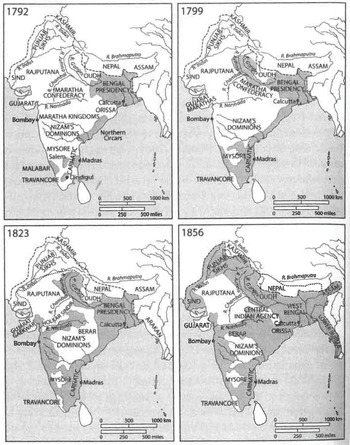
The Company’s conquest was thus incremental. It first acquired fiscal resources in Bengal, then neutralized European competitors, defeated major Indian states, imposed unequal alliances, and annexed strategically valuable regions when conditions favoured intervention.
The following reading consolidates this sequence and links political conquest to colonial revenue extraction.
East India Company | History, John Company, Battle of Plassey, Definition, & Facts
Read Encyclopedia Britannica’s overview of the East India Company for a concise account of the Company’s shift from trade to empire, its revenue base in Bengal, and the immediate outcome of the uprising of 1857.
In the opening historical overview, read from the discussion beginning with Plassey and Buxar. Focus on the difference between conquest through war and indirect rule through treaties with princely states. Next, in the section “Economic and social impact,” read the passage on Diwani and revenue; connect fiscal control to the Company’s capacity for further expansion. Finally, under “The Indian Rebellion of 1857,” read the outbreak at Barrackpore, Meerut, and Delhi, noting why the aged Bahadur Shah II became a powerful symbol despite lacking real imperial power.
7. 1857: the end of Mughal sovereignty, not the end of resistance
The uprising of 1857 brought together several grievances, but it was neither uniform across the subcontinent nor reducible to the cartridge controversy alone.
The immediate military trigger was the belief that cartridges for the new Enfield rifle were greased with cow and pig fat. This offended both Hindu and Muslim religious sensibilities because the cartridges had to be bitten before use. However, the deeper causes included:
- resentment among sepoys over service conditions and perceived religious interference;
- annexation and the dispossession of ruling families;
- anger in Awadh after its annexation in 1856;
- heavy revenue demands and rural distress in some areas;
- fears generated by missionary activity and intrusive social policies;
- broader hostility to Company arrogance and racial exclusion.
In May 1857, sepoys at Meerut revolted and marched to Delhi. They proclaimed the elderly Mughal emperor Bahadur Shah II, also called Bahadur Shah Zafar, as their symbolic sovereign. This shows the continued emotional and political value of Mughal legitimacy even after its material power had vanished.
The uprising was strongest in parts of North and Central India, especially Delhi, Awadh, Kanpur, Jhansi, and nearby regions. It did not spread uniformly to Punjab, Sindh, Bengal, or much of southern India. Crucially, many Indian rulers, groups, and soldiers supported or remained aligned with the British. The Company’s recruitment from Punjab and the North-West Frontier, and the support of several princely states, helped it suppress the revolt.
Its immediate consequences were decisive:
- The East India Company’s rule ended in 1858.
- The British Crown assumed direct authority over India.
- Bahadur Shah II was exiled to Rangoon.
- The Mughal dynasty formally ended.
- The colonial army was reorganized to reduce the risk of another unified sepoy revolt.
- British policy became more cautious about overt social intervention, while becoming more centralized and racially hierarchical.
An exam-ready causal synthesis
A 20-mark answer should not list isolated causes. Show how they reinforced one another.
| Dimension | Mughal decline | British ascendancy |
|---|---|---|
| Political | Succession conflicts, factional nobles, autonomous provinces | Manipulation of succession disputes, treaties, residents, subsidiary alliances |
| Fiscal | Jagir shortages, falling actual collections, agrarian pressure | Diwani revenues from Bengal funded army, trade, and administration |
| Military | Decentralized contingents, weak coordination, prolonged wars | Sepoy armies, naval support, artillery, drill, global resources |
| Social | Rural unrest, regional identities, weakened elite-centre bargains | Colonial revenue policies and annexations generated resentment but also created collaborators |
| External | Nadir Shah and Abdali shattered prestige and security | British defeat of French rivals and access to global maritime power |
The key analytical conclusion is that Mughal decline produced a fragmented political field. The Company was able to move within that field because it possessed money, naval capacity, military organization, diplomatic adaptability, and increasingly an Indian revenue base. Its empire was not built by one decisive battle, but by the conversion of commercial privilege into fiscal sovereignty, fiscal sovereignty into military power, and military power into political control.
Key takeaways
Mughal decline after 1707 was a long and uneven process rather than an instant collapse. Its main causes were political succession struggles, noble factionalism, Deccan overextension, jagirdari and agrarian pressures, military deterioration, regional resistance, and devastating invasions by Nadir Shah and Ahmad Shah Abdali.
British ascendancy followed a different logic. The East India Company exploited Mughal and regional fragmentation, but it also created a powerful military-fiscal state of its own. Plassey opened political influence in Bengal; Buxar and the Diwani gave the Company the revenues that made sustained conquest possible. By annexing Sindh in 1843, Punjab in 1849, and Awadh in 1856, it had established supremacy shortly before the uprising of 1857 ended Mughal sovereignty and Company rule alike.
The next lesson turns from political decline to social and religious continuity: the role of Sufi networks, ulema, and Muslim religious leaders in preserving and reshaping Muslim society under conditions of imperial fragmentation and colonial expansion.
Can't find a good explanation? Sign up and we'll make it for you
Sign up