
Hello. In the previous lesson, we saw that Muslim society in the subcontinent survived political upheaval through a dense institutional world of mosques, madrasas, khanqahs, shrines, scholarly lineages, and charitable endowments. Shah Waliullah of Delhi emerged from that world at a moment when Mughal authority was fragmenting, regional powers were competing, and Muslim scholars confronted both internal disunity and a rapidly changing political order.
This lesson examines Shah Waliullah’s reform program as a connected intellectual, educational, social, and political project. The central argument is that he did not found a single mass movement or offer a modern nationalist blueprint. Rather, he renewed the intellectual resources through which later Muslims debated law, Sufism, education, social justice, political action, and communal survival. That breadth explains why later movements as different as Deoband, Ahl-i Hadith, Barelvi circles, Aligarh modernism, and reformist political thought could all claim parts of his legacy.
1. A reformer in a collapsing political order
Shah Waliullah Dehlawi lived from 1703 to 1762. His lifetime nearly coincided with the early post-Aurangzeb crisis: Aurangzeb died in 1707, and thereafter Mughal emperors increasingly lacked the military, fiscal, and administrative capacity to control their far-flung empire. Delhi remained symbolically important, but its rulers faced factional nobles, invasions, Maratha expansion, Afghan intervention, regional successor states, and the growing commercial-military power of the East India Company.
This setting is essential. Waliullah did not merely believe that Muslims had suffered political decline; he thought that religious, ethical, intellectual, and social disorder had weakened Muslim society from within. For him, political strength could not be restored solely by replacing one ruler with another. A durable revival required reforming how Muslims understood and practised Islam.
He inherited a major intellectual institution: Madrasah-i Rahimiyya in Delhi, established by his father, Shah Abd al-Rahim. It became the base from which Waliullah taught, wrote, trained students, and maintained scholarly links across the subcontinent. His study in the Hijaz during the early 1730s was equally formative. There he encountered wider networks of Hadith scholarship and legal learning, reducing his dependence on the narrower intellectual boundaries of late Mughal Delhi.
A useful way to understand his reform is as an attempt to answer four connected questions:
| Problem he perceived | His broad response |
|---|---|
| Muslims lacked direct understanding of their religious sources | Spread Quranic and Hadith learning beyond a closed scholarly elite |
| Legal schools and sectarian groups were divided by rigid partisanship | Encourage principled reconciliation and renewed legal reasoning |
| Sufism and popular religious practice could become detached from Islamic norms | Reconnect spiritual discipline with the Quran, Sunnah, and Sharia |
| Society was marked by exploitation, luxury, injustice, and political disorder | Explain Islamic law as a means of social welfare, ethical order, and just government |
This makes him more than a preacher of individual piety. His concern was the reconstruction of a morally coherent Muslim social order.
2. The intellectual core: Quran, Hadith, law, and welfare
Waliullah’s reform began with a claim that may sound obvious today but was significant in eighteenth-century North India: Muslims should understand the foundational sources of Islam rather than merely inherit religious practice through custom or institutional habit.
His influential Persian translation of the Quran, commonly known as Fath al-Rahman, made the Quran more accessible to Persian-reading Muslims. Persian was then the principal language of educated Muslim culture and administration in North India. His sons later extended this accessibility through Urdu Quran translations. The larger significance was not simply linguistic: it was an effort to make revealed guidance intellectually available and socially relevant.
He also promoted the study of Hadith, especially through his engagement with Imam Malik’s Muwatta. Hadith had always been studied in the subcontinent, but Waliullah’s scholarly networks and teaching helped make it a more central reference point in later North Indian Muslim learning. This influence is visible in the curricula and chains of transmission of later madrasas.
Ijtihad without abolishing the legal schools
One of Waliullah’s most important contributions concerned fiqh, Islamic jurisprudence. In much of South Asia, the Hanafi school predominated. Waliullah himself was Hanafi, but he opposed excessive taqlid: rigid adherence to inherited legal opinions merely because they belonged to one’s school.
His position requires precision:
- He did not call for Muslims to discard the four Sunni legal schools.
- He did not advocate unrestricted personal interpretation by anyone without scholarly competence.
- He did argue that qualified scholars must continue to exercise ijtihad, disciplined legal reasoning.
- He held that juristic disagreements often reflected differences in evidence and method, rather than contradictions in Islam itself.
- He allowed a scholar, and in some circumstances an ordinary believer, to adopt a better-supported or more suitable view from another Sunni school on a particular matter.
Thus, Waliullah sought to preserve legal tradition while preventing it from becoming a source of sectarian hostility or unnecessary hardship. His reform was neither legal anarchy nor blind traditionalism.
Law and Sufism in modern South Asia: A changing relationship
Read Muhammad Qasim Zaman’s scholarly analysis to grasp the most important qualification in Waliullah’s legal reform: he criticised rigid legal partisanship, but did not reject learned legal tradition itself. The closing discussion is especially valuable for understanding why later movements selectively appropriated his legacy.
In the section “Wali Allah as a legal thinker” on pp. 330–333, read from the opening analysis through the discussion of ijtihad, legal-school flexibility, and maslaha. Focus on the distinction between rejecting rigid imitation and rejecting the schools altogether. Then go to the final section, “A constricted legacy,” on pp. 354–356. Read the conclusion. Notice Zaman’s central point: later scholars elevated Waliullah while separating, simplifying, or omitting aspects of his thought that did not fit their own agendas.
Sharia as wisdom and human welfare
Waliullah’s best-known work, Hujjat Allah al-Balighah—usually translated as The Conclusive Argument from God—gave a distinctive explanation of Islamic law. He asked not only, “What is the legal rule?” but also, “What human and social good does this rule serve?”
The key concept is maslaha, human welfare or public benefit. Waliullah argued that the Sharia was not an arbitrary collection of prohibitions. Its principles were intended to cultivate moral persons, orderly households, economic fairness, social cooperation, and political stability.
This did not mean that he reduced revelation to human reason. Some religious duties, particularly ritual obligations, depend on revelation and cannot be derived independently through reason. Yet even these obligations were intelligible within a broader moral order. His approach therefore joined:
- Revelation, which provides authoritative norms;
- Reason, which helps explain their wisdom and application;
- Spiritual discipline, which transforms the self so that law is practised ethically rather than mechanically.
Waliullah also analysed the development of social life through the idea of irtifaqat, often understood as stages or arrangements of civilised life. He discussed the person, household, economy, and political community as linked levels of order. This makes his thought unusually wide-ranging: he treated worship, family, markets, rulers, taxation, military power, and social inequality as parts of one moral universe.
It would be anachronistic to call him a modern democrat, socialist, or nationalist. But it is accurate to say that he made justice, public welfare, restraint of elite excess, and responsible government central to his religious analysis.
3. Reforming Sufism without abandoning it
A frequent CSS/PMS simplification depicts Shah Waliullah as an opponent of Sufism. The evidence does not support that. He was deeply formed by Sufi traditions, particularly the intellectual world associated with wahdat al-wujud, often rendered as “Unity of Being.” His mystical experience was not a private side of his life; it helped shape his legal and ethical thought.
At the same time, he criticised religious practices that, in his judgment, compromised monotheism, encouraged superstition, or made devotion to saints more important than obedience to God. His aim was to discipline Sufism through Sharia, not to eradicate spiritual life.
This distinction matters:
| Oversimplification | More accurate interpretation |
|---|---|
| “Waliullah rejected Sufism.” | He remained a Sufi thinker but sought a Sufism aligned with Islamic law and ethical reform. |
| “He was purely rationalist.” | He valued reason, but mystical insight and spiritual experience also informed his thought. |
| “He only attacked shrine practices.” | His agenda was broader: scholarship, law, education, moral renewal, social welfare, and political order. |
| “Later reformers preserved his thought unchanged.” | Later movements adopted different parts of his legacy and often rejected other dimensions. |
The relationship between law and Sufism is, in fact, the key to his originality. Waliullah did not think outward law and inward spirituality were rival systems. Law without ethical and spiritual transformation could become formalistic; spirituality detached from the Sharia could lose normative discipline.
4. Unity, justice, and political intervention
Waliullah’s reform program also sought to reduce conflict within the Muslim community. Legal-school disputes, Sunni-Shia tensions, factional politics, and competition among elites weakened collective capacity. He tried to identify shared foundations while explaining why disagreement had emerged historically.
His goal was not to erase all difference. Rather, he wanted Muslims to distinguish between:
- legitimate scholarly disagreement;
- destructive sectarian hostility;
- essential religious principles;
- local custom, habit, or political faction presented falsely as religion.
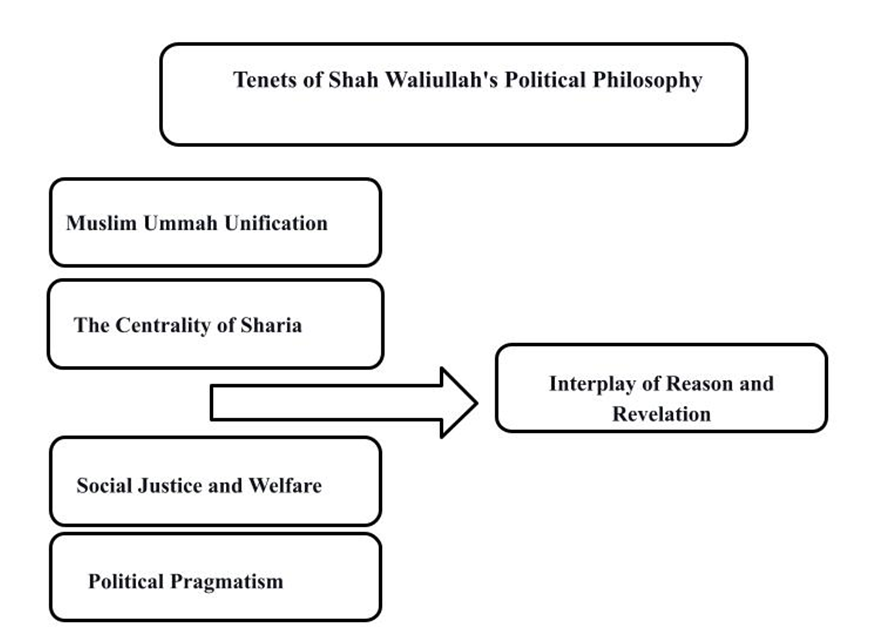
The following modern infographic captures several themes associated with his political and social thought, though it should not be treated as a primary source or as a complete representation of his ideas.
The Abdali invitation and the Third Battle of Panipat
Waliullah’s political engagement was practical and urgent. As Maratha influence expanded into North India and Mughal authority weakened, he wrote to Muslim rulers and elites urging coordinated action. His letters to Ahmad Shah Durrani (Ahmad Shah Abdali) are commonly associated with Durrani’s intervention in North India and the Third Battle of Panipat in 1761, where the Durrani coalition defeated the Marathas.
For examination purposes, make a balanced assessment:
- Waliullah feared that political fragmentation would further endanger Muslim institutions and social order.
- He saw military and political action as necessary in an emergency; he was not merely a secluded scholar.
- Panipat checked Maratha expansion in the immediate term.
- It did not restore a stable Mughal Empire.
- The battle was catastrophically destructive and did not prevent the later rise of Company power.
Therefore, the invitation to Abdali illustrates political pragmatism, not a successful blueprint for permanent restoration. It shows that Waliullah linked religious reform to political security, while recognising that neither could endure without the other.
5. From Waliullah to later renaissance movements
It is better to speak of Waliullahi influences than of one uninterrupted “Waliullahi movement.” His descendants, students, and later readers transmitted his texts, Hadith networks, and reformist questions. But they did not all reach the same conclusions.
Shah Waliullah Al Dehlawi - The Greatest Scholar of India | Shaykh Dr. Yasir Qadhi
Watch the selected part of “Shah Waliullah Al Dehlawi – The Greatest Scholar of India” by Shaykh Dr. Yasir Qadhi as a quick orientation to the range of later groups that claimed Waliullah’s inheritance. Its main value here is the reminder that no single later movement can plausibly claim his whole legacy.
Watch contested heirs. Track the speaker’s central observation that later South Asian religious currents selected different elements—Hadith, legal reasoning, reform, or Sufism—from Waliullah’s corpus. Treat particular biographical links as prompts for verification rather than as sufficient historical proof; the following discussion supplies the necessary distinctions.
1. Shah Abd al-Aziz and the continuation of the Delhi school
Waliullah’s son, Shah Abd al-Aziz (1746–1824), continued the scholarly work of Madrasah-i Rahimiyya and helped carry Waliullah’s influence into the nineteenth century. His declaration that India had become Dar al-Harb after the British takeover of Delhi in 1803 became an important conceptual reference for later anti-colonial and reformist thinkers.
However, avoid a crude formula that he issued a simple universal command for armed rebellion. The legal category of Dar al-Harb was interpreted in different ways, and its political implications remained contested. Its significance lay in recognising that Muslims now faced a radically altered relationship to political authority.
2. Sayyid Ahmad of Rai Bareli and Shah Ismail Shahid
The movement of Sayyid Ahmad of Rai Bareli and Shah Ismail Shahid, Waliullah’s grandson, carried forward several Waliullahi concerns:
- purification of religious practice;
- stronger emphasis on the Quran and Hadith;
- opposition to what they considered un-Islamic customs;
- disciplined communal organisation;
- political and military resistance.
Their movement attempted to establish an Islamic order in the north-western frontier region. Sayyid Ahmad and Shah Ismail were killed at Balakot in 1831, fighting forces of the Sikh kingdom, not the British. This correction is important because exam answers often incorrectly present Balakot as a direct Anglo-Muslim battle.
Their reform turned some of Waliullah’s intellectual concerns into a more activist and militant programme. Yet it was not identical with Waliullah’s own approach: later followers sharpened scripturalist and anti-customary tendencies that existed alongside broader Sufi and legal-pluralist elements in his thought.
3. Deoband: Hadith, Hanafi law, disciplined Sufism, and institutional survival
The founders of Darul Uloom Deoband in 1866 inherited important strands of the Waliullahi tradition. In the post-1857 colonial environment, Deobandis developed autonomous madrasa networks that preserved Muslim scholarship outside direct state patronage.
Their inheritance included:
- commitment to Hadith learning;
- Hanafi legal scholarship;
- reform of religious practice;
- a form of Sufism subordinated to Sharia;
- institutional self-reliance through community funding.
But Deoband was not simply Waliullah repeated. Later Deobandi scholars often gave much less scope than Waliullah did to mystical experience and to legal flexibility across the Sunni schools. In other words, Deoband inherited his concern for reform but also systematised and narrowed some dimensions of his expansive intellectual world.
4. Ahl-i Hadith and scriptural reform
Ahl-i Hadith circles drew inspiration from Waliullah’s insistence on Hadith, critique of rigid legal conformity, and concern for direct engagement with foundational texts. Yet it would be misleading to label Waliullah simply Ahl-i Hadith before the movement existed.
He did not abolish the authority of the madhhabs. His own position was more accurately one of critical and comparative engagement with the schools. Later scripturalists could claim one side of his project, but not its entirety.
5. Barelvi appropriations and the contested Sufi legacy
Later Barelvi scholars and devotional circles could point to Waliullah’s Sufi affiliations, reverence for saints, and participation in forms of devotional practice that more purist reformers criticised. They thereby challenged the claim that his legacy was exclusively anti-Sufi or anti-shrine.
This is historically significant: Waliullah’s writings contained both a reformist critique of excess and a rich Sufi universe. Later groups often preserved one side while marginalising the other.
6. Modernists: Sir Syed, Iqbal, and the possibility of reconstruction
Waliullah also influenced Muslim modernist thought, though not as an organisational founder. Sir Syed Ahmad Khan cited him as a precedent for the continuing need for qualified reinterpretation. Allama Iqbal famously described Waliullah as perhaps the first Muslim to feel the urge of a new intellectual spirit.
Modernists were drawn especially to:
- the role of reason in understanding revelation;
- the historical context of legal rules;
- the welfare-oriented rationale of the Sharia;
- the possibility of renewing Islamic thought without abandoning Islam’s foundational sources.
Yet modernists were often less comfortable with Waliullah’s mystical claims and extensive Sufi commitments. Again, the pattern is selective inheritance rather than complete continuity.
7. Ubaydullah Sindhi and politically engaged reform
In the twentieth century, Ubaydullah Sindhi interpreted Waliullah as a thinker of anti-colonial liberation, economic justice, social transformation, and inter-communal cooperation. He treated Waliullah’s thought as a resource for practical political action, not merely private devotion or seminary learning.
This reading demonstrates the adaptability of Waliullah’s social thought, but it also reminds us that interpreters sometimes projected their own political programmes onto him.
6. A critical evaluation: why his influence was so wide
Shah Waliullah’s enduring influence did not arise from a single slogan. It arose because he addressed several crises at once.
His achievement can be assessed under five headings:
| Dimension | Contribution | Critical assessment |
|---|---|---|
| Educational | Revitalised Quranic and Hadith learning; strengthened Madrasah-i Rahimiyya | His impact spread chiefly through scholarly networks before reaching wider movements |
| Legal | Critiqued rigid taqlid; promoted ijtihad, comparative fiqh, and legal welfare | Later groups often selected either his anti-rigidity or his attachment to tradition, but rarely both |
| Spiritual | Joined Sufi self-reform with Sharia-based discipline | His broad Sufi thought was frequently sanitised by later reformers |
| Social | Connected law with justice, family order, economy, ethical restraint, and public welfare | His ideas were premodern and should not be casually equated with modern political ideologies |
| Political | Urged Muslim elites to respond to fragmentation and external threats | Panipat checked one threat but failed to reverse imperial decline or prevent British ascendancy |
The strongest conclusion is therefore not that Waliullah “created Pakistan” or that all subsequent Muslim movements followed him faithfully. Such claims are teleological: they read later history backward into the eighteenth century.
A defensible conclusion is this:
Shah Waliullah supplied a vocabulary of renewal before colonial rule fully consolidated in North India. His call for scriptural understanding, Hadith learning, principled legal reasoning, social welfare, disciplined Sufism, Muslim unity, and responsible political order shaped the questions that nineteenth- and twentieth-century Muslim reformers would answer in markedly different ways.
For a CSS/PMS question such as “Discuss the salient aspects of Shah Waliullah’s movement and analyse its impact on the Muslims of the subcontinent,” build your answer around this argument rather than merely listing achievements.
A strong structure would be:
- Context: late Mughal decline, political fragmentation, religious and social disorder.
- Reform programme: Quran and Hadith, Persian translation, Madrasah-i Rahimiyya, ijtihad, welfare-oriented Sharia, Sufi reform, Muslim unity.
- Political dimension: letters to Muslim rulers and Ahmad Shah Durrani; Panipat as a limited intervention.
- Legacy: Shah Abd al-Aziz, the Tariqah-i Muhammadiyah, Deoband, Ahl-i Hadith, Barelvi contestation, Sir Syed, Iqbal, and Ubaydullah Sindhi.
- Judgement: foundational intellectual influence, but no single successor and no automatic path from Waliullah to Pakistan.
Key takeaways
Shah Waliullah was an eighteenth-century scholar-reformer who responded to the decline of Mughal power with a programme of religious and social renewal. He promoted wider access to the Quran, revived Hadith scholarship, resisted rigid legal partisanship, defended qualified ijtihad, and explained Sharia in terms of wisdom and human welfare.
His reform of Sufism was corrective rather than hostile: he sought to integrate spiritual discipline with Islamic law and ethical responsibility. His intervention in politics, including his appeal to Ahmad Shah Durrani, showed that he regarded public order and Muslim security as inseparable from religious renewal, though Panipat could not reverse imperial decline.
His later influence was profound precisely because it was contested. Deobandis, Ahl-i Hadith scholars, Barelvi thinkers, modernists such as Sir Syed and Iqbal, and political interpreters such as Ubaydullah Sindhi each drew selectively from his thought. The next lesson moves into the nineteenth-century colonial setting and examines the Faraizi Movement in Bengal: its origins, reform agenda, rural social base, and impact.
Can't find a good explanation? Sign up and we'll make it for you
Sign up