
Hello. In the previous lesson, you learned to sequence paragraphs into a sustained line of argument: each paragraph should develop a thesis rather than repeat the same point with a different quotation.
This lesson changes perspective. Instead of asking, “How can I write this essay?”, you will ask, “What would an examiner reward here, and why?” By the end, you should be able to evaluate a sample extract-to-whole-text response using the AQA assessment objectives, select an overall level using the best-fit method, and justify a realistic mark.
What AQA is assessing
For the 30-mark literature response, AQA assesses three objectives:
| Assessment objective | Marks | In practical terms |
|---|---|---|
| AO1 | 12 | A focused, conceptual response to the question, supported by relevant references across the text |
| AO2 | 12 | Analysis of the writer’s methods and the meanings or effects they create |
| AO3 | 6 | Relevant connections between the text, its ideas, and context |
| AO4 | 4, where assessed | Clear expression, accurate spelling and punctuation, and controlled vocabulary and sentences |
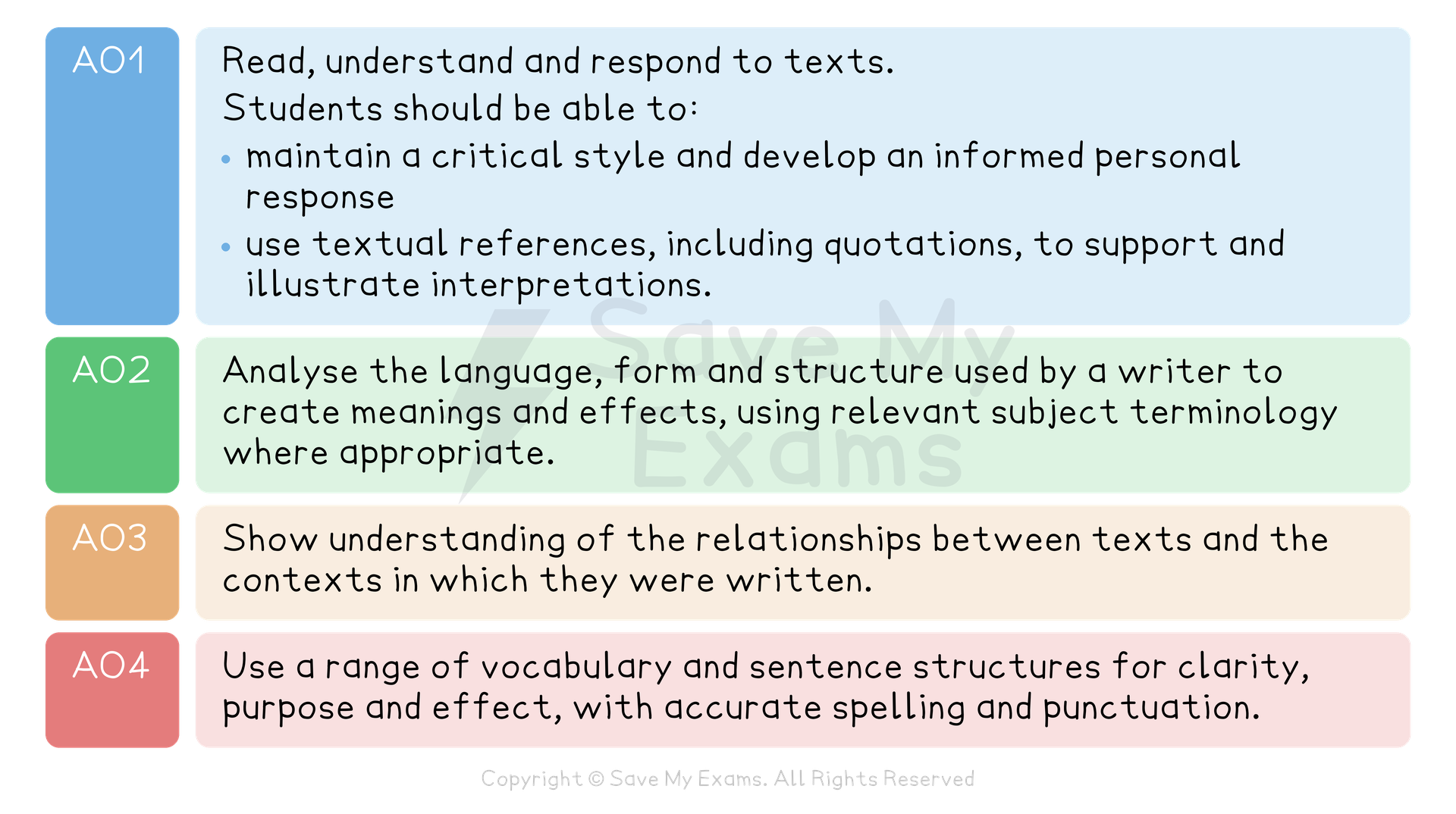
One important qualification: AO4 is assessed only on Paper 1, Section A, the Shakespeare question. So, if you are evaluating a Macbeth answer, you should consider AO4 separately out of four. An A Christmas Carol response receives the 30 marks for AO1, AO2 and AO3, but not these additional AO4 marks.
The objectives overlap in a good paragraph. For example:
Dickens presents Bob’s “dismal little cell” as a symbol of the confinement created by poverty; by reducing his workplace to a “cell”, Dickens suggests that employment does not necessarily bring freedom or security for the poor.
This earns credit in more than one way:
- AO1: it answers a question about poverty and supports the point with evidence.
- AO2: it analyses Dickens’s image of a “cell”.
- AO3: if you then connect this directly to Victorian attitudes towards poor workers, that contextual understanding may deepen the interpretation.
However, do not mark mechanically by counting techniques. Writing “metaphor,” “adjective,” and “semantic field” does not automatically create AO2. The vital question is always: has the student explained how this deliberate choice supports their argument about the question?
[PDF] mark scheme – gcse english literature – 8702/1 – june 2023 - AQA
Read the official AQA mark scheme to see how examiners decide a level and then a precise mark. This matters more than memorising a list of impressive-sounding features.
On pages 4-5, under “How to apply the mark scheme”, read the examiner process. Focus especially on the idea that a response is judged as a whole using best fit. Then turn to page 6, “Assessment objectives (AOs)”, to confirm what AO1, AO2, AO3 and AO4 require. Finally, on pages 8-10, read the full Levels 6 to 1 grid, from the level descriptors. As you read, compare the verbs: Level 4 tends to explain, Level 5 examines, and Level 6 explores.
The best-fit principle: do not add up isolated successes
AQA does not expect an answer to fit every descriptor perfectly, nor do examiners award a separate mark for each paragraph. They first decide which level best describes the response overall.
This is called the best-fit approach.
Suppose an essay has:
- a strong central argument;
- several perceptive method points;
- secure whole-text references;
- but one weak or generic context sentence.
That does not automatically prevent it from reaching Level 6. Equally, one sophisticated paragraph does not make an otherwise descriptive essay Level 6. The examiner judges the dominant quality of the whole response.
Use this process when evaluating:
-
Read the response once without annotating.
Decide whether it feels like one argument, a set of relevant points, or plot-led commentary. -
Read again with the assessment objectives in mind.
Annotate brief evidence of AO1, AO2 and AO3 in the margin. -
Start at the lower levels and move upwards.
Ask, “Does this response securely meet Level 3? Level 4? Level 5?” Stop when the next level is no longer a fair description of the overall answer. -
Choose a mark within that level.
A response at the bottom of a level is beginning to show its qualities. A response near the top sustains them consistently. -
Assess AO4 separately, only if it applies.
Check technical accuracy and clarity across the whole answer, not whether every sentence is long or contains ambitious vocabulary.
A useful warning: AO3 is worth six marks, while AO1 and AO2 are each worth twelve. Context is valuable when it sharpens an interpretation, but it cannot compensate for an answer that does not address the question or analyse the writer’s methods.
Recognising the difference between Levels 4, 5 and 6
For Grade 7 and above, the most useful distinctions are usually between Levels 4, 5 and 6.
| Level | Overall quality | What it tends to sound like |
|---|---|---|
| Level 4 | Clear and explained | “Dickens uses the word ‘cell’ to show that Bob is trapped by poverty.” |
| Level 5 | Thoughtful and developed | “The ‘cell’ suggests that Bob’s employment confines rather than frees him, exposing the cruelty of Scrooge’s working conditions.” |
| Level 6 | Critical and exploratory | “By placing the obedient clerk in a ‘dismal little cell’, Dickens makes Scrooge’s office resemble a prison: Bob is technically employed, yet the capitalist arrangement still imprisons him. This challenges readers to question whether respectable business can coexist with social responsibility.” |
The Level 6 version is not better merely because it is longer. It develops a conceptual implication: employment may appear respectable, but Dickens exposes how it can still be oppressive. It also returns to a wider argument about social responsibility.
AO1: What makes an argument conceptual?
AO1 is more than including quotations. At the higher levels, a response:
- answers the exact wording of the question throughout;
- offers an interpretation rather than announcing obvious facts;
- selects references from the extract and the whole text;
- develops a coherent argument across paragraphs.
Compare these openings for a question on the suffering of the poor:
Dickens shows that poor people suffer in the novella.
This is relevant, but it is a basic statement.
Dickens presents the suffering of the poor as a consequence of social indifference: the wealthy choose to ignore poverty until its human cost becomes impossible to deny.
This gives the essay an argument to prove. It also creates a potential line of development: indifference, consequences, then Dickens’s demand for change.
AO2: What counts as developed method analysis?
At Level 4, a student may clearly explain a method and its effect. At Levels 5 and 6, the analysis becomes more precise and purposeful.
A response should not simply label:
Dickens uses a metaphor in “dismal little cell”.
Instead, it should explore the choice:
Dickens’s metaphorical “cell” transforms Bob’s workplace into a place of punishment. The adjective “dismal” implies emotional as well as physical deprivation, suggesting that Scrooge’s profit depends upon making his employee’s life joyless.
Notice the sequence:
- Identify the significant word or method.
- Explore its connotations.
- Explain how it shapes the reader’s understanding.
- Link it back to the question and the essay’s argument.
At the top level, fine-grained analysis often means taking a short quotation seriously. A single word can be more useful than a long quotation if the response explores it precisely.
AO3: Context as interpretation, not decoration
AO3 is not a history test. A weak contextual addition can sound detached:
This was set in Victorian England, when poor people were treated badly.
A stronger AO3 point is integrated into the analysis:
By making Bob too afraid to ask for more coal, Dickens exposes how Victorian workers could be dependent on employers who controlled both their wages and their basic comfort.
Here, context clarifies why the detail matters. It does not interrupt the argument.
At Level 6, AQA describes AO3 as an exploration of ideas, perspectives and contextual factors through specific, detailed links between context, text and task. The link is the crucial part.
A worked moderation: evaluating a model response
The following model answer addresses this question:
Starting with this extract, explore how Dickens presents the suffering of the poor in A Christmas Carol.
It begins with Ignorance and Want, then ranges across Tiny Tim, the charity collectors, Bob Cratchit and Scrooge. Read it as an examiner would: do not just notice what is impressive. Decide whether its strengths are sustained across AO1, AO2 and AO3.
Paper 1 Model Answers - AQA GCSE English Literature
This Save My Exams model is presented as a Level 6 full-mark response. Read both the answer and its commentary, but make your own judgement before accepting the label.
Begin in “Model answer breakdown” and identify the question before reading the answer. First, read the thesis. Decide whether it gives the essay a whole-text argument. Then read the first main paragraph, from the extract analysis. Look for the movement between the printed extract and elsewhere in the novella. Continue through the paragraphs on structure and Bob Cratchit. In particular, trace the method analysis from the structural discussion, then read the context-focused section beginning with Scrooge and Bob. Finally, compare your annotations with the commentary beneath each section.
Examiner-style evaluation of the model
AO1: Does it sustain a conceptual response?
The model opens with the claim that poor people are “trapped in a system through no fault of their own”. This is a conceptual argument because it goes beyond “poverty is bad.” It identifies Dickens’s wider criticism: suffering is created and maintained by social structures and by the choices of the wealthy.
The response sustains this argument through a broad range of references:
- Ignorance and Want embody neglected poverty.
- Tiny Tim shows its potential human consequences.
- The repeated questions about prisons and workhouses expose Scrooge’s indifference.
- Bob demonstrates the everyday exploitation of workers.
These are not simply listed. The essay repeatedly connects them to Dickens’s critique of social indifference. Its references are generally concise and embedded, such as “emaciated and wretched”, “Are there no prisons?”, “to warm himself at the candle”, and “dismal little cell”.
Judgement on AO1: This is securely Level 6. It is focused on the task, conceptualised, whole-text in scope, and supported with judicious references.
AO2: Does it explore writer’s methods?
The response has a broad range of relevant methods:
- Allegory: Ignorance and Want are not only children but symbolic figures.
- Religious imagery: the children “knelt down” and “clung” to the Spirit’s garment.
- Structural repetition: the Spirit repeats Scrooge’s earlier words about prisons and workhouses.
- Contrast: scenes of festive abundance are placed before the appearance of Ignorance and Want.
- Naming and omission: Bob is initially reduced to “the clerk”.
- Symbolic setting: Bob’s workplace is a “dismal little cell”.
What makes this high-level AO2 is that the response usually explains why each method matters. For instance, the image of a “cell” is not treated as a random technique; it becomes evidence that poverty and exploitative employment confine Bob.
A careful evaluator should still distinguish between a method that is merely named and one that is explored. For example, saying that a child is “symbolic” would not be enough alone. The stronger parts of the model explain what the figure symbolises and how Dickens uses that symbolism to confront the reader.
Judgement on AO2: Level 6. The analysis is detailed, relevant and often fine-grained, while the structural choices support the central argument rather than appearing in a separate, forced “structure paragraph”.
AO3: Is context connected precisely to the text?
The response discusses workhouses, poor working conditions, child mortality and capitalist inequality. Crucially, these details are usually attached to a textual moment:
- Workhouses deepen the significance of Scrooge’s questions.
- Victorian working conditions give force to Bob’s inability to ask for coal.
- Inequality and child poverty clarify Dickens’s use of Tiny Tim, Ignorance and Want.
This is why the context earns more than a generic statement about “Victorian poverty.” The response uses context to explain Dickens’s social purpose.
One claim deserves careful treatment: the suggestion that “Bob” may refer to a Victorian term for a shilling is phrased tentatively, so it functions as a possible interpretation rather than an asserted fact. Even so, it is less securely grounded than the analysis of “the clerk” and the “dismal little cell”. A strong evaluator notices such variation without letting one speculative point outweigh the quality of the response as a whole.
Judgement on AO3: Level 6. The response establishes specific links between Dickens’s ideas, textual details and Victorian social conditions.
Reaching the overall mark
Because this response is sustained and consistently demonstrates Level 6 qualities, it belongs in the 26-30 mark range.
The resource presents it as a full-mark answer. Treating it as the complete response, the justified final judgement is:
| Overall level | Mark | Examiner rationale |
|---|---|---|
| Level 6 | 30/30 | A critical, conceptualised whole-text argument; precise and varied references; detailed analysis of relevant methods; and contextual understanding integrated into interpretations. |
This does not mean every Grade 7+ answer needs to resemble this model exactly. A real exam answer may use fewer paragraphs, fewer quotations, or a different structure. What matters is the quality of its thinking: a clear argument, precise evidence, meaningful method analysis, and context that develops rather than interrupts the response.
Also remember that models are polished teaching examples. In an exam, assess the response actually written. Do not award Level 6 because it contains sophisticated vocabulary, and do not deny it because one sentence is less effective than the rest.
A reliable self-marking routine
When you next review one of your own essays, use these four margin codes:
- AO1 — Argument: Where is the answer directly addressing the question? Is there a clear thesis and a developed line of argument?
- AO1 — Evidence: Are references precise, relevant and drawn from the extract and wider text?
- AO2 — Method: Where does the response explain how a word, image, structural choice or dramatic method creates meaning?
- AO3 — Context: Does contextual material deepen a specific interpretation of the text?
Then write a short examiner summary before choosing a mark:
The response is mostly Level 5 because it has a thoughtful thesis and clear method analysis, but its final paragraph becomes general and its context is not consistently integrated. It is therefore stronger than Level 4 but not yet exploratory enough for Level 6.
That kind of statement is much more useful than simply writing “add more AO2.” It identifies the precise feature that needs improving.
Key takeaways
- AQA marks the 30-mark response through best fit: judge the essay’s overall quality, rather than counting isolated successful points.
- AO1 rewards a conceptual, sustained answer supported by judicious references.
- AO2 rewards exploration of how methods create meaning, not technique spotting.
- AO3 is strongest when context is integrated into a textual interpretation.
- The key distinction at the highest levels is between clear explanation, thoughtful development and critical exploration.
- AO4 is assessed separately on the Shakespeare question in Paper 1, Section A.
- When evaluating a response, identify its dominant level first, then decide where it sits within that mark range.
You have now completed the foundations module. Next, the course moves into Macbeth in depth, beginning with Shakespeare’s presentation of ambition as both a powerful influence on Macbeth and a choice for which he remains responsible.
Can't find a good explanation? Sign up and we'll make it for you
Sign up