Hello! Welcome back to our course on designing high-load distributed systems.
Introduction
In our last lesson, we focused on the foundational layer of network communication, learning how to configure TCP keepalives to ensure the health and resilience of individual TCP connections. We established that maintaining a stable connection is critical, especially when dealing with connection pools and long-lived sessions that pass through network intermediaries.
Now that we know how to keep our connections alive, the next logical question is: how do we intelligently distribute these connections across our backend services? This brings us to the core of load balancing.
Today's lesson addresses the learning outcome: Analyze Layer 4 vs Layer 7 load balancing trade-offs in terms of performance, observability, and routing capabilities. We will explore two fundamentally different philosophies of traffic distribution, each with distinct advantages and disadvantages.
This decision is one of the first and most critical architectural choices you'll make when designing a system's entry point. Your background in building low-latency and high-load platforms will be particularly relevant as we dissect the performance implications of each approach.
1. The OSI Model and the Fundamental Divide
To understand the difference between Layer 4 and Layer 7 load balancing, we first need to place them within the context of the OSI model.
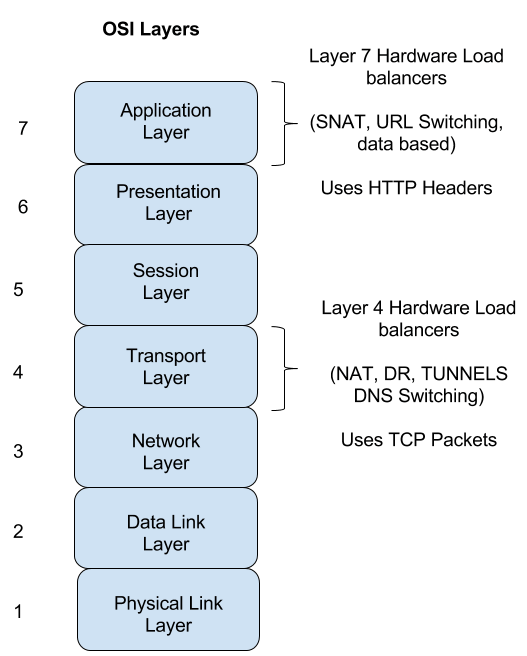
As the diagram illustrates:
- Layer 4 (L4) Load Balancers operate at the Transport Layer. They are concerned with TCP and UDP packets. Their decisions are based on the "5-tuple": source IP, source port, destination IP, destination port, and the protocol.
- Layer 7 (L7) Load Balancers operate at the Application Layer. They understand application-level protocols, most commonly HTTP. They can inspect the content of the messages, such as HTTP headers, URL paths, and cookies.
A great analogy from the article "Layer 4 Load Balancers: A Complete Deep Dive Guide" is to think of an L4 load balancer as a traffic cop who directs cars based only on their license plates and destination address, while an L7 load balancer is like a customs agent who inspects the cargo inside each vehicle before deciding where it should go.
To get a concise overview of this distinction, please watch the following clip.
What are L4 Load Balancers and how do they work?
This video from Arpit Bhayani clearly explains the core difference between L4 and L7 load balancers based on how deeply they inspect network traffic.
Watch the segment from 02:21 to 03:38. Focus on the key idea: the distinction lies in whether the load balancer peeks into the application data or restricts itself to the transport layer information.
2. Layer 4 Load Balancing: The Speed Demon
An L4 load balancer is a high-performance packet forwarder. Because it doesn't inspect the content of the packets, it can make routing decisions extremely quickly with minimal CPU overhead.
Key Characteristics
- Performance: Very high throughput and low latency. It's essentially performing network address translation (NAT) at high speed.
- Routing Capabilities: Limited. Routing decisions are based on simple algorithms like round-robin, least connections, or hashing the 5-tuple. It cannot route based on the URL path (e.g.,
/usersvs./orders). - Observability: Limited to the transport layer. You can monitor connection counts, packet rates, and byte counts, but you have no visibility into application-level metrics like HTTP status codes, request latency, or error rates per endpoint.
- Protocol Agnostic: It can balance any traffic based on TCP or UDP, including databases (PostgreSQL, MongoDB), message queues, and real-time gaming protocols.
A Deeper Dive: Pass-Through vs. Proxy Mode
A crucial detail about L4 load balancers is that they can operate in two distinct modes, which have significant architectural implications. The video you just watched introduces these; let's now explore them in more detail.
What are L4 Load Balancers and how do they work?
Arpit Bhayani's video provides an excellent explanation of the two L4 operating modes: pass-through and proxy.
Please watch from 05:55 to 16:08. As you watch, focus on understanding: Pass-Through Mode (Direct Server Return - DSR): How does it achieve maximum performance by having the response bypass the load balancer? Note the single TCP connection and the complex network configuration required. Proxy Mode: Why does terminating the connection at the load balancer (creating two separate TCP connections) give it more control for smarter routing and health checks, at the cost of some performance?
This distinction is vital. Pass-through mode offers the ultimate performance but is complex and offers less control. Proxy mode is simpler to manage and provides better observability at the connection level, making it a common choice for L4 load balancers like HAProxy in TCP mode.
3. Layer 7 Load Balancing: The Intelligent Router
An L7 load balancer is an application-aware proxy. It terminates the client's connection (both TCP and often TLS), inspects the application data, and then makes a new connection to an appropriate backend server.

Key Characteristics
- Performance: Inherently slower than L4 due to the overhead of terminating connections, parsing application data (e.g., HTTP headers), and potentially handling TLS encryption/decryption. However, modern implementations (like nginx, HAProxy, Envoy) are highly optimized.
- Routing Capabilities: Extremely flexible. This is its primary advantage. It enables:
- Path-based routing:
/api/users-> User Service,/api/products-> Product Service. - Host-based routing:
api.example.com-> API servers,www.example.com-> Web servers. - Header/Cookie-based routing: For A/B testing, canary deployments, or maintaining session persistence ("sticky sessions").
- Path-based routing:
- Observability: Excellent. Since it understands the application protocol, it can provide detailed metrics like HTTP status code counts (2xx, 4xx, 5xx), request rates per URL, and precise end-to-end latency measurements. This is invaluable for monitoring and debugging.
- Additional Features:
- SSL/TLS Termination: Offloads the cryptographic work from backend servers.
- Content Modification: Can add/remove headers (e.g.,
X-Forwarded-For), rewrite URLs, or compress responses. - Caching: Can cache responses for static assets to reduce load on backend services.
To see how this works in practice, let's turn to another excellent explanation.
Load balancing in Layer 4 vs Layer 7 with HAPROXY Examples
This segment from Hussein Nasser's channel explains the mechanics of L7 load balancing, emphasizing the two-connection architecture and its benefits for microservices.
Watch from 22:33 to 31:33. Pay attention to how the L7 load balancer acts as a full proxy, creating two separate TCP connections. Understand why this architecture is a natural fit for microservice-based systems and the pros and cons discussed.
4. Analyzing the Trade-Offs
The choice between L4 and L7 is a classic architectural trade-off. To solidify your understanding, please read the following article, which provides a concise summary of the key characteristics and decision criteria.
Nginx, HAProxy, and Layer 4 vs 7 Deep Dive
This article, 'Load Balancing Explained: Nginx, HAProxy, and Layer 4 vs 7 Deep Dive', provides a clear, structured comparison.
Read the sections 'Layer 4 vs Layer 7: The Fundamental Choice' and 'Choosing the Right Approach'. Focus on the tables and bullet points that summarize the key characteristics and best use cases for each layer.
Let's synthesize this into a clear table:
| Feature | Layer 4 Load Balancer | Layer 7 Load Balancer |
|---|---|---|
| Performance | Very High. Minimal CPU/memory usage, low latency. | High, but lower than L4. Incurs overhead for parsing, TLS, and buffering. |
| Observability | Low. Connection-level metrics only (packets, bytes). | High. Application-level metrics (HTTP codes, latency per URL, headers). |
| Routing Capabilities | Limited. Based on IP/port (round-robin, hashing). | Rich. Based on URL path, headers, cookies, etc. Ideal for microservices. |
| Complexity | Simple logic, but DSR mode can be complex to configure. | More complex logic, but enables sophisticated traffic management. |
| Use Cases | Non-HTTP protocols, high-speed packet forwarding, simple TCP load distribution. | Web applications, APIs, microservices, A/B testing, canary deployments. |
Thought Experiment
Imagine you are the architect for a global fintech platform similar to the one you helped build. The platform has two main entry points:
- A public-facing API gateway that handles REST and gRPC requests for trading, account management, and market data.
- A private, internal endpoint for high-frequency trading (HFT) clients using a custom binary TCP protocol, where every microsecond of latency counts.
How would you approach load balancing for these two distinct entry points? Which layer would you choose for each, and why?
Click to see a possible solution
For the public-facing API gateway, an L7 load balancer (like Nginx, Envoy, or HAProxy in HTTP mode) is the clear choice.
- Routing: You need to route requests based on the URL path (
/api/v1/trade,/api/v1/account) and possibly headers (e.g., API version) to different backend microservices. - Observability: Rich application-level metrics are essential for monitoring the health of the API, tracking error rates (4xx/5xx), and measuring latency for specific endpoints.
- Features: SSL termination is a must for a public endpoint. You might also want to implement rate limiting, authentication, and request transformation at this layer.
For the HFT endpoint, an L4 load balancer is the superior choice, likely in pass-through (DSR) mode.
- Performance: The primary requirement is minimizing latency. The raw packet-forwarding speed of an L4 balancer is critical. DSR mode is ideal as it removes the load balancer from the response path, shaving off precious microseconds.
- Protocol: Since it's a custom binary protocol, an L7 load balancer wouldn't understand it anyway. L4's protocol-agnostic nature is perfect here.
- Routing/Observability: The routing logic is likely simple (distributing connections across a fleet of identical HFT gateways), and the need for deep application observability is secondary to raw speed.
This hybrid approach is common in real-world systems, using the right tool for the right job.
Conclusion
In this lesson, we dissected the fundamental differences between Layer 4 and Layer 7 load balancing. You learned that this is not just a technical detail but a core architectural decision that impacts your system's performance, resilience, and observability.
Key Takeaways:
- L4 load balancers are fast but "dumb." They offer maximum performance and protocol flexibility at the cost of limited routing intelligence and observability. They are ideal for non-HTTP traffic or when raw throughput is the absolute priority.
- L7 load balancers are smart but "slower." They provide rich, application-aware routing and deep observability, making them essential for modern microservice architectures, but they introduce latency and require more resources.
- The choice is a trade-off. You must analyze your application's specific needs for performance, routing complexity, and monitoring to select the appropriate layer. Often, large systems use a combination of both.
Preview of the Next Lesson:
Having analyzed the theory, it's time to get practical. In our next lesson, we will dive into one of the most popular L7 load balancers in the world. The learning outcome will be: Configure nginx as a reverse proxy with upstream definitions, load balancing algorithms, and health checks. We will take the concepts from today and translate them into a working configuration.