
Hello. In the previous lesson, you solved linear equations by preserving equality: simplifying expressions carefully, applying the same operation to both sides, isolating , and checking your answer in the original equation.
An inequality uses the same algebraic tools, but it asks a different question. Rather than finding one value that makes two sides equal, we find every real number that makes a comparison true. This lesson develops the one rule that distinguishes inequalities from equations: multiplying or dividing by a negative number reverses the inequality sign. You will also express complete solution sets using number lines, interval notation, and set-builder notation—language used constantly when describing domains, constraints, and feasible values in later mathematics.
1. Inequalities describe sets of possible values
The four main inequality symbols are:
| Symbol | Read as | Does the boundary value count? |
|---|---|---|
| less than | No | |
| greater than | No | |
| less than or equal to | Yes | |
| greater than or equal to | Yes |
For instance,
does not have one solution. It is true for , , , and infinitely many other values. Its solution set is every real number strictly greater than .
A number line makes this set visible:
- Put an open circle at , because is excluded.
- Shade to the right, because larger numbers lie to the right.
By contrast,
includes , so use a filled circle at and shade left.
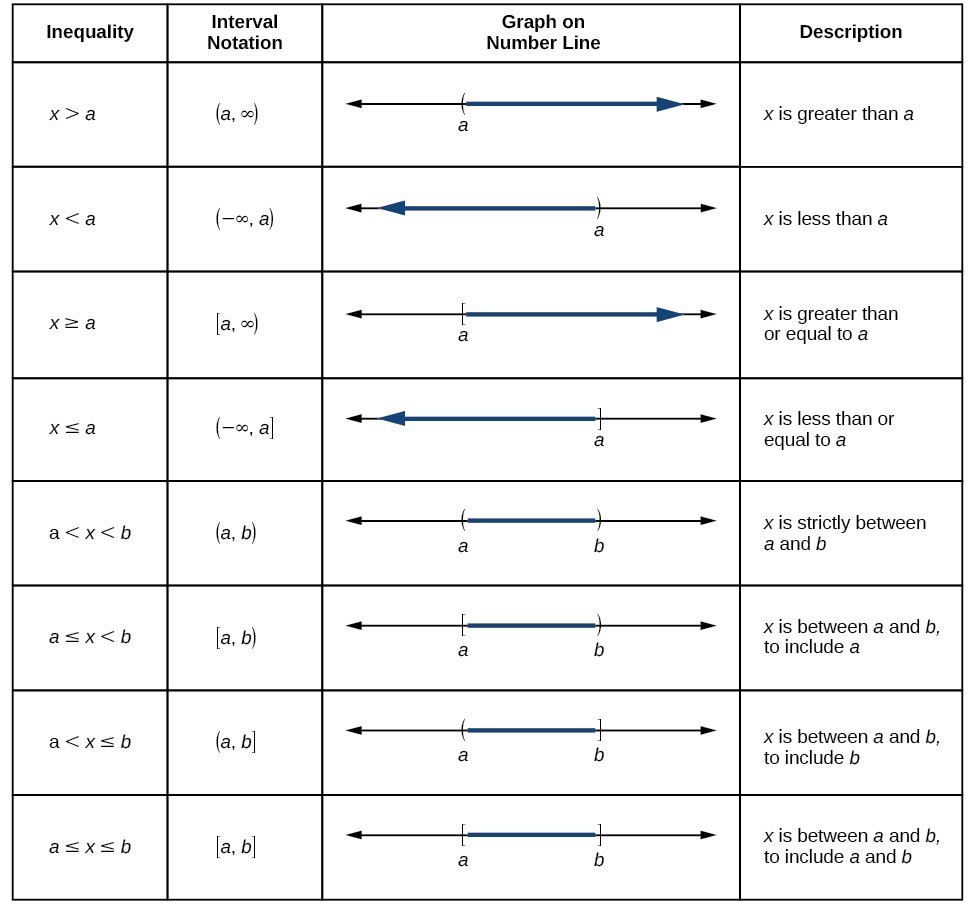
Three equivalent ways to state a solution set
Take the inequality
These each describe exactly the same set:
-
Inequality notation
-
Set-builder notation
Read this as: “the set of all real numbers such that is at least .” The vertical bar means “such that.”
-
Interval notation
A bracket means the endpoint is included; a parenthesis means it is excluded. Infinity always has a parenthesis:
This is because is not an ordinary real number that can be included as an endpoint.
Intervals and interval notation | Functions | Algebra I | Khan Academy
Watch Khan Academy’s “Intervals and interval notation” to connect number-line pictures to inequality, set-builder, and interval notation.
Watch closed intervals for included endpoints and the notation [a,b]. Continue with open intervals for excluded endpoints and parentheses. Then watch mixed endpoints and infinite intervals. Focus on one question at each endpoint: “Can x equal this number?”
Here is a compact translation guide:
| Solution in inequalities | Set-builder notation | Interval notation |
|---|---|---|
The order in interval notation is always left endpoint first, right endpoint second, just as numbers are ordered on a number line.
2. Which algebra steps preserve an inequality?
The previous lesson’s balance principle still applies in large part. If
then adding or subtracting the same number from both sides preserves the comparison:
Likewise, multiplying or dividing by a positive number preserves the comparison:
But multiplying or dividing by a negative number reverses it:
This reversal is essential, not a convention to memorize mechanically.
Why does the sign reverse?
Start with a true statement:
Multiply both sides by :
On the number line, lies to the right of . Therefore,
The original smaller number becomes the larger number after multiplication by a negative value. Negatives reflect positions across zero, reversing their order.
A short algebraic proof makes the same point. Suppose . Then the difference is positive:
Multiply this positive quantity by :
Rearrange:
which is equivalent to
After multiplying the original comparison by , we obtain
So the inequality symbol must reverse to keep the statement true.
2.5 Solve Linear Inequalities - Intermediate Algebra 2e | OpenStax
Read OpenStax’s explanation of the algebraic rules behind inequality solving. It reinforces which operations leave a comparison unchanged and why a negative multiplier requires a reversal.
In Section 2.5, under the subsection “Solve Linear Inequalities,” begin at the comparison with equations. Read through the Multiplication and Division Property of Inequality and the discussion immediately before Example 2.50. Keep a separate note of the only exceptional operation: multiplication or division by a negative quantity.
A useful workflow is:
- Simplify each side: distribute and combine like terms.
- Add or subtract terms on both sides to collect variable terms and constants.
- Isolate the variable.
- At every multiplication or division step, check the sign of the number used.
- Write the answer in inequality, set-builder, and interval notation.
- Test a value from the proposed solution set in the original inequality.
3. Solving inequalities step by step
Example 1: a positive coefficient
Solve
Subtract from both sides:
Now divide both sides by . Since is positive, the direction stays unchanged:
The three equivalent final forms are:
To verify, choose a value that the solution claims should work, such as :
This is true. A value outside the solution set, such as , should fail:
This is false.
Unlike an equation, a single successful test does not prove that you found all solutions. The algebraic transformations do that. Testing is still valuable for catching sign mistakes and checking that your answer makes sense.
Example 2: dividing by a negative number
Solve
First subtract :
Now divide by . This is the critical step: because the divisor is negative, reverse the inequality sign.
In interval notation:
In set-builder notation:
Check the endpoint, :
It is true, confirming that the bracket at is correct.
If you had forgotten to reverse the sign and written , then would supposedly qualify. But substitution gives
which is false. The check exposes the error immediately.
4. Variables on both sides and expressions with parentheses
The algebra from equation solving transfers directly until the final isolation step.
Solve:
Subtract from both sides:
Add to both sides:
Divide by , reversing the sign:
Thus,
or
The negative coefficient arose because we chose to subtract . That is valid, but there is a strategic alternative. Start again and subtract instead:
Divide by :
Finally, write the variable on the left:
Both routes are correct. The second route avoids division by a negative number, but it still requires careful reading of the final comparison.
Now include parentheses:
Distribute first:
Combine constants:
Subtract from both sides:
Add :
Divide by , which is positive:
So the solution set is
The endpoint is included because the original inequality permits equality.
Multi-step inequalities | Linear inequalities | Algebra I | Khan Academy
Watch Khan Academy’s “Multi-step inequalities” for worked examples that closely parallel the equation-solving workflow you have already learned, including the crucial negative-division step.
Watch a positive case to review ordinary isolation and interval notation. Then watch the negative case, where a negative coefficient forces the inequality to reverse. If you want one fuller worked example with distribution, continue with a multi-step example. Pause immediately before the final division in each negative-coefficient example and state aloud what must happen to the sign.
5. All real numbers, no solution, and a careful final check
As with equations, simplifying can eliminate the variable. But inequalities have outcomes that must be interpreted as statements about every real number or no real number.
An identity: all real numbers
Solve:
Distribute and simplify:
Subtract from both sides:
This statement is always true. It does not depend on , so every real number solves the original inequality.
Write the solution as:
or
or, in interval notation,
A contradiction: no solution
Now solve:
Distribute:
Subtract :
This is false. No value of can make the original inequality true.
The solution set is the empty set:
Do not write an interval for no solution. There is no interval containing no real numbers.
Final-answer checklist
Before you finish an inequality problem, check all four items:
- Did you simplify parentheses and like terms correctly?
- Did you reverse the sign exactly when multiplying or dividing by a negative number?
- Does the endpoint use a bracket for or , and a parenthesis for or ?
- Does a test value from your proposed region make the original inequality true?
This is a small but powerful habit. In later work, inequalities will define valid inputs of functions, constraints in optimization, and regions in multivariable spaces. Precision with endpoint inclusion and sign reversal prevents errors from spreading into those topics.
You can now solve a one-variable linear inequality using the same disciplined transformations used for equations, while treating multiplication or division by a negative number as the decisive exception. You can also communicate the complete solution set in inequality, set-builder, and interval notation.
Next, you will return to equations and learn how to solve quadratic equations by factoring and by the quadratic formula.
Can't find a good explanation? Sign up and we'll make it for you
Sign up