
Welcome back. Previously, we used Keynes’s beauty-contest model to separate a venture’s fundamental prospects from beliefs about what later investors, recruits, customers, and acquirers will believe. That raised a practical question: when another investor acts, how should that action change your belief rather than merely pull you into the same convention?
This lesson introduces Bayesian social learning as a disciplined answer. You will treat category evidence as signals: some private to your firm, some public to everyone, and some embedded in other investors’ visible decisions. The objective is not to manufacture false numerical precision around venture outcomes. It is to make the updating logic explicit: what was believed beforehand, what the new observation would be expected to look like in competing worlds, and whether it genuinely adds information.
1. Beliefs should move because evidence discriminates
Let be a proposition about a venture category. For example:
: AI-enabled laboratory software can become a durable category of valuable, repeatably monetizable companies, rather than a temporary collection of services and point solutions.
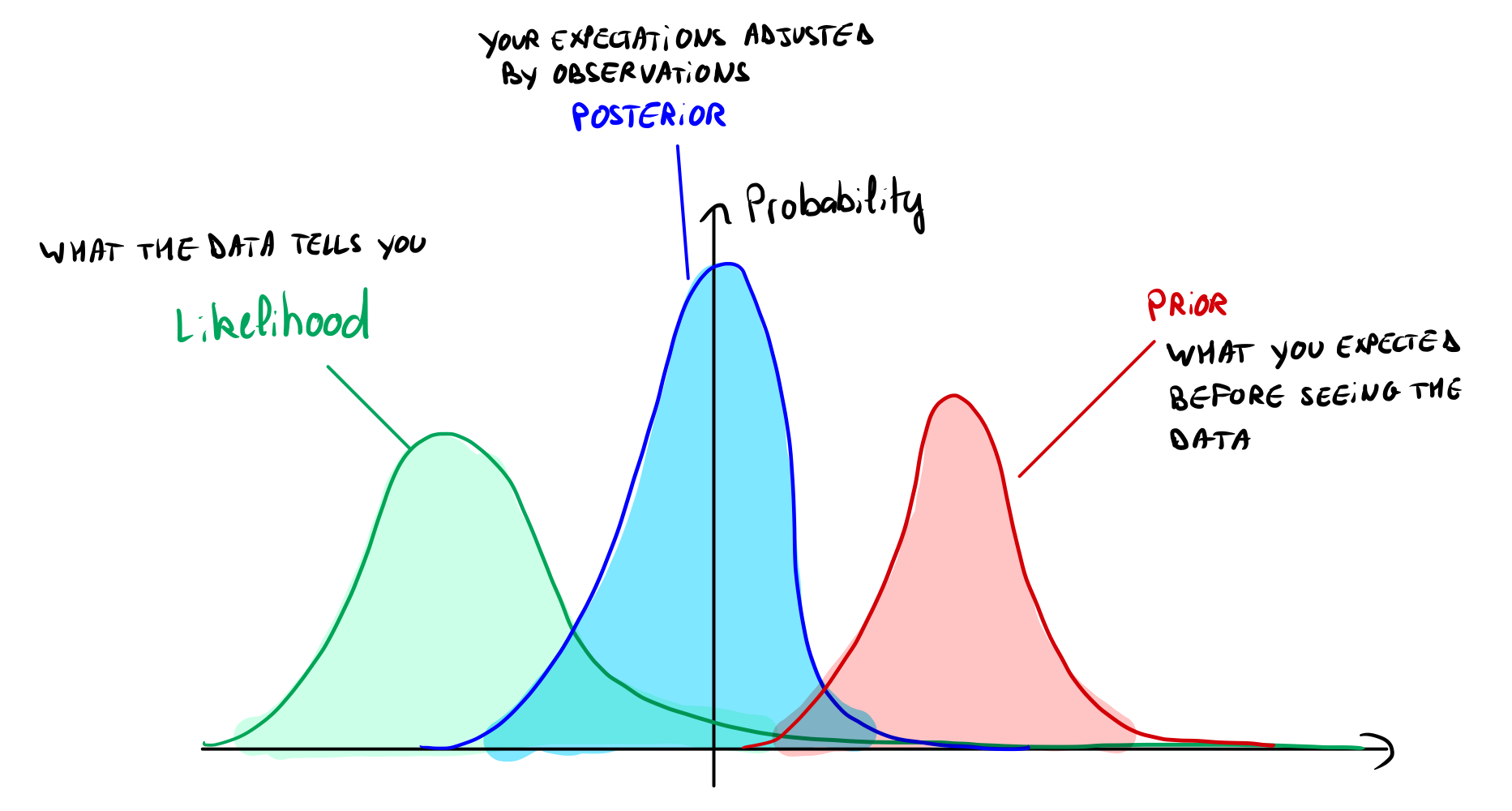
Before new evidence, you hold a prior belief:
After observing evidence , you hold a posterior belief:
Bayes’ rule connects the two:
The central term is the likelihood. It asks neither whether you like the evidence nor whether it is impressive in isolation. It asks:
How much more expected would this observation be if the category thesis were true than if it were false?
A category can produce a striking data point without that data point being especially diagnostic. A well-known founder raising a large seed round may be compatible with a durable category—but it may also be entirely compatible with a world in which the category is overheated and investors are funding pedigree, not economics.
The useful compact form is posterior odds:
The final ratio is the likelihood ratio. It gives evidence its proper role:
- If the ratio is close to , the observation does little to distinguish the two worlds. Your belief should barely move.
- If it is substantially greater than , the evidence favors .
- If it is below , the evidence favors .
This does not require that you assign exact probabilities to every claim in an investment memo. Often a range is sufficient: weakly supportive, strongly supportive, or largely uninformative. The discipline lies in forcing the comparison with the alternative explanation.
Bayes theorem, the geometry of changing beliefs
Watch “Bayes theorem, the geometry of changing beliefs” from 3Blue1Brown for a visual explanation of the relation among prior, likelihood, and posterior. It is a concise refresher before applying the concepts to venture-category signals.
Watch the formal framework. Focus on the distinction between the prior probability of a hypothesis, the likelihood of evidence if that hypothesis is true, and the posterior probability after observing the evidence. Translate “hypothesis” into a category thesis and “evidence” into a diligence observation or public market event.
2. Private evidence: your direct but fallible view
A private signal is information that is not broadly available to the market at the time you act. In early-stage VC, it may arise from:
- technical diligence that clarifies whether a claimed capability is reproducible;
- customer conversations conducted independently of the founder’s references;
- insight into implementation cost, data access, regulation, or procurement;
- an assessment of team execution based on sustained interaction;
- a non-public observation about the economics of an adjacent company.
“Private” does not mean “certain” or “superior.” A proprietary diligence process can still be biased, sample-selected, or misinterpreted. It means that other investors cannot automatically incorporate it into their own beliefs.
Suppose your prior probability that an emerging category will produce durable venture-scale businesses is . Your private evidence is that several independently sourced design partners report a recurring workflow problem and willingness to pay, not merely curiosity. You judge that evidence to be twice as likely in a durable-category world as in a transient-hype world:
Your prior odds are:
After incorporating the private evidence, your posterior odds become:
which corresponds to a posterior probability of:
The point is not the particular number. The point is that a meaningful piece of evidence can shift a belief substantially without justifying certainty. A few promising customer conversations do not erase base rates: many apparent workflow pains are real but insufficiently frequent, expensive, or urgent to support a large independent company.
The same logic also protects against the opposite failure: refusing to revise because a prior was once formed carefully. A prior is a starting point, not a commitment device.
NBER WORKING PAPER SERIES BAYESIAN LEARNING ...
Read the mathematical core of “Bayesian Learning” from the NBER Working Paper Series. It provides the formal language for combining an initial belief with new information, then extends it to the case in which each agent has both a common public signal and a distinct private signal.
In Section 2.1, “Bayesian updating” (PDF pp. 2–3), begin with the paragraph starting “Suppose there is an unknown random variable” and read the update setup. Focus on why a more precise signal receives more weight, rather than on the normal-distribution notation itself. Then move to Section 3.2.1, “A beauty-contest with exogenous signals” (PDF pp. 10–12). Begin at the paragraph that introduces the common public signal and individual private signals, and read the public and private signal model. Pay particular attention to the finding that a public signal receives extra weight in actions when agents have reason to coordinate with one another.
3. Public evidence is common knowledge, so it changes more than one belief
A public signal is observed, or expected to be observed, by many relevant decision-makers. Examples include:
- audited or reliably reported revenue data from category peers;
- a benchmark result that independent experts can reproduce;
- a regulatory decision that clearly expands or closes a market;
- a major customer publicly deploying a category product;
- a prominent financing, acquisition, shutdown, or down round;
- a visible change in public-market comparables.
Public signals matter for two distinct reasons.
First, they may improve the estimate of the underlying category state. A credible revelation that multiple enterprises renewed an expensive annual contract is evidence about economic value.
Second, they tell everyone that others have seen the same evidence. In a financing-dependent sector, this shared knowledge affects anticipated behavior by future investors and customers. This is the bridge from ordinary Bayesian updating to the Keynesian higher-order beliefs of the prior lesson.
In the normal-signal formulation, an investor combines a prior mean, a public signal , and a private signal :
Here, denotes precision, the inverse of variance. More reliable evidence has greater precision and receives greater weight.
The formula captures an important VC reality. A public observation may deserve a meaningful weight even when your private diligence points elsewhere. But the action you take can respond more strongly to public information than your internal belief changes, because financing, hiring, and customer adoption partly depend on coordinated views.
For a company needing a Series A in eighteen months, a widely observed financing shock may alter the near-term financing environment even if it says little about the company’s underlying technical quality. This is not necessarily irrational capitulation. It can be a reasonable inference about what the next financing audience will now believe.
The key analytical separation is:
| Question | Object of belief |
|---|---|
| Does the public event reveal something about category economics? | Fundamental state |
| Does it alter how other actors will behave? | Coordination environment |
| Does it directly change company opportunities, such as recruiting or access to customers? | Fundamentals through feedback |
A brand-name VC’s investment may operate through all three channels. Treating it as only a signal understates its possible causal force; treating it as proof of quality overstates its informational content.
4. Other investors’ actions are compressed signals, not raw facts
Social learning occurs when you infer from what another person does. In the simple case, an investor has private information, takes an action, and you observe the action but not the underlying information.
Suppose a respected specialist fund leads a Series A in a difficult category. It is tempting to say: “They must know something.” Bayesian social learning turns that instinct into a more demanding question:
The investment is strong evidence only if the fund would be materially less likely to invest in the unfavorable world.
That depends on how the action was generated. Before treating it as a category signal, assess at least five possibilities:
| Driver of the observed investment | Implication for your update |
|---|---|
| The fund uncovered genuinely superior technical or commercial evidence. | Potentially informative. |
| The fund is specialized and can add decisive operational value. | The action may be more informative about this company than about the whole category. |
| The fund is following a prior commitment, strategic relationship, or portfolio need. | Less informative about category fundamentals. |
| The investment is partly reputational or narrative-driven. | It may forecast near-term attention without strongly supporting intrinsic value. |
| The fund’s participation makes hiring, customer access, and follow-on financing easier. | The action changes future fundamentals; it is not only evidence about pre-existing fundamentals. |
A lead investment also aggregates information imperfectly. You usually do not observe the full diligence record, the competing opportunities declined by the fund, the partner’s incentives, or the valuation at which the decision became acceptable. The visible action is a compressed report.
This has a practical implication: do not count logos; count independent information sources.
If five funds follow the same lead into a round, the five actions are not five independent confirmations. They may all be downstream of one diligence process, one reference customer, one benchmark, or one shared fear of missing the category. Likewise, several apparently independent favorable customer references may ultimately trace to the same founder-selected network.
For sequential evidence and , the shortcut of multiplying likelihood ratios is valid only if the observations are conditionally independent given the true state. In full form:
If is mostly a consequence of , its incremental likelihood ratio should be close to . The second observation adds visibility, perhaps, but little new information.
5. A worked category example: evidence, action, and feedback
Return to the hypothetical laboratory-software category. You begin with a prior that it can support a durable venture-scale business category.
Step 1: private commercial evidence
Your customer work is favorable. As above, suppose its likelihood ratio is . Your probability rises from to approximately .
Step 2: a specialist fund leads a round
Assume, provisionally, that the specialist fund would be twice as likely to lead a company in a genuinely durable category as in a weak category:
If the fund’s action adds genuinely independent evidence, posterior odds rise from to :
The posterior probability becomes:
The superficial conclusion would be that the category is now “proven.” That would be a mistake.
The more rigorous interpretation is conditional:
- Your belief rises if the lead’s action is based on meaningful and partly independent information.
- The update should be reduced if the fund mainly saw the same evidence you saw, or was influenced by the same public narrative.
- The financing may nevertheless improve the company’s prospects even if it contains little new information, because the lead may improve recruiting, credibility, customer access, and follow-on financing.
- A high posterior for category attractiveness does not alone justify a high entry valuation. The investment still depends on price, company-specific execution, financing dependency, and the timing of recognition.
This distinction is central to contrarian VC. A category can be fundamentally attractive while still being an unattractive investment at prevailing valuations. Equally, a category can be temporarily unfashionable while its underlying evidence is improving—provided companies can survive until the market notices.
6. Why social learning can fail even when everyone is rational
The benchmark social-learning model is deliberately simple:
- there is an unknown state, such as a high-value or low-value category;
- each investor receives a private signal;
- investors act in sequence;
- later investors observe earlier actions, but not the private signals behind them;
- each investor rationally combines private information with observed actions.
Under these assumptions, observing behavior can be useful. The first investor’s action reveals something about their private signal. The second investor’s action can add another piece of information.
But a problem emerges quickly. Once later investors infer that earlier actions already favor one direction strongly enough, they may rationally choose the same action even when their own private signal points the other way. Their action then reveals almost nothing about their signal. The public information pool stops improving.
This is the mechanism behind an information cascade, which the next lesson will examine in full. At this stage, the essential point is simpler:
An observed action is informative only if the actor’s private evidence still had the capacity to affect that action.
In venture markets, a run of similar financings may look like mounting confirmation. It can instead reflect diminishing information content. The fifth follower may be acting largely because of the first two visible financings, not because they have uncovered a fifth independent source of evidence.
[PDF] Information Cascades and Social Learning
Read the foundational model in “Information Cascades and Social Learning,” an NBER survey. The simple binary model is intentionally stylized, but it makes clear why actions can initially reveal private information and then cease to do so.
In Section 2, “The Simple Binary Model: A Motivating Example,” read the introductory motivation and Section 2.1, “Basic Setup: Binary Actions, Signals, and States.” Use the model setup to locate this material. Focus on the distinction between observing others’ underlying signals and observing only their actions. Then read Section 2.2, “Why Information Stops Accumulating: Information Cascades.” Begin at the paragraph beginning “To see why outcomes are inefficient” and continue through the discussion of path dependence, using the cascade mechanism as a locator. Notice why later identical actions may carry no additional private information.
7. A Bayesian protocol for an investment-category memo
For a live category, Bayesian social learning is most useful as a memo discipline rather than as a claim to calculate a precise posterior probability.
1. State the proposition narrowly
Avoid a vague hypothesis such as “this is an exciting category.” Define a proposition with an economic and temporal content:
“Within five years, a meaningful share of mid-market research organizations will pay recurring software fees for autonomous experimental-design workflows.”
A narrow hypothesis makes both supporting and disconfirming evidence legible.
2. Record the prior and its basis
The prior should draw on relevant base rates:
- adjacent-category adoption history;
- procurement and integration friction;
- founder and company formation quality;
- plausible market size at sustainable pricing;
- historical frequency with which apparent technical capabilities became durable businesses.
Do not use current valuation or media volume as a prior. Those are themselves outcomes of the social process you are trying to analyze.
3. Separate evidence by source and visibility
Label each observation:
| Evidence type | Example | Main concern |
|---|---|---|
| Private and direct | Independently sourced customer workflow evidence | Sample selection and interpretation |
| Public and direct | Audited peer revenue or a regulatory decision | Whether it generalizes to the category |
| Private action | A trusted operator joins a startup after deep diligence | Why that actor acted |
| Public action | A prominent fund leads a round | Information versus reputation, incentives, and coordination |
| Public narrative | Repeated press framing of a category as inevitable | Attention is not evidence of economic durability |
4. Ask what the observation would look like in the unfavorable world
A large round is not strong evidence if large rounds are common in temporarily fashionable sectors. A customer renewal is not strong evidence if it was heavily subsidized or bundled with services. A failed company is not strong negative evidence if failure resulted from a founder conflict, an avoidable go-to-market error, or financing terms unique to that company.
The task is always comparative: would we expect this evidence to appear under both hypotheses?
5. Discount correlated evidence
Map the common origin of signals. If founder references, customer enthusiasm, benchmark reports, and co-investor interest all trace back to one unusually successful flagship company, the evidence is less diverse than it first appears.
6. Separate learning from reflexivity
Conclude the memo with two columns:
| Informational question | Reflexive question |
|---|---|
| What does this signal reveal about pre-existing category economics? | How does the signal change financing, hiring, customer trust, or competition? |
| How reliable and independent is the evidence? | Can the visible event itself make the thesis more or less true? |
This final distinction prepares the move from social learning to reflexivity later in the course. Investors sometimes observe genuine information. At other times, their collective response changes the reality being observed.
Key takeaways
- Bayesian updating begins with a prior and revises it according to how diagnostic new evidence is under competing hypotheses.
- A private signal is not automatically better than a public one; its weight should depend on reliability, relevance, and independence.
- Public signals matter both because they may reveal fundamentals and because everyone knows that others have seen them.
- Another investor’s action is a compressed signal. Its information value depends on the investor’s expertise, incentives, selection process, and the action’s plausibility in an unfavorable world.
- Do not treat several correlated investments, references, or financings as independent confirmations.
- A visible action can be both evidence about a category and an intervention that changes the category’s financing and operating environment.
- The critical warning sign is when later investors’ actions no longer reveal their own private information because they are responding mainly to earlier visible actions.
Next, we will examine the conditions under which this individually rational process becomes an information cascade—including why a small early preponderance of funding decisions can produce a category-wide boom, stigma, or prolonged neglect.