
Principal and Yield Tokens: Separating Principal from Variable Yield at Maturity
Welcome. This module examines the mechanics that make a fixed-maturity yield exchange possible: taking an asset that produces uncertain, changing yield and separating its principal claim from its future-yield claim.
The key idea is familiar from fixed income, but the on-chain implementation has important differences. A principal token can resemble a zero-coupon bond, and a yield token can resemble detached coupons. But the claims are ultimately backed by a DeFi position and its dependencies, not by a sovereign or corporate issuer. Understanding precisely what is fixed, what remains variable, and what risks remain is essential when positioning Exponent to institutional users.
One yield-bearing asset, two distinct economic claims
A yield-bearing asset is any tokenized position whose holder receives economic value over time. Examples include a liquid-staking token, a lending receipt token, a stablecoin savings token, or a liquidity-provider position.
Before tokenization, holding one such asset gives its owner two things at once:
- Principal exposure: the right to recover the base position.
- Future yield exposure: the right to whatever rewards, interest, fees, or incentives accrue over a stated period.
Yield tokenization unbundles these rights for a defined interval ending at a fixed maturity date. In its simplest normalized form:
where:
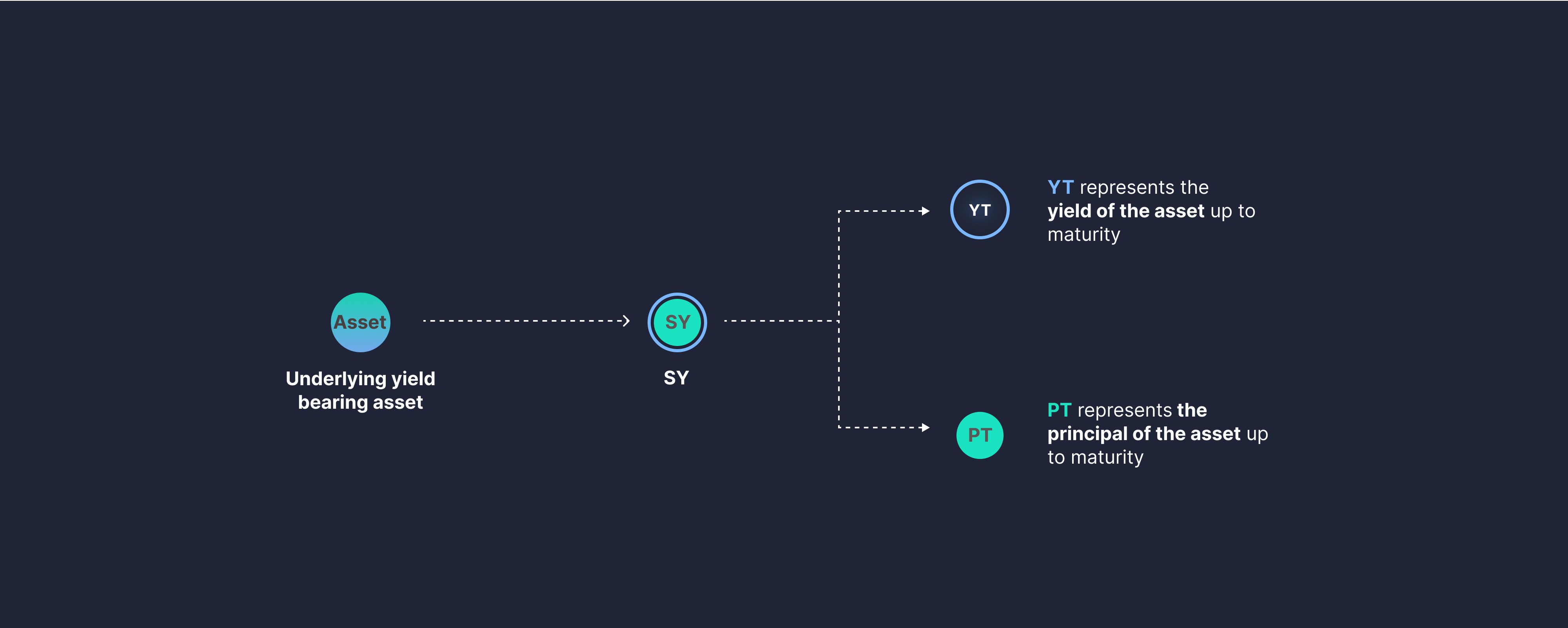
- PT, the Principal Token, represents the claim on the principal at maturity.
- YT, the Yield Token, represents the claim on yield generated from now until maturity.
The tokenization does not create yield from nowhere. It divides the economics already embedded in the original yield-bearing asset. Whoever buys PT gives up the future yield stream; whoever buys YT takes exposure to it.
Watch Pendle’s short visual explanation first. Although this course focuses on Exponent’s Solana implementation, the video establishes the general economic structure shared by fixed-maturity yield exchanges.
Chapter 1: What is Yield Tokenization
Watch “Chapter 1: What is Yield Tokenization” from Pendle. It introduces the central separation of an income-producing asset into principal and future yield, then distinguishes the respective economic claims of PT and YT.
Watch the core split for the rental-property intuition. Then watch the PT segment, focusing on why buying principal below its maturity redemption value creates a fixed return if the position is held to maturity. Finish with the YT segment, focusing on the fact that the income stream is uncertain and expires at the stated date.
The rental-property analogy is useful if used carefully. Imagine a property with one year remaining in an agreement:
- The property itself at the end of the year corresponds to the principal claim.
- The rents paid during that year correspond to the yield claim.
One investor can purchase the future property claim at a discount. Another can purchase the right to the year’s rental income. Neither has created extra property value; together, their claims reconstruct the original owner’s economics.
The same logic applies to an on-chain yield source. The yield might be staking rewards, lending interest, trading fees, protocol incentives, or some combination. Unlike a contractual bond coupon, however, the amount is generally not known in advance.
What “fixed maturity” actually fixes
A common mistake is to call PT “risk-free” or to say that a yield exchange turns variable yield into a guaranteed fiat return. Neither statement is generally correct.
A fixed-maturity market fixes the endpoint of the claims:
- Before maturity, PT and YT are separate, tradeable claims.
- At maturity, PT becomes redeemable for its defined principal amount.
- YT is entitled only to the yield accrued up to that maturity, after which it expires.
What is not automatically fixed includes:
- the dollar value of the underlying asset;
- the amount of yield that the YT will receive;
- the market price of PT before maturity;
- smart-contract, issuer, validator, oracle, liquidity, and operational risks.
For example, suppose a PT is redeemable for one unit of a liquid-staking asset at maturity. The holder who keeps it to maturity has a defined claim in units of that asset. If that asset falls 30 percent against the dollar, the PT holder still receives one unit, but the dollar value of that unit is lower. “Fixed” here means a maturity redemption amount in the protocol’s asset terms, subject to the protocol functioning as designed. It does not mean a fixed dollar payoff.
This distinction matters in institutional conversations. A treasury seeking predictable stablecoin-denominated income and a fund seeking more SOL or ETH exposure face materially different risks even if both buy “fixed-yield” PTs.
PT: the principal claim
A Principal Token gives its holder the right to redeem a specified principal claim at maturity. Before maturity, it normally trades below that maturity redemption value because its buyer has paid today for something received later.
Conceptually, a PT buyer is doing two things:
- paying for the future principal claim at a discount;
- giving up the uncertain yield generated before maturity.
If the holder buys PT and holds through maturity, the discount converges toward the redemption value over time, conditional on the underlying asset and protocol performing as expected. That discount is the economic source of the buyer’s implied fixed yield.
The fixed-income analogy is a zero-coupon bond:
| Traditional fixed income | Fixed-maturity DeFi analogue |
|---|---|
| Face value paid at maturity | PT redemption claim at maturity |
| Discounted purchase price | PT market price before maturity |
| Yield to maturity from discount accretion | Implied fixed yield from PT discount |
| Credit and market risk | Underlying, protocol, smart-contract, liquidity, and asset-price risks |
The analogy stops at the risk structure. A zero-coupon Treasury is a legal obligation of a government in a specified currency. A PT is an on-chain token backed by a particular yield-generating position, its associated contracts, and its redemption mechanics.
Read the following sections for the formal framing and the bond-stripping comparison.
Chapter 2 - Yield Tokenization Basics | Pendle Documentation
Read Pendle Documentation’s “Chapter 2: Yield Tokenization Basics.” It provides a concise conceptual model for splitting principal and yield, then connects PT and YT to zero-coupon bonds and detached coupons.
In the opening “TL;DR” section, read the explanation of the split. Focus on why the two pieces together represent the original position, rather than two independent sources of return. Then go to “Analogy of PT & YT in TradFi” and read the bond stripping analogy. Treat it as a language bridge for institutional communication, while keeping in mind that on-chain claims retain protocol and underlying-asset risk.
YT: the variable-yield claim
A Yield Token gives its holder the right to yield generated by the underlying position between the time of tokenization and the fixed maturity date.
The YT buyer is not buying principal. They are purchasing a limited-life claim on future cash flow whose amount is uncertain. Their outcome depends on realized yield relative to the price paid for YT.
Sources of YT yield can include:
- base staking rewards;
- lending interest paid by borrowers;
- liquidity-provider fees;
- incentive-token emissions;
- other protocol-defined rewards.
A YT therefore behaves more like a position in the future level of a yield source than a conventional fixed coupon. If realized yield is high relative to what the buyer paid, YT can be profitable. If realized yield declines, incentives end, utilization falls, or the underlying mechanism underperforms, the YT buyer may receive less than expected.
Crucially, time is working against a YT holder. Each day that passes removes one day from the claim period. As maturity approaches, there is less future yield left to receive; at maturity, no future-yield period remains and the YT expires after any remaining accrued yield is collected.
This is why YT is not simply “the interest-bearing part” of a position. It is a dated, decaying claim on variable future yield.
A simple six-month example
Suppose one unit of a yield-bearing stablecoin position is split with six months to maturity. To keep the arithmetic intuitive, use the normalized relationship:
Assume market prices today are:
Together, they equal one unit of the standardized underlying value before fees and execution effects.
Now compare three possible yield outcomes over the six months:
| Realized yield paid to YT | YT purchase cost | Simplified YT result before fees |
|---|---|---|
| Loss of | ||
| Break-even | ||
| Gain of |
The PT holder paid for a maturity claim of one principal unit; their return comes from the discount closing by maturity. The YT holder paid for all yield during the period; their return depends on actual yield realized. Together, the two positions recreate the economics of holding the original yield-bearing asset through maturity.
The example deliberately leaves out trading fees, price impact, incentive-token price risk, and conversion details. Those become important in actual execution, but they do not change the central split of principal from yield.
Exponent’s implementation: SY, PT, and YT
Exponent introduces an additional layer: the Standardized Yield Token, or SY. The role of SY is to present diverse yield-bearing assets through a standardized interface before they are separated into PT and YT.
This matters because yield sources do not naturally share the same mechanics. One may accrue through a rising exchange rate; another through rebasing balances; another through externally claimable rewards. Standardization makes it possible for the exchange to work with a consistent representation of yield-bearing capital.
Exponent’s process is:
- A user supplies a yield-bearing position that is represented through SY.
- The protocol strips that SY position into matching PT and YT claims for a specific maturity.
- PT carries the principal claim to maturity.
- YT carries the yield claim until that same date.
Read Exponent’s “Core Overview.” This is the protocol-specific version of the general PT/YT structure, introducing the SY layer and Exponent’s important requirement for earning through a YT position.
Under “How It Works,” read the overview and token definitions. Pay special attention to the distinction between possessing a YT and placing it in the designated yield position that accrues yield. Then continue immediately below to the paragraph beginning “The number of PT and YT minted depends” and read the stripping and maturity mechanics. Notice that the SY exchange rate can affect token quantities without changing the underlying economic principle.
Exponent’s documentation expresses the quantity relationship as:
Here, is the current SY exchange rate. If , then depositing SY produces PT and YT under the documented convention.
The important point is not the token count itself. The exchange-rate factor is an accounting normalization: it reflects how SY represents the underlying yield-bearing asset. The economic matching remains intact:
- the PT and YT are minted as a pair;
- they share the same underlying source and maturity;
- the matched pair corresponds to the original standardized yield position.
For a first-pass explanation to a client, begin with “one underlying position is split into a principal claim and a future-yield claim.” Introduce the SY exchange-rate adjustment only once the client needs to understand minting quantities or reconciliation.
One Exponent-specific operational detail deserves emphasis: according to the documentation, merely holding YT in a wallet does not accrue yield. The YT must be deposited into the appropriate yield position. That is an important difference between an economic entitlement in the abstract and the actual operational steps needed to realize it in the protocol.
Recombining the claims and the role of maturity
Before maturity, a holder with the correct matching quantities of PT and YT can combine them to recreate the standardized yield position. This is often called merging. Conversely, depositing the standardized yield position to create PT and YT is called stripping.
Maturity changes the relationship:
- Before maturity: PT plus YT is required to reconstruct the complete yield-bearing position, because the YT still owns the remaining yield rights.
- At maturity: there is no remaining future yield period. PT can redeem for its defined principal claim without the YT.
- After maturity: YT has no future yield left to represent. Any final accrued yield is collected under the protocol’s rules, then the YT expires.
This is the economic reason PT becomes a maturity instrument and YT becomes a wasting asset. PT’s claim persists to its redemption point; YT’s claim is consumed as the yield window closes.
The ability to strip and merge also imposes discipline on market prices. If the combined value of PT and YT diverges materially from the value of the corresponding standardized asset, market participants have an economic reason to trade, mint, or merge claims to exploit the difference. The mechanics and arbitrage logic are the subject of the next lesson; for now, retain the basic constraint that PT and YT are two linked halves of one dated position.
A practical institutional framing
When describing an Exponent-style yield market to an allocator, separate economic exposure from execution and risk.
| Position | Economic purpose | What the investor gives up | Principal risks that remain |
|---|---|---|---|
| Hold the yield-bearing asset | Keep principal and variable yield together | Ability to separately price or hedge yield | Underlying, protocol, and asset-price risks |
| Buy PT | Seek known principal redemption amount at a fixed maturity, acquired at a discount | Yield earned before maturity | Underlying, redemption, smart-contract, liquidity, and dollar-price risks |
| Buy YT | Express a view that realized yield will exceed the market-implied level | Principal claim | Yield decline, emission changes, time decay, liquidity, and protocol risks |
| Hold matched PT and YT | Recreate the whole yield-bearing economic position | Separation of exposures | Same core risks as the underlying position |
A few careful phrases are useful:
- Accurate: “PT allows an investor to lock an implied return in units of the underlying asset if held to maturity, subject to protocol and underlying risks.”
- Accurate: “YT isolates the variable yield earned until a stated expiry.”
- Misleading: “PT is a risk-free bond.”
- Misleading: “YT guarantees the asset’s APY.”
- Incomplete: “PT has no volatility.” Its maturity redemption amount may be defined, but its market price can move materially before maturity.
For an institutional sales conversation, this precision builds credibility. The value proposition is not that DeFi risks disappear. It is that the protocol makes previously bundled risks and cash-flow claims separable, priceable, transferable, and maturity-specific.
Key takeaways
Yield tokenization divides a yield-bearing position into two linked claims ending at a fixed maturity:
- PT represents the principal redemption claim at maturity. Its discount to maturity value is the source of its implied fixed return.
- YT represents yield generated only until maturity. Its payoff is variable, and its remaining economic value declines as maturity approaches.
- A matched PT and YT pair can recreate the standardized underlying position before maturity; at maturity, PT redeems while YT’s future-yield right expires.
- At Exponent, SY standardizes the yield-bearing asset before stripping, and YT must be placed into the relevant yield position to accrue yield.
- “Fixed maturity” does not eliminate smart-contract, underlying-asset, liquidity, or dollar-price risk.
Next, we will use the identity between the underlying position, PT, and YT to explain stripping and merging arbitrage: why these claims cannot trade independently for long without creating an economically actionable discrepancy.
Can't find a good explanation? Sign up and we'll make it for you
Sign up