Introduction
Welcome to the final lesson in our module on foundational tactics. In the previous lessons, you've done an excellent job learning to identify forks, pins, and skewers, and even how to combine them in puzzle-based scenarios. You've seen how a decoy sacrifice can set up a winning pin, or how a pin can disable a key defender, allowing a fork to land.
The learning outcome for today is to apply fork, pin, and skewer patterns in practice games. This is the most crucial step: moving from the controlled environment of a puzzle, where you know a tactic exists, to the dynamic and often chaotic environment of a real game. We'll focus on building a systematic process to help you "tune your tactical radar" so you can begin to spot these opportunities on your own.
Let's start with a quick visual recap of the patterns we've covered.
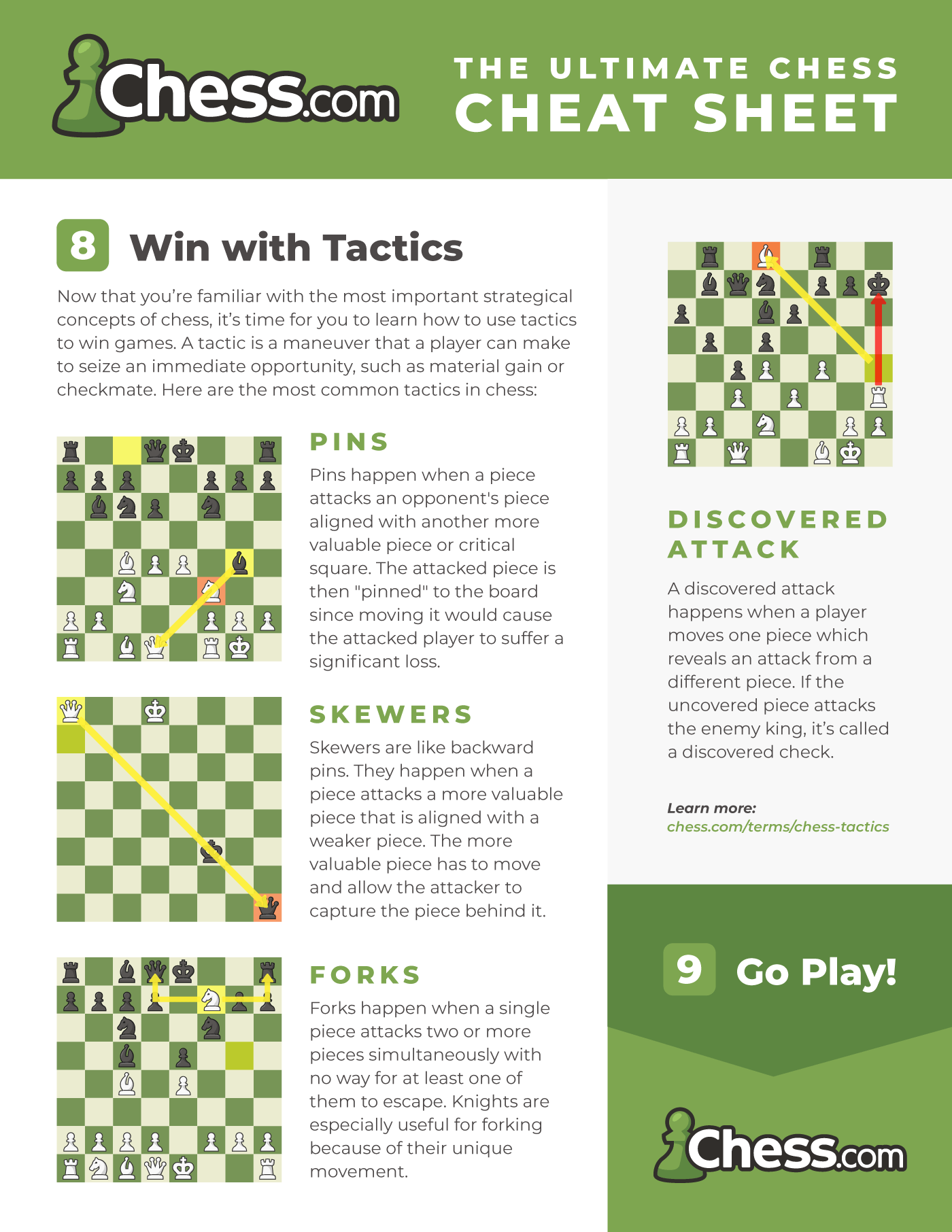
1. From Solving to Seeing: Tuning Your Tactical Radar
The biggest challenge in applying tactics is knowing when to look for them. In a puzzle, the search is already on. In a game, you need triggers—signals that a tactical opportunity might be present. These signals are weaknesses in your opponent's position.
The following article introduces the idea of "tactical red flags" or "Seeds of Tactical Destruction." Learning to spot these is the first step to finding tactics in your games.
How to Improve Your Chess Tactics & Master the Chessboard
This article from Chessable, 'How to Improve Your Chess Tactics', contains a vital section on developing your tactical intuition. It provides a list of weaknesses to look for in your opponent's position.
Please read the section titled 'Tuning Your Chess Tactics Radar'. Focus on the bulleted list of weaknesses or 'red flags'. These are the signals you should be looking for in your games.
As the article points out, the key "red flags" to watch for are:
- Undefended pieces: These are freebies waiting to be taken by a tactic.
- An exposed king: A king with few pawn defenders is a prime target.
- Pieces in a row: Pieces aligned on a rank, file, or diagonal are vulnerable to pins and skewers.
- Pieces that can be forked: Pay special attention to pieces on the same color squares (for bishops) or at the right distance for a knight.
- Overloaded pieces: A single piece doing too many defensive jobs at once.
Once you spot these red flags, you can shift from just playing moves to actively hunting for a combination.
2. A Systematic Approach: Your Pre-Move Checklist
Spotting red flags tells you when to look. But how should you look? The most effective method is to use a consistent, systematic pre-move checklist. Given your background in development, you can think of this as running a "linter" on the position before you commit your move.
One of the most valuable things you can do is to analyze the position for forcing moves: checks, captures, and threats.
Your mental checklist you run through before each move.
This Chess.com forum discussion contains an excellent, detailed checklist created by a user named ChessBookBastion. It provides a structured way to analyze the board on every single move.
Read the post by 'ChessBookBastion'. Pay close attention to the questions in section 'I. Analyze the board every move using the following system:', particularly points 1(a) through 1(e). This is a template for your own thought process.
The key questions from that checklist, which you should start asking yourself before every move, are:
- Can my opponent create a pin?
- Can my opponent fork any of my pieces? (The post specifically mentions pawn and knight forks, which are easy to miss).
- Do I have any opportunities to use these same tactics against my opponent?
This systematic check transforms tactical awareness from a passive hope into an active search.
3. A Grandmaster's Mindset in Action
Now, let's see how this works in practice. We'll watch Grandmaster Daniel Naroditsky play a game against an 1100-rated player. He constantly verbalizes his thought process, which is a perfect model for how to apply the ideas we've just discussed.
Beginner To Master | Chess Speedrun | 1100 | Grandmaster Naroditsky
In this 'Speedrun' video, GM Naroditsky explains his moves as he plays. Notice how his commentary revolves around undefended pieces, potential forks, and counter-attacks—the very 'red flags' we've been discussing.
Watch the following key moments. For each one, listen to how Naroditsky identifies a tactical vulnerability and formulates a plan. Defensive Awareness (03:59 - 04:41): He spots a potential queen fork his opponent could play and proactively prevents it. This is applying tactics defensively. The Knight Fork (07:21 - 07:42): Here, he executes a simple but effective knight fork, winning material by attacking two pieces at once. The Overloaded Piece (23:56 - 24:12): He identifies that his opponent's queen has too many defensive tasks. This is a subtle but critical observation. Post-Game Analysis (36:39 - 37:05): Naroditsky reviews the 'overloaded queen' moment, confirming the tactical flaw and how it led to a win. Repetition helps reinforce the pattern.
Naroditsky’s thinking process demonstrates the core loop of practical chess tactics:
- Scan: He constantly assesses the position for undefended pieces and other weaknesses.
- Identify: He spots a concrete opportunity, like the knight fork on d3 or the overloaded queen.
- Calculate: He verifies that the tactic works.
- Execute: He plays the winning move.
This is the process you will now begin to build for yourself.
4. Your Practical Action Plan
Theory and observation are essential, but improvement comes from doing. Here is your action plan for your next few games. The goal is not just to win, but to consciously practice this new thought process.
Play a 15+10 rapid game on Chess.com. The longer time control is crucial—it gives you time to think. During the game, follow this three-step routine for every move:
-
After Your Opponent Moves:
- Identify the Threat: What is the immediate purpose of their move? Does it attack anything?
- Scan for New Red Flags: Has their move created any new weaknesses? (e.g., Did they move a pawn, exposing their king? Did they move a piece, leaving another piece undefended?)
-
Before You Move (Your Turn):
- Run the Forcing Moves Checklist:
- Checks: Do I have any safe checks? What do they lead to?
- Captures: Do I have any safe captures? Do they lead to an advantage?
- Threats: Can I make a move that creates a fork, pin, or skewer?
- Blunder Check: Once you've chosen your move, ask one final question: "What is my opponent's best reply to this move?" Look for any simple tactics you might have missed. (This is from the forum post LINK, section 2).
- Run the Forcing Moves Checklist:
-
After the Game:
- Win or lose, run the game through the Chess.com analysis tool.
- Pay special attention to any "Missed Wins" or tactical opportunities the engine points out for either side. Try to understand why it was a tactic. Was there an undefended piece? An overloaded defender?
This deliberate practice will feel slow and difficult at first, but it is the single most effective way to build the habit of tactical awareness.
Conclusion
Congratulations on completing the first module! You've moved from learning the definitions of forks, pins, and skewers to applying them in complex puzzles, and now you have a framework for hunting them in your own games.
Key Takeaways:
- Tactics don't appear out of nowhere; they arise from specific weaknesses ("red flags") in a position, like undefended pieces, an exposed king, or overloaded defenders.
- To find tactics reliably, you must actively look for them. Use a systematic pre-move checklist focused on checks, captures, and threats (especially forks, pins, and skewers).
- Applying tactics isn't just about attacking. It's also about defensive awareness—spotting and preventing your opponent's tactical ideas.
Preview of the Next Lesson:
With this foundation, you are ready to expand your tactical arsenal. In our next lesson, we will begin Module 2, "Advanced Tactical Motifs." The first topic will be the Discovered Attack, a powerful tactic where moving one piece unveils a hidden attack from another. The systematic search process you learned today will be essential for spotting these more subtle and surprising combinations.