Introduction
Welcome to your first lesson on the path to 1500 ELO! This course is designed to build on your current skills, focusing on the practical, pattern-based approach you prefer. We'll start by sharpening your tactical vision, which is the fastest way to see a significant rating increase.
This lesson kicks off our first module on "Foundational Tactics." Our goal today is to master one of the most common and decisive tactical motifs: the fork. By the end of this session, you will be able to confidently identify knight and pawn fork opportunities to win material. We'll focus on recognizing the specific geometric patterns that allow these tactics to work, moving from simple recognition to spotting them in more complex situations.
Let's start with a quick look at what a fork is.
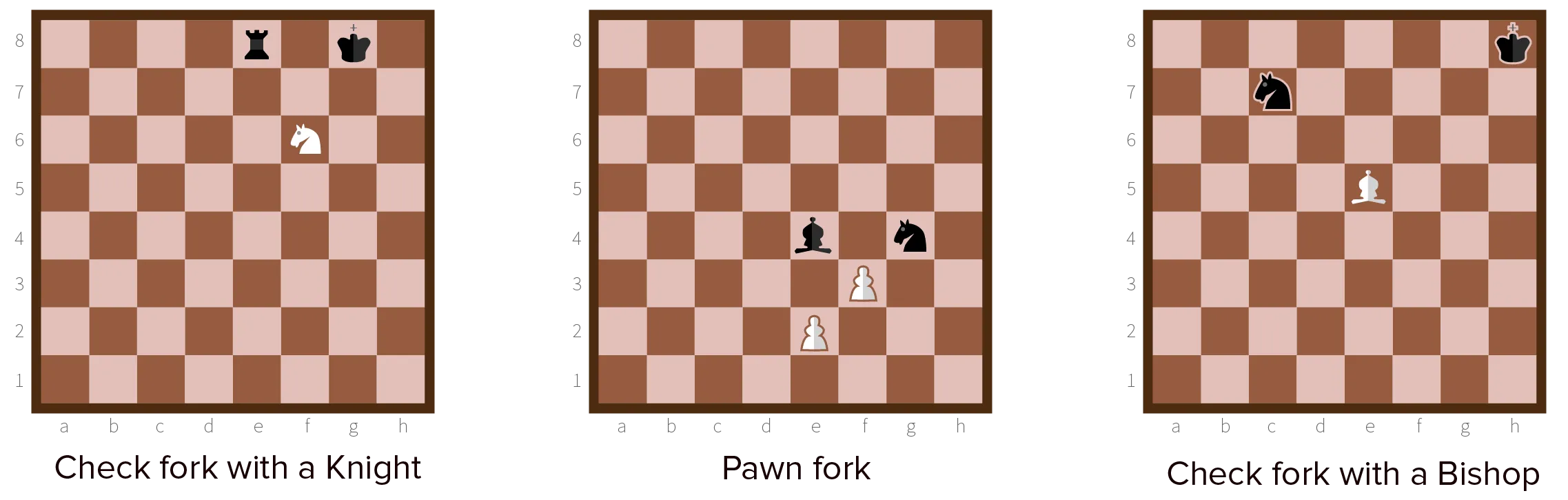
As you can see, a fork occurs when a single piece attacks two or more enemy pieces at the same time. The defender can usually only move one of their attacked pieces, allowing you to capture the other. Today, we'll concentrate on the two most frequent perpetrators of this tactic: the knight and the pawn.
The Mighty Knight Fork
The knight's unique "L-shaped" move makes it a master of surprise attacks. Because it's the only piece that can jump over other pieces, its forks can appear seemingly out of nowhere. Your ability to spot these is critical.
A Simple Rule for Spotting Knight Forks
There's a very effective heuristic for spotting potential knight forks. It has to do with the color of the squares. The following short video explains this rule clearly.
How to spot Knight Forks in chess
Watch this segment from the What the Fork channel to learn a simple rule for identifying which pieces a knight can potentially attack.
Watch from 00:41 to 02:57. Pay close attention to the explanation of how a knight always moves to an opposite-colored square and how this helps you identify potential targets.
The key idea is this:
- A knight on a light square can only attack pieces that are on dark squares.
- A knight on a dark square can only attack pieces that are on light squares.
Therefore, to find a fork, look for two or more valuable enemy pieces that are sitting on squares of the same color. Then, check if your knight can safely jump to a square from which it attacks them both.
High-Value Forks: The Royal and Family Fork
When a fork involves the opponent's most valuable pieces, it's often game-deciding. There are special names for these:
- Royal Fork: A fork of the enemy King and Queen.
- Family Fork: A fork of the enemy King, Queen, and one or more Rooks.
These are the types of tactical shots you should always be looking for. The following article snippet from Chess.com by IM Jeremy Silman illustrates these concepts.
The Misunderstood Knight Fork - Part 1: Greed
Please read this short excerpt from the article 'The Misunderstood Knight Fork' to familiarize yourself with the terms 'Royal Fork' and 'Family Fork'.
Read the section that begins 'Here are two kinds of greedy Knight forks...' and includes the two diagrams illustrating a 'family fork' and a simple King/Rook fork. You can stop right before the game example involving Tarrasch.
Forks in Combination
At your 1200 ELO level, forks don't always appear in simple, one-move positions. Often, you need to set them up or combine them with other ideas. The next video shows two examples that are highly relevant for your target rating. The first involves a decoy, and the second uses another crucial tactic: removing the defender.
10 Levels of Tactics: Master the Fork
This video from 'the chess nerd' channel presents tactical puzzles by ELO level. We'll look at two that demonstrate how forks can be part of a short combination.
Watch the 'Level 2' and 'Level 3' puzzles. Level 2 (02:10 - 04:07): Notice how a queen sacrifice is used to decoy the enemy queen, setting up a devastating Royal Fork. Level 3 (04:07 - 05:34): Pay attention to how Black first captures a pawn that is defending a key square, which then makes the knight fork possible.
This idea of "removing the defender" is something we will explore in a future lesson, but seeing it here shows how different tactical ideas work together. Before you play a fork, always ask: is there a piece defending the square I want to land on? If so, can I capture or chase that defender away first?
The Humble Pawn Fork
While knight forks are flashy, pawn forks are the workhorses of chess tactics. They happen frequently and are a reliable way to win material.
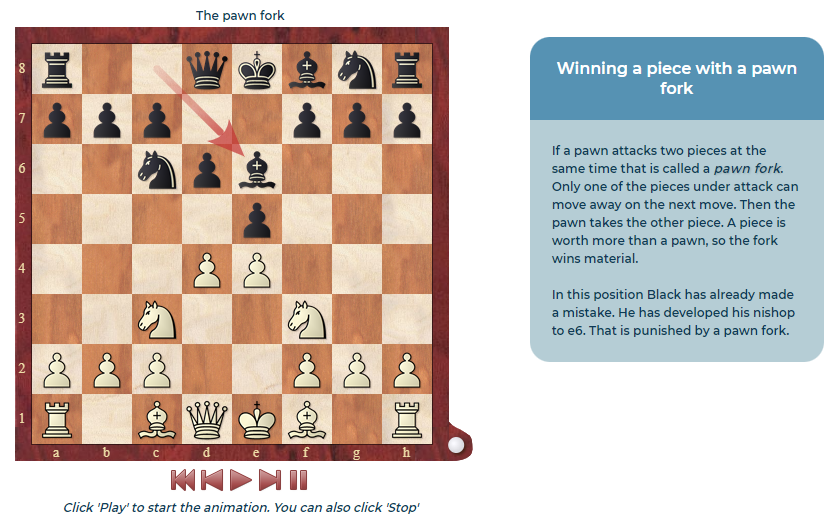
Key characteristics of a pawn fork:
- A pawn attacks two pieces that are on adjacent squares, one rank ahead of it, diagonally.
- They are especially effective against knights and bishops.
- Because pawns are your least valuable pieces, you can often execute a pawn fork even if one of the forked pieces can capture your pawn. The trade will almost always be in your favor.
Always be aware of your pawns and the squares they control one and two steps ahead. A simple pawn push can often be the best move on the board.
Practice: Burn the Patterns
Now for the most important part of your training: active practice. Solving puzzles is the best way to train your brain to recognize these patterns automatically in your games.
Below is a link to a set of puzzles. Your task is to find the winning fork in each position.
100 Puzzles: Forks, Pins, Discoveries, and Skewers!
It's time to test your new knowledge. The following resource contains a series of fork puzzles. Try to solve them without moving the pieces, just like you would in a real game.
Go to the section titled 'Find the Fork'. Solve puzzles (1) through (10). For each puzzle, identify the forking move and visualize what you would capture after your opponent responds.
Take your time with each puzzle. First, scan for enemy pieces on same-colored squares (for knight forks) or pieces that are geometrically aligned for a pawn fork. Then, calculate the move and the resulting material gain. This exercise directly builds the tactical vision needed to climb to 1500 ELO.
Conclusion
In this lesson, we established the first building block of your tactical arsenal: the fork.
Key Takeaways:
- A fork is a single piece attacking two or more enemy pieces simultaneously.
- To spot knight forks, look for valuable enemy pieces on squares of the same color. The knight attacks from a square of the opposite color.
- Royal Forks (King + Queen) are often game-winning.
- Pawn forks are a common and effective way to win material by attacking two pieces diagonally.
- Tactics are often part of a sequence. Look for ways to set up a fork by first decoying or removing a defender.
By consistently training to spot these patterns, you will begin to find more opportunities to win material and convert them into victories.
Preview of the Next Lesson:
In our next session, we will explore another fundamental tactic: the pin. A pin occurs when you attack a piece that cannot move without exposing an even more valuable piece behind it. Like forks, pins are a powerful way to restrict your opponent and create winning chances.