
Welcome back. So far, you have seen the institutions behind Indian markets and learned that indices such as NIFTY 50 and Sensex are weighted measures—not instructions to buy every stock that rises with them.
This lesson follows one actual delivery-based equity transaction through the system. You will distinguish placing an order from executing a trade and from settling it, then trace where money and shares go after a purchase or sale. This is the operational foundation for investing in individual Indian shares; it applies whether your intended holding period is weeks or years.
A trade is agreed first; settlement completes it later
When you buy a listed share through a broker’s app, three distinct events can occur:
- Order placement: you tell the broker the stock, quantity, and conditions under which you want to buy or sell.
- Trade execution: the exchange matches your order with an opposing order. You have a confirmed trade price and quantity.
- Settlement: money is transferred from the buyer’s side and shares are transferred from the seller’s side through the clearing system.
It is easy to treat these as one event because a broker app may immediately show “Executed” or display a newly bought stock in a portfolio view. Operationally, though, execution and settlement are different.
For a normal cash-equity trade, India primarily follows a T+1 rolling settlement cycle:
- T means the trade date: the day your order is matched on NSE or BSE.
- T+1 means the next applicable business day: the settlement date.
If you buy on a Monday that is a normal trading day, settlement is ordinarily on Tuesday. Weekends, exchange holidays, and relevant bank holidays are excluded when calculating the settlement day.
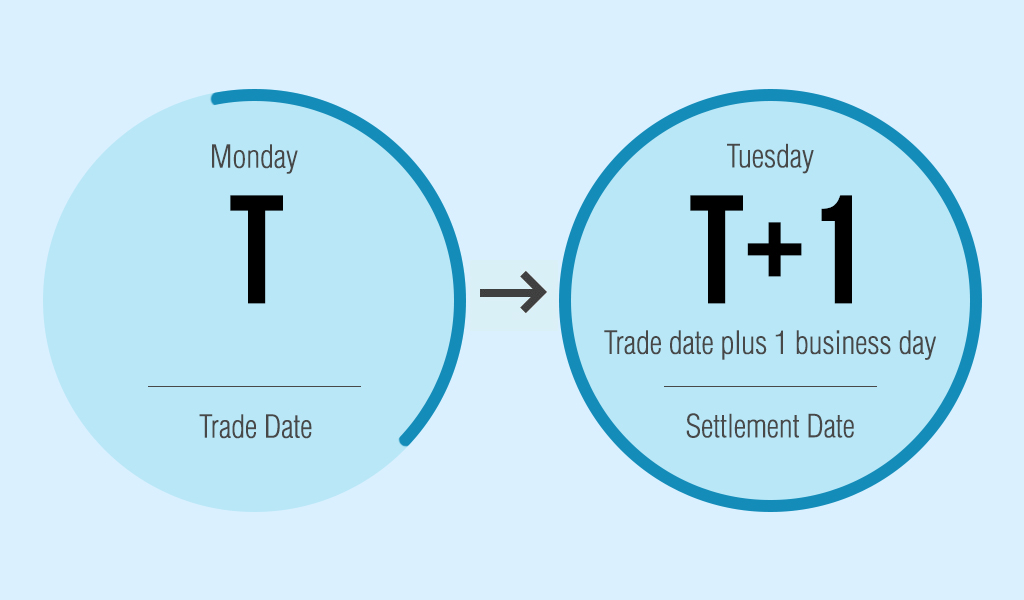
The phrase rolling settlement means that every trading day has its own next-business-day settlement. Monday’s trades settle on Tuesday; Tuesday’s trades settle on Wednesday, assuming there is no holiday.
Read NSE India’s “Settlement Cycle” page for the official framework behind normal equity settlement. It distinguishes the standard T+1 process from the separate T+0 segment and shows the core clearing, pay-in, and pay-out stages.
In the opening “Settlement Cycle” section, read NSE's overview to understand what T and T+1 refer to and why holidays matter. Then open the “Rolling Settlement” subsection and study the rolling schedule, especially the difference between securities and funds pay-in and pay-out. The precise institutional deadlines are less important than the sequence.
Although NSE also offers a T+0 segment for eligible securities and transactions, treat T+1 as the normal delivery-equity baseline for now. Do not assume every share or order type settles on the same day simply because T+0 exists.
The three accounts behind a delivery transaction
A retail investor usually encounters three account layers. They are connected, but they do different jobs.
| Account or record | Main role | What you see there |
|---|---|---|
| Bank account | Provides money for purchases and receives withdrawn sale proceeds | Bank balance and bank transactions |
| Trading account and broker ledger | Sends orders to the exchange and records your cash obligations, charges, and trade confirmations | Orders, funds, positions, contract notes |
| Demat account | Holds securities electronically in your name as the beneficial owner | Shares credited, debited, and current holdings |
Your broker provides the trading interface. Your demat account is maintained through a depository participant (DP) connected to either NSDL or CDSL. The shares themselves are held in dematerialised form, rather than as paper certificates.
Two practical distinctions matter:
- A trading-account balance is not identical to your bank balance. A broker may block funds for an order, debit funds after execution, or show sale proceeds in its client ledger before you withdraw them to the bank.
- An executed buy order is not necessarily the same thing as shares fully credited to your demat account. Apps may show the stock promptly for convenience, but the settlement cycle still has to complete.
Your contract note and broker ledger are the useful records for confirming price, quantity, brokerage, taxes, and other charges. The demat statement confirms the securities holding.
A purchase and sale, traced together
Consider a simple fictional transaction on Monday:
- Priya places a delivery-equity purchase order for 20 shares of ABC Ltd.
- Arjun already owns 20 ABC Ltd. shares in his demat account and sells them.
- Their orders are matched on the exchange at Rs. 500 per share.
The gross value of the trade is:
This is only the share value. Priya’s total debit will be somewhat above Rs. 10,000 because transaction charges apply. Arjun’s final credited proceeds will be somewhat below Rs. 10,000 for the same reason. You will calculate those costs in detail later; for now, focus on the path of money and securities.
On Monday: order, match, and clearing obligation
Priya submits a buy order through her broker. Her broker checks whether adequate funds or purchasing limit are available. When the exchange matches her order with Arjun’s sell order, both parties receive confirmation through their respective brokers.
At this point:
- Priya has a confirmed purchase of 20 shares at Rs. 500.
- Arjun has a confirmed sale of 20 shares at Rs. 500.
- The exchange has matched the trade.
- The clearing corporation calculates what each clearing member must deliver or receive.
The clearing corporation does not need to move every individual transaction separately. It determines each clearing member’s net obligation across that member’s clients and trades.
For example, one clearing member may have clients who both bought and sold ABC Ltd. that day. Its final obligation may be to deliver only the net shortfall in shares, rather than the gross quantity sold by all clients. The same netting principle applies to funds. This reduces the amount that must actually move at settlement.
What “pay-in” and “pay-out” mean
These two terms describe the settlement legs:
| Term | Meaning for securities | Meaning for funds |
|---|---|---|
| Pay-in | Sellers’ side supplies the required shares to the clearing corporation | Buyers’ side supplies the required money to the clearing corporation |
| Pay-out | Clearing corporation releases shares to the buyers’ side | Clearing corporation releases money to the sellers’ side |
The clearing corporation sits between the two sides and coordinates this exchange. It is why Priya does not need to know Arjun, assess his ability to deliver shares, or transfer money directly to him.
The seller’s key responsibility: authorising delivery
For Arjun’s sale to settle, the required ABC Ltd. shares must be available and authorised for delivery from his demat account.
The exact method depends on the broker and depository arrangement. In a modern retail workflow, the seller may authorise the debit using a depository PIN or electronic delivery instruction, sometimes called eDIS. Some clients may have provided an approved standing authorisation arrangement such as a DDPI. The important principle is the same:
A sell order is a commitment to deliver the specified shares if the order executes.
If Arjun sells shares that are not actually available, or fails to complete the required authorisation, the seller’s broker may be unable to meet its delivery obligation. This is called a short delivery situation. It is not a normal inconvenience to ignore: the clearing corporation may conduct a buy-in auction, and additional costs or close-out consequences can arise.
Before selling delivery holdings, check:
- the correct stock and quantity are present in the demat holdings;
- the shares are not already pledged or otherwise unavailable;
- any broker-required depository authorisation is completed on time;
- you have not accidentally placed duplicate sell orders.
Never share a depository PIN, broker login, password, or one-time password with a tip provider or anyone claiming to “help execute” a trade.
T+1: settlement through clearing members and depositories
By the next business day, the clearing obligations from Monday’s trades are finalised. Priya’s broker-side clearing member must provide the funds due for her purchase; Arjun’s broker-side clearing member must provide the shares due for his sale.
The high-level sequence is:
| Settlement stage | Priya, the buyer | Arjun, the seller |
|---|---|---|
| Funds/securities pay-in | Funds are supplied through her broker and clearing member | 20 ABC Ltd. shares are supplied through his broker, DP, and clearing member |
| Clearing corporation process | The clearing corporation confirms that required obligations are met | The clearing corporation confirms that required obligations are met |
| Pay-out | Shares are released to Priya’s broker-side account and then credited to her demat account | Sale funds are released to Arjun’s broker-side ledger |
| After settlement | Priya holds 20 ABC Ltd. shares in demat | Arjun can withdraw eligible sale proceeds to his linked bank account, subject to broker processing rules |
The individual investor normally sees only the beginning and end of this process. But in the background, clearing-member accounts and depository accounts make the securities movement auditable and controlled.
Market Transfers | Settlement via Demat Accounts - NSDL
Read NSDL’s “Market Transfers” explanation to see the securities side of settlement in operational detail. It uses a seller, two clearing members, their DPs, and the clearing corporation to show how demat securities travel after an exchange trade.
Begin with the opening explanation of market trades. Then read Steps 1 through 8 as one continuous trace, using the eight-step transfer. Focus on the path from selling client to selling clearing member, clearing corporation, buying clearing member, and buying client. The named pool and receipt accounts are institutional transit accounts; your broker app may use different labels and a modern electronic authorisation process.
NSDL’s walkthrough is deliberately focused on securities. It explicitly notes that NSDL does not handle funds. The money leg is handled through the clearing system, clearing banks, clearing members, and ultimately your broker’s client ledger.
What you should expect to see in your broker app
The labels differ among brokers, but this general sequence is common for a delivery transaction:
If you buy shares
- You submit an order from your trading account.
- Once matched, its status changes to executed or complete.
- Your order book shows the execution price and quantity. Your funds or ledger reflect the required debit, including charges.
- On settlement, shares are credited through the demat system.
- The stock becomes part of your settled delivery holdings.
A purchase can be partially executed. If you ordered 100 shares but only 60 were matched, you own an executed quantity of 60; the remaining 40 might remain pending or be cancelled, depending on the order’s conditions. Settlement applies to the executed portion.
If you sell shares already held in demat
- You select the holding and submit a sell order.
- You complete any required delivery authorisation.
- Once matched, the order book confirms the sale quantity and price.
- On settlement, shares are debited from the demat account through the settlement process.
- Net sale proceeds appear in your broker ledger and can be transferred to your linked bank account according to the broker’s withdrawal schedule.
One subtle but important point: the price shown as your app’s current portfolio value will change throughout the day, but it has nothing to do with whether a past trade has fully settled. Market value, trade execution, cash availability, and demat settlement are separate concepts.
When settlement does not go normally
Most retail delivery trades settle routinely. Still, understand the main exception.
If the seller’s side cannot deliver shares, the clearing corporation can arrange a buy-in auction to obtain the shares. NSE’s settlement schedule notes that an auction may occur on T+1 and that auction settlement can occur on T+2. This is why selling shares without ensuring availability and authorisation can create avoidable costs and complications.
As a buyer, do not make a decision based on the assumption that settlement is irrelevant once an app says “executed.” As a seller, do not assume a sale has become bank cash merely because the order was filled. Wait for the proper ledger and settlement records.
A useful low-risk habit is to inspect, after every real delivery transaction:
- the order-book execution details;
- the contract note issued by the broker;
- the funds ledger;
- the demat holding or transaction statement after settlement.
This is not just administration. It helps detect an incorrect quantity, unexpected charge, duplicate order, or a missing demat credit early.
Key takeaways
- Order placement, execution, and settlement are different stages. An exchange match confirms a trade; settlement completes the exchange of funds and securities.
- In normal Indian cash-equity settlement, T is the trade date and T+1 is the next applicable business-day settlement date.
- Your trading account sends orders and records funds; your demat account holds securities; your bank account supplies or receives cash.
- Clearing corporations calculate and manage obligations between clearing members. Pay-in supplies funds and shares; pay-out releases shares to buyers and funds to sellers.
- A seller must have the shares available and complete the required depository delivery authorisation. Failure can lead to short delivery and auction-related consequences.
- Check the order book, contract note, funds ledger, and demat statement rather than relying only on a portfolio screen.
Next, you will learn how to evaluate financial news, social-media tips, and recommendations—especially useful now that you understand that an apparently simple “buy this stock” call leads to a real, regulated transaction and a real ownership position.
Can't find a good explanation? Sign up and we'll make it for you
Sign up