Hello! Welcome back to your course on using game theory for your business.
In our last lesson, we established the core principle of interdependence: your success doesn't happen in a vacuum, but is critically linked to the choices of your competitors, customers, and suppliers. We saw that in a market like custom woodworking, your decisions on pricing or product lines will provoke reactions that determine your ultimate profit.
Today, we take the next practical step. Instead of just acknowledging this interdependence, we're going to start mapping it. The goal of this lesson is to systematically list the possible actions—the strategic moves—available to your new woodworking business and your key competitors. This is the essential groundwork before we can begin analyzing scenarios and picking the best path forward.
What is a "Strategic Action"?
In game theory, an "action" or "strategy" isn't just a vague goal like "becoming the best." It's a specific, comprehensive set of choices that positions you to compete. Your engineering background gives you an edge here: think of it like defining the operational parameters of a system. Before you can optimize the system, you must first know all its possible settings.
A plan is often a list of internal activities, like "buy a CNC machine" or "set up a website." A strategy, on the other hand, is an integrated set of choices designed to win against competitors in a specific market.
To clarify this crucial distinction, please watch the following video from Harvard Business Review.
This video, titled 'A Plan Is Not a Strategy', powerfully explains that a strategy is a coherent set of choices that positions you to win, not just a list of things to do. The Southwest Airlines example is a perfect illustration of a set of strategic actions.
Watch from the beginning to 02:07, and then from 03:53 to 06:22. Pay close attention to how Roger Martin defines strategy as a set of choices to win on a playing field, and how Southwest's specific actions (one plane type, no meals, point-to-point routes) formed a coherent strategy that beat their competitors.
As the video explains, a strategy has a theory of why you will win. That theory is built upon the specific actions you choose to take.
Step 1: Brainstorming Your Possible Actions
The first step is to map out your own set of possible moves. Let's ground this directly in the decisions you're facing with your woodworking business. For now, don't judge the options—just list them.
Here are the key decision areas for a new business like yours, along with some potential actions:
-
Product Line Strategy:
- Action A1: Specialize only in high-end, custom solid-wood doors.
- Action A2: Specialize only in custom kitchen cabinet systems.
- Action A3: Offer both doors and cabinets as a full-service custom shop.
- Action A4: Start with one (e.g., doors) with a plan to expand into the other later.
-
Pricing Strategy:
- Action B1: Premium Pricing: Price 15-20% above the highest-priced existing competitor to signal superior quality.
- Action B2: Market-Rate Pricing: Price in line with other local custom shops.
- Action B3: Penetration Pricing: Offer an introductory discount for your first six months to win initial customers and build a portfolio.
-
Initial Investment Strategy (Machinery):
- Action C1: Invest in a top-of-the-line 5-axis CNC for maximum capability and precision.
- Action C2: Purchase a reliable but more standard 3-axis CNC to minimize initial debt, and outsource any highly complex work.
- Action C3: Lease equipment initially to maintain flexibility.
These are your "moves" in the game. A complete strategy for your business would involve choosing one action from each category (e.g., Specialize in doors, use Premium Pricing, and buy a 5-axis CNC).
Step 2: Mapping Your Competitors' Actions
This is where game theory really comes alive. Your best move depends on what your competitors might do in response. To analyze this, you first need to list their possible actions.
An excellent article from the management consulting firm Kanvic explains this process clearly. It breaks down how to think about the options available to your rivals.
Applying game theory to strategy practice
This article, 'Applying game theory to strategy practice', outlines a practical, step-by-step process for using game theory. We will focus on the initial steps of identifying players and their options.
First, read the paragraph under the heading 'Setting up and playing the game' to understand how to identify relevant players. Then, read the section 'Build a matrix of their available options'. Notice the concrete example: the client had three pricing options, and for each, the competitor also had three response options (do nothing, reduce prices, match warranty).
Let's apply this thinking to your woodworking business. Imagine you enter the market specializing in high-end doors (your Action A1). What can your main competitor—let's call them "Traditional Cabinets Inc."—do in response?
- Competitor's Possible Actions:
- Action R1: Do Nothing. They might ignore you, believing your niche is too small or that their existing reputation is strong enough.
- Action R2: Compete on Price. They could lower the price of their cabinets to make them seem more attractive to customers who might otherwise have paid a premium for your doors.
- Action R3: Increase Marketing. They could launch a new marketing campaign emphasizing their long history, local ties, and established quality.
- Action R4: Match Your Move. They could invest in new equipment and start offering high-end custom doors themselves, competing with you head-to-head.
By mapping out these actions, you're no longer making your decision in a vacuum. You are preparing to think one step ahead.
Test your understanding!
You're considering the pricing strategy of Penetration Pricing (offering a 20% discount for your first 6 months). Your main competitor is a well-established premium brand. What are at least three distinct actions they could take in response, and why might they choose each one?
Show answer
Here are three possible responses from the established premium competitor:
- Do Nothing: They might ignore your discount, believing their brand is strong enough that their customers won't be swayed by a temporary price cut. They might assume your lower price signals lower quality, reinforcing their own premium position.
- Run a Promotion: They could launch a short-term promotion of their own (e.g., "free installation this month") to counter your offer without permanently lowering their prices or devaluing their brand.
- Launch a "Fighter Brand": This is a more advanced move. They could launch a second, lower-priced line of cabinets under a different name to compete directly with your discounted price, while keeping their main brand's premium status intact.
- Increase Brand Advertising: They could increase their advertising, focusing on their history, quality, and the risks of going with a new, unproven company. This is an attempt to make price less relevant in the customer's decision.
Visualizing the Game: An Introduction to Game Models
Once you have lists of actions for yourself and your competitors, you need a way to organize them to analyze the outcomes. Game theory gives us two primary tools for this, which we will explore in depth in the next module. For now, let's just get familiar with what they look like.
1. The Payoff Matrix (for simultaneous decisions)
When you and a competitor have to make a decision at the same time without knowing the other's choice (like setting prices for the season), we use a payoff matrix. It's a grid showing all possible combinations of actions and the resulting outcomes (payoffs).

2. The Game Tree (for sequential decisions)
When decisions happen in a sequence (e.g., you enter the market, then your competitor reacts), we use a game tree. It maps out the path of decisions, like a flowchart.
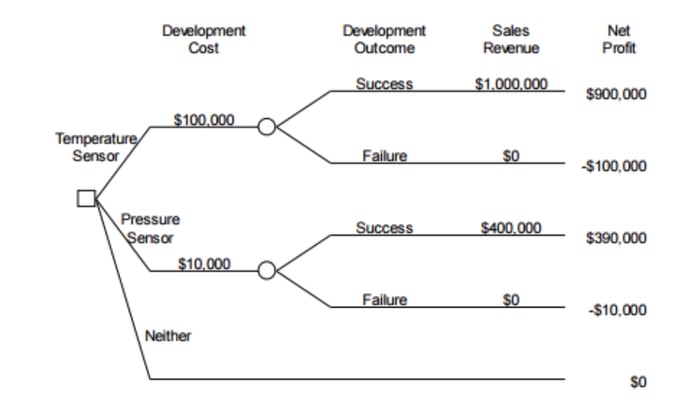
For now, the key takeaway is that the "actions" we've been brainstorming today are the fundamental building blocks you will use to construct these powerful analytical tools.
Conclusion
You've now made a critical transition from thinking abstractly about competition to systematically cataloging the specific moves that define the game. This is a foundational skill for strategic analysis.
Key Takeaways:
- A strategic action is a specific, well-defined choice you make to compete in the market, not just an internal plan.
- Mapping your own actions involves brainstorming the feasible options for key decisions like product line, pricing, and investment.
- Mapping a competitor's actions involves anticipating their potential responses to your moves.
- These lists of actions are the raw material for building payoff matrices and game trees, the visual tools we use to analyze strategic scenarios.
Preview of the Next Lesson:
In the next lesson, we will officially begin Module 2 by diving into these models. We'll start by learning to distinguish between simultaneous-move and sequential-move games. You'll then learn how to build your first game tree to represent a sequential decision, like your entry into the woodworking market and a competitor's potential reaction.