
Identifying Prepositions and Their Objects
Hello, and welcome to the first lesson in Prepositions. This course will help you make accurate choices with prepositions in everyday English, beginning with the basic structure that makes all later choices easier: a preposition connects one part of a sentence to another, and it normally has an object.
In this lesson, you will learn to find a preposition and identify its object in simple sentences. You will also learn to recognize the complete prepositional phrase, which often contains the preposition, the object, and a few descriptive words.
The basic idea: a relationship word and its object
A preposition is a word that shows a relationship. That relationship might concern place, time, direction, or another connection:
- place: under the table
- time: after lunch
- direction: to the station
- connection: with my friend
The noun or pronoun connected by the preposition is its object.
Consider this sentence:
The keys are under the chair.
- under is the preposition.
- the chair is the object of the preposition.
- under the chair is the complete prepositional phrase.
The preposition tells us the relationship; the object tells us what the relationship concerns. Here, the keys are located in relation to the chair.
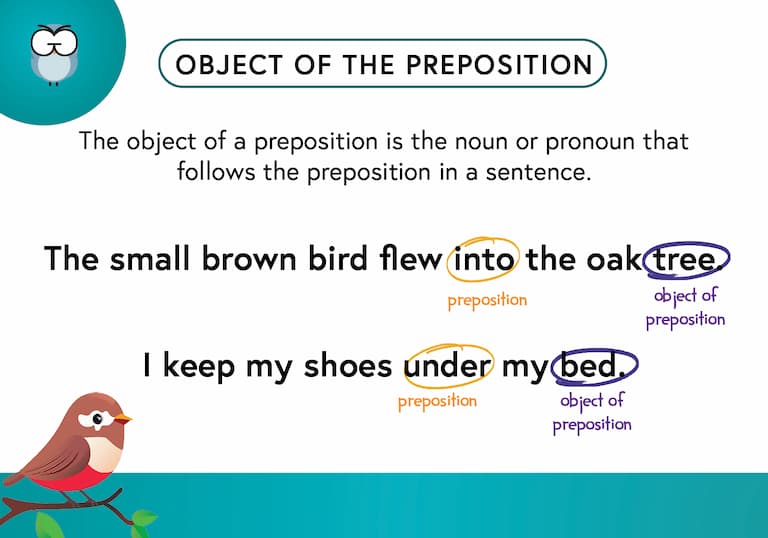
In ordinary classroom grammar, you may see the object identified in two slightly different ways:
- Object phrase: the chair
- Head noun of the object: chair
Both point to the same important word. When a task asks for the object, it is usually safest to give the full noun phrase, such as the chair, and recognize that chair is its central noun.
See the pattern in action
Watch the following short segment from “Object of the Preposition - Language Skills for Kids!” by the Miacademy & MiaPrep Learning Channel. It introduces the structure of a prepositional phrase and then models how to identify objects in sentences.
Object of the Preposition - Language Skills for Kids!
Watch “Object of the Preposition - Language Skills for Kids!” by the Miacademy & MiaPrep Learning Channel to see the core pattern explained and applied to several sentences.
Watch the core pattern to review how prepositional phrases begin with a preposition and end with a noun or pronoun that serves as its object. Then watch worked examples. Pause briefly before each answer and try to identify the phrase, its preposition, and its object yourself.
The key pattern is:
preposition + object
Often, however, other words describe the object:
preposition + modifier(s) + object
For example:
The cat hid under the old blanket.
- under is the preposition.
- the old blanket is the object phrase.
- blanket is the head noun, or central object word.
- the and old describe blanket; they are not the object themselves.
Do not stop at the first word after the preposition. In under the old blanket, the first word after under is the, but the is an article, not a noun. Keep reading until you find the noun or pronoun that completes the phrase.
A reliable method for finding the object
When you read a simple sentence, use this method.
-
Find a likely preposition.
Common examples include in, on, at, under, over, beside, with, from, after, and to. -
Read from that preposition through the noun or pronoun that completes its meaning.
This whole group is the prepositional phrase. -
Identify the noun or pronoun in that phrase.
It is the object of the preposition. If the object has modifiers, name the entire noun phrase as well.
For example:
We talked with her.
- with introduces a relationship.
- her is a pronoun.
- Therefore, with is the preposition and her is its object.
Now compare that with:
We talked with the new manager.
- with is the preposition.
- the new manager is the object phrase.
- manager is the head noun.
The object is not always a physical thing. It can refer to a person, a place, a time, or an idea.
| Sentence | Preposition | Object |
|---|---|---|
| The train leaves at noon. | at | noon |
| I sat beside Maya. | beside | Maya |
| The photo is on the wall. | on | the wall |
| They came from Canada. | from | Canada |
| We worked with them. | with | them |
The relationships in these examples are different, but the grammatical pattern stays stable: a preposition is followed by its object.
Worked examples: identify the pair, then the full phrase
Let’s apply the method carefully.
Example 1: one phrase
The book is on the desk.
First, locate the relationship word: on.
Then ask, “On what?” The answer is the desk.
- Preposition: on
- Object: the desk
- Complete phrase: on the desk
Example 2: a pronoun as the object
Jordan walked with us.
The word with expresses accompaniment. Its object is not a noun here, but the pronoun us.
- Preposition: with
- Object: us
- Complete phrase: with us
Example 3: two prepositional phrases
The dog ran into the park at six o’clock.
This sentence has two separate relationships.
| Complete phrase | Preposition | Object |
|---|---|---|
| into the park | into | the park |
| at six o’clock | at | six o’clock |
The first phrase tells us where the dog ran. The second tells us when it ran. Later lessons will look closely at these kinds of meanings; for now, your main task is simply to spot each preposition and its object.
Example 4: a compound object
I sat between Ava and Leo.
- Preposition: between
- Object: Ava and Leo
- Complete phrase: between Ava and Leo
Here, the preposition relates the speaker to two people. You can think of Ava and Leo as one compound object phrase.
Do not confuse every familiar word with a preposition
Some English words can do more than one job. For this lesson, use a practical test: a preposition in a simple prepositional phrase is followed by a noun or pronoun object.
Compare these sentences:
We walked to the library.
Here, to is a preposition because it is followed by the noun phrase the library.
We want to leave.
Here, to is not a preposition. It is part of the infinitive verb to leave. The word after it is a verb, leave, not a noun or pronoun object.
A similar contrast appears with inside:
The children waited inside the building.
- inside is a preposition.
- the building is its object.
The children waited inside.
Here, inside has no object after it, so it is functioning as an adverb rather than as a preposition.
You do not need to memorize every special case now. Simply check whether the word introduces a noun or pronoun phrase. That test will prevent many early mistakes.
Read examples with a grammar lens
The Blue Book of Grammar and Punctuation gives several clear sentence examples, including a sentence with two prepositional phrases. Read the examples below after you have tried the method above.
Object of a Preposition Examples - The Blue Book of Grammar and Punctuation
Read “Object of a Preposition Examples” from The Blue Book of Grammar and Punctuation to reinforce the distinction between a preposition, its object, and the complete phrase.
In the section “Finding the Object of a Preposition,” begin with the pizza example and read through the examples about the dog, Jackie, and the desk. In the dog example, pay special attention to the two phrases: identify each preposition first, then name the noun phrase that serves as its object. Notice that a sentence can contain more than one preposition-object pair.
As you read, keep one distinction clear:
- The preposition is usually one word, such as on, into, at, or to.
- The object is the noun or pronoun phrase after it, such as the table, the park, six o’clock, or Jake.
- The prepositional phrase includes both: on the table, into the park, and so on.
A quick analysis habit
When you encounter a simple sentence, briefly mark it in three layers:
The cyclist stopped near the fountain.
- Underline the complete phrase: near the fountain
- Circle the preposition: near
- Box the object phrase: the fountain
This approach is more reliable than trying to memorize a long list of prepositions. You are looking for a meaningful unit: a relationship word plus the noun or pronoun that completes it.
It also helps to read the sentence naturally. Near alone feels incomplete in this sentence: near what? The fountain supplies the needed object.
Key takeaways
A preposition expresses a relationship, often involving place, time, direction, or connection. Its object is usually the noun or pronoun that follows and completes that relationship.
Remember the central pattern:
- under the table: under is the preposition; the table is the object.
- with him: with is the preposition; him is the object.
- after the meeting: after is the preposition; the meeting is the object.
A sentence may contain more than one prepositional phrase, so check for each separate preposition-object pair.
Next, you will move beyond identification and classify the relationships prepositions express: place, time, movement, and other connections.
Can't find a good explanation? Sign up and we'll make it for you
Sign up