
Hello. In the previous lesson, you learned that a digit’s position determines its value: for example, the 5 in means , while the 3 means . That place-value understanding is exactly what lets us decide which whole number is larger.
In this lesson, you will compare whole numbers using , , and , then use those comparisons to put several numbers in ascending or descending order. By the end, you will have a reliable method that works for two-digit numbers and much larger whole numbers.
The three comparison symbols
A comparison statement tells how two numbers are related.
| Symbol | Read it as | Meaning | Example |
|---|---|---|
| | is equal to | both numbers have the same value | |
| | is less than | the number on the left is smaller | |
| | is greater than | the number on the left is larger | |
The symbols and have a wide, open side and a pointed side:
- The open side faces the greater number.
- The point points toward the smaller number.
For example, in
the opening faces 72, the greater number. Read the full statement from left to right: “18 is less than 72.”
The same comparison can be stated in reverse:
This says, “72 is greater than 18.” Both statements describe the same relationship.
The equals sign is different. It does not say that one number is larger; it says the values match exactly:
Compare the numbers before choosing a symbol
A useful habit is to separate the task into two parts:
- Decide which number is greater, smaller, or equal using place value.
- Then choose the symbol that makes a true statement when read from left to right.
Do not begin by guessing which way the symbol should point. First understand the numbers.
This worksheet gives a visual reminder: the open side of each comparison sign faces the larger number, while the equal sign is used when both values match.
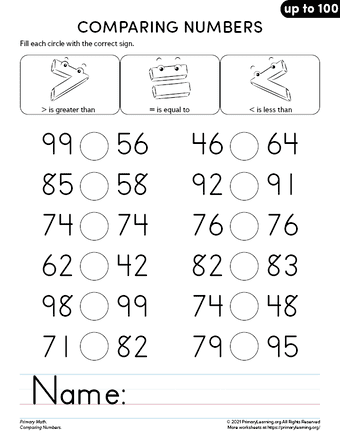
Consider:
Both numbers have two digits, so compare the digits in the greatest place first: the tens place.
- has 9 tens, or .
- has 5 tens, or .
Since is greater than , is greater than :
Now consider a pair with the same tens digit:
Both have 8 tens, so compare the ones digits. Since is less than ,
The place-value comparison method
For whole numbers written in their usual form, use this method every time.
- Compare the number of digits. A whole number with more digits is greater.
- If the numbers have the same number of digits, compare the digits in the leftmost place.
- If those digits are equal, move one place to the right.
- Continue until you find the first place where the digits differ.
- The number with the greater digit in that place is the greater whole number.
- If every corresponding digit is the same, use .
Why start at the left? The leftmost digit has the greatest place value, so it has the most influence on the number’s size.
For instance, compare:
The first number has 4 thousands; the second has 3 thousands. Because is greater than , there is no need to compare the remaining digits:
Even though is a large amount after the 3 in , it cannot make up for having one fewer thousand.
Comparing Whole Numbers - Math Antics Extras
Watch “Comparing Whole Numbers - Math Antics Extras” by mathantics. It demonstrates the exact place-value method: align the numbers, begin with the greatest place, and move right only when the digits match.
Watch the method for the overall comparison routine. Then watch matching places to see examples where the hundreds, then tens, and finally ones places decide the answer. Finish with larger numbers, which explains why a number with more digits is always greater and applies the method to six-digit numbers. Pause briefly at each example and name the first place that decides the comparison.
Worked comparisons
Different numbers of digits
Compare:
The number has three digits and has two digits. Any three-digit whole number is greater than any two-digit whole number.
You can also view as : it has 0 hundreds, while has 1 hundred. Since hundred is greater than hundreds, is larger.
Same leading digit, different later digit
Compare:
Write the place values mentally:
| Place | ||
|---|---|---|
| Hundreds | 8 hundreds | 8 hundreds |
| Tens | 5 tens | 4 tens |
| Ones | 6 ones | 2 ones |
The hundreds digits match, so move to tens. Five tens is greater than four tens. Therefore,
The ones digits do not need to be checked. Once a greater place differs, it settles the comparison.
Several matching digits
Compare:
| Place | First number | Second number | Result |
|---|---|---|---|
| Hundred thousands | 1 | 1 | equal |
| Ten thousands | 3 | 3 | equal |
| Thousands | 4 | 7 | second is greater |
The first different digits are 4 and 7 in the thousands place. Since is greater than ,
Notice that you do not compare with first. The thousands place has greater value than the hundreds, tens, and ones places together.
Equal numbers
Compare:
Every digit in the same place matches, so the numbers have exactly the same value:
Comparing and Ordering Numbers - Meaning, Steps, Symbols, Examples
Read “Comparing and Ordering Numbers” from Cuemath as a concise written reinforcement of the digit-count rule, the left-to-right place-value method, and the meanings of the three symbols.
In the sections “Comparing Numbers Meaning,” “Steps for Comparing Numbers,” and “Symbols for Comparing Numbers,” read the comparison method. Then read the symbol table and the paragraph explaining that the open side faces the greater number. Focus on the order of decisions: digit count first, then the greatest place value, then each place to the right only if necessary.
Ordering more than two numbers
Ordering means arranging numbers by size.
- Ascending order goes from smallest to greatest.
- Descending order goes from greatest to smallest.
To order a list, compare the numbers using the same place-value method. Find the smallest or greatest one first, then continue with the remaining numbers.
Suppose the numbers are:
For ascending order, begin with the smallest:
- has 3 thousands, while the others have 4 thousands, so it is smallest.
- Of the three numbers beginning with 4 thousands, has 0 hundreds, so it comes next.
- and both have 2 hundreds. Compare tens: tens is less than tens.
So the ascending order is:
For descending order, list the same values from greatest to smallest:
The numbers have not changed; only the order has changed.
A practical check is to read your completed list aloud. In ascending order, each number should be greater than the number before it. In descending order, each number should be less than the number before it.
Avoiding common mistakes
Comparing from the wrong side
In and , it would be a mistake to look at the ones digits first and decide that 9 makes greater. Start on the left:
- Both have 4 thousands.
- The hundreds digits differ: 2 hundreds is greater than 1 hundred.
Therefore,
Forgetting that zero holds a place
Compare:
The thousands digits are equal. At the hundreds place, has 0 hundreds, while has 8 hundreds. Therefore,
The zero is important: it tells us there are no hundreds in .
Reversing the symbol after finding the answer
Suppose you determine that is greater than . Both of these are true:
But this is false:
After writing a symbol, read the complete statement from left to right. If the sentence is not true, reverse the symbol.
Key takeaways
Comparing whole numbers is an application of place value.
- Use when values are the same, when the left number is smaller, and when the left number is greater.
- The open side of or faces the greater number.
- A whole number with more digits is greater than one with fewer digits.
- When digit counts match, compare from the leftmost, greatest place value.
- Stop at the first place where the digits differ.
- Ascending order lists numbers from smallest to greatest; descending order lists them from greatest to smallest.
Next, you will use place value again to add whole numbers with a standard written method, lining up ones, tens, hundreds, and larger places carefully.
Can't find a good explanation? Sign up and we'll make it for you
Sign up