Hello! Welcome to the final lesson in our module, "Diligence for AI Startups."
In our previous lessons, we've gone deep into the weeds of data. We started by analyzing a startup's strategy for acquiring data, then we learned how to evaluate the quality and defensibility of the dataset itself using concepts like the four pillars of data defensibility and the "Golden Dataset."
Today, we zoom back out to the strategic level. This lesson will synthesize everything we've learned and connect it directly to long-term business value. We will focus on the learning outcome: Identify how proprietary data and data network effects create competitive moats for AI companies.
As a future investor and incubator lead, understanding this link is paramount. It’s the ability to distinguish between a startup with a cool AI feature and one with a durable, defensible business model. We'll explore how technical assets like data translate into the powerful economic barriers that protect a company from competition.
1. What is a Competitive Moat in the AI Era?
In traditional business strategy, a "competitive moat" is a sustainable advantage that protects a company's long-term profits and market share from competitors. Think of Coca-Cola's brand or a railroad's exclusive tracks. In the fast-moving world of AI, the nature of these moats has changed, but their importance has only grown.
With the power of foundation models, building a simple AI application—a "ChatGPT wrapper"—is easier than ever. This leads to a crucial question you must ask of every AI startup: What prevents a competitor, or the foundation model provider itself, from replicating this business and driving profits to zero?
The answer lies in building a defensible moat. Let's start with a high-level overview of the most powerful moats for AI startups.
The 7 Most Powerful Moats For AI Startups
The video 'The 7 Most Powerful Moats For AI Startups' from Y Combinator adapts the classic 'Seven Powers' framework of business strategy to the current AI landscape. It provides an excellent primer on the types of moats you should be looking for.
Please watch the introduction of this video (00:00 - 10:06). Pay close attention to the discussion on why moats have become such a critical topic for AI founders and the argument that for early-stage companies, the first and most important moat is simply speed.
The key takeaway is that while speed and execution are vital at the start, a company must be building towards a more durable, long-term moat. For most AI companies, that durable moat is built on data.
2. Proprietary Data: The "Cornered Resource" of the Digital Age
One of the classic business moats is controlling a cornered resource—a valuable asset that competitors cannot easily obtain. In the past, this might have been a diamond mine or a patent. In the AI era, the most valuable cornered resource is often proprietary data.
But as we learned previously, not all data is created equal. The moat is not built on public data or static datasets that can be purchased. It's built on data that is a unique byproduct of the company's operations.
The 7 Most Powerful Moats For AI Startups
Let's revisit the Y Combinator video to see how they frame data as a cornered resource. This section provides concrete examples of what makes data proprietary and defensible.
Watch the segment on 'Cornered Resources' (14:26 - 19:25). Notice how the examples shift from traditional assets (patents) to modern ones like regulatory approvals for government work (Scale AI) and, most importantly, proprietary data from real workflows.
The video emphasizes that getting embedded with a customer to understand their unique workflows allows a startup to capture data that is impossible for an outsider to replicate. This directly connects to two of the "four pillars" of data defensibility we discussed in our last lesson:
- Pillar 1: Proprietary Data Collection: Generating data that literally cannot exist elsewhere (e.g., Tesla's fleet data).
- Pillar 3: Workflow Integration: Embedding so deeply into a customer's operations that you capture unique, contextual data while also creating high switching costs (another powerful moat).
A prominent AI executive puts this even more bluntly.
Inside Nebius Token Factory (Episode 115)
In this short clip from an interview with Helen Yu, Roman Churnin, a leader in the MLOps space, makes a very strong claim about the role of data in building a competitive advantage.
Watch this brief segment from 32:27 to 33:50. The core message here is a powerful lens through which to view your due diligence process.
The statement that "data is the only moat that exists in the AI era" may be an oversimplification, but it correctly highlights that data is the foundation upon which most other AI moats are built. Without a unique and continuously updated data stream, models become commodities, and long-term defensibility vanishes.
3. Data Network Effects: The Self-Reinforcing Flywheel
The most powerful type of data moat is not static; it is a living system that improves with use. This is known as a data network effect.
Unlike a traditional network effect (like a telephone network, where each new user adds value to other users), a data network effect is a cycle where each new user contributes data that makes the AI smarter, which in turn delivers more value and attracts the next wave of users.
This creates a powerful, self-reinforcing flywheel.
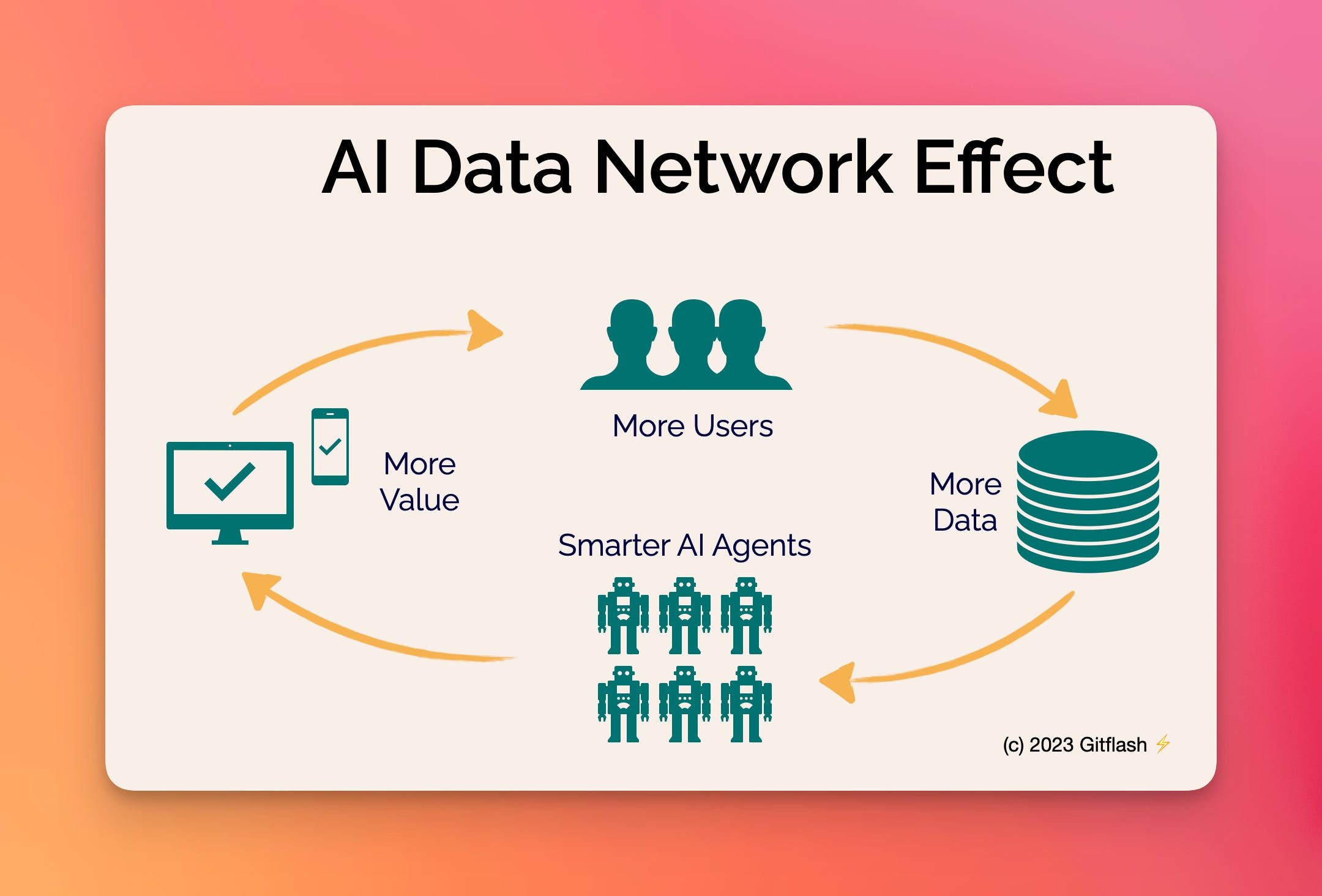
This flywheel is the ultimate competitive advantage. A new competitor starting from scratch has an inferior product because it doesn't have the data, and it can't get the data without users, who won't sign up because the product is inferior. It's a classic chicken-and-egg problem for competitors, and a powerful moat for the incumbent.
The 7 Most Powerful Moats For AI Startups
The Y Combinator video also covers this concept under the term 'Network Economies.' Their discussion provides great examples of this flywheel in action.
Watch the segment on 'Network Economies' (37:25 - 40:57). Focus on how they describe the shape of network effects in AI as being about data. The examples of ChatGPT and Cursor show how user interactions and private enterprise data are fed back to improve the model, compounding the company's lead.
This directly links to the Pillar 2: Feedback Loop Architecture from our previous lesson. A company with a true data network effect has a system where user interactions, corrections, and implicit feedback are automatically captured to continuously improve the model. This is the engine of the moat.
4. The Path to a Moat: From Model Consumer to Vertical Player
Understanding the types of moats is one thing; understanding how they are built is another. For you as an incubator lead, this is critical for guiding your portfolio companies. Most AI startups don't begin with a massive data moat on day one. They build it.
A useful framework is to think of AI startups evolving from "Model Consumers" to "Vertical Model Players."
How to Evaluate Generative AI Opportunities
The article 'How to Evaluate Generative AI Opportunities' by Tribe AI provides a useful framework for understanding how startups can build defensibility over time. It shows the journey from a vulnerable 'Model Consumer' to a defensible 'Vertical Model Player'.
Please read the sections 'Model Consumers', 'Vertical Model Players', and the example 'Constructing a Defensible Moat – an Example'. This will illustrate the strategic path a startup can take to build a data moat.
Let's summarize the journey:
- Model Consumer (Low Defensibility): The startup begins by using a third-party API (like OpenAI's) or an open-source model. Their initial advantage is a clever user interface or a specific workflow application. This is a "Yellow Light" or "Red Light" moat—vulnerable to copycats and platform risk.
- Building the Flywheel: The startup uses its initial product to gain traction and, crucially, to start collecting proprietary data. This is data about user interactions, specific industry jargon, and successful outcomes within their niche.
- Vertical Model Player (High Defensibility): With this proprietary dataset, the company begins to fine-tune its own models or even train specialized models from scratch. Their product is no longer just a "wrapper"; it's a highly specialized solution powered by a data asset no one else has. They have constructed a "Green Light" data moat.
The "EduSynth" example in the article is a perfect illustration of a company executing this playbook to build a defensible business.
Test your understanding!
You are evaluating two AI startups that both create social media content for restaurants.
-
Startup A (PostPerfect): Uses the latest GPT-4 model via API. It has a slick interface where a restaurant owner types in a special (e.g., "Taco Tuesday, 2-for-1 margaritas"), and it generates a clever Instagram post. The founder says their moat is their "superior prompt engineering."
-
Startup B (MenuMind): Started the same way as PostPerfect. However, for the last year, it has also been tracking the real-world engagement (likes, comments, shares) of every post it generates for its 1,000 restaurant customers. It uses this performance data to continuously fine-tune a smaller, specialized language model. Its generated posts are now consistently outperforming both the base GPT-4 model and PostPerfect's.
Which startup has a more defensible moat and why? Use the concepts of "proprietary data" and "data network effects" in your answer.
Show answer
Startup B (MenuMind) has a significantly more defensible moat.
Here's why:
-
Proprietary Data: PostPerfect's "moat" of prompt engineering is not very defensible. A skilled competitor could replicate their prompts relatively easily. MenuMind, on the other hand, has a truly proprietary dataset: a year's worth of post-performance data linking specific content to specific engagement outcomes for restaurants. This data was generated through their business operations and cannot be purchased or replicated by a competitor. It is a "cornered resource."
-
Data Network Effects: MenuMind has successfully created a data network effect flywheel. Each new restaurant that uses their service adds more data to the system (what posts work for what kind of restaurant in what city, etc.). This data is used to improve their specialized model, making the product better and more effective at generating engaging content. This superior performance attracts more restaurants, which in turn generates more data, accelerating the flywheel. PostPerfect has no such loop; its model's quality is entirely dependent on the next general update from its API provider.
In short, PostPerfect is a classic "Model Consumer" with a weak moat, while MenuMind is on the path to becoming a "Vertical Model Player" with a strong, compounding data moat.
Conclusion
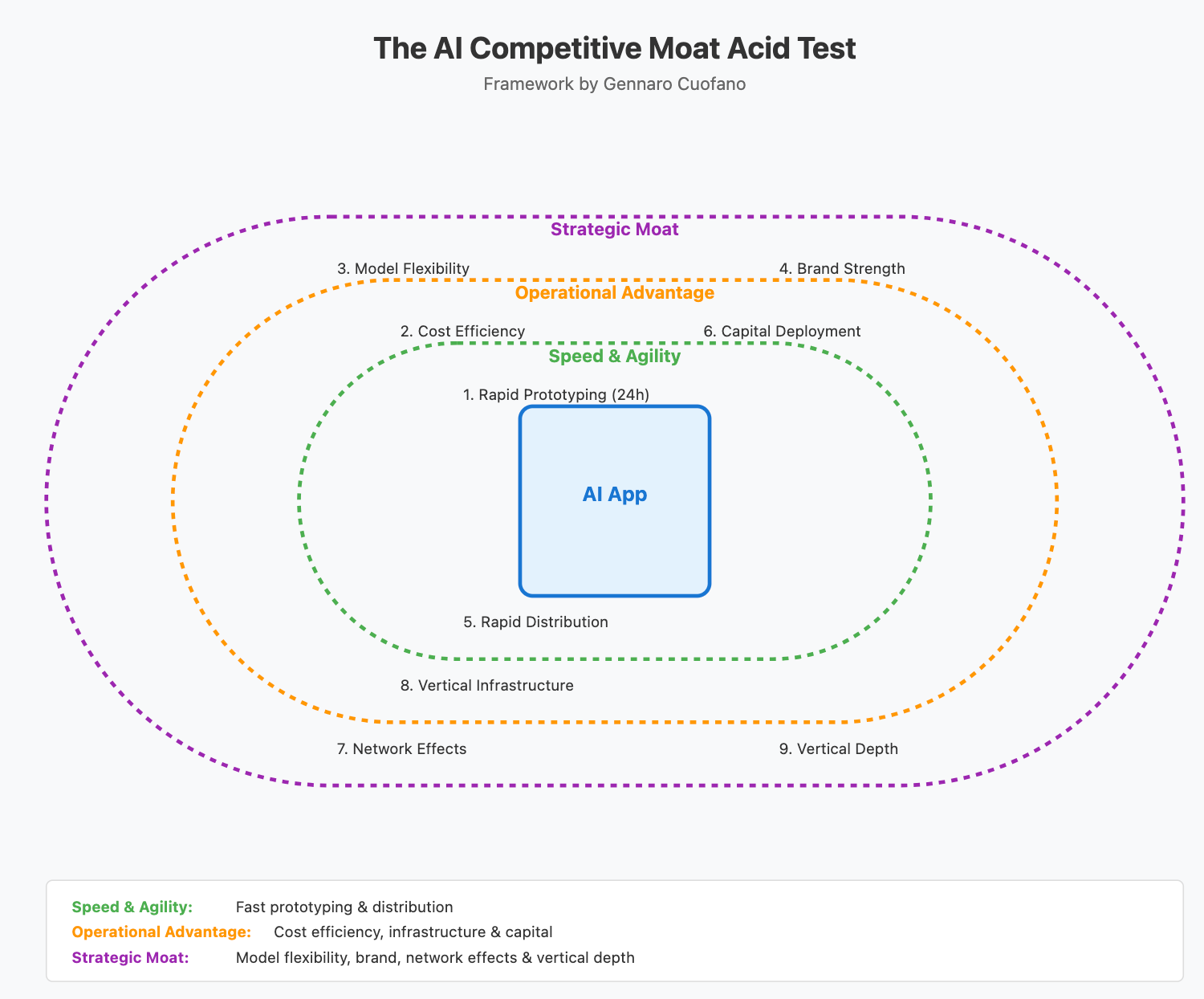
In this module on AI diligence, we have built a complete framework for assessing the technological heart of an AI startup. We now understand that a competitive moat in AI is rarely about having the "best" algorithm in a vacuum. It's about creating a system where the business model, the product, and the data create a virtuous cycle of improvement that leaves competitors behind.
Key Takeaways:
- A competitive moat for an AI startup is what protects it from being easily replicated by competitors or large platform players.
- Proprietary data, especially data generated through deep workflow integration, acts as a "cornered resource" that is difficult for others to obtain.
- The most powerful moat is a data network effect, where the product gets smarter with more users, creating a self-reinforcing flywheel that is extremely difficult for new entrants to overcome.
- The strategic journey for many successful AI startups involves evolving from a "Model Consumer" with low defensibility to a "Vertical Model Player" with a strong data moat built on a proprietary data asset.
Preview of the Next Lesson
Having completed our deep dive into the special diligence required for AI startups, we will now move into the practicalities of running your accelerator. The next module, "Accelerator Program Design and Delivery," will shift our focus to the structure and content of your program. The first lesson will be "Design a milestone framework and KPIs to track startup progress through the program," where we'll establish how to measure and guide the development of the companies you invest in.