
Hello, and welcome. This course is designed to turn substantial technology-operations experience into a focused, credible candidacy for Technology COO and VP Technology Strategy & Operations roles. It is intentionally job-landing-oriented: each module produces material you can use in targeting, résumé development, networking, and interviews.
This first lesson establishes the reference point for the rest of the course: an industry-agnostic target-role scorecard. Rather than relying on a job title—which varies widely by company—you will identify the recurring mandate, the evidence employers look for, and the contextual requirements that are genuinely role-specific. This matters because a Technology COO may be responsible for service operations and execution at one company, while a VP Strategy & Operations may own the CIO operating rhythm, portfolio, investment planning, and transformation governance at another. The common thread is the ability to make the technology organization operate as an enterprise system.
Read job descriptions as evidence of a mandate
A posting is not merely a list of tasks. It is a compressed description of the problems the CIO or enterprise leadership team needs solved. For these roles, those problems usually include competing investments, unclear accountability, inconsistent execution, weak portfolio visibility, fragmented decision-making, and difficulty translating technology activity into business outcomes.
Start by reviewing one representative Strategy & Operations posting. Its particular industry context is not the point; focus on the responsibilities that would be needed in almost any sizable enterprise technology organization.
Jobgether hiring AVP, Technology Strategy and Operations in United States | LinkedIn
Read this job description as a sample of the senior technology-operations mandate: converting enterprise priorities into governed execution, actionable executive information, and accountability.
In the “Accountabilities” section, read the operating mandate. Notice the verbs: operate, translate, coordinate, analyze, prepare, govern, identify, and drive. These are not administrative activities when performed at this level; they create the management system through which a CIO organization makes and executes decisions. Then, in the “Requirements” section, read the core experience requirements, followed by the executive capabilities. Treat references to a regulated industry, particular software, or physical job requirements as contextual rather than universal selection criteria.
A useful distinction follows:
- Accountabilities describe what the leader is expected to make happen.
- Selection criteria describe the experience, capabilities, and judgment the employer uses to decide who can make it happen.
- Context requirements describe where the work happens: industry, technology stack, location, reporting line, and operating environment.
Do not confuse activity with accountability. “Prepare executive decks” is an activity. “Enable timely executive decisions by framing options, trade-offs, recommendations, and required actions” is an accountability. At VP level, the quality of the decision system matters more than the production of its artifacts.
A second posting illustrates how the same core mandate appears when the role is explicitly positioned as portfolio management and enterprise strategy.
Vice President, Technology Strategy & Portfolio Management - NBCUniversal
This VP-level posting provides a useful contrast: it makes the connections among strategy, investment portfolio, operating rhythm, financial planning, and executive reporting especially explicit.
In “Job Description,” first read the overall VP mandate. Then read the “Enterprise Technology Strategy” bullets from strategy development; the “Portfolio Management & Governance” bullets from portfolio accountability; and the “Business Operations” bullets from operational stewardship. Separate the enterprise-wide patterns from the company-specific elements. For example, experience with named enterprise platforms can be decisive for this particular position, but it is not a universal requirement for every Technology COO or Strategy & Operations role.
The two descriptions use different titles and organizational settings, yet their overlap is striking: strategy, investment governance, financial and workforce planning, operational cadence, executive reporting, cross-functional influence, and measurable value realization.
The operating-system view of the role
A strong scorecard should test whether a role owns or materially shapes the technology operating system—the combination of people, resources, decision rights, routines, information, and performance mechanisms that turn strategy into results.
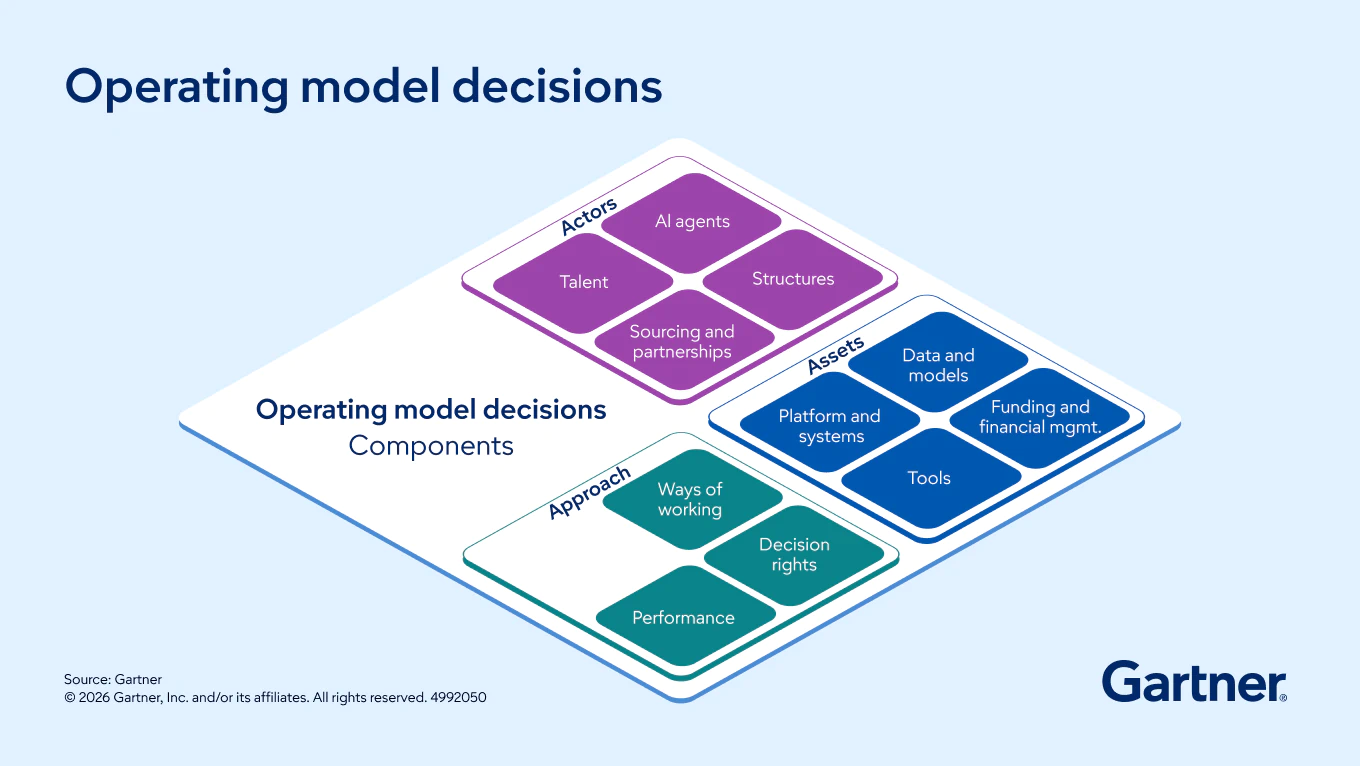
The framework is valuable because it prevents an overly narrow view of Strategy & Operations as “planning and presentations.”
- Actors: Who owns outcomes? How are teams structured? What capabilities are internal, sourced, or partner-led?
- Assets: How are money, platforms, data, tools, and capacity allocated and governed?
- Approach: How are decisions made, performance reviewed, risks escalated, and commitments followed through?
For example, an annual technology plan is not just a document. It is an operating mechanism connecting enterprise priorities (approach) to investment and capacity (assets) through accountable leaders and delivery teams (actors).
At VP level, the question is usually not “Can this person run a process?” It is: Can this person create enough clarity, discipline, and decision quality for a complex technology organization to execute enterprise priorities?
Baseline scorecard: recurring Technology COO and VP Strategy & Operations accountabilities
Use the following as your industry-agnostic baseline. It is deliberately broader than a Chief of Staff job and more enterprise-oriented than a PMO reporting role. A target position will emphasize some dimensions more than others, but a credible senior mandate will usually contain most of them.
| Scorecard dimension | Recurring executive accountability | What this looks like in practice | Strong evidence an employer seeks |
|---|---|---|---|
| 1. Enterprise technology strategy | Translate business strategy, market shifts, and technology opportunities into an actionable technology direction. | Multi-year roadmaps, strategic choices, executive strategy reviews, alignment across technology and business leaders. | Experience shaping strategy or roadmaps and explaining investment choices in business terms. |
| 2. Portfolio governance and investment prioritization | Ensure the enterprise funds, sequences, pauses, or stops the work that best supports strategic outcomes. | Investment intake, prioritization criteria, portfolio reviews, transformation governance, benefits tracking. | Ownership of portfolio governance, prioritization, PMO leadership, or investment-planning mechanisms. |
| 3. Financial, capacity, and workforce stewardship | Match budgets, vendor spend, internal capacity, and workforce plans to strategic priorities. | Budget and forecast cycles, demand-versus-capacity decisions, resource trade-offs, financial performance reviews. | Responsibility for meaningful budgets, cost management, capacity planning, supplier economics, or workforce planning. |
| 4. Technology performance and service operations | Make operational health visible and ensure issues receive timely executive attention. | KPI scorecards, service and delivery reviews, risk trends, corrective actions, escalations. | Ability to connect reliability, delivery, productivity, risk, and financial metrics to management action. |
| 5. Operating model and organizational effectiveness | Improve how technology teams are structured, governed, and coordinated. | Decision-rights design, leadership cadence, role clarity, cross-functional processes, transformation execution. | Operating-model design, organizational change, PMO maturation, or sustained improvement of delivery mechanisms. |
| 6. Executive operating rhythm and decision support | Enable the CIO and leadership team to make decisions, maintain alignment, and follow through. | Quarterly business reviews, leadership meetings, decision logs, pre-reads, board material, action tracking. | Executive synthesis, strong judgment about what needs escalation, and evidence of driving decisions to closure. |
| 7. Vendor and ecosystem value | Govern strategic suppliers and external partners so commercial, delivery, and innovation outcomes remain aligned. | Supplier reviews, contract and performance governance, sourcing decisions, partner roadmaps, issue resolution. | Vendor strategy, negotiations, commercial governance, performance management, and executive stakeholder management. |
| 8. Transformation execution and value realization | Turn strategic initiatives into accountable execution and measurable outcomes. | Milestones, dependency management, value cases, benefits realization, intervention on at-risk initiatives. | Leadership of complex, cross-functional change with credible outcome measures and lessons learned. |
| 9. Enterprise influence, risk, and alignment | Surface trade-offs and build alignment across technology, finance, security, business, and delivery stakeholders. | Framing options, resolving priority conflicts, escalating risks, influencing without direct authority. | Examples of senior-stakeholder influence, difficult trade-offs, sound judgment, and constructive conflict management. |
Several points are worth emphasizing.
First, portfolio governance is not status reporting. Reporting tells leaders what is happening. Governance creates a forum and method for deciding what should happen next: whether to approve, redirect, defer, stop, or accelerate work.
Second, executive communication is not slide production. It is the ability to convert incomplete and competing information into a decision-quality narrative: the decision needed, the strategic context, the options, the trade-offs, the recommendation, and the owner of the next action.
Third, financial stewardship does not mean claiming savings whenever you managed a budget. Your experience with a global infrastructure budget is strong scope evidence. It becomes impact evidence only where you can accurately show decisions you made, the financial mechanism involved, and the verified result—such as cost avoidance, forecast accuracy, contract-value improvement, reallocation, or risk reduction.
Finally, the relative weight of operational performance differs by mandate:
- A Technology COO role often places greater weight on service operations, execution discipline, organizational effectiveness, workforce capacity, vendor performance, and enterprise delivery.
- A VP Strategy & Operations role often places greater weight on CIO agenda-setting, strategic planning, governance, portfolio decisions, executive communications, and cross-functional coordination.
- In many organizations, the roles overlap substantially. The reporting line, decision authority, and scope determine the real job.
Turn accountabilities into selection criteria
Employers do not hire a scorecard category; they hire evidence that a candidate can perform it. Selection criteria therefore need to capture both what you have done and how you operate under executive conditions.
Here is the companion selection-criteria scorecard.
| Selection criterion | What it signals | Evidence to look for in your experience |
|---|---|---|
| Enterprise scale and complexity | Readiness to operate beyond a single team or project. | Global scope, meaningful budgets, multiple business units, complex vendor ecosystem, distributed stakeholders, material operational footprint. |
| Technology strategy and business acumen | Ability to connect technology decisions to enterprise outcomes. | Roadmaps, investment cases, strategic planning, technology-to-business translation, market or vendor analysis. |
| Portfolio and governance leadership | Ability to make trade-offs transparent and decisions repeatable. | Investment governance, PMO leadership, prioritization, executive forums, benefits measurement, portfolio reporting tied to action. |
| Financial and commercial stewardship | Judgment with enterprise resources. | Budget accountability, forecasting, demand management, vendor contracts, sourcing, business cases, financial trade-offs. |
| Operational credibility | Ability to govern execution rather than discuss strategy in the abstract. | Service performance, delivery health, resilience, risk management, incident or issue escalation, execution metrics. |
| Operating-model and transformation leadership | Ability to improve the system, not merely work within it. | Decision-rights design, process redesign, organizational change, transformation governance, capability building. |
| Executive influence without formal authority | Ability to align peers and senior leaders amid competing priorities. | Influencing decisions, resolving cross-functional conflicts, leading through matrix structures, facilitating leadership forums. |
| Executive synthesis and communication | Ability to make complex issues usable for senior decision-makers. | Executive briefings, recommendations, board or leadership material, concise narrative development, facilitation. |
| People and talent leadership | Capacity to lead leaders, build capabilities, and set accountability. | Direct team leadership, matrix leadership, coaching, workforce planning, talent decisions, organizational development. |
| Technology and market fluency | Enough technical and commercial literacy to assess options credibly. | Familiarity with enterprise platforms, cloud, data, security, AI, delivery methods, supplier roadmaps, or relevant domain ecosystems. |
| Judgment, discretion, and executive presence | Trustworthiness when information is incomplete, sensitive, or politically contested. | Examples of difficult decisions, confidential work, accountability under pressure, thoughtful handling of setbacks. |
For your current candidacy, several criteria already have natural evidence anchors:
- Enterprise scale: global enterprise IT infrastructure scope and budget responsibility.
- Financial and commercial stewardship: budget, investment management, contracts, and vendor management.
- Operating model: direct experience designing operating models.
- Leadership: direct leadership of teams up to 20 people, plus any matrix leadership that you can describe accurately.
- Executive influence: exposure to and work with VPs is relevant evidence, but it should not be presented as C-suite or board-level experience unless that was genuinely your level of engagement.
This distinction between strong evidence and inflated language will be central throughout the course. Senior hiring panels are alert to it. A candidate who clearly says, “I led the analysis and governance process that enabled a VP decision,” can be more credible than one who vaguely claims, “I drove enterprise strategy.”
Universal versus contextual criteria
Not every item in a job description deserves equal weight. Sort requirements into three groups:
-
Core, portable criteria
These recur across industries: strategy, portfolio governance, financial stewardship, executive communication, operating-model effectiveness, influence, and execution discipline. -
Scope-dependent criteria
These may be central depending on the role: direct service operations, large-scale transformation delivery, a sizable direct organization, board exposure, or P&L-like accountability. -
Context-specific criteria
These include named platforms, regulated-industry knowledge, location and travel expectations, credential preferences, and a particular technology domain.
Context-specific requirements can be legitimate filters. If a role truly requires deep SAP, Workday, or media-platform expertise, do not dismiss that. But do not treat such requirements as proof that you are unsuited to the broader role family. They tell you which opportunities to target, not what the whole market values.
Build your reusable target-role scorecard
Your practical output from this lesson is a one-page scorecard that you can reuse for every opportunity. Do not create a generic list of strengths. Build a comparison tool that makes targeting decisions easier.
Use this structure:
| Dimension | Importance for this role | Employer wording or evidence | Your strongest verified evidence | Evidence level | Positioning note |
|---|---|---|---|---|---|
| Enterprise strategy | Core / Strong / Contextual | 0–3 | |||
| Portfolio governance | Core / Strong / Contextual | 0–3 | |||
| Financial and resource stewardship | Core / Strong / Contextual | 0–3 | |||
| Operational performance | Core / Strong / Contextual | 0–3 | |||
| Operating model and transformation | Core / Strong / Contextual | 0–3 | |||
| Executive operating rhythm | Core / Strong / Contextual | 0–3 | |||
| Vendor and ecosystem value | Core / Strong / Contextual | 0–3 | |||
| Executive influence and communication | Core / Strong / Contextual | 0–3 | |||
| People and talent leadership | Core / Strong / Contextual | 0–3 | |||
| Domain or platform context | Core / Strong / Contextual | 0–3 |
Use a simple evidence scale:
- 0 — No defensible evidence: You have not done the work or cannot substantiate it.
- 1 — Contributed: You supported a leader, workstream, or process but did not lead it.
- 2 — Led a defined scope: You owned a program, team, function, or mechanism with clear boundaries.
- 3 — Accountable at enterprise scale: You had sustained responsibility for an enterprise-wide outcome, operating mechanism, or material decision area.
The scale is not a claim about personal worth; it is a discipline for matching evidence to a role. Most plausible VP candidates will show a mix of 2s and 3s, rather than a perfect set of 3s. The question is whether the most heavily weighted dimensions have credible evidence at the required level.
A disciplined way to populate it
-
Collect three to five target postings under Technology COO, VP Technology Strategy & Operations, VP Technology Business Operations, VP Portfolio Management, or similar titles.
-
Extract the verbs and outcomes.
For example, convert “prepare KPI reporting” into “own performance management that enables leadership intervention.” Convert “manage annual planning” into “align investments and capacity with enterprise priorities.” -
Tag each line as core, scope-dependent, or contextual.
This stops a single posting’s named tool or industry preference from distorting your target profile. -
Write one evidence statement per core dimension.
Use this pattern:
Situation or scope + your action and authority + verified outcome or decision enabled.For example, the accurate structure might be: “Managed a global infrastructure budget, establishing [specific mechanism] to support [decision or trade-off], resulting in [verified outcome].” If the outcome is not verified, stop after the decision enabled; do not invent savings.
-
Record the boundary of your evidence.
Examples: “Led direct team of 20; influenced a broader matrix but did not directly manage it,” or “worked regularly with VPs; did not present to the board.” These notes are safeguards against overstatement and will later become the basis for honest interview positioning.
A useful final test is this: if a hiring executive reads your scorecard, could they see not only that you have performed senior activities, but that you understand the enterprise trade-offs behind them? The VP-level shift is from managing activity within a function to helping decide among competing enterprise priorities—investment versus cost, speed versus risk, internal capacity versus vendors, and local needs versus enterprise leverage.
Key takeaways
A Technology COO or VP Strategy & Operations role is best understood as ownership of the technology operating system, not as a collection of planning, reporting, or coordination tasks.
Your baseline scorecard should cover:
- enterprise technology strategy;
- portfolio governance and value realization;
- financial, workforce, and capacity stewardship;
- operational performance;
- operating-model effectiveness and transformation;
- executive rhythm and decision support;
- vendor value;
- cross-functional influence, risk, and accountability.
Selection criteria then test whether you have the scale, judgment, executive communication, governance experience, commercial fluency, and leadership evidence to execute that mandate. Your budget, global infrastructure remit, operating-model work, and vendor-management experience are meaningful evidence anchors; the task is to state them precisely and connect them to outcomes without overstating authority or impact.
Next, you will use this scorecard to define target-role filters—the mandate, reporting line, organizational scale, location, and transformation scope that distinguish a strong opportunity from a merely attractive title.
Can't find a good explanation? Sign up and we'll make it for you
Sign up