
Good to continue from the prior lesson. We established that Exponent separates a yield-bearing asset into maturity-specific principal and yield claims, then provides the trading infrastructure through which participants exchange those claims. This lesson puts the remaining pieces together: rather than treating Yield Markets, the Rate CLMM, the Rate Order Book, Strategy Vaults, and risk tranching as separate product lines, you will map them as one architecture for constructing, executing, managing, and protecting on-chain yield positions.
The institutional question is straightforward: what yield exposure is being created, how is it priced and traded, who manages it, and who ultimately bears downside risk?
One architecture, five distinct functions
The most useful way to understand Exponent is as a layered rate-markets stack. Each product has a distinct job, and not every investor needs every layer.
- Yield Markets create standardized, fixed-maturity rate instruments from a yield-bearing asset.
- Rate CLMM supplies active, automated liquidity for those instruments.
- Rate Order Book enables explicit rate quotes and order-driven execution.
- Strategy Vaults package one or more market activities into a managed mandate.
- Risk-tranching products allocate specified downside risks between capital providers.
The first three functions are inseparable from the exchange itself: a market needs instruments to trade and execution venues through which to trade them. Vaults and tranching sit around that exchange infrastructure. They make direct rate-market exposure easier to delegate, combine with other Solana protocols, or potentially protect against defined losses.
Read Exponent Docs’ “Overview” for the protocol’s own three-layer description. Focus on the difference between issuance, trading infrastructure, and managed products rather than treating all returns shown in an interface as the same type of yield.
In “Protocol Architecture,” read from the three-layer map. Then read “Flow Example,” beginning with the issuer-to-vault example. Notice that the market is first created, then made tradable, and only then can a vault use it as an input to a strategy.
The diagram below is a functional product map, not a claim that every line represents a direct smart-contract call or that every listed asset supports every product. It is intended to show where each product sits economically.
The key distinction: product layer versus yield source
The yield-bearing asset remains the economic foundation. It may earn staking rewards, borrower interest, credit income, stablecoin-related yield, or cash flows associated with tokenized assets. Exponent does not originate that yield simply because it lists a market around the asset.
Exponent’s Yield Market turns the asset’s remaining yield period into tradable claims for a stated maturity:
- PT provides the defined maturity claim on principal in units of the referenced underlying asset.
- YT carries the future variable yield and any applicable incentives for the remaining term.
- The market price of these claims creates an implied rate, which reflects supply, demand, time to maturity, perceived risk, and available liquidity.
The rest of Exponent’s product suite determines how those claims are executed, managed, and potentially paired with risk transfer.
A useful institutional shorthand is:
| Question | Architectural answer |
|---|---|
| Where does the economic yield originate? | The external yield-bearing asset and its issuer or protocol |
| What turns that yield into rate exposure? | The Yield Market and PT/YT structure |
| How can an investor execute or make a market? | The Rate CLMM or Rate Order Book |
| How can a client delegate complexity? | A Strategy Vault |
| How can specified downside be redistributed? | A risk-tranching arrangement |
Yield Markets are the instrument layer
“Yield Market” is not simply a dashboard category. It is the base market structure that gives the other products something standardized to use.
For a given underlying asset and maturity, the Yield Market defines:
- the reference asset;
- the maturity date;
- the principal claim, PT;
- the future-yield claim, YT;
- the rules for minting, merging, yield distribution, and maturity settlement.
This standardization matters to institutional users. A portfolio manager cannot meaningfully compare “fixed yield” opportunities unless the desk can identify the underlying asset, maturity, redemption unit, executable liquidity, and risks that remain after the rate is locked.
For example, a client buying PT may describe the position as fixed yield. That is directionally correct, but incomplete. The position locks an implied return in units of the referenced asset if held to maturity. It does not remove:
- risk in the underlying asset or its issuer;
- Exponent’s protocol and settlement risks;
- liquidity risk if the client needs to sell early;
- custody, wallet, and operational risks;
- dollar-price risk if the referenced asset is not a stable asset.
The Yield Market therefore produces the rate instrument, not a blanket safe-income product.
Two execution venues serve different market conditions
Once PT and YT exist, a market needs reliable price formation and executable liquidity. Exponent’s v2 architecture uses two complementary venues rather than forcing all activity into one AMM design.
Exponent v2 is Live - Built For Those Who Outperform - Exponent Blog
Read the sections “Institutional-grade Hybrid Liquidity for Interest Rate Trading,” “Interest-rate Order Book,” and “Rate CLMM” in Exponent’s v2 announcement. The important idea is that rate trading is organized around implied yield and time to maturity, not merely the spot price of a conventional token pair.
Begin at the paragraph starting the hybrid-liquidity rationale. Pay particular attention to which venue the announcement describes as suitable for larger, more established markets and which it presents as a liquidity-bootstrapping and active-management tool.
The Rate Order Book: precision and intentionality
The Rate Order Book is the order-driven path. It is designed for participants who care about quoting and transacting at a specific implied rate rather than accepting whatever rate is available from an automated pool at that moment.
A fixed-rate buyer could place an order only at or above a minimum target implied yield. A YT trader could specify the yield level at which they are willing to buy or sell. Professional market makers can maintain two-sided interest-rate quotes while choosing their own inventory and quoting logic.
Its practical strengths are:
- rate precision, because orders are expressed around implied-rate levels;
- limit execution, allowing a desk to define acceptable entry or exit conditions;
- potential suitability for larger or more established markets with sufficient order flow;
- an interface for professional market makers to quote their own strategies.
Its trade-off is familiar from any order-driven venue: a limit order has no guarantee of execution. The desired rate may never trade, and partial fills can leave residual exposure to manage.
The Rate CLMM: active liquidity around rate ranges
The Rate CLMM, or rCLMM, is a concentrated-liquidity market maker for rate instruments. Its central innovation is the coordinate system: liquidity is positioned around a selected implied-APY range, rather than around a conventional token-price range.
That design matters because rate-market prices can change sharply as expectations of future yield, risk appetite, or remaining maturity change. An LP does not merely decide, “I will pool PT and YT.” The LP makes an active view about where market participants are likely to transact and how much inventory risk they will accept if the implied rate moves.
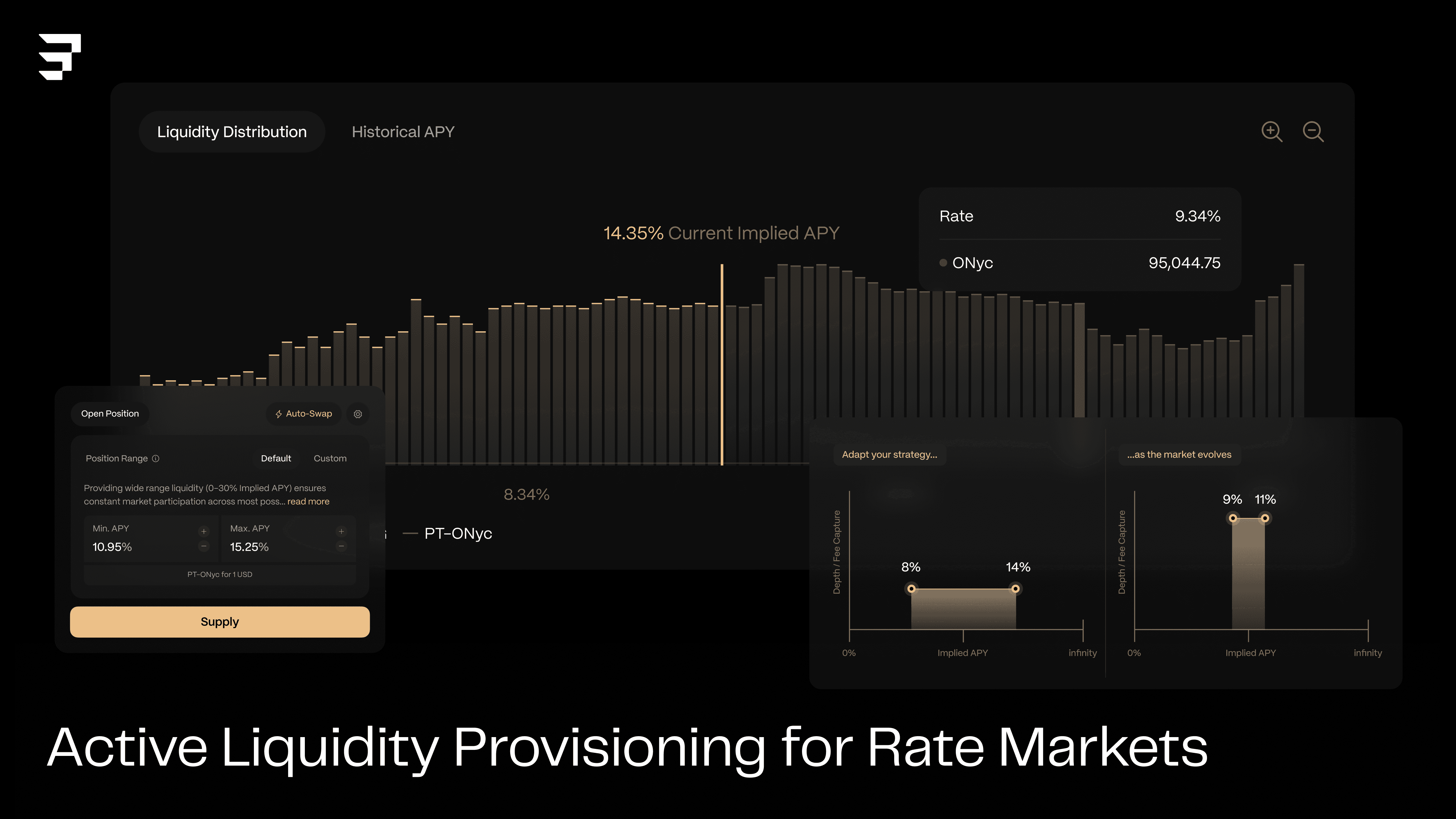
The rCLMM is particularly relevant when:
- a market is newer, thinner, more volatile, or long-tail;
- liquidity needs to be bootstrapped;
- an LP wants to concentrate capital near expected trading ranges;
- a market maker wants one-sided liquidity to gradually acquire or dispose of a PT fixed-rate position;
- the LP is equipped to monitor ranges, rebalance, and assess dynamic-fee compensation.
The image should not be read as an expected-return forecast. “Implied APY,” fee capture, and liquidity depth are scenario-sensitive. If the implied rate exits an LP’s active range, its liquidity may stop earning the intended trading fees and its inventory composition can change materially.
Venue choice is a market-structure decision
| Criterion | Rate Order Book | Rate CLMM |
|---|---|---|
| Primary mechanism | Explicit orders matched at quoted rates | Concentrated automated liquidity |
| Best fit | Precise rate execution and established, deeper markets | Volatile, long-tail, or developing markets |
| Investor priority | A defined entry or exit rate | Immediate liquidity within active ranges |
| Market-maker style | Custom quotes and order management | Range selection, inventory management, rebalancing |
| Main execution limitation | Non-fill or partial-fill risk | Price impact, range-exit risk, and changing inventory |
| Capital-efficiency logic | Capital is committed to selected orders | Capital is concentrated where the LP expects trading |
The venues are complements, not competitors in a simplistic sense. An institution might use the Order Book to work a large PT purchase at a target rate, while a market maker might use the rCLMM to support continuous liquidity in the same or a different market. Which route is preferable depends on actual depth, spread, order-book availability, time horizon, and the client’s tolerance for execution uncertainty.
Strategy Vaults turn market infrastructure into a mandate
Direct PT, YT, or rCLMM use requires operational competence. Someone must select maturities, assess implied rates, rebalance positions, manage liquidity ranges, harvest or reinvest proceeds, and decide when to exit. That is appropriate for some market makers, hedge funds, and specialist DeFi desks. It is not necessarily suitable for every allocator.
Strategy Vaults sit above the issuance and exchange layers. A manager deploys a defined strategy using Exponent’s rate instruments and, where permitted by the strategy, other Solana protocols. The depositor receives exposure to the manager’s mandate rather than manually operating PT/YT positions.
Exponent v2 is Live - Built For Those Who Outperform - Exponent Blog
Continue in Exponent’s v2 announcement with the section “Strategy Vaults – Easy Access to Portfolio Construction in DeFi.” Read it to separate the role of a managed vault from the role of the underlying rate exchange.
Read from the rationale and mechanism, then scan the named launch examples. Focus on the distinction between a vault’s strategy exposure and a simple passive deposit product.
A vault might, for example, buy PT to obtain fixed-rate exposure and use a permitted credit-market strategy to increase that exposure. Exponent’s documentation gives fixed-rate looping as an example. The important interpretation is not “the vault creates extra yield for free.” Instead, the vault combines several sources of return and risk:
- the underlying yield-bearing asset;
- the PT discount or implied fixed yield;
- possible leverage or looping;
- trading, borrowing, and management costs;
- strategy and smart-contract dependencies across protocols.
The docs state that Strategy Vault constraints are enforced on-chain. That is an important control, but it is not equivalent to a capital guarantee. A diligence process still needs to establish the precise mandate, permitted assets, leverage boundaries, manager role, fees, withdrawal mechanics, dependencies, and historical execution.
| Direct market interaction | Strategy Vault interaction |
|---|---|
| Investor chooses PT, YT, maturity, venue, and execution | Manager implements the stated strategy |
| Investor manages orders, liquidity ranges, and rebalancing | Strategy rules and management process govern these decisions |
| Exposure is transparent at the instrument level | Exposure must be understood through the vault mandate and current holdings |
| Suitable for active, operationally capable desks | Suitable for allocators seeking delegated access |
| Return comes directly from selected instruments | Return reflects selected instruments, strategy choices, costs, and manager fees |
For a sales conversation, describe a vault as managed access to rate-market strategies, not simply as “higher yield.” The latter phrasing obscures both the manager’s role and the additional risk introduced by strategy composition.
Risk tranching adds a risk-transfer layer
Risk tranching answers a different question from PT/YT trading. PT and YT redistribute future yield and rate exposure. A tranche structure redistributes defined downside risk.
In a generic senior-junior arrangement:
- a protection-seeking or senior capital provider accepts a lower-priority claim on upside in exchange for a contractual or programmatic loss buffer;
- junior or first-loss capital receives compensation for bearing losses first, up to the agreed attachment and exhaustion terms;
- the underlying asset, yield position, or reference portfolio remains the source of economic risk.
The key word is defined. Protection depends on the legal and technical terms of the structure: covered asset, loss definition, coverage amount, duration, triggers, valuation method, withdrawal rights, and treatment of insolvency, depeg, oracle, or smart-contract events. A tranche is not automatically insurance, and “principal protection” must never be presented as unconditional.
Exponent v2 is Live - Built For Those Who Outperform - Exponent Blog
Read the v2 announcement’s “Risk-Tranching Swaps – Principal Protection on Rate Assets” section. Treat it as evidence of Exponent’s stated product direction and early rollout framing, not as proof that a particular protection structure is currently available for every asset or client.
Read from the risk-tranching proposal. Focus on why the product is positioned as a complement to the yield exchange: it addresses loss allocation, whereas PT/YT markets address yield and rate allocation.
Within the full architecture, a risk-tranching product is therefore neither:
- a new source of yield;
- an execution venue like the Order Book or rCLMM;
- nor automatically a feature of every PT, YT, or vault position.
It is a risk-transfer overlay that may make a defined yield exposure more usable for capital with principal-protection requirements, while creating a compensated risk-bearing role for junior capital. The later structured-products module will examine coverage utilization and loss waterfalls in detail.
Mapping client objectives to the architecture
The architecture becomes practical when mapped to investor intent. The same underlying Yield Market can support very different mandates.
| Client objective | Likely primary product path | What the client is actually choosing |
|---|---|---|
| Lock a defined return in underlying units through maturity | Buy PT through the Order Book or Rate CLMM | Maturity, implied fixed rate, underlying-asset risk, and execution route |
| Take a view that realized yield will exceed market expectations | Buy or trade YT | Variable-yield exposure, incentive exposure, time decay, and entry price |
| Provide market liquidity and monetize execution demand | Rate CLMM or Rate Order Book market making | Fee opportunity in exchange for inventory, rate, and active-management risk |
| Access a managed Solana yield strategy | Strategy Vault | Manager mandate, policy constraints, costs, external dependencies, and withdrawal terms |
| Seek a defined buffer against losses in an eligible exposure | Risk-tranching arrangement | Protection terms, coverage scope, seniority, and the identity of loss-bearing capital |
A strong institutional explanation keeps the layers separate:
Exponent first creates a maturity-specific rate market from a yield-bearing Solana asset. The Rate CLMM and Rate Order Book make that market executable through distinct liquidity models. Strategy Vaults allow managers to deploy those instruments within on-chain constraints, while risk tranching can redistribute defined downside risk for eligible yield exposures.
That is more accurate than saying that every Exponent product is “a yield vault” or that principal protection eliminates the need to assess an underlying asset.
Key takeaways
Exponent’s product architecture can be understood as a connected rate-markets stack:
- Yield Markets create the maturity-specific PT and YT instruments.
- Rate CLMM provides active, concentrated automated liquidity around implied-rate ranges.
- Rate Order Book provides explicit implied-rate quoting and order-driven execution, especially useful where precision and deeper market structure matter.
- Strategy Vaults are managed strategies that use the issuance and exchange layers; they do not replace diligence on the instruments, strategy, manager, or external protocols.
- Risk tranching is a loss-allocation and protection layer, not a new source of yield or a universal guarantee.
- The same market can serve a fixed-rate buyer, a variable-yield trader, a market maker, a managed-strategy allocator, and a protection-seeking institution—but each occupies a different risk position.
Next, you will translate these capabilities into specific outcomes for asset managers, market makers, treasuries, and family offices.
Can't find a good explanation? Sign up and we'll make it for you
Sign up