
Using the Reactivity Series to Predict Displacement and Metal Extraction
Hello. This first module is about using the reactivity series as a prediction tool: you will infer an order from evidence, decide whether a displacement reaction happens, and use carbon’s position to explain how metals are extracted from ores. These are closely connected ideas rather than three separate facts.
For tomorrow’s test, aim to remember one central rule: a more reactive element can take the place of a less reactive one in a compound.
1. What “more reactive” means
A metal reacts by losing electrons and forming positive ions. A metal near the top of the reactivity series loses electrons more readily, so it reacts more easily and often more vigorously.
A useful GCSE version of the series is:
The exact list may include more metals, but the relative positions are what matter.
- Carbon is included even though it is not a metal because it is used in metal extraction.
- Hydrogen is included because it helps predict whether a metal reacts with dilute acids.
- Metals above hydrogen react with dilute acids to make a salt and hydrogen gas.
- Metals below hydrogen, such as copper, do not react with dilute hydrochloric acid.
The reactivity series is therefore not just a list to memorise. It summarises experimental evidence.
GCSE Chemistry - The Reactivity Series - Metal Reactions | Displacement Reactions (2026/27 exams)
Watch GCSE Chemistry – The Reactivity Series by Cognito for a compact overview of what the series measures, how acid reactions provide evidence, and how displacement works.
Watch the series idea for the meaning of reactivity and why carbon and hydrogen appear in the list. Then watch acid evidence; focus on why fizzing, reaction speed, and temperature rise must be compared in a fair test. Finish with displacement for the core prediction rule.
Ranking metals from reaction evidence
When metals are added separately to the same acid, a more reactive metal normally reacts more quickly and releases more energy.
The general pattern is:
For example:
Possible evidence that one metal is more reactive than another includes:
- faster or more vigorous fizzing, caused by hydrogen gas;
- a larger temperature increase, because these reactions release energy;
- the metal disappearing more quickly;
- a greater volume of hydrogen produced in the same time.
However, these observations are only valid evidence if the comparison is fair. Keep the acid volume and concentration, starting temperature, metal mass, and ideally metal surface area the same. Powdered metal reacts faster than a large strip of the same metal because it has more surface area, not because it is intrinsically more reactive.
For example, suppose equal masses of metal powder are reacted with identical hydrochloric acid samples:
| Metal | Temperature change |
|---|---|
| Magnesium | |
| Zinc | |
| Iron | |
| Copper |
The supported order is:
A larger temperature rise means more energy was transferred to the surroundings under the same conditions, indicating a more reactive metal. Copper’s lack of reaction places it below hydrogen; it does not mean copper is “not a metal” or cannot react with anything.
2. Displacement: using a reaction to compare metals directly
A displacement reaction occurs when a more reactive metal is put into a solution containing ions of a less reactive metal. The more reactive metal forms ions in solution, while the less reactive metal is produced as a solid.
The rule is:
A metal displaces a less reactive metal from its compound.
Consider magnesium placed in copper sulfate solution:
Magnesium is above copper in the reactivity series, so magnesium displaces copper.
At particle level:
- magnesium atoms become magnesium ions in solution;
- copper ions gain electrons and become copper atoms;
- copper appears as a reddish-brown solid deposit.
The sulfate part of the compound remains in solution; it effectively switches from being paired with copper to being paired with magnesium.
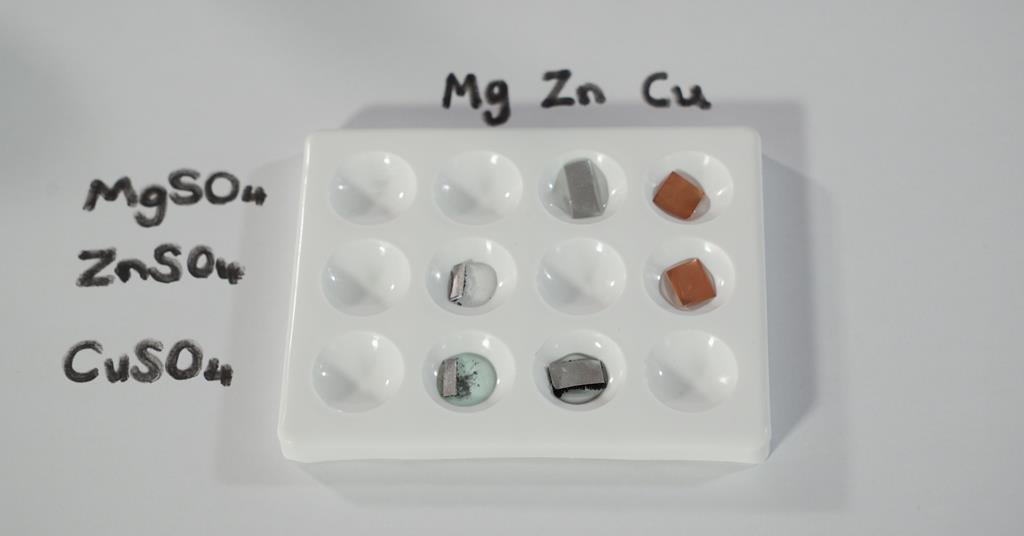
In the image, the rows are sulfate solutions and the columns are solid metals. The key observations are:
- Magnesium reacts with zinc sulfate and copper sulfate, so magnesium is more reactive than zinc and copper.
- Zinc reacts with copper sulfate, so zinc is more reactive than copper.
- Copper does not displace magnesium or zinc from their sulfate solutions.
Therefore:
Predicting a displacement reaction reliably
Use this short method in a test:
- Identify the solid metal added.
- Identify the metal in the compound or solution.
- Find both in the reactivity series.
- If the solid metal is higher, a reaction occurs.
- If the solid metal is lower, write no reaction.
For instance:
Zinc is above copper, so zinc displaces copper.
But:
Copper is below zinc, so it cannot displace zinc.
A common error is to assume that any metal plus any metal salt reacts. It does not. The direction matters.
Using displacement evidence for an unknown metal
Displacement is especially useful if acid evidence is unclear. Imagine an unknown metal :
- reacts with copper sulfate solution.
- does not react with iron sulfate solution.
The first result shows:
The second shows:
Together:
A possible identity could be tin or lead, depending on the exact reactivity series supplied in the question. Notice how each result provides a boundary: one tells you what is above, and the other tells you what it is below.
3. Carbon’s place in the series: extracting metals from ores
Most metals are found in the Earth’s crust as compounds rather than as pure metals. Many are found in ores, rocks containing enough of a metal compound to make extraction worthwhile. Metal oxides are particularly common because metals react with oxygen over time.
To obtain the metal, the oxygen must be removed from its oxide. Removal of oxygen is called reduction.
Carbon is the dividing line because it can remove oxygen from the oxides of metals below carbon in the reactivity series.
The rule to memorise is:
- Metal below carbon: carbon reduction can be used.
- Metal above carbon: carbon reduction cannot be used; electrolysis is needed instead.
- Very unreactive metals: may sometimes be found uncombined in the Earth.
For a metal oxide below carbon, heating with carbon transfers oxygen from the metal oxide to the carbon. The metal oxide is reduced, and carbon is oxidised.
For example, zinc can be extracted from zinc oxide:
Here:
- zinc oxide loses oxygen, so it is reduced;
- carbon gains oxygen, so it is oxidised;
- carbon acts as the reducing agent because it causes the zinc oxide to be reduced.
The oxygen-containing carbon product can vary with conditions. For example, carbon dioxide may form in some equations, while the industrial zinc example above produces carbon monoxide. For the reactivity-series question, the essential reasoning is always the same: carbon removes oxygen from the oxide only when carbon is more reactive than the metal.
GCSE Chemistry - Separating Metals from Metal Oxides | Extraction of Metals & Reduction
Watch GCSE Chemistry – Separating Metals from Metal Oxides by Cognito to connect reduction, carbon’s position in the series, and industrial extraction.
Start with oxides and reduction to see why metals are usually found combined with oxygen. Watch carbon reduction for the extraction rule and its link to the reactivity series. Then use the iron example to connect this rule to extracting a useful industrial metal from an ore.
Why aluminium needs electrolysis but iron does not
Aluminium is above carbon:
Carbon is not reactive enough to remove oxygen from aluminium oxide. Aluminium therefore requires electrolysis, which uses electricity to decompose its compound. This is energy-intensive and expensive.
Iron is below carbon:
So iron oxide can be reduced using carbon in industrial extraction. In an iron blast furnace, coke supplies carbon, and carbon monoxide formed in the furnace is an important reducing agent. At GCSE level, this is classified as extraction by reduction with carbon.
A strong explanation question answer links the method directly to position in the series:
Iron can be extracted from iron oxide using carbon because iron is less reactive than carbon. Carbon removes oxygen from iron oxide, reducing it to iron. Aluminium cannot be extracted this way because aluminium is more reactive than carbon, so electrolysis is required.
Test-ready summary
Use these three linked rules:
- Rank from evidence: under fair conditions, more vigorous fizzing, faster reaction, or a greater temperature rise indicates a more reactive metal.
- Predict displacement: a solid metal displaces a metal below it in the reactivity series from a solution of its compound.
- Predict extraction: metals below carbon can be extracted from oxides by carbon reduction; metals above carbon require electrolysis.
Also keep these definitions precise:
- Oxidation: gain of oxygen.
- Reduction: loss of oxygen.
- Displacement: a more reactive element replaces a less reactive element in a compound.
Next, you will use the same reaction patterns to choose reactants and predict products when preparing named salts from acids, metal oxides, carbonates, metals, and alkalis.
Can't find a good explanation? Sign up and we'll make it for you
Sign up