
Hello, and welcome to the first step in designing your own 3D game. This module moves from a rough game idea toward a small, playable greybox prototype: a level made from simple shapes that lets you test whether the game is understandable and enjoyable before investing in art or complex systems.
Professional game design begins with a practical question: what will the player do over and over, and why will they want to do it again? In this lesson, you will learn to spot that repeating cycle—the core game loop—and describe it in terms of player observation, choices, actions, feedback, and rewards. We will use a small top-down 3D “collect and escape” game as the running example for the project you will build later.
The core loop: the game’s repeated conversation with the player
A core game loop is the repeated set of actions and game responses that makes up most of play. It is not the plot, menu, art style, or final ending. It is the meaningful activity the player keeps returning to.
In a platform game such as the original Mario, the basic repeated actions include moving, running, and jumping. Enemies, terrain, and power-ups make those same actions more varied and demanding, but the actions themselves remain central. In a simple roguelike, a core loop might be moving, attacking, and collecting.
How To Perfect Your Game's Core Loop
Read “How To Perfect Your Game’s Core Loop” from GameAnalytics for a concise explanation of why repeated player actions are the foundation of a game, rather than an added feature.
In the opening discussion, read from the first paragraph through the paragraph immediately before “The core loop for all it’s worth.” Focus on the distinction between a game’s lowest-level repeated actions and larger goals such as completing a level. Use the central discussion to locate most of this passage.
A loop needs more than a list of button presses. For it to feel like play, the player needs to understand the situation, make a choice, act, and see a consequence. A useful model is:
- Observation: the player notices the current situation.
- Decision: the player forms an intention or chooses an approach.
- Action: the player does something in the game.
- System response and feedback: the game changes state and communicates what happened.
- Reward or consequence: the player gains progress, information, capability, or faces a setback. The new state gives them something new to observe.
The final state does not end the cycle; it creates the next decision. A player might see a collectible, choose a route to reach it, move toward it, collect it, see their count increase, and then choose which collectible to pursue next.
What are loops in game design? - Loops - Game Design Theory
Watch “What are loops in game design?” by Game Design with Michael. It introduces a more precise version of this model: players form expectations, act, receive feedback, and revise their understanding of the game.
Watch the opening for the basic purpose of loops in structuring player behavior. Then watch the loop model, noting the difference between the player’s mental model, their action, the system’s processing, feedback, and interpretation. Continue with the worked example to see those stages in an actual gameplay situation. Finally, watch loop scale for the idea that games contain loops that operate at different speeds.
Objective, challenge, feedback, and reward
The loop becomes meaningful when it serves an objective and contains challenges.
- An objective tells the player what success ultimately looks like: for example, “collect the energy cores and leave through the exit.”
- A challenge is what stands between the player and that objective: a blocked route, limited time, an enemy, uncertainty, or a difficult movement task.
- Feedback tells the player what the game has registered. It might be a counter changing, an object disappearing, a sound, a gate opening, or a brief visual effect.
- A reward is the valuable result of an action. It can be progress toward the objective, access to a new area, useful information, points, or a new ability.
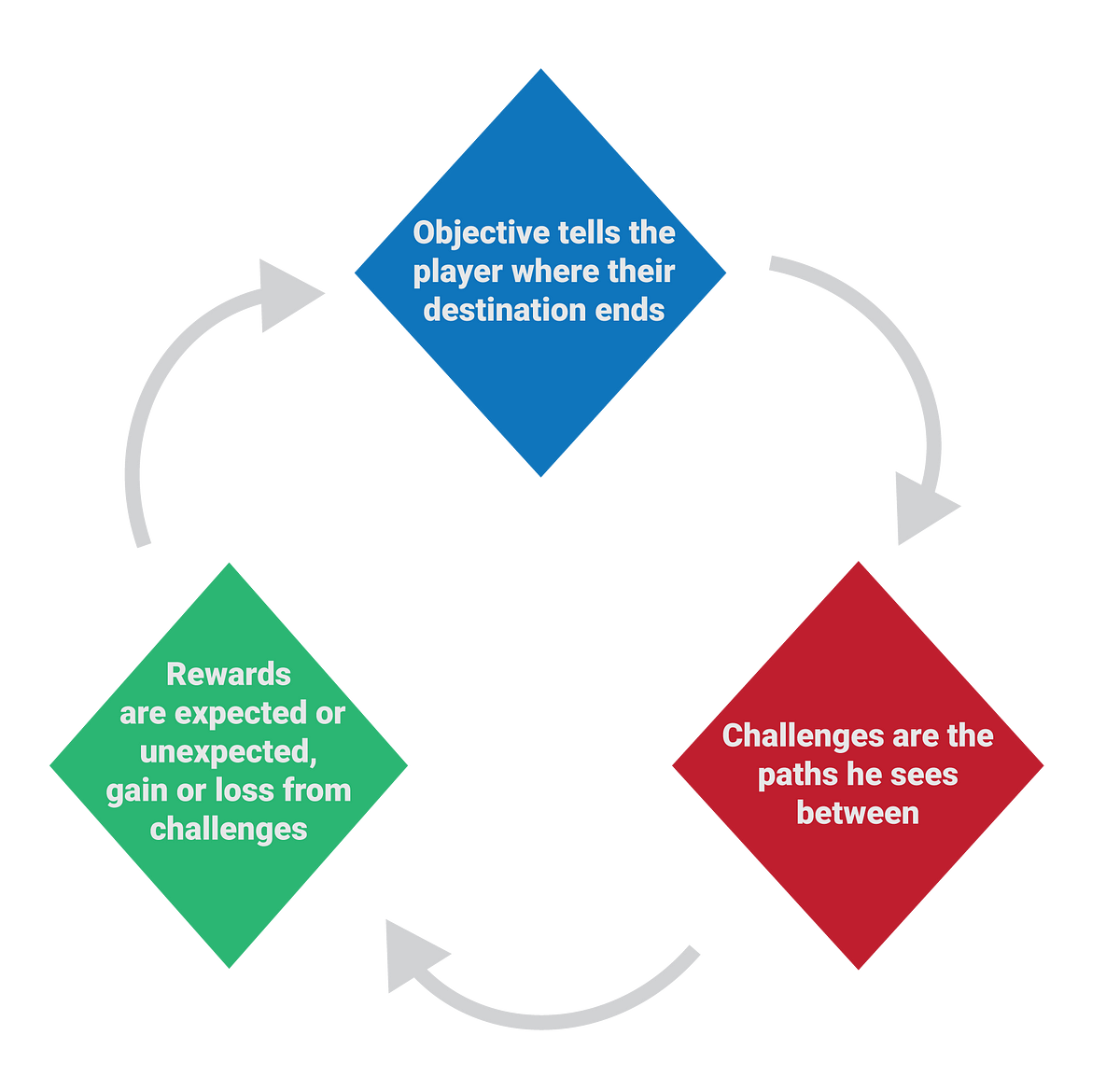
The diagram is useful, but be precise about one detail: an objective does not need to be repeated every few seconds. It gives the larger loop direction. The core loop is the short cycle of decisions and actions that repeatedly moves the player toward that objective.
Consider a top-down 3D prototype set in a compact ruin:
The player searches for energy cores, chooses routes through the space, collects the cores, and escapes when enough have been found.
Its repeating collection loop could be described like this:
| Part of the loop | What happens in the prototype |
|---|---|
| Observation | The player sees a nearby energy core, walls, paths, and the locked exit. |
| Decision | They choose which core to pursue and how to approach it. |
| Action | They move their character through the 3D space and reach the core. |
| System response | The game registers the collection and changes the world state. |
| Feedback | The core disappears and the collection counter visibly increases. |
| Reward | The player makes progress toward unlocking the exit. |
| Next cycle | Remaining cores and routes become the next situation to assess. |
The reward here is modest but real: visible progress and eventual access to the exit. It tells the player that their chosen action mattered.
A common design mistake is to treat feedback and reward as identical. They often happen together, but they have different jobs:
- If a core vanishes, that is feedback: “your pickup worked.”
- If the core count rises from two out of five to three out of five, that is feedback and progress.
- If collecting the last core opens the exit, the opening gate is feedback, while access to the exit is the reward.
Without clear feedback, the game may technically change state while the player remains uncertain. If the player walks through a collectible and nothing visibly changes, they cannot confidently update their understanding of what to do next. The loop has broken from the player’s point of view.
Rewards should create anticipation, not confusion
Rewards help a player anticipate what their efforts can achieve. A predictable reward does not have to be dull: collecting a core can consistently advance the count, while the routes, obstacles, and decisions around each core create the variety.
Read the short discussion in “What is a core game loop?” from Skeleton Code Machine on what a well-defined loop does for players. It is especially useful for connecting repeated actions to understandable rewards and player expectations.
Find the three-item list beginning “Provides a quick overview,” immediately before the later section titled “Core game loop vs. compulsion loop.” Read the three benefits. Focus most closely on how a loop guides player actions and helps them anticipate a reward.
For the kind of small game you are making, rewards should reinforce the experience you intend to create. If the intended experience is tense exploration, rewards might include discovering a safe route, collecting a scarce item, and seeing a distant exit become reachable. If the intended experience is calm exploration, rewards might be new views, clear progress, and satisfying navigation rather than constant threats.
This is also a useful design ethic. A reward cycle should help the player understand and enjoy the game, not merely pressure them to continue through confusing or random incentives. For an early prototype, clear and testable progress is more important than elaborate reward systems.
Core loop versus larger game loops
Games operate at several time scales. Do not mistake every repeated pattern for the same kind of loop.
For the collect-and-escape prototype, you might identify three levels:
| Time scale | Example | Design purpose |
|---|---|---|
| Moment to moment | Notice a wall or route, steer the character, adjust direction | Makes movement readable and responsive |
| Core collection loop | Choose a core, navigate to it, collect it, receive progress feedback | Defines the main activity of the game |
| Level loop | Collect all required cores, unlock the exit, escape, restart | Gives the session a beginning and an ending |
The boundaries can be flexible. In some games, “fight an enemy, gain loot, improve equipment” is the main loop. In others, fighting is only a supporting activity within a broader loop of exploration and discovery.
To identify the right loop for a game, use three tests:
- Frequency: Does the player do this repeatedly during ordinary play?
- Decision: Does it involve a meaningful choice, even a small one?
- Identity: If this activity disappeared, would the game’s central experience fundamentally change?
For example, “reach the final exit” is important, but it happens once per playthrough, so it is usually an objective or end condition rather than the core loop. “Move through the level and collect required objects” happens repeatedly and drives the player’s choices, so it is much closer to the core loop.
Likewise, “the game has a fantasy ruin setting” is not a loop. It may support atmosphere and navigation, but the player can still perform the core activity without knowing the story behind the ruin. Separating core actions from supporting features will later help you decide what must be built first.
A compact design note for your prototype
Keep this simple template in your design notes. It gives you a way to turn a vague idea into something you can later build and test.
| Prompt | Collect-and-escape example |
|---|---|
| The player repeatedly notices… | energy cores, available routes, and the current progress count |
| The player chooses… | which core or route is worth pursuing next |
| The player repeatedly does… | navigates through the space and collects a core |
| The game clearly communicates… | that a core was collected and how much progress was made |
| The player gains… | progress toward unlocking the exit |
| The cycle restarts when… | the player identifies another remaining core or a newly opened route |
Notice that this description is not yet a technical plan. It does not specify code, collision settings, interface components, models, or visual effects. Those will come later. At this stage, the important thing is that you can explain what the player does, what changes, and why they continue.
A well-stated core loop also creates a useful priority rule for your first prototype: build the smallest version of the loop first. A grey box can use simple cubes for walls and glowing placeholder objects for cores. If players can make choices, collect objects, see progress, and understand that they are working toward escape, then you have something real to test.
Key takeaways
A core game loop is the repeated conversation between player and game. The player observes a situation, makes a decision, acts, receives feedback, gains a reward or consequence, and encounters a changed situation that invites another decision.
For the 3D prototype in this course, the central loop is likely:
Find a collectible, choose a route, move to collect it, receive clear progress feedback, and choose the next target.
The overall objective—collect enough items and escape—gives that loop direction, while the layout and obstacles create the challenges that make each repetition worth thinking about.
Next, you will turn the desired player experience behind this loop into a single clear sentence. That sentence will become a design compass for later decisions about movement, level layout, challenge, and feedback.
Can't find a good explanation? Sign up and we'll make it for you
Sign up