
Welcome. This module focuses on communicating Exponent in language an investment committee, trading desk, or allocator can use without losing the protocol’s economic reality. The aim is not to force DeFi into TradFi labels; it is to use the labels where they clarify cash-flow and rate exposure, then state precisely where they stop being equivalent.
By the end, you should be able to describe Exponent’s yield markets as a fixed-maturity, on-chain rate market; position PT and YT for different mandates; and pre-empt the most important misunderstandings around “fixed yield,” principal, and settlement.
Begin with the economic decomposition
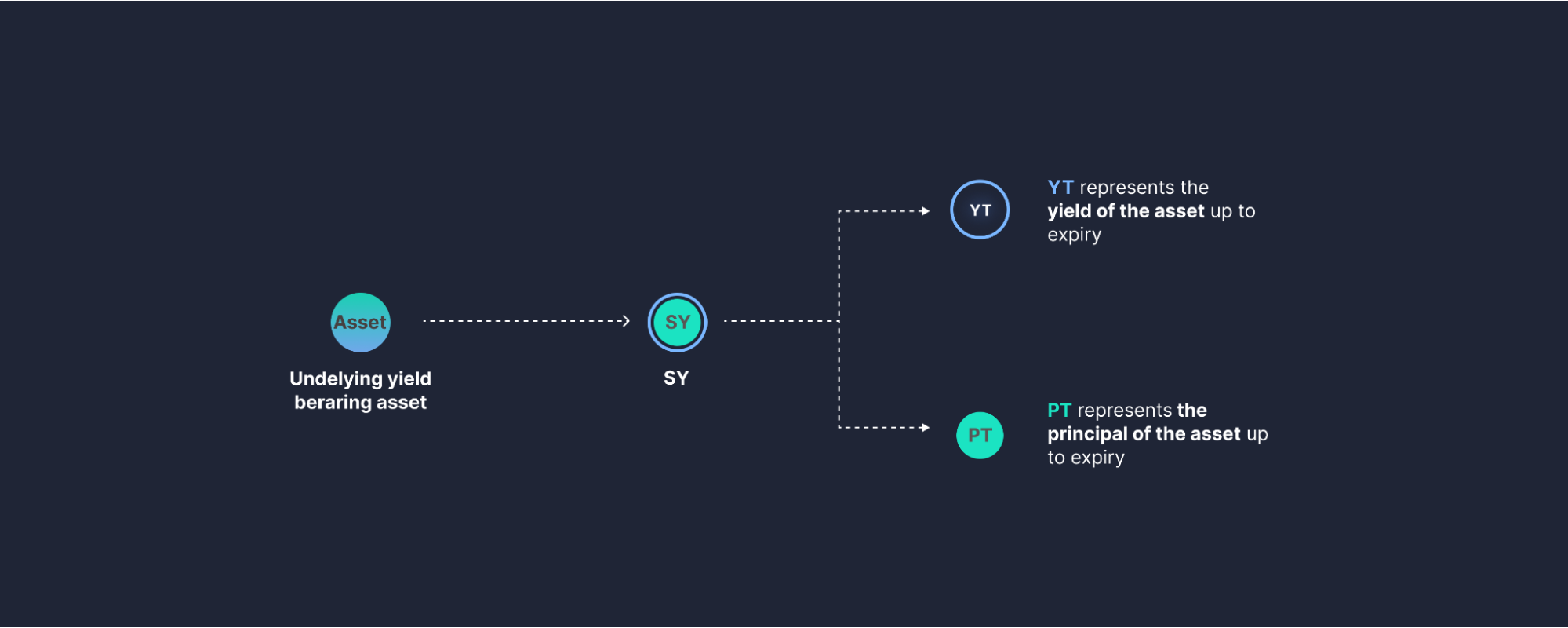
Exponent takes a yield-bearing on-chain asset for a defined maturity and separates its two economic components:
- the right to receive the principal asset at maturity;
- the right to receive the variable yield produced by that asset before maturity.
For each unit of underlying asset placed into the stripping mechanism, the protocol creates one Principal Token and one Yield Token:
This is a claims and accounting identity. It means that PT and YT from the same underlying and maturity can be recombined to recover the underlying asset before maturity. That ability to strip and merge is important because it gives arbitrageurs a mechanism to keep the combined value of the two tokens aligned with the underlying asset.
Yield Stripping & Swap - Exponent Docs
Read Exponent Docs’ “Yield Stripping & Swap” for the protocol’s own description of issuance, merging, and rate exposure. It provides the core Treasury STRIPS and interest-rate-swap analogies used in this lesson.
In the opening of “Yield Stripping & Swap,” read the opening analogy. Then, in “How Stripping Works,” follow the issuance sequence. Continue through the “Stripping Example” and “Merging” subsections. Focus on the merging mechanism: it explains why PT and YT are linked rather than independent speculative tokens. Finally, in “Interest Rate Swap,” read the PT analogy and the YT analogy.
An institution does not normally need to strip assets manually. It can trade the desired exposure directly. But understanding the issuance mechanism is what makes the fixed-income language defensible: PT and YT are not arbitrary wrappers; they are matched claims on a specified underlying asset and yield period.
Translate each product into fixed-income language
The following translations are useful because they describe the economics of a position. The final column is just as important as the analogy.
| Exponent term | Useful institutional description | Where the analogy ends |
|---|---|---|
| Underlying yield asset | The reference asset or funding asset producing the income stream | It is usually a crypto asset or tokenized claim, not a cash bond. Its USD value, protocol mechanics, and yield source can change. |
| PT | A tokenized, zero-coupon maturity claim bought at a discount and redeemable at par in units of the underlying | “Par” means one unit of the underlying token, not necessarily one dollar. It is not an issuer’s unsecured debt obligation. |
| YT | A prepaid claim on the floating income leg; economically similar to a yield forward or a stripped floating-coupon exposure | It has no principal repayment. Its payoff depends on realized on-chain yield and may include specified incentives or points. |
| Yield stripping | Coupon and principal stripping, analogous to Treasury STRIPS | The process is performed through smart-contract infrastructure and token claims, rather than through a conventional securities depository. |
| Implied Rate | A market-implied forward rate for the remaining maturity | It is not a benchmark curve, a policy rate, or the underlying asset’s displayed current APY. |
| Maturity | Contractual end date for the yield period and redemption point | Settlement is into the underlying token through protocol mechanics, not automatically into fiat cash through a central securities depository. |
| Rate CLMM / Rate Order Book | Electronic secondary-market execution venues for rate exposure | They are on-chain liquidity mechanisms; execution quality depends on available liquidity, market design, and operational access. |
PT: the fixed-rate or zero-coupon analogy
A Principal Token is most naturally described as a discount instrument. An investor acquires PT below its maturity redemption value and, if it is held through maturity, redeems one PT for one unit of the specified underlying asset.
The economic return comes from discount accretion. If an investor pays less than one unit of the underlying for one PT and receives one unit at maturity, the difference is the fixed return in underlying-token terms. The rate is known at entry, provided the investor holds to maturity and the redemption mechanism functions as designed.
For an underlying holder, exchanging floating-yield exposure for PT exposure resembles being a fixed-rate receiver and floating-rate payer. They surrender the uncertain yield that the underlying would have earned during the remaining term and obtain the fixed return embedded in the PT discount.
This is also where “bond-like” needs discipline:
- PT has a maturity payoff convention, but it is not necessarily a bond.
- PT gives fixed return denominated in the underlying asset, not necessarily fixed purchasing power or a fixed USD return.
- A PT holder still depends on the underlying asset, the underlying yield source, Exponent’s contracts, and the ability to custody and redeem the token.
- Selling before maturity turns a fixed hold-to-maturity position into a mark-to-market rate position.
A useful client sentence is:
“PT is economically similar to buying a zero-coupon instrument on the underlying asset: you pay a discount today and redeem one unit of that asset at maturity. The return is fixed in token terms, conditional on the market’s redemption and underlying infrastructure functioning, but it is not cash-equivalent principal protection.”
YT: the floating-income or yield-forward analogy
A Yield Token receives the yield generated by one corresponding unit of principal until the stated maturity. An investor pays an upfront price for this claim. Their outcome depends on whether the yield actually realized over the remaining period exceeds that acquisition cost.
In fixed-income language, YT is closest to a prepaid floating-income claim or, as Exponent’s documentation puts it, an on-chain analogue of acquiring a yield forward. It lets a trader take a view that future realized yield, including eligible incentive flows where applicable, will be higher than the rate currently priced by the market.
The word “leveraged” here is economic rather than necessarily borrowed leverage. The buyer commits less capital than buying the entire underlying asset, while receiving the yield generated by a full unit of that asset for the remaining term. That increases sensitivity to the realized yield outcome.
Do not call YT a floating-rate note:
- a floating-rate note returns principal at maturity; YT does not;
- YT has an upfront premium and a wasting time value, because less future yield remains as maturity approaches;
- its payoff is tied to actual yield generation, not merely a published reference index plus a contractual spread;
- YT can lose value if realized yield disappoints relative to the implied rate paid at entry.
The implied rate is a forward price of yield, not the current APY
The Implied Rate is the market-cleared expectation of average yield over the remaining maturity. This makes it comparable to a forward rate, not to a dashboard’s current staking or lending APY.
That distinction matters in client conversations. A current underlying APY answers: what is this asset yielding now? The implied rate answers: what yield is the market currently pricing for the time remaining until this maturity?
When demand for PT rises, its price rises relative to the underlying. Because the PT buyer earns the gap between purchase price and par at maturity, the implied fixed yield falls. This is familiar bond mathematics: higher price corresponds to lower yield, all else equal.
Demand for YT has the inverse effect within the paired PT/YT structure. Buying yield exposure increases the price of YT and raises the rate the market implies for the remaining period.
Read Exponent Docs’ “Yield Markets” to connect the PT/YT instruments to the trading interface, execution choices, and the return risks that matter in an institutional explanation.
In “Trading Rates on Exponent,” compare PT terms with YT terms. Notice that PT is framed around predictable maturity redemption, whereas YT is framed around outperforming the implied APY. Then read the “Instant vs. Limit Orders” table. Treat an instant order as an instruction prioritizing execution and a limit order as an instruction prioritizing rate control. Finish with “Understanding Risks and Returns,” especially the risk overview. The distinction between a maturity payoff and a pre-maturity exit value should be explicit in any client discussion.
Explain Exponent as market infrastructure, not as a yield issuer
A precise high-level description is:
Exponent is a Solana-based, fixed-maturity on-chain yield exchange. It lets holders of yield-bearing assets separate principal exposure from future yield exposure and lets other participants trade either side at market-implied forward rates.
That description identifies three distinct roles:
- Yield issuers or underlying-asset holders bring an asset with a yield source, such as staking, lending, stablecoin, or tokenized real-world-asset yield.
- Rate takers buy PT to lock a fixed token-denominated return or buy YT to obtain floating-yield exposure.
- Liquidity providers and market makers facilitate secondary-market execution in the Rate CLMM and Rate Order Book.
The user-facing labels are simple:
- Income refers to PT trading, designed for the investor seeking a fixed return through maturity.
- Farm refers to YT trading, designed for the investor seeking future variable yield and eligible incentive exposure.
- Instant orders seek immediate execution against available liquidity.
- Limit orders seek execution only at a chosen implied-rate level and may remain unfilled.
For a market maker, the Rate CLMM and Rate Order Book are electronic liquidity venues. For an allocator, they are execution routes. For a treasury, PT can be described as a maturity-dated yield-locking tool. The product is the same; the mandate changes the relevant vocabulary.
State the limits before the client has to ask
The most credible institutional explanation pairs each benefit with the condition that makes it true.
“Fixed yield” is not the same as “risk-free return”
A PT’s maturity redemption amount is deterministic in underlying-token units: one PT redeems for one unit of the specified underlying asset at maturity. But that outcome remains contingent on several layers functioning properly.
At minimum, distinguish:
-
Underlying-asset risk. If the client reports in USD, EUR, or another base currency, the asset received at maturity can move materially in value. A fixed JitoSOL-denominated outcome does not lock a fiat-denominated return.
-
Underlying-yield-source risk. Staking, lending, stablecoin, and RWA yield each arise from different economic and operational sources. The PT holder gives up that variable yield; the YT holder is directly exposed to its realization.
-
Protocol and smart-contract risk. The stripped claims, vault operations, redemption process, and any relevant administrative controls are on-chain infrastructure dependencies, not a traditional issuer covenant.
-
Liquidity and exit risk. Holding PT to maturity differs from selling PT early. Before maturity, the exit price depends on the current implied rate, available depth, and spread. A large order can face slippage.
-
Operational, custody, legal, and accounting risk. Wallet controls, transaction processes, token eligibility, compliance treatment, and valuation policy may matter as much as the rate trade itself for an institution.
These categories should not be presented as a generic disclaimer. Tie them to the client’s mandate. A treasury intending to hold PT through maturity is chiefly assessing redemption, custody, and underlying-token exposure. A fund trading PT tactically also needs to manage rate volatility and secondary-market liquidity. A YT buyer needs a view on realized yield and the possibility that the premium paid is not recovered.
A client-ready positioning statement
Use this as a starting script, then replace the underlying asset and maturity with the actual market under discussion:
“Exponent is an on-chain fixed-maturity yield market on Solana. It separates a yield-bearing asset into a Principal Token and a Yield Token for a defined maturity. The PT is economically similar to a discounted zero-coupon claim: an investor buys it below one unit of the underlying and can redeem one unit at maturity, thereby locking a token-denominated return. The YT is the complementary floating-yield claim: its holder receives the yield generated until maturity and benefits if realized yield exceeds the rate implied in its purchase price.
“The implied rate is a forward market rate, not today’s displayed APY. Investors can execute immediately through available liquidity or place rate-specific limit orders. The fixed-income analogy is useful for the rate exposure, but it does not make PT a cash bond or remove crypto-specific risks. Redemption remains in the underlying token, and investors must diligence the underlying asset, smart-contract infrastructure, liquidity, custody, and operational setup.”
Avoid two common phrases:
- Do not say “principal guaranteed” without adding “in units of the underlying asset at maturity, subject to protocol and underlying risks.”
- Do not say “a bond” when you mean “economically analogous to a zero-coupon maturity claim.”
That precision is not merely legal caution. It demonstrates that you understand the difference between a rate payoff and the full risk profile of the instrument.
Key takeaways
Exponent’s yield markets can be communicated in institutional fixed-income terms:
- PT resembles a discounted, zero-coupon maturity claim and a floating-to-fixed rate conversion.
- YT resembles a prepaid floating-income claim or yield-forward exposure.
- Implied Rate is a market-priced forward yield for a stated maturity, not the current underlying APY.
- Rate CLMM and Rate Order Book provide on-chain secondary-market execution, while instant and limit orders express different execution priorities.
- The analogies stop at legal form, settlement asset, risk transfer, infrastructure, and liquidity: a fixed PT return is fixed in underlying-token terms, not a risk-free fiat return.
Next, we will isolate the key distinction behind the PT proposition: a deterministic maturity redemption amount versus the protocol, underlying-asset, liquidity, and operational risks that remain.
Can't find a good explanation? Sign up and we'll make it for you
Sign up