
Hello. In the previous lesson, you practiced writing an institutional newsletter that paired every advertised opportunity with its conditions: target yield with its source, protection with coverage, and seniority with liquidity and operational constraints. Live presentation requires the same discipline, but at a faster tempo: an allocator should leave understanding both the opportunity and the diligence still required.
This lesson turns that written discipline into a ten-minute Exponent product presentation, followed by concise technical and risk Q&A. The target is not to explain every program or market. It is to earn a sensible next step: a mandate-specific diligence and deployment discussion.
Build the presentation around an institutional decision
A weak DeFi product presentation is an interface tour: it lists features, quotes APYs, and calls the protocol “innovative.” An institutional presentation should instead answer four questions in order:
- What portfolio problem does the product address?
- What economic instrument or exposure does the investor actually receive?
- What risks and dependencies remain?
- What evidence and operating work are needed before capital can be deployed?
For Exponent, the central proposition is that a yield-bearing on-chain asset can be divided into a fixed-maturity principal component and a variable-yield component, then traded and managed through a rate-market infrastructure. This gives an allocator distinct choices: lock a maturity-specific rate through PT, express a view on future yield through YT, provide rate-market liquidity, delegate within a Strategy Vault, or use risk tranching where appropriate.
Do not present those choices as interchangeable yield products. They have different cash flows, exit paths, risk sensitivities, and operational demands.
Before rehearsing the deck, refresh the mechanics that must be explainable in plain language.
Yield Stripping & Swap - Exponent Docs
Read “Yield Stripping & Swap” in the Exponent Docs to prepare the technical core of the presentation: issuance, the PT/YT relationship, implied rates, and YT execution.
In “How Stripping Works,” read the full subsection, beginning with the overview of yield stripping and its Treasury STRIPS analogy. Focus on issuance mechanics: one underlying position creates a PT and a YT with the same maturity. Then read “Interest Rate Swap” and “Implied Rate.” Focus on the rate-trading framing. Be able to distinguish the market’s forward-looking implied rate from a yield source’s current APY. In “Flash Swaps,” including “How Flash Swaps Work” and “Why Flash Swaps Matter,” study the execution logic. Finish with “Yield Routing and Emissions,” concentrating on rewards routing and why incentives belong in a YT discussion rather than a PT-return claim.
The key identity beneath the presentation is:
That is an accounting relationship, not a statement that PT is a cash-equivalent instrument. A PT holder who retains the position to maturity has a claim to one unit of the underlying asset under the protocol’s rules. The fixed return comes from acquiring PT below its maturity redemption value; it does not remove underlying-asset, protocol, operational, or legal risk.
A ten-minute Exponent presentation: eight slides
Use the following structure as a rehearsal script. It is deliberately designed for an institutional allocator, rather than a crypto-native trader. The total spoken content is approximately nine minutes and forty-five seconds at a measured pace, leaving a few seconds to transition between slides.
Slide 1 — The decision frame
Time: 0:00–0:45
On the slide
Exponent: fixed-maturity and variable-yield tools for Solana-native yield assets
Decision today: determine whether a mandate-specific diligence discussion is warranted.
Speaker notes
“The question is not whether on-chain yield is risk-free, nor whether every portfolio should use it. The question is whether Exponent provides a sufficiently transparent way to shape yield exposure, manage maturity, and execute rate views to justify further diligence for a particular mandate.
Exponent is a Solana-based yield-market stack. It enables fixed-maturity principal positions, variable-yield positions, rate-market liquidity, and strategy or risk-management structures around supported yield assets. Throughout this discussion, I will separate the instrument’s economics from the risks of the underlying asset, the protocol, liquidity, and the investor’s own operating model.”
This opening does three things: it establishes a professional standard, prevents “DeFi yield” from sounding like a generic asset class, and signals that risk will not be treated as an appendix.
Slide 2 — The institutional problem
Time: 0:45–1:40
On the slide
| Institutional need | Exponent-relevant expression |
|---|---|
| Reduce uncertainty around future yield | Buy a maturity-specific PT |
| Take a view on realized future yield | Buy or sell YT exposure |
| Supply liquidity to rate markets | Rate CLMM or Rate Order Book activity |
| Access a defined strategy mandate | Strategy Vaults |
| Exchange yield for a first-loss buffer, or provide it | Risk-tranching products |
Speaker notes
“Yield-bearing digital assets often bundle several exposures: the asset itself, variable cash flow, incentive programs, and market liquidity. That bundling can make it difficult to express a simple investment view.
An allocator may want to lock a maturity-specific rate, while another wants upside if realized yield exceeds market expectations. A market maker may prefer to earn execution fees and manage inventory. A different client may seek a defined strategy mandate or a senior-junior risk allocation.
Exponent’s role is to make these distinct exposures more separable and tradable. It is not simply a centralized exchange account, a conventional lending pool, or a passive vault. The suitability question depends on which exposure the mandate is actually seeking.”
Avoid presenting the table as a menu of products to sell. It is a map that lets you ask a better follow-up question: which exposure does the client want, and which risks can it tolerate?
Slide 3 — The product architecture
Time: 1:40–2:35
On the slide
| Layer | Function |
|---|---|
| Exponent Core | Creates and manages PT/YT yield-market positions |
| Rate CLMM | Concentrated liquidity for rate-market trading |
| Rate Order Book | Limit offers and market execution at chosen APY levels |
| Strategy Vaults | Strategy layer using Exponent markets and selected DeFi venues |
| Risk-Tranching | Senior and Junior allocation of yield and losses |
Speaker notes
“The architecture matters because each layer introduces a different economic role and risk surface. Exponent Core handles the stripping, merging, and yield-distribution logic. The Rate CLMM and Rate Order Book provide trading and liquidity infrastructure. Strategy Vaults package positions or strategies, while Risk-Tranching separates senior and junior exposure around a yield-bearing asset.
In diligence, we should not treat ‘Exponent’ as one undifferentiated smart-contract risk. A PT trade, an actively managed liquidity position, and a Junior tranche may all involve the broader platform, but their return drivers and practical risks differ materially.”
Keep program addresses, transaction instructions, and interface screenshots in an appendix. They are important for operational diligence, but they dilute the decision-focused opening of a ten-minute meeting.
Slide 4 — The core economic mechanism: PT and YT
Time: 2:35–4:05
On the slide
PT: claim on principal at a defined maturity
YT: claim on variable yield and eligible rewards until that maturityFixed return is embedded in the PT discount to maturity.
YT return depends on realized yield relative to its purchase cost.
Speaker notes
“At the core is yield stripping. For each unit of a supported underlying asset, the system creates one Principal Token and one Yield Token for a defined maturity. PT is the principal-side claim: when held to maturity, it is redeemable one-for-one for the underlying asset under the market’s terms. Because PT generally trades below that maturity value, its appreciation to par creates the implied fixed return.
YT receives the variable yield generated before maturity, including eligible additional rewards where the market routes them to YT holders. Economically, buying YT means paying for future yield and taking a view that realized yield, and potentially rewards, will exceed what the market has priced.
The fixed rate is therefore a maturity-specific, market-priced return in units of the underlying asset. It is not a promise that the underlying will retain a given fiat value, and it does not eliminate protocol or liquidity risk.”
The phrase “in units of the underlying asset” is essential. It prevents a listener from hearing “fixed yield” and assuming a dollar-denominated, insured, or credit-risk-free instrument.
Slide 5 — How rate-market execution works
Time: 4:05–5:15
On the slide
PT liquidity is central to the market design
- Rate CLMM: concentrated liquidity for rate trading
- Rate Order Book: limit pricing at selected APY levels
- Flash swaps: direct YT experience using strip-and-merge logic internally
Speaker notes
“A yield market needs more than token issuance; it needs practical execution. Exponent provides two primary venues. The Rate CLMM supports concentrated liquidity around rate ranges, while the Rate Order Book allows participants to post offers at particular APY levels and execute against available orders.
YT trading is designed to use the same core market structure rather than requiring a separate, isolated YT liquidity pool. Through flash-swap logic, the protocol can atomically strip or merge the required components inside one transaction. The investor experiences a direct YT trade, while the system uses PT and underlying liquidity to complete the economics.
For an institution, the key diligence question is not merely whether an interface offers a trade button. It is whether available liquidity, expected price impact, fees, order-book depth, and exit routes are appropriate for the intended ticket size.”
This is the moment to distinguish market design from current liquidity. The architecture may be efficient, but execution quality must be observed in the specific market at the proposed time and size.
Slide 6 — A vault return is a portfolio of return sources
Time: 5:15–6:25
On the slide
Do not evaluate a vault by one headline APY.
Decompose return by source, sustainability, and risk.
Speaker notes
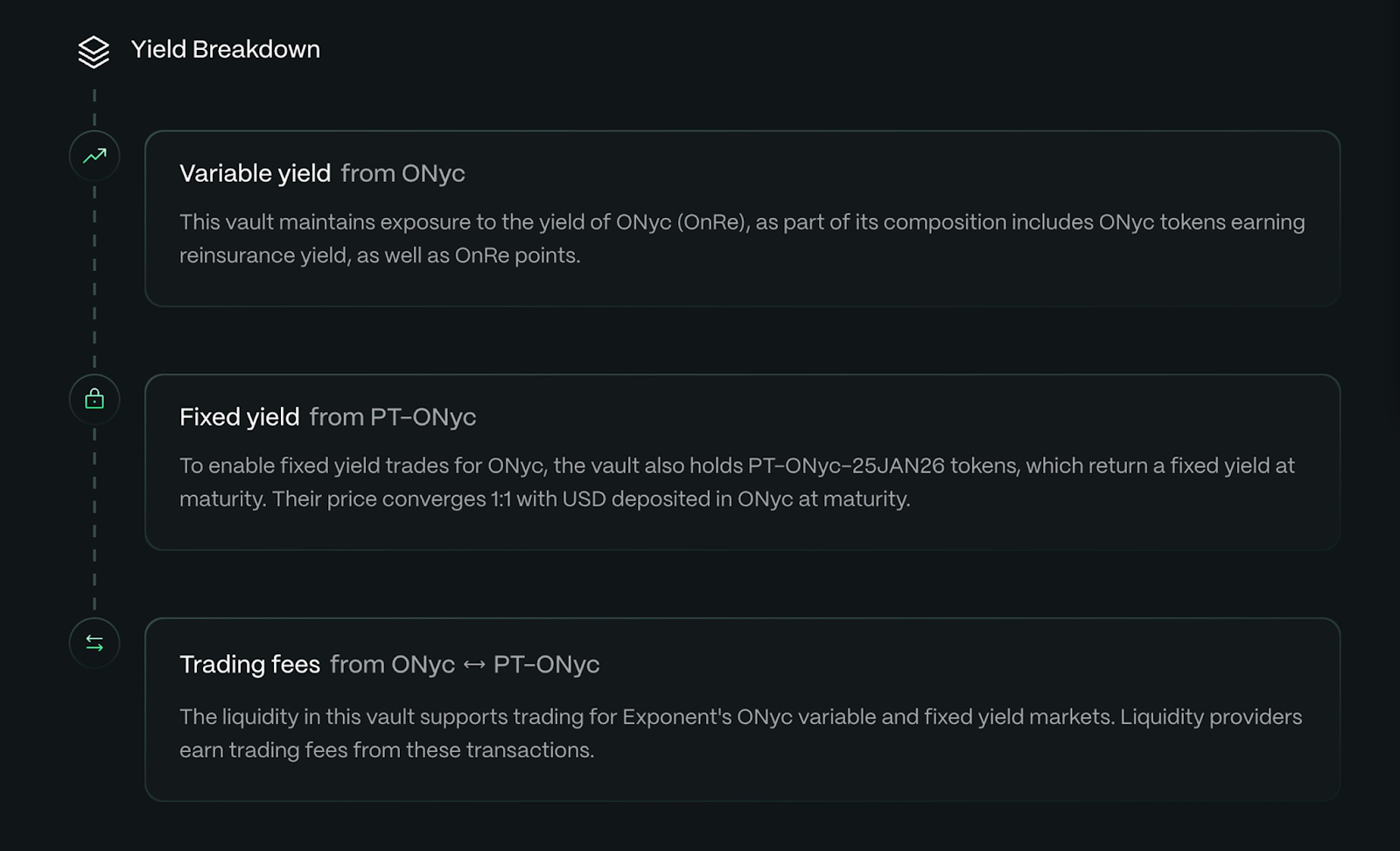
“This ONyc vault example is useful because it makes a broader point: a vault’s displayed return can have multiple sources. The visual separates variable yield from ONyc, fixed-maturity yield from PT-ONyc, and trading fees earned from supporting transactions between the two.
These components should not be treated as equally durable. Variable yield depends on the underlying yield source. PT return depends on entry price, maturity, and holding or exit path. Trading-fee income depends on realized volume, liquidity placement, and inventory exposure. If incentives or points are present, they should be identified separately from recurring economic cash flow.
The right institutional question is: which return source is being underwritten, and what happens to the expected result if that source weakens?”
Do not use current APY screenshots unless the slide carries a clear timestamp, source, fee treatment, and statement of whether incentives are included.
Slide 7 — Risks, controls, and evidence
Time: 6:25–8:10
On the slide
| Risk layer | Evidence to request or verify |
|---|---|
| Underlying asset | Yield source, NAV or exchange-rate mechanics, liquidity, counterparties |
| Market and liquidity | Depth, price impact, order-book activity, exit route, maturity |
| Smart contracts | Program scope, audits, findings, upgrades, dependencies |
| Administrative control | Multisig configuration, authorities, parameter controls, incident process |
| Operations | Custody, wallet policy, signing controls, accounting, reporting, legal status |
Speaker notes
“A fixed maturity does not mean fixed risk. First, there is the underlying asset: its yield source, asset value, liquidity, counterparties, and any dependencies must be independently underwritten. Second, there is market risk: an investor exiting PT before maturity or trading YT needs sufficient liquidity at an acceptable price.
Third, there is protocol risk. Exponent describes testing, third-party review, monitoring, market-level inflow and outflow limits, and multisig administration for sensitive actions. These controls are relevant evidence, not a guarantee. The documentation also states that code and parameters can be mutable, so a diligence process must identify the specific upgrade and administrative authorities, their configuration, and the applicable controls.
Finally, every institution must solve the operational layer: approved custody, wallet and signing policy, accounting treatment, reporting, and permitted-investment status. We should not call a product institution-ready until those constraints have been tested against the client’s actual operating model.”
Prepare this security material before presenting. It supports a credible answer without suggesting that audits remove all risk.
Programs & Security - Exponent Docs
Read “Programs & Security” in the Exponent Docs to prepare a factual, appropriately qualified security and architecture discussion.
In “Core Programs,” scan the full table from Exponent Core through Exponent Risk-Tranching. Use the program map to connect each program to its operational role. Keep the addresses in your appendix for transaction verification rather than reading them aloud. In “Security Practices,” read the opening overview and focus on the review process. Do not convert this into a claim of zero smart-contract risk. Then read “Stress Testing,” “Security Testing,” and “Real-Time Monitoring.” Focus on testing and monitoring. In “Inflow and outflow limits,” study the guardrail rationale. Finally, read the complete “Admin control under multisig” paragraph; its conclusion that multisig governance matters should lead directly to questions about signers, threshold, upgrade authority, and any timelock.
Slide 8 — Mandate fit and the proposed next step
Time: 8:10–9:45
On the slide
Potential fit
- Allocators seeking a maturity-specific return on an approved yield asset
- Specialist yield or trading capital with a view on future realized yield
- Market makers able to manage active liquidity and inventory risk
- Institutions whose Solana custody and governance workflows are approved
Next step: a market-specific diligence and execution review
Speaker notes
“The most suitable client is not simply a ‘yield seeker.’ A PT user may be an allocator seeking a maturity-specific return on an underlying asset it is willing and able to hold. A YT user is more likely to be specialist capital that can underwrite future yield, rewards, valuation sensitivity, and a potentially volatile exit price. Liquidity provision is appropriate only where the investor can manage concentration, inventory, rebalancing, and market-depth risk.
Our recommended next step is a market-specific review: confirm the underlying asset, maturity, rate, capacity, expected execution cost, liquidity route, contract addresses, security materials, administrative controls, and operational workflow. If those conditions fit the mandate, begin with a defined pilot size, documented monitoring triggers, and a pre-agreed exit route. If they do not, the correct outcome is to decline or defer deployment.”
Close
Time: 9:45–10:00
“Exponent makes yield exposure more separable: fixed-maturity principal, variable yield, rate-market liquidity, strategies, and risk allocation. That flexibility is valuable only when the client matches the exposure to its mandate and underwrites the dependencies behind it. I welcome questions on mechanics, execution, and risk.”
How to answer technical and risk questions concisely
For most questions, use a four-part answer:
- Give the direct answer first.
- State the relevant mechanism.
- Name the condition, limitation, or residual risk.
- Offer the evidence or next diligence step.
This prevents two common mistakes: answering a narrow technical question with a long protocol history, or providing a technically correct answer that conceals the important qualification.
Technical questions
| Question | Concise institutional answer |
|---|---|
| What makes PT fixed income? | “PT trades at a discount and is redeemable one-for-one for the underlying asset at maturity under the market terms. Holding it to maturity therefore locks the return implied by that discount, in units of the underlying asset. It is fixed-maturity exposure, not a risk-free cash instrument: underlying-asset, protocol, and operational risks remain.” |
| How does PT differ from the underlying asset? | “The underlying retains variable yield exposure. PT separates out that future variable yield and instead provides principal-side redemption at maturity. The PT buyer gives up the upside and downside of realized yield over the period in exchange for the implied fixed return.” |
| What exactly does a YT holder own? | “YT is the claim on variable yield generated by the underlying until that market’s maturity. Where the market routes additional rewards, those also go to YT holders. The return is variable and depends on realized yield, reward value, time remaining, and the entry price paid for YT.” |
| Why is the implied rate different from the current APY? | “Current APY describes the yield being generated now. The implied rate is the market’s forward price for yield over the remaining period to maturity. It reflects supply and demand for PT and YT, so it can differ materially from today’s observed yield.” |
| How can a user trade YT without separate YT-only liquidity? | “Exponent uses flash-swap logic. The transaction can atomically strip or merge components and use PT and underlying liquidity to complete the YT exposure. This aims to avoid fragmenting liquidity, but the user should still evaluate quoted execution, fees, and price impact.” |
| What happens after maturity? | “PT is redeemable one-for-one for the underlying asset, while YT stops accruing new yield. Any accrued but unclaimed yield remains claimable under the market’s rules. A client should confirm the precise maturity and redemption workflow for the chosen market.” |
Risk and diligence questions
| Question | Concise institutional answer |
|---|---|
| Is PT principal protected? | “PT provides a defined redemption claim on the underlying asset at maturity; it does not protect against every form of loss. The investor still bears the underlying asset’s risk, Exponent program risk, any relevant interface or integration risk, and potentially liquidity risk if exiting before maturity.” |
| What if we need to exit early? | “Early exit is a market sale rather than a maturity redemption. The realized outcome depends on available liquidity, bid-offer spread, price impact, remaining maturity, and the prevailing implied rate. We would estimate those conditions at the intended ticket size before deployment.” |
| What protects us from a smart-contract incident? | “The documented controls include internal and external review, testing, on-chain monitoring, guardrail limits, and multisig administration. Those measures can reduce or contain some risks, but they do not eliminate them. We would review audit scope and findings, program dependencies, upgrade authority, incident procedures, and market-specific limits.” |
| Who controls upgrades and protocol parameters? | “Exponent’s documentation states that code and parameters can be mutable and that sensitive administration is governed through a multisig rather than one key. Before allocation, we would verify the current signers, threshold, authority scope, upgrade process, and whether a timelock or equivalent control applies.” |
| How should we evaluate Strategy Vault yield? | “We decompose it by source: underlying variable yield, fixed-maturity PT return, trading fees, incentives, and any asset-price exposure. We then assess the sustainability and risk of each source separately, rather than underwriting a blended headline APY.” |
| Does a Senior risk tranche make the position safe? | “No. Senior status creates priority over Junior capital in the specified loss waterfall, funded by a Junior first-loss layer. Protection depends on live coverage and the size and treatment of losses; liquidity, protocol, pricing, custody, and underlying-asset risks still remain.” |
| Why should an institution use this rather than a centralized exchange? | “The relevant distinction is the market structure. Exponent’s instruments and execution are implemented through on-chain programs and market mechanisms rather than an exchange’s internal ledger. That can offer transparent, programmable exposure, but it also requires a stronger review of smart-contract dependencies, wallet controls, on-chain liquidity, and operational readiness.” |
Rehearsal and meeting discipline
Treat the presentation as an investment-committee conversation, not a memorization task.
Before a live meeting:
- Replace all changing figures with date-stamped, sourced data: maturity, implied rate, liquidity, fees, incentive treatment, capacity, and market status.
- Prepare a one-page appendix with the selected market, transaction path, program addresses, audit links, administrative-control evidence, live liquidity evidence, and a proposed pilot size.
- Record one timed rehearsal. If it runs over ten minutes, cut product history and interface detail before cutting the risk slide.
- Assign answers internally. Product should own mechanics; risk should own security and controls; operations should own custody, reporting, and onboarding.
- Do not improvise on unknown facts. Say: “I do not want to overstate that point. We will verify the current program configuration and return with the relevant evidence.” This is stronger than a speculative answer.
Key takeaways
A credible ten-minute Exponent presentation is organized around an institutional decision, not a feature list. Explain how PT and YT separate principal and variable yield, show how the Rate CLMM, Rate Order Book, Strategy Vaults, and risk-tranching products fit into one architecture, and make clear that each expression has different return drivers and risks.
For Q&A, lead with the direct answer, explain the mechanism, name the limitation, and point to verifiable evidence. In particular, state plainly that PT’s fixed return is tied to maturity redemption in the underlying asset, YT is variable-yield exposure, early exits depend on market liquidity, and documented security controls reduce but never eliminate risk.
Next, the course moves to capital acquisition and interview readiness: identifying target accounts, designing a pipeline, and translating this product fluency into an institutional-growth strategy for Exponent.
Can't find a good explanation? Sign up and we'll make it for you
Sign up