
Good to see you again. Last time, you reviewed continents, oceans, Pangaea, Antarctica, and Lake Baikal. Now the focus is the Earth-science vocabulary in your study guide: the solid Earth, the air around it, height differences in landforms, molten rock, and the ways rock is changed or moved.
The goal is quick recognition: read a definition or example, then choose the correct term without being tricked by similar words such as magma/lava or weathering/erosion.
Earth’s solid surface, air, and landform height
The lithosphere is Earth’s rigid, solid outer layer. It includes the crust and the brittle uppermost part of the mantle. Continents, ocean floors, mountains, and tectonic plates are part of the lithosphere.
The atmosphere is the layer of gases surrounding Earth. It is the air in which weather occurs. Do not confuse it with the lithosphere:
| If the question describes… | Answer |
|---|---|
| Solid rock, crust, tectonic plates, outer solid Earth | LITHOSPHERE |
| Air, gases, clouds, wind, weather around Earth | ATMOSPHERE |
Read National Geographic’s “Lithosphere” for the precise definition your test is looking for and to see how the lithosphere relates to the atmosphere.
In the opening article paragraph, read from the core definition. Focus on the two parts included in the lithosphere: the crust and the brittle upper mantle. The later details about ductility are extra; do not spend time memorizing them for this test.
Relief is the difference in elevation between the highest and lowest points of a landform or area. It tells you how much the land rises or falls.
For example, if a mountain’s base is at meters elevation and its summit is at meters elevation, its relief is:
A flat plain has low relief. A steep mountain range or deep canyon area has high relief.
Spelling to memorize: RELIEF, not “releif.”
Spelling to memorize: LITHOSPHERE, not “litoshphere.”
Magma and lava: one material, two locations
This is a very common multiple-choice distinction.
- Magma is molten rock below Earth’s surface.
- Lava is magma that has erupted and reached Earth’s surface.
The material does not become a different substance simply because it erupts. Its name changes because its location changes.
About Volcanoes | U.S. Geological Survey
Read the U.S. Geological Survey’s “About Volcanoes” to lock in the magma-versus-lava distinction.
At the start of the section, read the key comparison. Then continue through the paragraph that explains magma rising toward the surface. Keep asking one question: “Is the molten rock still underground, or has it erupted?”
Use this memory rule:
| Location of molten rock | Correct term |
|---|---|
| Beneath Earth’s surface, in the crust or mantle | MAGMA |
| On Earth’s surface, flowing from a volcano | LAVA |
Your original study list says, “Molten rock that can form in the mantle and rise through the crust?” The accurate answer is MAGMA, not lava. Once that molten rock reaches the surface, it becomes LAVA.
Chemical weathering versus glacial erosion
Rock can be changed in place, or it can be moved. The difference matters.
Weathering breaks down or changes rock where it is.
Erosion wears away and moves rock or sediment to another location.
Chemical weathering changes a rock through chemical reactions. Acid rain is the standard test example: acidic water reacts with minerals in rock and can dissolve or alter them. The rock’s chemical makeup changes; this is more than simply cracking a rock into smaller pieces.
Weathering and Erosion | What Is the Difference between Weathering and Erosion?
Watch Learn Bright’s “Weathering and Erosion” for the key difference between weathering and erosion, then connect chemical weathering and glaciers to the correct examples.
Watch weathering versus erosion first. Notice that weathering breaks rock down, while erosion transports the pieces. Then watch chemical weathering for the three weathering types; concentrate on chemical changes to rock. Finish with erosion by ice, which identifies glaciers as large moving bodies of ice that reshape land.
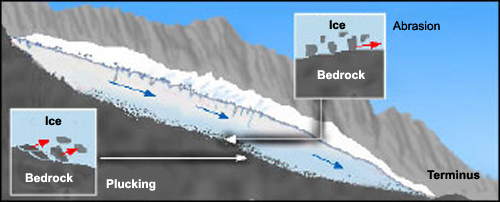
A glacier is a huge mass of ice that slowly moves over land. As it moves, it erodes rock mainly in two ways:
- Abrasion: rocks frozen into the ice scrape and grind the bedrock below, much like sandpaper.
- Plucking: ice freezes onto cracked bedrock and pulls pieces of rock away as the glacier moves.
The correct answer to “A glacier is an example of what type of erosion?” is usually:
GLACIAL EROSION or ICE EROSION
A glacier moves downhill partly because of gravity, but gravity is not the best classification answer when the question asks for the agent of erosion. The erosion is caused by moving ice.
Use this sorter:
| Example | Correct classification | Why |
|---|---|---|
| Acid rain reacts with a marble building | CHEMICAL WEATHERING | Chemicals alter or dissolve minerals. |
| Tree roots crack a sidewalk | Mechanical or biological weathering | Rock breaks in place. |
| A river carries sand downstream | EROSION | Sediment is moved. |
| Ice drags rocks across bedrock | GLACIAL EROSION | Moving ice scrapes and removes rock. |
| A chunk of rock breaks underground before an eruption | Not lava yet | It is below the surface; molten rock there is magma. |
Rapid multiple-choice review
Try to answer before looking at the line below each question.
1. The solid, rocky outer layer of Earth that includes the crust and uppermost mantle is the:
A. atmosphere
B. lithosphere
C. hydrosphere
D. biosphere
B. LITHOSPHERE
2. Which Earth system is made mainly of gases surrounding the planet?
A. lithosphere
B. atmosphere
C. mantle
D. relief
B. ATMOSPHERE
3. The difference between an area’s highest and lowest elevations is called:
A. weathering
B. relief
C. lava
D. atmosphere
B. RELIEF
4. Molten rock beneath Earth’s surface is called:
A. lava
B. magma
C. crust
D. ash
B. MAGMA
5. When magma erupts onto Earth’s surface, it is called:
A. lava
B. relief
C. lithosphere
D. chemical weathering
A. LAVA
6. Acid rain reacting with and dissolving minerals in rock is an example of:
A. chemical weathering
B. glacial erosion
C. lava flow
D. relief
A. CHEMICAL WEATHERING
7. A glacier carrying rocks that scrape across bedrock causes:
A. atmospheric erosion
B. chemical weathering
C. glacial erosion
D. volcanic eruption
C. GLACIAL EROSION
8. Which statement is accurate?
A. Lava is molten rock underground.
B. Magma is molten rock on Earth’s surface.
C. Magma becomes lava when it reaches Earth’s surface.
D. The lithosphere is made of gases.
C. MAGMA BECOMES LAVA WHEN IT REACHES EARTH’S SURFACE.
9. Which situation shows erosion rather than weathering?
A. Acid rain dissolves part of a statue.
B. Water carries broken rock pieces down a stream.
C. Ice expands in a crack and splits a rock.
D. Roots break apart a boulder.
B. WATER CARRIES BROKEN ROCK PIECES DOWN A STREAM.
10. A mountain range with very tall peaks and deep valleys has:
A. high relief
B. low relief
C. no lithosphere
D. chemical weathering only
A. HIGH RELIEF
Flashcard finish
Read the prompt, say the answer aloud, then check.
- Solid outer Earth: crust plus uppermost mantle — LITHOSPHERE
- Layer of gases around Earth — ATMOSPHERE
- Difference between highest and lowest elevation — RELIEF
- Molten rock below the surface — MAGMA
- Molten rock at the surface — LAVA
- Rock altered by reactions, such as acid rain — CHEMICAL WEATHERING
- Rock worn away and moved by a glacier — GLACIAL EROSION
- Glacial scraping by rocks in the ice — ABRASION
- Glacier pulling away blocks of bedrock — PLUCKING
Key takeaways
For the test, keep these distinctions sharp:
- LITHOSPHERE: solid outer Earth, including crust and upper mantle.
- ATMOSPHERE: gases surrounding Earth.
- RELIEF: difference between high and low elevation.
- MAGMA: molten rock underground.
- LAVA: magma at Earth’s surface.
- CHEMICAL WEATHERING: rock chemically changed, such as by acid rain.
- GLACIAL EROSION: moving ice scrapes and pulls away rock.
Next, you will connect plate movement to earthquakes, volcanoes, tsunamis, Alaska, the Ring of Fire, Chile, the New Madrid Seismic Zone, and Old Faithful.
Can't find a good explanation? Sign up and we'll make it for you
Sign up