
Hello! This crash-review module is built to help you recognize the exact wording your geography test is likely to use. In this lesson, focus on one key skill: when you see a short example, decide whether it is geography in general or one of the five themes of geography: location, place, region, movement, and human–environment interaction.
A useful way to remember the themes is MR. HELP:
- Movement
- Region
- Human–Environment interaction
- Location
- Place
Geography: more than maps
Geography is the study of places and the relationships among people, physical features, and environments on Earth. It asks questions such as:
- Where is it?
- What is it like?
- Why is it there?
- How do people affect it, and how does it affect people?
- How are places connected?
Geography - National Geographic Education
Read “Geography” from National Geographic Education for the big idea behind the subject: geography studies both Earth’s physical features and human life, especially the relationships among them.
At the beginning of the article, read the opening explanation beginning with the definition of geography. Then continue through the explanation of geographic questions, especially the geographic perspective. Focus on the difference between merely naming where something is and explaining why it is there.
For your test’s wording, this is the answer to remember:
The study of the distribution and interaction of physical and human features on Earth is GEOGRAPHY.
The five themes are a sorting tool. A real-life example can connect to more than one theme, but on a multiple-choice question, choose the theme the question emphasizes most.
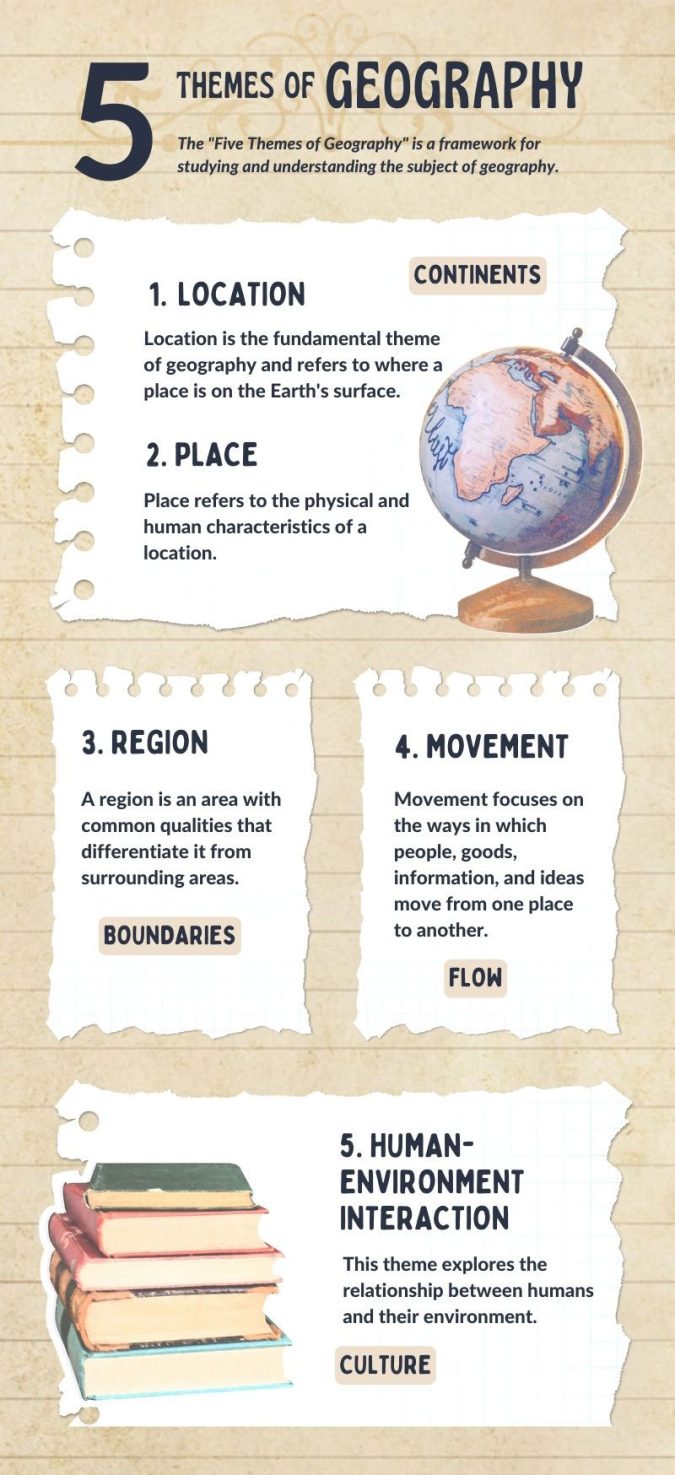
The five themes: identify the question being asked
1. Location: Where is it?
Location tells where a place is on Earth.
There are two common ways to describe it:
- Absolute location gives an exact position, such as an address or coordinates.
- Relative location describes a place compared with something else, such as “south of Chicago” or “near the Ohio River.”
Examples:
- “Greenwich, England, is at longitude.”
LOCATION - “The school is across the street from the library.”
LOCATION - “Illinois is north of Kentucky.”
LOCATION
A relative location can change because the reference point, roads, landmarks, or even political boundaries can change.
Relative locations can change: TRUE
Do not choose place just because a city is named. Choose location when the sentence mainly answers where.
2. Place: What is it like?
Place means the physical and human characteristics that make a location unique.
- Physical characteristics include landforms, climate, rivers, plants, and weather.
- Human characteristics include language, buildings, religion, population, jobs, and traditions.
Examples:
- “Alaska has high mountains, cold temperatures, and long winters.”
PLACE - “New Orleans is known for jazz music, historic buildings, and its location near the Mississippi River.”
PLACE - “The Sahara has a hot, dry climate and very little rainfall.”
PLACE
The strongest clue is a description of a location’s features.
3. Region: How are places similar or different?
A region is an area with shared characteristics. Those characteristics may be physical, cultural, political, or economic.
Examples:
- “The Midwest includes states with many shared farming and climate patterns.”
REGION - “Countries that use the euro form an economic region.”
REGION - “The Rocky Mountain region is defined by a major mountain system.”
REGION
For a basic test question, think: a group of places connected by something in common.
4. Movement: How do people, goods, and ideas travel?
Movement is the transfer of people, goods, information, and ideas between places.
Examples:
- “Families move from one state to another for jobs.”
MOVEMENT - “Trucks carry food from farms to grocery stores.”
MOVEMENT - “A new dance trend spreads through social media.”
MOVEMENT - “Students learn an idea by watching an online video.”
MOVEMENT
Movement is not just people physically traveling. Ideas, products, and messages count too.
5. Human–environment interaction: How do people relate to the physical world?
Human–environment interaction examines the two-way relationship between people and their environment. People may:
- Depend on the environment for water, food, energy, or materials.
- Adapt to the environment, such as wearing warm clothing in a cold climate.
- Modify the environment, such as building roads, dams, farms, or cities.
Examples:
- “Farmers use irrigation to bring water to dry land.”
HUMAN–ENVIRONMENT INTERACTION - “People in snowy areas build homes with steep roofs.”
HUMAN–ENVIRONMENT INTERACTION - “A city cuts down forests to build neighborhoods.”
HUMAN–ENVIRONMENT INTERACTION
The clue is a relationship: the environment affects people, people affect the environment, or both.
Five Themes Of Geography (AP Human Geography)
Watch “Five Themes Of Geography” by Mr. Sinn for a quick visual explanation of all five themes. It is especially useful for hearing the key distinctions between themes that can sound similar on a test.
Watch movement to review people, goods, and ideas traveling. Continue with regions, focusing on the idea that regions group places with shared characteristics. Watch human environment interaction for the two-way relationship between people and nature. Finish with location and place, paying close attention to the difference between where a place is and what makes it unique.
How to avoid the common mix-ups
The themes can overlap. For example:
“People build houses on stilts because their town floods often.”
This includes a place clue, because flooding is a physical characteristic. But the main point is that people changed how they live because of the environment. The best answer is:
HUMAN–ENVIRONMENT INTERACTION
Use this quick decision guide:
| If the question focuses on... | Choose... |
|---|---|
| Where something is | LOCATION |
| What a location is like | PLACE |
| Shared traits across an area | REGION |
| Travel, shipping, migration, or communication | MOVEMENT |
| People adapting to, depending on, or changing nature | HUMAN–ENVIRONMENT INTERACTION |
A fast test strategy:
- Underline the action or main idea in the sentence.
- Look for clue words: where, characteristics, shared, travels, or people and environment.
- Choose the theme that answers the question’s main focus, not every theme that could possibly fit.
Rapid flashcard check
Read each question, cover the answer line if possible, answer it, then check yourself.
1. A map shows that Mount Vernon is in southern Illinois. Which theme is this?
LOCATION
2. A description explains that an area has forests, rivers, cold winters, and a small population. Which theme is this?
PLACE
3. A group of states is known for growing large amounts of corn. Which theme is this?
REGION
4. A company ships phones from another country to stores in the United States. Which theme is this?
MOVEMENT
5. People build levees to reduce flooding near a river. Which theme is this?
HUMAN–ENVIRONMENT INTERACTION
6. “What is it like?” points to which theme?
PLACE
7. “Where is it?” points to which theme?
LOCATION
8. “How do people, goods, and ideas move?” points to which theme?
MOVEMENT
9. “How are places similar or different?” points to which theme?
REGION
10. “How do people relate to the physical world?” points to which theme?
HUMAN–ENVIRONMENT INTERACTION
Key takeaways
Geography studies the distribution and interaction of physical and human features on Earth. The five themes help you sort geographic information:
- Location: where it is
- Place: what it is like
- Region: how places are grouped by shared traits
- Movement: how people, goods, and ideas travel
- Human–environment interaction: how people and nature affect each other
For the next lesson, you will use globes and reference lines more precisely: the equator, prime meridian, latitude, hemispheres, Greenwich, and relative location.
Can't find a good explanation? Sign up and we'll make it for you
Sign up