
Good to see you again. In the last lesson, you practiced controlling verb tense so a reader can follow your paragraph’s timeline. Now you will control another part of readability: the punctuation that shows how your ideas fit together within a sentence.
Earlier in this module, you distinguished independent clauses—complete thoughts—from dependent clauses, which need another clause to be complete. That distinction is the key to comma and semicolon choices. By the end of this lesson, you will be able to punctuate compound, complex, and compound-complex sentences without creating comma splices or adding commas where they do not belong.
Punctuation follows clause structure
Do not begin by asking, “Where does this sentence sound like it needs a pause?” Spoken pauses can be useful, but they are unreliable punctuation guides. Instead, find the clauses first.
A compound sentence contains at least two independent clauses:
The draft was unfinished, but I submitted it on time.
Both parts can stand alone:
- The draft was unfinished.
- I submitted it on time.
A complex sentence contains an independent clause and a dependent clause:
Although the draft was unfinished, I submitted it on time.
The opening words although the draft was unfinished include a subject and verb, but they leave the reader waiting: Although it was unfinished, what happened? It is dependent on the main clause.
A compound-complex sentence combines both structures. It has at least two independent clauses and at least one dependent clause:
Although the draft was unfinished, I submitted it on time, and my teacher accepted it.
Here, the sentence contains:
- Dependent clause: Although the draft was unfinished
- Independent clause: I submitted it on time
- Independent clause: my teacher accepted it
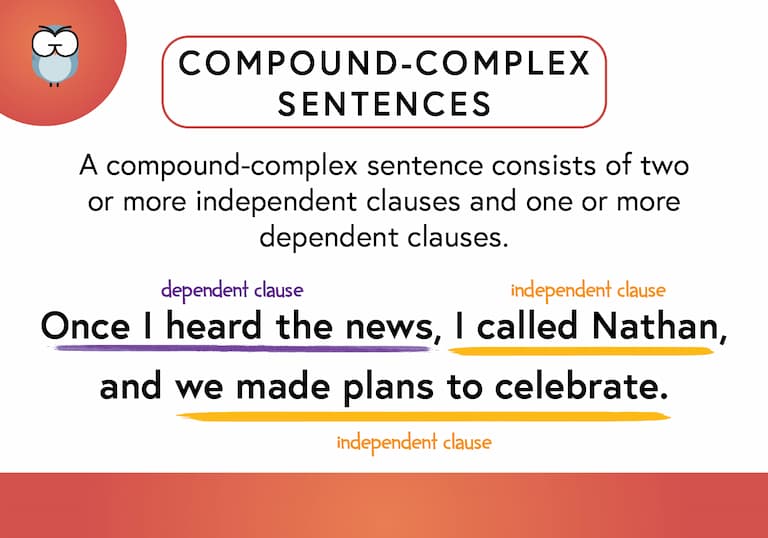
Before focusing on punctuation, use the stand-alone test: temporarily remove the connecting word and see whether each group of words works as a complete sentence. This test is especially helpful when a sentence contains several verbs.
For a concise visual review of clause types and the core comma rules, watch the opening of Sparkle English’s Commas and Clauses video.
Commas and Clauses | How to Use Commas with Independent & Dependent Clauses in English
In “Commas and Clauses,” Sparkle English connects clause identification directly to punctuation choices. Watch it to reinforce the stand-alone test before applying the rules in your own writing.
Watch clause basics to review independent and dependent clauses. Then watch compound commas for the rule governing two independent clauses joined by a coordinating conjunction. Finish with complex commas, which contrasts an opening dependent clause with a dependent clause that comes after the main clause. Notice that the speaker checks for a complete thought on both sides before adding a comma.
Commas in compound sentences: use the full pattern
When you join two independent clauses with a coordinating conjunction, use a comma before the conjunction.
The coordinating conjunctions can be remembered with FANBOYS:
- for
- and
- nor
- but
- or
- yet
- so
The reliable pattern is:
Independent clause, + coordinating conjunction + independent clause
I wanted to begin my essay early, but I could not choose a topic.
The evidence was convincing, so the writer strengthened her claim.
We can revise the introduction now, or we can return to it after drafting the body paragraphs.
The comma is not optional here. Without it, the sentence may be understandable, but it does not clearly mark the boundary between two complete thoughts.
Do not add a comma just because you see and or but
A coordinating conjunction does not automatically require a comma. It needs one only when it connects two independent clauses.
Compare these sentences:
No comma needed: I reread the prompt and revised my thesis.
The subject I applies to both verbs, reread and revised. This sentence has one independent clause with a compound predicate, not two independent clauses.
Comma needed: I reread the prompt, and I revised my thesis.
Now the second half has its own subject, I. The writer has created two independent clauses, so the comma belongs before and.
This distinction matters because unnecessary commas can make a sentence feel choppy:
Over-punctuated: The student researched the topic, and wrote a detailed outline.
Correct: The student researched the topic and wrote a detailed outline.
A quick check: look for a subject and a tense-carrying verb after the conjunction. If you find both and that group forms a complete thought, use the comma.
Commas in complex sentences: placement depends on order
Complex sentences are more flexible because the dependent clause can appear before or after the independent clause.
Put a comma after an introductory dependent clause
When a dependent clause comes first, use a comma to separate it from the main clause.
Because the deadline was close, I focused on revising the conclusion.
When the discussion ended, the class began writing.
If the source has no author, evaluate the organization that published it.
While I was drafting, I noticed that my examples were too general.
Words such as because, although, when, if, while, after, before, since, and unless often signal that a clause is dependent. They do not always guarantee the same punctuation, however; the clause’s position matters.
Usually omit the comma when the dependent clause comes second
When the independent clause comes first and the dependent clause follows it, no comma is generally needed:
I focused on revising the conclusion because the deadline was close.
The class began writing when the discussion ended.
Evaluate the organization if the source has no author.
The meaning remains the same, but the sentence emphasis changes slightly. Beginning with the dependent clause often places more attention on the condition, time, or contrast:
Although the evidence is limited, the argument remains plausible.
Beginning with the independent clause foregrounds the main claim:
The argument remains plausible although the evidence is limited.
For academic writing, this flexibility can help you vary sentence openings while staying grammatically controlled.
The comma splice: a comma cannot work alone
A comma splice occurs when a comma alone tries to join two independent clauses.
Comma splice: My first source was useful, it did not answer my research question.
Both halves are complete sentences:
- My first source was useful.
- It did not answer my research question.
A comma by itself is not strong enough to connect them. You have several correct options, but each communicates the relationship differently:
Comma + coordinating conjunction: My first source was useful, but it did not answer my research question.
Semicolon: My first source was useful; it did not answer my research question.
Two sentences: My first source was useful. It did not answer my research question.
Choosing among these is partly a style decision. The first version makes the contrast explicit through but. The semicolon links the ideas closely without adding a conjunction. Two sentences create the strongest separation.
Semicolons: connect closely related independent clauses
A semicolon joins two complete, closely related independent clauses. Think of it as stronger than a comma but less separating than a period.
My outline looked organized; its evidence did not yet support the thesis.
The group had gathered strong research; the members still needed to explain its significance.
Use the period test again. A semicolon is possible only if you could replace it with a period and have two complete sentences:
The group had gathered strong research. The members still needed to explain its significance.
A semicolon is useful when the ideas have roughly equal weight and belong together. It is not a way to make a sentence seem more formal, and it should not be used between an independent and a dependent clause.
Incorrect: I revised my outline; because my teacher gave useful feedback.
Correct: I revised my outline because my teacher gave useful feedback.
Also correct: Because my teacher gave useful feedback, I revised my outline.
Semicolons with transition words
Words such as however, therefore, instead, consequently, meanwhile, and for example show relationships between ideas, but they are not coordinating conjunctions. When they connect two independent clauses in one sentence, use a semicolon before the transition word and a comma after it.
The source seemed credible; however, its statistics were outdated.
The prompt required an argument; therefore, the thesis needed to take a clear position.
I could not find enough evidence for that claim; instead, I narrowed my topic.
Do not use only a comma before however or therefore when both sides are independent clauses:
Comma splice: The source seemed credible, however, its statistics were outdated.
Correct: The source seemed credible; however, its statistics were outdated.
You can also use a period:
The source seemed credible. However, its statistics were outdated.
In most school writing, periods and comma-plus-conjunction sentences should do most of the work. Use semicolons deliberately when you want to show a particularly close connection.
Combining the rules in compound-complex sentences
Compound-complex sentences can look intimidating because they contain more than one punctuation decision. Solve them one boundary at a time.
When I reread the prompt, I understood the task better, and I revised my thesis.
- When I reread the prompt is an introductory dependent clause, so it takes a comma after it.
- I understood the task better is an independent clause.
- I revised my thesis is another independent clause.
- The two independent clauses are connected by and, so put a comma before and.
A semicolon can also appear in a compound-complex sentence when it joins the two independent clauses:
When I reread the prompt, I understood the task better; I revised my thesis immediately.
Both versions are grammatically correct. The first explicitly shows addition with and; the second places the two actions side by side and emphasizes their close connection.
Read the relevant parts of Purdue OWL’s Punctuation in Sentences to see the same patterns in a compact reference.
Punctuation in Sentences - Purdue OWL® - Purdue University
Purdue OWL’s “Punctuation in Sentences” provides a concise reference for joining independent clauses and for combining compound and complex structures. Read it after working through the rules above to confirm the patterns and compare its examples with yours.
In the page’s “Compound” discussion, read the comma pattern, then continue into the explanation of semicolons. In the “Complex” and “Compound-Complex” portions, read the combined patterns. Focus on the author’s order of operations: first identify the introductory dependent clause, then decide how the independent clauses relate.
An editing routine you can use in any draft
When revising a paragraph, do not scan randomly for commas. Work sentence by sentence:
- Underline each subject-verb unit. A long sentence may contain two verbs but only one clause, so identify who performs each action.
- Test each unit for independence. Can it stand alone as a complete sentence?
- Locate the connector. Is it a coordinating conjunction such as but or so, a subordinating word such as because or although, or a transition such as however?
- Choose punctuation based on the structure.
- Two independent clauses with a coordinating conjunction: comma before the conjunction.
- An introductory dependent clause: comma after the clause.
- A following dependent clause: usually no comma.
- Two closely related independent clauses with no coordinating conjunction: semicolon or period.
- A transition word between independent clauses: semicolon before the transition and comma after it.
- Read the corrected sentence once for meaning. Punctuation should clarify the relationship—contrast, cause, condition, time, or addition—not merely break up a long line.
This method also helps with professional writing. For example, in an email, a clear complex sentence can explain a condition without sounding abrupt:
Because I have a medical appointment on Thursday, I will submit the report by Friday morning.
And a semicolon can link two tightly connected updates:
The meeting time has changed; the calendar invitation has been updated.
Clarity is the goal. A well-punctuated sentence lets the reader understand your point on the first pass.
The main takeaways are these:
- Use a comma before a coordinating conjunction only when it joins two independent clauses.
- Use a comma after an introductory dependent clause.
- When a dependent clause follows the main clause, you generally do not need a comma.
- Never join two independent clauses with a comma alone.
- Use a semicolon to connect two closely related independent clauses, including before a transition word such as however or therefore.
You have now completed the Sentence Foundations and Grammatical Control module. Next, you will move from sentence-level accuracy to generating and narrowing ideas, beginning with practical methods for finding a writing topic when the page feels blank.
Can't find a good explanation? Sign up and we'll make it for you
Sign up